

TL;DR:
- Running a payment operation without a structured security checklist is a costly risk that can lead to fines and loss of trust.
- Compliance with PCI DSS 4.0 is mandatory, requiring encryption, multi-factor authentication, and script governance to protect transactions effectively.
- Implementing tokenization, secure hosting, and regular staff training form a strong, ongoing defense that minimizes vulnerabilities and ensures compliance.
Running a payment operation without a structured payment security checklist is one of the most expensive gambles a business can take. A single breach can cost hundreds of thousands in fines, chargebacks, and lost customer trust. PCI DSS 4.0 became fully mandatory on March 31, 2025, tightening requirements across encryption, authentication, and script management. This guide gives you a detailed, current checklist built specifically for SMEs and e-commerce businesses, covering everything from network configuration to behavioral fraud detection, so you can protect every transaction and stay compliant.
Table of Contents
- Key takeaways
- Your payment security checklist: what to evaluate first
- Detailed checklist items every SME and e-commerce business should implement
- Comparing key payment security technologies and practices
- How to implement and maintain your checklist effectively
- My honest take on payment security in practice
- How Demivolt helps you stay secure and compliant
- FAQ
Key takeaways
| Point | Details |
|---|---|
| PCI DSS 4.0 is fully enforced | Compliance is not optional; it now includes real-time script monitoring and payment page controls. |
| Tokenization cuts fraud significantly | Using tokenization reduces online fraud by approximately 30% and improves payment approval rates. |
| Third-party scripts are a major risk | Every JavaScript on your payment page needs an inventory, approval workflow, and cryptographic hash. |
| Fraud tools must balance friction | Overly aggressive blocking creates false declines; reserve stepped-up authentication for high-risk transactions only. |
| Security culture beats one-time fixes | Regular staff training and daily monitoring catch threats that technical controls miss. |
Your payment security checklist: what to evaluate first
Before you work through individual checklist items, you need a framework for deciding what actually qualifies as adequate security. Too many SMEs treat compliance as the ceiling instead of the floor. PCI DSS 4.0 is the mandatory global standard as of early 2025, and it introduces requirements that go well beyond what most small businesses have historically implemented.
The core areas your checklist must address are:
- Encryption and data protection: All payment data in transit must use TLS 1.2 or higher. Cardholder data at rest must be either encrypted or removed entirely through tokenization.
- Access control and authentication: Every user touching payment systems needs a unique ID, a strong password policy, and multi-factor authentication (MFA).
- Script and software governance: Every third-party JavaScript on your checkout page falls under PCI DSS Req 6.4.3, requiring a formal inventory, approval workflow, and integrity verification.
- Monitoring and alerting: Real-time alerts for unauthorized changes to payment pages are now required under PCI DSS Requirement 11.6.1.
- Staff and process controls: Technical tools only work when the humans using them understand the risks. Training, change management procedures, and incident response plans are non-negotiable parts of your security posture.
One important administrative decision often overlooked: selecting the correct PCI DSS Self-Assessment Questionnaire (SAQ). Different SAQs apply based on how you process payment data. Choosing the right one reduces your compliance scope significantly, which saves both time and cost.
Pro Tip: If you outsource your payment page to a hosted provider, you may qualify for SAQ A, the simplest form. But you still own responsibility for server-side webhook verification and third-party script controls. Don’t assume outsourcing removes your obligations.
Detailed checklist items every SME and e-commerce business should implement
Work through these in order. The first several items address foundational controls that everything else depends on.
-
Enforce TLS 1.2 or higher on all payment endpoints. Disable SSL and older TLS versions entirely. Verify your cipher suites are strong and that HTTPS is enforced with no mixed-content exceptions on checkout pages.
-
Configure and maintain firewalls on all systems storing or transmitting payment data. Disable all vendor-supplied defaults, including default passwords. Document every change to firewall rules.
-
Apply security patches without delay. Patch promptly and deploy WAFs to protect against OWASP Top 10 threats. Parameterized queries prevent SQL injection, which remains one of the most common attack vectors on e-commerce sites.
-
Implement MFA for all admin and payment system access. Every account with access to cardholder data or payment configuration needs MFA. This applies to internal staff and third-party vendors with remote access.
-
Build a complete inventory of all JavaScript on your payment pages. An explicit inventory with approval workflows and technical controls is now a compliance requirement, not a best practice. E-skimming attacks inject malicious scripts that silently steal card data at the point of entry.
-
Apply cryptographic hashes to all payment page scripts. Scripts require cryptographic hashes and continuous monitoring under PCI DSS 4.0 Requirement 11.6.1. Any unauthorized change should trigger an immediate alert.
-
Implement tokenization across your payment flows. Tokenization reduces online fraud by approximately 30% and improves approval rates by 3 to 4 percentage points according to Visa data. Replace stored card numbers with tokens wherever possible.
-
Enable digital wallets as a payment option. Digital wallets accounted for 40% of U.S. online spending in 2025. They use tokenization and biometric authentication by default, which reduces your exposure to raw card data and lowers fraud risk.
-
Deploy risk-based 3-D Secure 2.x authentication. Use 3DS for high-risk transactions only, not as a blanket requirement. Reserve stepped-up authentication for transactions that trigger risk signals. Applying it universally increases friction and reduces conversions without proportional security gains.
-
Add behavioral biometrics and device intelligence to your fraud stack. Behavioral biometrics and device intelligence enable real-time fraud detection with fewer false declines than static rule sets. They analyze how users interact with your site, not just what transaction data looks like.
-
Verify webhook signatures server-side for every payment event. Client-side success events can be faked, leaving a gap that attackers exploit to mark fraudulent transactions as successful. Always confirm payment outcomes through server-side verification against your payment provider’s signature.
-
Store API keys and credentials in secure environment variables, never in client code. Avoid hardcoding API keys in source code or front-end scripts. Use a secrets management system and rotate credentials on a fixed schedule.
-
Log all access to payment systems and review logs regularly. Record admin actions, configuration changes, and authentication events. Set up automated alerts for anomalies and review logs at minimum weekly.
-
Run quarterly vulnerability scans and annual penetration tests. Both are required under PCI DSS. Penetration tests should specifically target your payment page, authentication flows, and any third-party integrations.
Pro Tip: When setting up your secure payment workflow, map every point where payment data touches your systems. Reducing that surface area, through hosted payment forms and tokenization, is often more effective than adding more security tools on top of a complex flow.
Comparing key payment security technologies and practices

Not all security tools are created equal, and the right choice depends on your business model, team size, and technical capacity. Here is a breakdown of the major options.
| Technology or practice | Main benefit | Key limitation | Compliance impact |
|---|---|---|---|
| Tokenization | Removes raw card data from your environment | Requires provider support | Reduces PCI DSS scope significantly |
| Hosted payment pages | Shifts compliance burden to provider | Less UI control | Qualifies for SAQ A in many cases |
| In-house script management | Full control over checkout experience | High governance overhead | Requires full PCI DSS 6.4.3 compliance |
| MFA on all accounts | Stops credential-based attacks | Adds login friction for staff | Mandatory under PCI DSS 4.0 |
| Static fraud rules | Simple to implement | High false positive rate | No direct compliance requirement |
| Behavioral biometrics | High accuracy, low false declines | Higher cost, requires data volume | Supports fraud prevention requirements |
| Risk-based 3DS | Reduces friction for low-risk buyers | Complex to configure correctly | Meets SCA requirements under PSD2 |
The most common mistake SMEs make is picking one technology and treating it as their entire security strategy. Tokenization without strong access controls still leaves you exposed to insider threats. Behavioral fraud detection without proper script management means attackers can still skim card data before your fraud tools even see it.
For most e-commerce businesses, the best starting point is a hosted payment page combined with tokenization and MFA. This combination minimizes your PCI DSS scope, removes raw card data from your servers, and blocks the most common attack vectors without requiring a dedicated security team. You can layer in behavioral analytics and digital wallet integrations as your transaction volume grows.
How to implement and maintain your checklist effectively
Having a list is one thing. Executing it without disrupting your operations is another. Here is how to approach implementation in a way that actually sticks.
-
Start with the highest-impact, lowest-cost fixes. Enabling TLS 1.3, enforcing MFA, and removing default credentials cost almost nothing and close major vulnerabilities immediately. Do these before investing in advanced fraud tools.
-
Build your script inventory before the next deployment cycle. Review every third-party tag, analytics script, and payment widget on your checkout page. Assign ownership and establish an approval workflow so no new script goes live without review.
-
Train staff in short, regular sessions. Ten-minute training refreshers every few months outperform annual compliance seminars. Keep the focus on specific, recent threats, such as phishing attempts targeting payment credentials or unusual order patterns.
-
Set a quarterly review calendar. Threats and regulations change. Your checklist should be a living document, reviewed against new PCI DSS guidance and updated after any security incident or significant system change.
-
Audit your business payments checklist against actual transaction flows at least once a year. Theory and practice diverge over time. A walk-through of how a payment actually moves through your systems often surfaces gaps that documentation reviews miss.
Pro Tip: When evaluating fraud tools, ask vendors for their false decline rate, not just their fraud catch rate. Overly aggressive fraud blocking damages revenue just as real fraud does. The goal is precision, not just protection.
My honest take on payment security in practice
I’ve watched too many SME owners treat PCI DSS compliance as a finish line. They complete the SAQ, file it away, and move on. Then six months later, a third-party script gets quietly modified by an attacker, and card data starts flowing out of their checkout page undetected for weeks.
Payment security is continuous risk management. The technical controls matter, but so does the governance around them. In my experience, the businesses that stay secure long-term are the ones that assign ownership to every item on their checklist, not just the ones that set up tools and assume they’re running.
The hardest tradeoff I see is between fraud prevention and customer experience. Locking down every transaction with heavy authentication feels safe but quietly kills conversions and frustrates legitimate buyers. The smarter path is using behavioral analytics and risk scoring to reserve friction for the transactions that actually warrant it. That approach protects revenue on both sides of the equation.
My advice to any SME or e-commerce manager reading this: start with scope reduction. Every piece of card data you don’t store or handle is a vulnerability you don’t have to protect. Tokenize, use hosted forms, and let your payment provider carry the compliance weight where they’re built for it. Then build your monitoring and governance layer on top of that smaller, cleaner foundation.
— dd
How Demivolt helps you stay secure and compliant
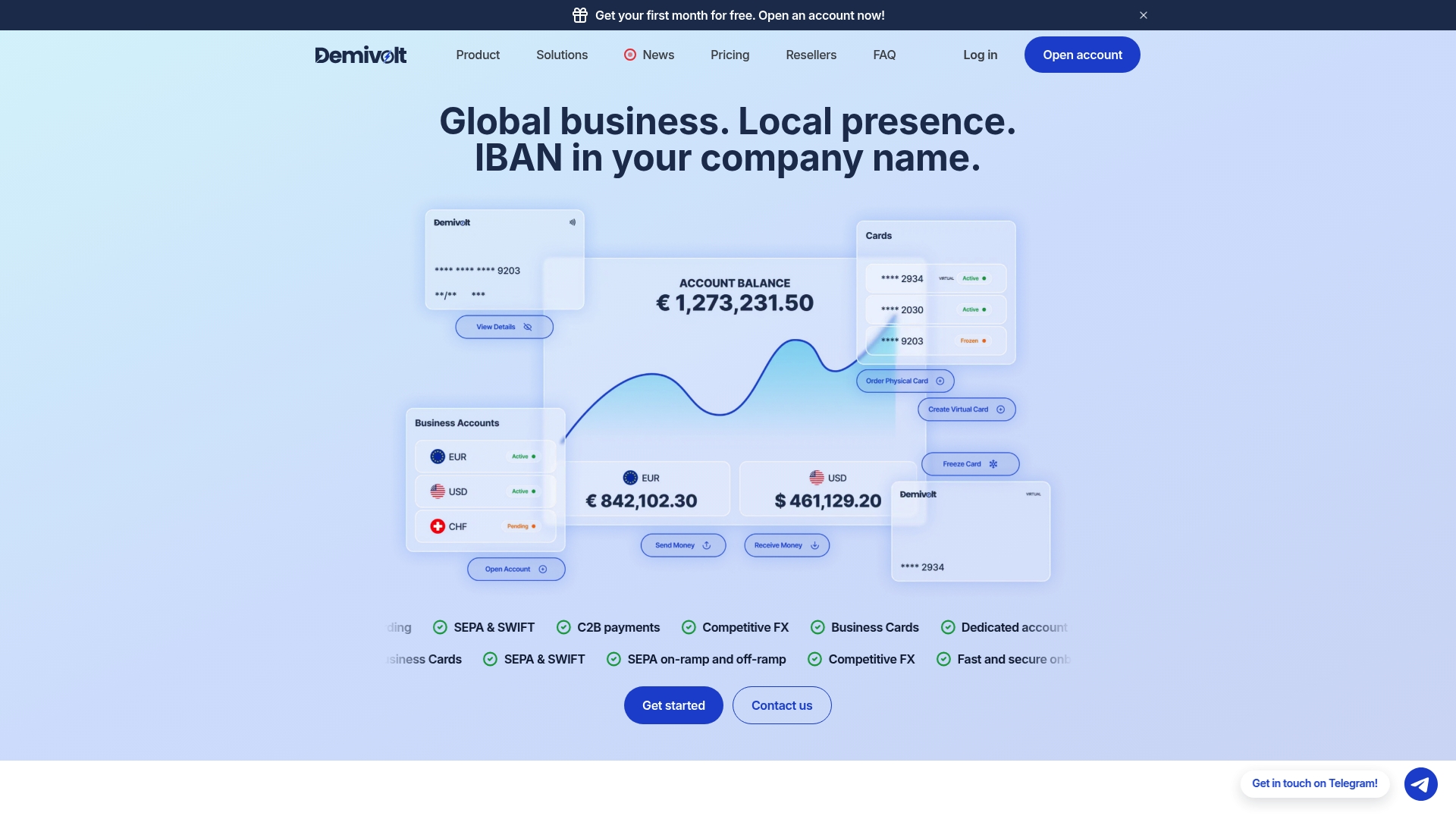
Demivolt is built for exactly this kind of operational reality. As a regulated European fintech platform, Demivolt provides dedicated IBAN accounts, SEPA and SWIFT payment infrastructure, and role-based access controls that align with the governance principles in this checklist. Every client account is held in a segregated structure, which reduces your exposure and supports your compliance posture from day one. If you’re an SME or e-commerce business looking for clear, compliant banking that doesn’t require a full compliance team to manage, Demivolt is worth a close look. The platform is designed to give you financial control and auditability without the overhead.
FAQ
What is a payment security checklist?
A payment security checklist is a structured list of controls, configurations, and practices a business must implement to protect payment transactions from fraud and comply with standards like PCI DSS. It covers areas including encryption, access control, script management, and fraud detection.
Is PCI DSS 4.0 compliance mandatory for small businesses?
Yes. PCI DSS 4.0 became fully enforceable in March 2025 and applies to any business that stores, processes, or transmits cardholder data. The specific requirements depend on your processing method, and selecting the correct SAQ can reduce your compliance workload significantly.
How does tokenization improve payment security?
Tokenization replaces sensitive card numbers with non-sensitive tokens, meaning your systems never store or transmit raw card data. Visa data shows this reduces online fraud by approximately 30% and improves payment approval rates by 3 to 4 percentage points.
What is the biggest mistake businesses make with payment security?
Treating compliance as a one-time event rather than ongoing risk management. Scripts get modified, staff turn over, and threats evolve. A security posture built on static controls without regular review and training degrades quickly.
How often should you review your payment security measures?
At minimum, conduct a full review quarterly. Run vulnerability scans every quarter, penetration tests annually, and review your script inventory before every significant deployment. Update your checklist after any incident or major regulatory change.