

TL;DR:
- Online business banking offers significantly lower fees, higher interest rates, and 24/7 digital access for small and medium-sized businesses. It enhances operational efficiency through automation and integration with accounting tools but lacks direct cash deposit features. Hybrid banking remains the most practical choice for cash-heavy businesses or those with cross-border needs.
Online business banking is defined as a fully digital financial service that replaces branch-based banking with app and API-driven account management. The online business banking benefits 2026 SMEs care most about are lower fees, faster payments, and direct integrations with tools like QuickBooks and Xero. Platforms such as Mercury, Bluevine, and Novo have made digital-first banking the default choice for small and medium-sized businesses that move fast and operate lean. This guide breaks down every major advantage, flags the real trade-offs, and helps you choose the right setup for your business.
1. What are the core cost advantages of online business banking?
Most online business banks charge $0 in monthly fees and require no minimum balance. Traditional banks typically charge $5–$25 per month just to keep an account open. That difference adds up to $180 or more in annual savings for a small business.
The interest advantage is even more significant. Top online banks offer APYs of 4.35%–4.75% on savings accounts, far above what most traditional banks pay. A business holding $50,000 in operating funds at 3% APY earns $1,500 annually. That is money sitting in an account doing real work.
Pro Tip: Read the full fee schedule before opening any account. One outgoing wire transfer can cost $15–$25 and wipe out an entire month of fee savings in a single transaction.
The no-fee headline is accurate for many providers, but transaction fees on wire transfers or ACH payments can offset those savings quickly. Businesses that send frequent international payments need to calculate their true monthly cost, not just the maintenance fee.
2. How does automation improve day-to-day operations?
Cloud computing and APIs power the automation that makes online banking faster than legacy systems. Identity verification, account onboarding, and transaction reporting all run automatically. That removes the manual steps that slow down traditional bank processes.

The biggest operational win for most SMEs is accounting integration. Bank feeds connected to QuickBooks or Xero eliminate hours of manual data entry each month. Transactions post in real time, categories apply automatically, and reconciliation takes minutes instead of hours.
Bill pay, mobile check deposits, and early direct deposit round out the automation picture. Early direct deposit arrives 1–2 days before the standard payday. For a business managing tight cash flow, that timing difference is meaningful.
Pro Tip: Choose a bank with a native API integration over one that uses screen-scraping to connect to your accounting software. Screen-scraping breaks frequently and creates reconciliation errors that cost you time to fix.
3. What accessibility features set online banking apart in 2026?
Online business banking runs 24 hours a day, 7 days a week, from any device. There is no branch to visit, no queue to wait in, and no closing time. For a business owner managing finances between client calls or across time zones, that access is a genuine operational advantage.
ATM access is broader than most people expect. Online banks partner with nationwide ATM networks providing fee-free access to 40,000–80,000+ ATMs. Some providers reimburse third-party ATM fees entirely. That coverage often exceeds what a regional traditional bank offers.
Real-time transaction alerts give you instant visibility into every payment in and out. That level of control reduces fraud risk and makes cash flow management far more accurate. You know your balance at any moment without logging into a portal.
| Feature | Online banking | Traditional banking |
|---|---|---|
| Monthly fees | $0 at most providers | $5–$25 typical |
| ATM network | 40,000–80,000+ fee-free | Varies by branch network |
| Account access | 24/7 mobile and web | Branch hours plus online |
| Transaction alerts | Real-time push notifications | Varies by provider |
| Cash deposits | Not supported directly | Full branch support |
| Onboarding time | Minutes to hours | Days to weeks |
The one genuine limitation is cash handling. Online banks do not accept cash deposits directly. Businesses that collect cash regularly need a workaround, such as a secondary account at a traditional bank or a cash deposit service through a retail partner.
4. How do leading online business banking providers compare?
The three most referenced providers for SMEs in 2026 are Mercury, Bluevine, and Novo. Each targets a slightly different business profile, and the differences matter when you are choosing.
Mercury suits tech startups and digital businesses well. It offers no monthly fees, FDIC insurance up to $5,000,000 through partner banks, and treasury yield products for idle cash. Bluevine focuses on businesses that want high-yield checking, offering competitive APYs directly on checking balances rather than requiring a separate savings account. Novo positions itself as the integration-first option, with direct connections to Stripe, Shopify, and QuickBooks built into the core product.
| Provider | Monthly fee | APY on deposits | Key integration | Best for |
|---|---|---|---|---|
| Mercury | $0 | Treasury yield products | Stripe, QuickBooks | Tech and digital businesses |
| Bluevine | $0 | Competitive on checking | QuickBooks, Xero | Revenue-generating SMEs |
| Novo | $0 | Not publicly listed | Shopify, Stripe, QuickBooks | E-commerce and freelancers |
Online banks excel for SMEs that rarely handle cash and value integration speed. Traditional banks remain the better fit for cash-heavy businesses or those that need commercial lending relationships. Knowing which category your business falls into saves you from switching providers six months after opening an account.
For European SMEs operating across borders, platforms like Demivolt add SEPA and SWIFT payment infrastructure, dedicated IBAN accounts, and EU-compliant onboarding to the digital banking equation. That combination matters for businesses with cross-border payment needs that US-focused providers do not address. You can explore business account benefits for European SMEs to see how the European context changes the feature priorities.
5. What efficiency gains come from paperless digital workflows?
Paperless workflows in digital banking reduce processing times for business tasks far beyond the environmental benefit. Document uploads replace courier deliveries. Digital signatures replace notarized forms. Approval chains that took days now complete in hours.
For compliance-heavy businesses, digital record-keeping is a direct audit advantage. Every transaction, approval, and document lives in a searchable, exportable format. Preparing for a tax audit or investor due diligence takes hours rather than days when your financial records are already organized digitally.
The onboarding process itself reflects this shift. Digital onboarding automates identity verification and account setup, cutting the time from application to active account from weeks to hours. For a business that needs to start transacting quickly, that speed is a competitive advantage.
Pro Tip: Connect your bank account to a budgeting app using a direct API link rather than manual exports. Tools that support bank account connections give you real-time budget tracking without any manual data work.
6. How should SMEs structure their banking to get the most value?
The most practical approach for most SMEs is a hybrid model. Use an online bank for daily operations, payroll, and digital payments. Keep a traditional bank account for cash deposits, commercial loans, or any service that requires in-person support.
A hybrid banking model balances the speed and cost benefits of online banking with the cash handling and lending capabilities of traditional banking. It is not a compromise. It is a deliberate structure that uses each type of bank for what it does best.
Before committing to any provider, audit your transaction volume. Count how many wire transfers, ACH payments, and international transactions you send each month. Then calculate the true monthly cost at each provider you are considering. The no-fee headline only holds if your transaction mix does not trigger per-transaction charges.
Review your provider’s fee structure at least once a year. Online banks update their pricing and features regularly. A provider that was the best fit in january may have changed terms by july. Staying current on those changes protects your cost position.
For businesses with international operations, assess the quality of SEPA and SWIFT support before choosing a provider. Domestic US providers often lack the cross-border infrastructure that European or globally active SMEs need. That gap is where purpose-built platforms like Demivolt fill a real role, offering integrated banking for SMEs with EU-compliant infrastructure from day one.
7. What security and compliance features protect your business?
Digital banking platforms in 2026 carry FDIC insurance, multi-factor authentication, and real-time fraud monitoring as standard features. These are not optional add-ons. They are baseline requirements for any regulated provider.
Role-based user management is a feature that traditional banks rarely offer at the SME level. Online platforms let you assign specific permissions to team members, accountants, or finance managers. A bookkeeper can view transactions and export reports without having transfer authority. That separation of duties reduces internal fraud risk significantly.
For European businesses, EU regulatory compliance adds another layer. Platforms operating under European financial regulations must hold client funds in segregated accounts. That structure protects your money even if the platform itself encounters financial difficulty. Demivolt operates under this model, with client funds held separately from operational funds as required by EU standards.
Key takeaways
Online business banking delivers the strongest value for SMEs that prioritize cost control, accounting integration, and 24/7 access over cash handling and in-person lending.
| Point | Details |
|---|---|
| Fee savings are real but conditional | Zero monthly fees save $180+ annually, but wire and ACH fees can offset gains quickly. |
| Interest income adds up | $50,000 at 3% APY earns $1,500 per year, a return traditional banks rarely match. |
| Integration quality determines efficiency | Native API connections to QuickBooks or Xero save hours monthly; screen-scraping does not. |
| Hybrid banking suits most SMEs | Pair an online bank for daily operations with a traditional account for cash and lending. |
| European businesses need cross-border features | SEPA, SWIFT, and IBAN support are non-negotiable for internationally active SMEs. |
Why I think most SMEs are still underusing digital banking
The businesses I see getting the most from online banking are not the ones chasing the highest APY. They are the ones who connected their bank feed to their accounting software and never looked back. The time savings from automated reconciliation alone justify the switch, even before you count the fee reductions.
The cash handling limitation gets more attention than it deserves. Most SMEs in digital services, consulting, e-commerce, or cross-border trade handle almost no physical cash. For those businesses, the limitation simply does not apply. The hybrid model argument is valid, but for a large share of modern SMEs, the online-only setup is already complete.
What I find underappreciated is the compliance advantage of digital record-keeping. When every transaction is timestamped, categorized, and exportable, your financial records are audit-ready by default. That is not a minor convenience. It is a structural advantage that saves real money when tax season or investor due diligence arrives.
The 2026 business banking trends point toward more API depth, better multi-currency support, and faster cross-border settlement. Providers that invest in those areas will pull further ahead of legacy banks. The SMEs that evaluate their banking setup annually, rather than setting it and forgetting it, will capture those gains first.
— dd
Demivolt makes digital business banking work for European SMEs
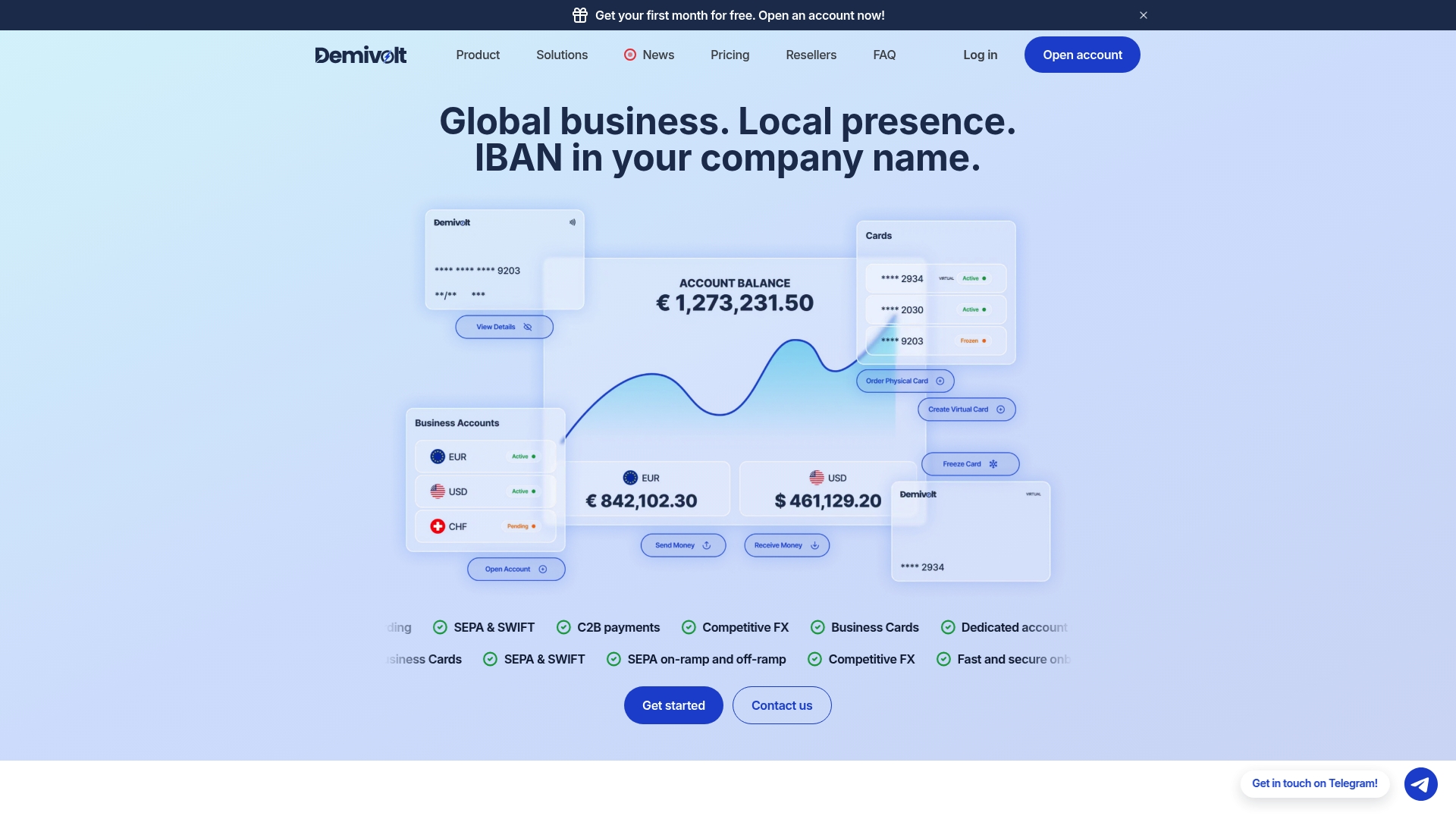
Demivolt is a regulated European fintech platform built for SMEs that need more than a basic checking account. The platform provides dedicated IBAN accounts, SEPA and SWIFT payment management, virtual and physical business cards, and role-based user controls. Onboarding meets EU regulatory standards, and client funds are held in segregated accounts for full protection. For businesses operating across borders, Demivolt’s infrastructure handles the compliance and payment complexity that generic online banks cannot. Use the free IBAN validator tool to verify international account numbers instantly, or explore the full suite of free SEPA tools to support your cross-border payment operations. Demivolt’s business banking platform is built for the way modern SMEs actually work.
FAQ
What are the main online business banking benefits in 2026?
The top benefits are zero monthly fees, high-yield savings rates of 4.35%–4.75%, 24/7 mobile access, and direct integrations with accounting tools like QuickBooks and Xero. These features reduce costs and manual work for SMEs.
Can online banks handle cash deposits for small businesses?
Most online-only banks do not accept cash deposits directly. Businesses that handle cash regularly should use a hybrid model, pairing an online bank with a traditional account that supports branch deposits.
How do I avoid hidden fees with online business banking?
Audit your monthly transaction volume before choosing a provider. Wire transfers and ACH payments carry per-transaction fees that can exceed the savings from a zero monthly fee account.
Is online business banking safe for SMEs?
Yes. Regulated online banks carry FDIC insurance, multi-factor authentication, and real-time fraud monitoring. European platforms operating under EU regulations also hold client funds in segregated accounts for added protection.
Which online business bank is best for cross-border payments?
US-focused providers like Mercury and Bluevine handle domestic transactions well but have limited cross-border infrastructure. European SMEs with SEPA or SWIFT payment needs are better served by purpose-built platforms like Demivolt.