

TL;DR:
- A cross-border payment checklist guides businesses to reduce errors and compliance risks in international transactions. It emphasizes selecting the best payment routes, prioritizing local methods, and ensuring compliance to improve approval rates and lower costs. Regular review of payment performance and understanding settlement finality are essential for efficient global payment operations.
An online business international payment checklist is a structured framework that defines every operational, compliance, and customer-experience step required to accept cross-border payments without errors, delays, or regulatory exposure. The industry term for this practice is cross-border payment orchestration, and it covers everything from gateway selection to sanctions screening. Businesses that follow a formal checklist reduce cart abandonment, protect margins against hidden FX costs, and meet standards set by bodies like PCI DSS, OFAC, and AML programs. Without one, even experienced operators leave money on the table and expose themselves to compliance risk.
1. What is an online business international payment checklist?

An online business international payment checklist is a step-by-step reference that covers payment rails, security controls, localization, reconciliation, and performance monitoring for global transactions. Think of it as a pre-flight checklist for pilots. Every item must be confirmed before you accept your first cross-border payment at scale.
The checklist matters because international payments carry risks that domestic transactions do not. Currency conversion, local regulations, sanctions lists, and regional payment preferences all create failure points. A structured approach turns those failure points into managed processes.
2. Select the right payment rails and gateways
Payment rail selection is the foundation of your cross-border payment setup. A single gateway rarely covers every market you need. Multi-rail orchestration outperforms single-rail setups by routing each transaction across the best available network based on cost, speed, and approval probability.
An orchestration layer sits above your gateways and makes routing decisions automatically. It sends a Brazilian transaction through a local acquirer, a European B2B payment through SEPA, and a US card payment through a domestic processor. Each route is chosen for the lowest cost and highest approval rate.
Treat each payment method as a product with its own operational requirements, including reconciliation logic, refund handling, and customer support training. That mindset prevents gaps when a method goes live.
Pro Tip: Start with the top 2–3 payment methods per high-volume market rather than trying to support every option globally. Depth beats breadth for approval rates.
3. Prioritize local payment methods by market
Local payment method prioritization is the single highest-impact item on any ecommerce payment checklist. Localized checkout with regional payment method availability directly reduces declines and boosts conversion for international buyers.
Focus on the methods that dominate each market. PIX is the default instant payment in Brazil. iDEAL covers the majority of Dutch online transactions. UPI is the leading mobile payment rail in India. Offering a card-only checkout in these markets is a conversion killer.
Prioritize the top 2–3 local methods per high-volume country rather than building a global catalog of every available option. Fewer, well-integrated methods outperform a long list of poorly supported ones.
4. Implement multi-currency pricing and FX transparency
Multi-currency pricing means displaying prices in the buyer’s local currency at checkout, not just in your home currency. Buyers who see a foreign currency total abandon carts at a higher rate than those who see a localized price.
You have two main approaches. Live FX conversion shows the buyer a real-time converted price using current exchange rates. Market-specific pricing sets fixed local prices that do not fluctuate with daily FX movements. Market-specific pricing works better for markets where you have consistent volume and want price stability.
FX spreads and beneficiary bank charges often add 2–4% to the total cost of an international payment beyond the headline fee. Multi-currency accounts that hold balances in local currencies reduce this drag significantly.
5. Apply EMV 3DS 2.x and fraud controls
EMV 3-D Secure version 2.x is the current standard for authenticating card-not-present transactions across borders. 3DS 2.x uses risk-based authentication to challenge only high-risk transactions, reducing friction for legitimate buyers while blocking fraud.
Implement full 3DS 2.x support and monitor exemption failure rates by market. Some markets, particularly in the European Economic Area under PSD2, require strong customer authentication for most card transactions. Failing to support 3DS 2.x in these markets results in declined payments, not just fraud losses.
Pair 3DS 2.x with velocity checks, device fingerprinting, and IP geolocation rules. No single fraud tool covers every attack vector. Layered controls catch what individual tools miss.
6. Build PCI DSS 4.0.1 compliance into your security checklist
PCI DSS 4.0.1 is the current version of the Payment Card Industry Data Security Standard, and it applies to every business that stores, processes, or transmits cardholder data. PCI DSS 4.0.1 requires quarterly ASV scans and penetration testing with remediation completed within three months.
Use hosted payment fields and tokenization to reduce your PCI scope. When your checkout page never touches raw card data because a third-party hosted field captures it directly, your compliance obligations shrink considerably. That reduction in scope also reduces your audit costs.
- Conduct quarterly Approved Scanning Vendor (ASV) scans
- Complete annual penetration tests and remediate findings within 90 days
- Use tokenization to avoid storing raw card numbers
- Apply hosted payment fields to keep cardholder data off your servers
- Review your PCI scope annually as your payment stack changes
Pro Tip: Pair your payment security checklist with a formal scope reduction exercise each year. Removing systems from scope is cheaper than securing them.
7. Automate sanctions screening and AML controls
Sanctions screening against OFAC’s Specially Designated Nationals (SDN) list is a legal requirement for any business with US nexus, and equivalent lists apply in the EU and UK. Manual sanctions screening creates compliance liability. Automated platforms with real-time transaction screening reduce that risk significantly.
Automated compliance engines check each transaction against current sanctions lists before funds move. They also flag unusual transaction patterns for AML review. Manual processes cannot match that speed or consistency.
Look for payment platforms with built-in Know Your Customer (KYC), Know Your Business (KYB), and AML screening. These tools handle the regulatory heavy lifting so your team focuses on exceptions rather than routine checks. Demivolt’s platform, for example, meets EU regulatory standards and uses segregated accounts to protect client funds while supporting compliant cross-border operations.
8. Localize your checkout experience
Checkout localization goes beyond currency display. Address fields, phone number formats, postal code validation, and even the order of name fields vary by country. A checkout form built for US buyers will confuse and frustrate buyers in Japan or Germany.
Mobile wallets exceed 55% of digital transactions in markets like Indonesia. That share means a checkout without mobile wallet support loses more than half the potential transactions in those markets before a buyer even enters card details.
Place Apple Pay and Google Pay buttons prominently on mobile checkout pages. Express wallet options reduce the steps to purchase and increase mobile conversion rates. For markets where installment payments are culturally expected, offer buy-now-pay-later options at checkout. Installment options double conversion on orders over $80 in Brazil.
| Region | Priority payment method | Key localization action |
|---|---|---|
| Brazil | PIX, installments | Enable PIX rails and BNPL for orders over $80 |
| Netherlands | iDEAL | Add iDEAL as primary checkout option |
| India | UPI | Integrate UPI and display prices in INR |
| Indonesia | Mobile wallets | Place wallet buttons above card fields |
| EU (general) | Cards + SEPA | Support 3DS 2.x and SEPA Direct Debit |
9. Understand settlement finality vs. payment delivered
Settlement finality and payment delivery are not the same thing. Card network payments can be reversed months after settlement, while stablecoins and instant payment systems settle irreversibly within seconds or minutes. Treating all payment types as equally final creates cash flow and fraud risk.
Build your reconciliation logic around the actual finality rules of each payment method. Card payments require chargeback reserves and dispute management processes. Instant payment rails like SEPA Instant or PIX settle with near-immediate finality and require different risk handling.
Map each payment method in your stack to its finality timeline. That map becomes the foundation of your cash flow forecasting and your fraud reserve calculations.
10. Build a reconciliation pipeline
Reconciliation ties every authorization, capture, settlement, refund, and chargeback back to a single transaction identifier. Without that linkage, your finance team spends hours matching records manually, and errors compound across reporting periods.
Standardize transaction identifiers across your payment gateway, accounting system, and bank statements. Use a consistent reference format from the moment a payment is authorized through to final settlement. Automation tools for exception handling flag mismatches before they become month-end problems.
Review your cross-border payment performance on a 90-day cycle. Track authorization rates, chargeback rates, and checkout abandonment by market. That cadence gives you enough data to spot trends without reacting to daily noise.
11. Monitor and review payment performance every 90 days
A 90-day review cycle is the standard cadence for international payment KPIs including authorization rate, chargeback rate, and checkout abandonment by market. Quarterly reviews give you enough data to identify patterns and make informed changes.
Track FX spreads, intermediary fees, and settlement-side charges separately from your headline processing fees. Hidden payment costs including FX spreads and beneficiary charges add 2–4% to total payment cost if left unmanaged. That margin erosion is invisible without dedicated cost tracking.
Set market-level benchmarks for each KPI and alert thresholds that trigger a review outside the regular cycle. A sudden drop in authorization rate in a specific market usually signals a gateway issue, a fraud rule misfiring, or a local regulatory change.
Key takeaways
A structured cross-border payment checklist covering rails, compliance, localization, and reconciliation is the most direct path to higher approval rates and lower payment costs for online businesses.
| Point | Details |
|---|---|
| Use multi-rail orchestration | Route payments across multiple gateways to maximize approval rates and minimize costs. |
| Prioritize local payment methods | Enable the top 2–3 methods per high-volume market rather than supporting every option globally. |
| Automate compliance screening | Use platforms with built-in KYC, KYB, and OFAC sanctions screening to reduce manual liability. |
| Understand settlement finality | Card payments can reverse months post-settlement; instant rails settle irreversibly within minutes. |
| Review KPIs every 90 days | Track authorization rates, chargeback rates, and abandonment by market on a quarterly cycle. |
Why most businesses get international payments wrong
The most common mistake I see is treating payment acceptance as a technical checkbox rather than a customer experience channel. Businesses spend months choosing a gateway, then launch with a single currency, no local payment methods, and a checkout form built for their home market. The result is a technically functional payment page that converts poorly in every international market it serves.
The second mistake is compliance by assumption. Operators assume their payment provider handles OFAC screening, PCI DSS compliance, and AML monitoring automatically. Sometimes that assumption is correct. Often it is not, and the gap only surfaces during an audit or a fraud incident.
What actually works is treating the international payments process as an ongoing operational discipline, not a one-time setup task. The businesses I have seen succeed internationally review their payment stack quarterly, localize aggressively by market, and build compliance into their platform selection criteria from day one. They also think carefully about settlement finality before choosing payment methods, because cash flow surprises from chargebacks are avoidable with the right setup.
The orchestration mindset is the real shift. Once you stop thinking of payment acceptance as a single gateway decision and start thinking of it as a routing, compliance, and experience system, the checklist stops feeling like overhead. It becomes the operating manual for a revenue-generating function.
— dd
Demivolt’s tools for cleaner international payment operations
Accurate beneficiary account data is the starting point for any cross-border payment. A single digit error in an IBAN sends funds to the wrong account or triggers a costly return. Demivolt’s free IBAN validator tool checks account numbers against the ISO 13616 standard before a payment is submitted, catching errors at the source.
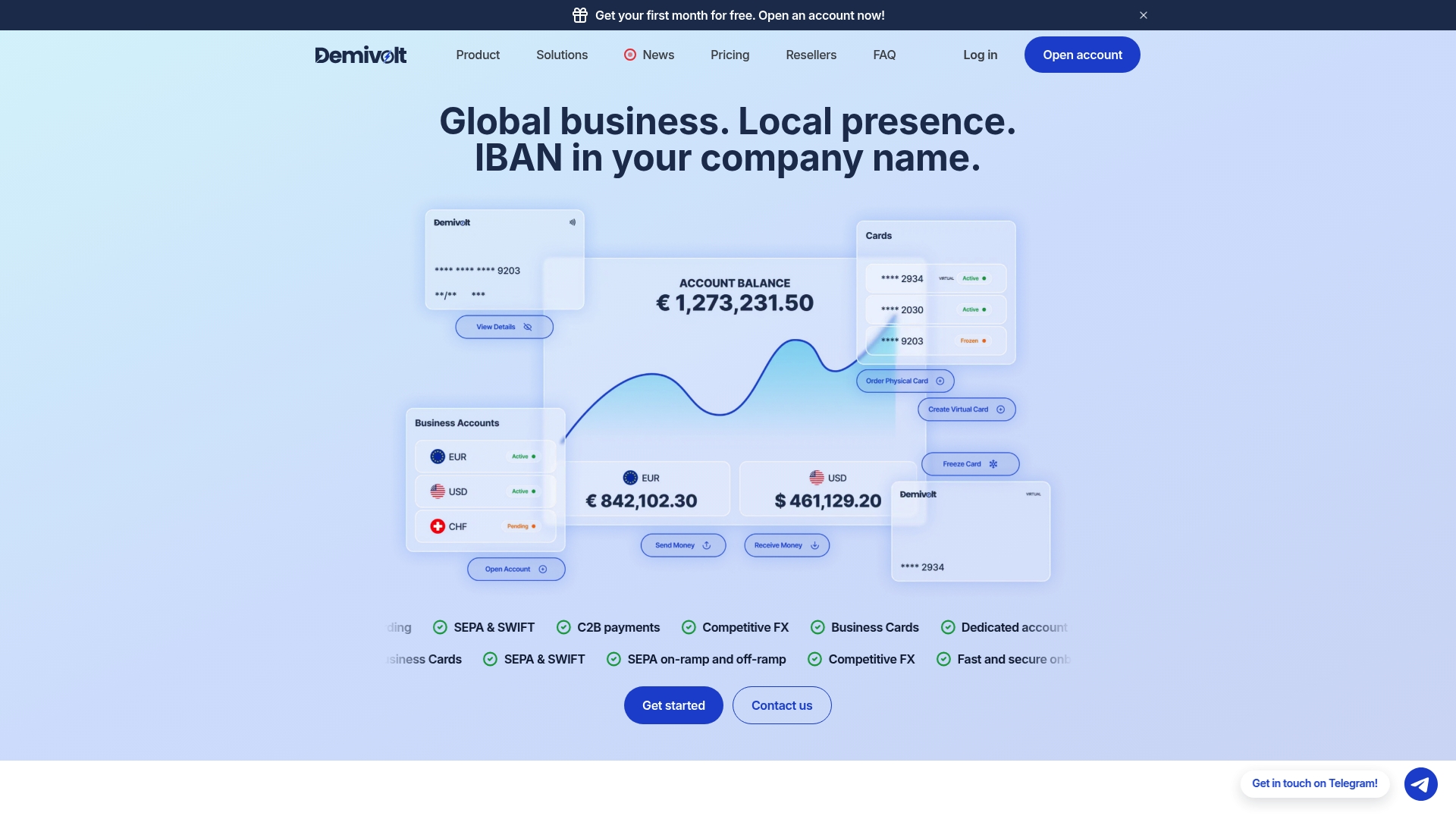
Demivolt also offers a suite of free SEPA tools that support payment validation and compliance across European markets. For businesses building out their international payment infrastructure, Demivolt’s business banking platform provides dedicated IBAN accounts, SEPA and SWIFT payment management, and EU-regulated financial infrastructure designed for cross-border operations. These tools reduce reconciliation errors and speed up payment processing from the first transaction.
FAQ
What is an international payment checklist for online businesses?
An international payment checklist is a structured set of steps covering gateway selection, local payment methods, compliance controls, localization, and reconciliation for cross-border transactions. It reduces errors, lowers costs, and improves conversion rates in global markets.
How often should I review my international payment performance?
Review authorization rates, chargeback rates, and checkout abandonment by market every 90 days. That cadence provides enough data to identify trends and make informed adjustments without overreacting to short-term fluctuations.
What is PCI DSS 4.0.1 and does it apply to my online business?
PCI DSS 4.0.1 is the current Payment Card Industry Data Security Standard, and it applies to any business that processes, stores, or transmits cardholder data. It requires quarterly ASV scans and penetration testing with findings remediated within three months.
Why do hidden fees make international payments more expensive?
FX spreads and beneficiary bank charges add 2–4% to the total cost of an international payment beyond the headline processing fee. Multi-currency accounts that hold local currency balances reduce this cost by eliminating unnecessary conversion steps.
What is settlement finality and why does it matter?
Settlement finality is the point at which a payment becomes irreversible. Card payments can be reversed months after settlement through chargebacks, while instant payment rails like PIX and SEPA Instant settle with near-immediate finality. Understanding the difference shapes your cash flow management and fraud reserve strategy.