

SEPA Instant Credit Transfer, formally known as SCT Inst, is the European Payments Council’s scheme for euro credit transfers that reach the recipient’s account in under ten seconds, 24 hours a day, 365 days a year. For businesses, that single operational fact changes the entire logic of cash flow management, supplier relationships, and customer payment experiences.
The bottom line for finance teams: instant SEPA payments are no longer a premium add-on. The Instant Payments Regulation (IPR) has made them a mandatory capability across the euro area, which means your counterparties will increasingly expect to send and receive funds in seconds, not hours.
Immediate business impacts to plan for:
- Cash flow timing: Funds settle in seconds rather than the next business day, which tightens working capital cycles and changes how you model intraday liquidity.
- Reconciliation speed: Payments arrive with a precise timestamp (to the millisecond under the 2025 rulebook), making automated matching faster and more reliable.
- Customer experience: Checkout flows, marketplace payouts, and supplier settlements can all confirm payment in real time, reducing disputes and support overhead.
- 24/7 availability: Unlike standard SEPA Credit Transfers, SCT Inst operates through weekends and public holidays, removing the batch-processing gaps that delay B2B settlements.
Key Takeaways
SCT Inst is now a mandatory capability across the euro area, and the ten-second settlement target, combined with IPR-enforced pricing parity, makes instant SEPA payments the default expectation for euro-denominated business transactions.
| Point | Details |
|---|---|
| settlement target in seconds | SCT Inst requires funds to be available in the recipient’s account within ten seconds, 24/7/365. |
| IPR mandatory deadlines | Euro-area PSPs must receive instant payments from January 9, 2025, and send them from October 9, 2025. |
| Pricing parity is law | Instant transfer fees cannot exceed standard SCT fees under the Instant Payments Regulation. |
| VoP is a baseline control | Verification of Payee applies to both instant and standard credit transfers; mismatches must pause payment, not fail silently. |
| Demivolt as a practical path | Demivolt provides dedicated IBAN accounts and SEPA payment processing, giving businesses direct access to instant euro rails without the overhead of direct PSP membership. |
Table of Contents
- What is SEPA Instant (SCT Inst) and who governs it?
- How does SEPA Instant work technically?
- What does the Instant Payments Regulation mean for reachability?
- Fees, transaction limits, and fraud controls you need to know
- How can a U.S. company send or receive SEPA Instant payments?
- Implementation checklist for treasury and engineering teams
- Regulatory and compliance notes for non-EEA businesses
- The IPR changes more than compliance deadlines
- How Demivolt supports your SEPA Instant adoption
- Sources
What is SEPA Instant (SCT Inst) and who governs it?
SCT Inst is a payment scheme built on top of the existing SEPA Credit Transfer (SCT) framework. Where a standard SCT typically settles within one business day, SCT Inst compresses that to seconds. The scheme was published by the European Payments Council (EPC) in November 2016 and entered into effect in November 2017, making it one of the newer additions to the SEPA payment instruments family.

Two institutions define how the scheme operates in practice. The European Payments Council (EPC) owns the SCT Inst rulebook, sets participation requirements, and publishes updates, including the 2025 version that introduced millisecond timestamping and clarified sub-timelines. The European Central Bank (ECB) provides the settlement infrastructure through TARGET Instant Payment Settlement (TIPS), which launched in November 2018 to enable immediate, round-the-clock settlement at the central bank level.
The geographic scope covers the full SEPA area, which spans multiple European countries including all EU member states plus Iceland, Liechtenstein, Norway, Switzerland, Andorra, Monaco, San Marino, and Vatican City. Not every payment service provider (PSP) in every country has historically offered SCT Inst, but the IPR is closing that gap rapidly.
Key participants and infrastructure components:
- PSPs and banks: Any bank or licensed payment institution that adheres to the EPC rulebook can participate as an originator or beneficiary PSP.
- Clearing and settlement mechanisms (CSMs): Private clearing platforms and the ECB’s TIPS service process and settle SCT Inst transactions. TIPS specifically enables pan-European reachability by connecting PSPs across jurisdictions on a single settlement layer.
- One-Leg-Out (OLO) scenarios: When only one of the two PSPs involved is a SEPA participant, the transaction qualifies as a One-Leg-Out instant payment. These are increasingly relevant for U.S. and non-EEA entities transacting with European counterparties.
- Pan-European reachability: The ECB and EPC treat consistent reachability across all SEPA jurisdictions as a strategic objective, specifically to prevent fragmentation where instant payments work domestically but fail cross-border within SEPA.
For a broader overview of how SEPA rails work before diving into the instant layer, the SEPA payments explainer from Demivolt covers the foundational mechanics.
How does SEPA Instant work technically?
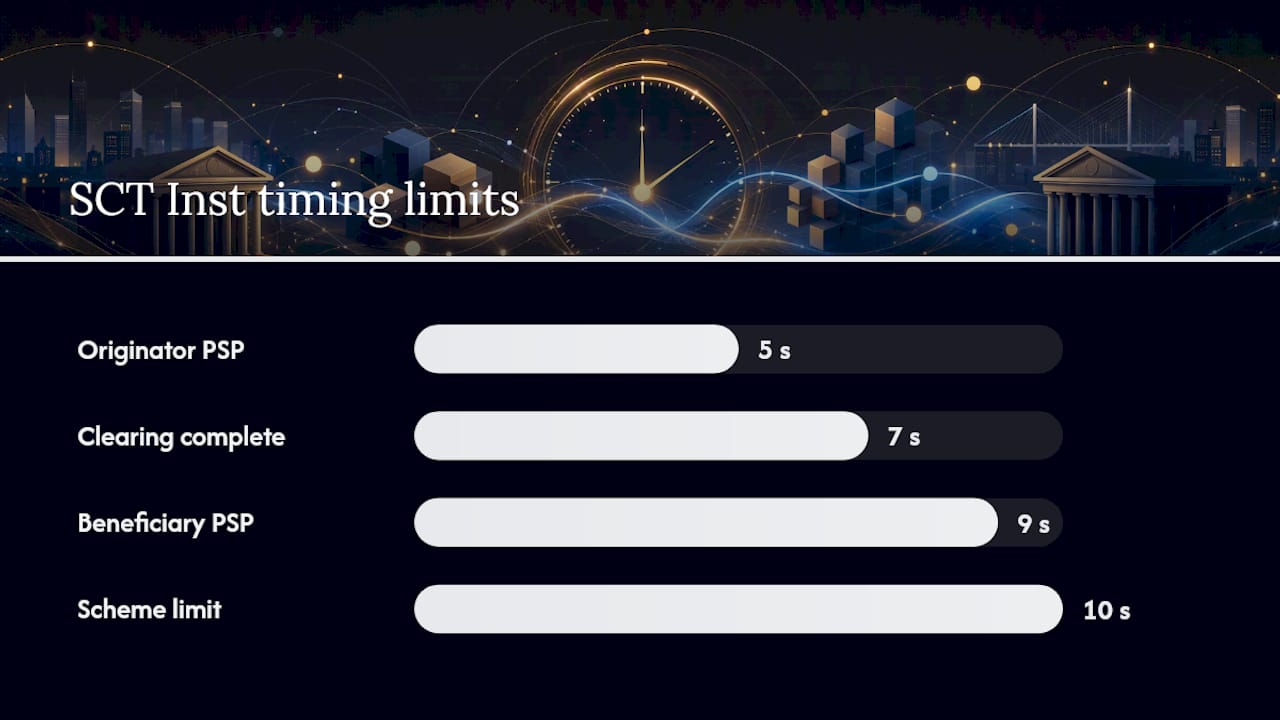
The SCT Inst rulebook sets a maximum end-to-end execution time of ten seconds from the moment the originator PSP accepts the payment instruction to the moment the beneficiary PSP confirms funds availability. That ten-second window is not a target to aim for on a good day. It is the outer boundary the scheme enforces.
Within that ten seconds, the 2025 rulebook version clarifies internal sub-timelines: roughly five seconds for the originator PSP to authorize and forward the instruction, seven seconds for clearing to complete, and nine seconds for the beneficiary PSP to confirm receipt, leaving a one-second buffer before the scheme limit is breached. Engineering teams building on SCT Inst need to treat these sub-timelines as functional requirements, not guidelines.
The message format is ISO 20022, specifically the pacs.008 (credit transfer) and pacs.002 (payment status report) message types. The 2025 rulebook introduced the AT-T056 timestamp attribute, which requires timestamps recorded to the millisecond. Clock synchronization across systems is therefore a hard technical dependency, not an optional optimization.
| Timing element | Scheme requirement | Practical implication |
|---|---|---|
| End-to-end execution | Maximum 10 seconds | Hard limit from originator PSP acceptance to beneficiary confirmation |
| Originator PSP processing | Approximately 5 seconds internal | Authorization, fraud screening, and message forwarding |
| Inter-PSP clearing | Approximately 7 seconds cumulative | Clearing platform routes and matches the instruction |
| Beneficiary PSP confirmation | Maximum 9 seconds cumulative | Funds credited and status report sent |
| Timestamp precision | Milliseconds (AT-T056) | Required in all SCT Inst messages per 2025 rulebook |
| Availability | 24/7/365 | Planned maintenance windows permitted; must be short and foreseeable |
How a payment flows in practice:
- The payer’s business initiates a payment instruction via their PSP’s interface or API.
- The originator PSP validates the instruction, screens for fraud and AML flags, and forwards the ISO 20022 pacs.008 message to the clearing platform.
- The clearing platform (a private CSM or TIPS) routes the message to the beneficiary PSP and confirms matching.
- The beneficiary PSP credits the recipient’s account and returns a pacs.002 status report.
- The originator PSP notifies the payer of confirmed settlement, all within ten seconds.
Settlement through TIPS is final and irrevocable at the moment the beneficiary PSP confirms. There is no end-of-day netting or deferred settlement, which has direct implications for treasury liquidity management.
Regarding planned downtime: the rulebook permits PSPs to schedule short, foreseeable maintenance windows. The scheme-level maximum transaction amount has been removed from the rulebook, meaning individual PSPs set their own per-transfer limits subject to any applicable regulatory caps.
What does the Instant Payments Regulation mean for reachability?
Voluntary adoption of SCT Inst created a fragmented landscape where instant payments worked reliably within some countries but failed unpredictably across borders. The Instant Payments Regulation (IPR) resolved that by making technical capability mandatory for PSPs operating in the euro area.
The regulatory deadlines are specific. Under the IPR, PSPs were required to establish the technical infrastructure to receive instant payments by January 9, 2025. The obligation to send instant payments followed on October 9, 2025. Both deadlines apply to euro-area PSPs. Non-euro EU member states have extended timelines, but the direction is the same: mandatory participation, not optional.
The Central Bank of Ireland confirms that as of October 9, 2025, all banks and relevant PSPs in the euro area are required to facilitate sending SEPA instant credit transfers, and that these payments must be available through existing channels, meaning customers should not need a separate app or service to access instant payments.
What “mandatory reachability” means for your business:
- Any euro-denominated payment to a euro-area bank account should now be sendable as an instant transfer, not just a standard SCT.
- Your PSP cannot charge more for an instant transfer than for an equivalent standard credit transfer. Price parity is a legal requirement under the IPR, not a commercial choice.
- One-Leg-Out scenarios, where your U.S. entity sends euros to a European beneficiary through a SEPA-connected PSP, are supported but depend on your PSP’s specific reachability agreements.
To check whether a specific counterparty or PSP is reachable for SCT Inst, the EPC publishes a reachability register. Your PSP’s compliance team or account manager can also confirm whether a given IBAN is reachable before you build a payment flow that depends on instant settlement. The ECB’s retail payments page tracks SCT Inst uptake as a share of all SEPA credit transfers, providing a macro indicator of how broadly instant rails are being used across the euro area.
For a deeper look at the regulatory timeline and what EU payment rules mean for your operations, the EU payment regulations overview from Demivolt covers the 2026 landscape in detail.
Fees, transaction limits, and fraud controls you need to know
Transaction limits and pricing
The EPC removed the scheme-level maximum transaction amount from the SCT Inst rulebook. Individual PSPs now set their own per-transfer limits, which vary widely in practice. Some banks cap instant transfers at €100,000 per transaction; others set higher thresholds for verified business accounts. Your PSP’s documentation or API reference will state the applicable limit for your account type.
On pricing, the IPR is unambiguous: the fee for an instant SEPA transfer cannot exceed the fee for a standard SEPA Credit Transfer on the same account. If your bank charges €0.20 for a standard SCT, it cannot charge €0.50 for the instant equivalent. This parity rule applies to both the originator and beneficiary sides of the transaction.
Settlement finality
SCT Inst settlement is final and irrevocable the moment the beneficiary PSP confirms funds availability. There is no recall window equivalent to a standard credit transfer recall. Once the pacs.002 confirmation is returned, the funds belong to the beneficiary. For treasury teams, this means:
- Pre-payment validation (correct IBAN, correct beneficiary name) is critical because there is no post-settlement correction path.
- Chargeback mechanisms that apply to card payments do not apply to SCT Inst. Dispute resolution must happen through direct bank-to-bank contact or legal channels.
Fraud and AML considerations
The speed of instant rails compresses the time available for fraud screening. PSPs are required to perform AML and sanctions checks within the ten-second execution window, which demands automated, real-time screening rather than batch review processes.
Verification of Payee (VoP) is the primary fraud-prevention mechanism introduced alongside the IPR. VoP requires PSPs to check that the account holder’s name matches the IBAN provided before executing a transfer. The Central Bank of Ireland notes that VoP applies to both instant and standard credit transfers, making it a baseline control rather than an instant-specific feature.
Risk checklist for treasury teams:
- Confirm your PSP performs VoP checks before payment execution, not just after.
- Build exception flows for VoP mismatches: a name mismatch should pause the payment and alert the operator, not fail silently.
- Establish reconciliation logic that handles the millisecond timestamps in incoming pacs.002 messages.
- Document your planned maintenance window exposure: if your PSP schedules downtime, which payment flows are affected and what is the fallback?
- Review your AML screening vendor’s latency: if screening takes longer than five seconds, you will breach the originator PSP sub-timeline.
Pro Tip: Validate IBANs before submitting any SCT Inst instruction. An invalid IBAN will cause an immediate rejection, but a valid IBAN with a mismatched name will trigger a VoP alert. Both scenarios cost time and create reconciliation exceptions. Pre-validating with a tool like Demivolt’s IBAN validator before payment submission eliminates the most common failure modes.
How can a U.S. company send or receive SEPA Instant payments?
U.S. businesses that trade with European counterparties, pay European suppliers, or receive euro-denominated revenue have four practical paths to access instant SEPA payment rails.
- Direct PSP membership: Becoming a direct participant in the SCT Inst scheme requires EPC adherence, EU regulatory licensing, and technical integration with a CSM or TIPS. This path suits large financial institutions, not most U.S. operating companies. The regulatory overhead and time to market typically run twelve to eighteen months.
- Correspondent banking arrangements: A U.S. bank with a European correspondent can route euro payments through that correspondent’s SCT Inst-capable infrastructure. Settlement speed depends on the correspondent’s capabilities and the nostro account funding model. Intraday liquidity management becomes more complex because you are funding a correspondent account rather than settling directly.
- Third-party PSPs with SEPA access: Licensed European PSPs can originate and receive SCT Inst payments on your behalf. You fund a euro account held by the PSP, and they execute transfers within the scheme. This is faster to market than direct membership but introduces a dependency on the PSP’s own reachability and limits.
- Fintech platforms with dedicated IBANs: Platforms that issue dedicated IBAN accounts to business clients provide the most direct operational experience. Your business holds a named IBAN, sends and receives SCT Inst transfers in its own name, and accesses reconciliation data through an API or dashboard. Time to market is typically days to weeks rather than months.
Trade-offs across these options:
- Direct membership offers maximum control but demands significant regulatory investment.
- Correspondent arrangements are familiar to treasury teams but add a liquidity layer and reduce visibility into settlement timing.
- Third-party PSPs reduce overhead but may impose lower transaction limits or slower onboarding for non-EEA entities.
- Fintech platforms with dedicated IBANs balance speed to market with operational transparency, particularly for SMEs and digital-first businesses.
For businesses comparing euro payment rails more broadly, the SEPA vs. SWIFT comparison from Demivolt explains when each rail fits the use case.
Pro Tip: When evaluating third-party PSPs or fintech platforms, ask specifically about their intraday liquidity model and their reachability coverage for your key counterparty IBANs before signing. A platform that cannot reach your top five suppliers on instant rails delivers limited value over a standard SCT arrangement.
Implementation checklist for treasury and engineering teams
Enabling SCT Inst in your payment stack requires parallel workstreams across treasury, engineering, and compliance. The checklist below maps each item to an owner and a testable pass/fail criterion.
Treasury workstream:
- Confirm your PSP’s per-transfer limit and whether it covers your largest routine payment values.
- Verify pricing parity: your instant transfer fee must not exceed your standard SCT fee under the IPR.
- Model intraday liquidity requirements, since instant settlement removes the float that batch processing creates.
- Define your reconciliation logic for millisecond timestamps in incoming payment confirmations.
- Document exception handling for VoP mismatches, timed-out instructions, and planned maintenance windows.
Engineering workstream:
- Map your existing payment messages to ISO 20022 pacs.008 and pacs.002 formats.
- Implement the AT-T056 millisecond timestamp attribute in all outgoing SCT Inst messages per the 2025 EPC rulebook.
- Synchronize system clocks to a reliable NTP source. Clock drift of even a few hundred milliseconds can cause timestamp validation failures.
- Build timeout handling: if no pacs.002 is received within ten seconds, the instruction status is unknown and must be queried before retrying.
- Integrate VoP check responses into your payment initiation flow as a blocking step, not a post-submission log.
| Checklist item | Owner | Pass/fail criterion |
|---|---|---|
| PSP limit confirmed | Treasury | Documented limit covers routine payment values |
| Pricing parity verified | Treasury | Instant fee equals or is less than standard SCT fee |
| ISO 20022 message mapping complete | Engineering | pacs.008 and pacs.002 pass PSP sandbox validation |
| AT-T056 millisecond timestamp implemented | Engineering | Timestamps present and correctly formatted in all test messages |
| Clock synchronization configured | Engineering | System clock drift under 100 milliseconds against NTP reference |
| Timeout handling tested | Engineering | Unknown-status query fires correctly after 10-second window |
| VoP mismatch flow tested | Engineering/Compliance | Mismatch triggers payment pause and operator alert, not silent failure |
| Planned maintenance window documented | Operations | Fallback payment route identified for each maintenance window |
Test cases to run before go-live:
- Successful instant credit: End-to-end payment completes within ten seconds; pacs.002 received with confirmed status.
- Timed-out instruction: No pacs.002 received within ten seconds; system queries status correctly and does not auto-retry.
- VoP mismatch: Beneficiary name does not match IBAN; payment pauses and alert fires.
- Planned maintenance window: PSP maintenance active; fallback to standard SCT executes without manual intervention.
For reconciliation and batching best practices that complement instant payment integration, the SEPA transfer best practices guide from Demivolt covers the operational detail. Bank synchronization tools can also automate the reconciliation of instant payment data directly into your accounting system, as covered in this bank synchronization guide for SMBs.
Regulatory and compliance notes for non-EEA businesses
The IPR creates direct obligations for PSPs licensed in the EU and EEA. U.S. and other non-EEA businesses are not directly subject to the IPR, but they are affected by it whenever they transact through a SEPA-connected PSP. Understanding the obligations that apply to your PSP helps you set accurate expectations and build compliant payment flows.
Key compliance points:
- Receiving capability (January 9, 2025): Euro-area PSPs must be technically capable of receiving SCT Inst transfers. If your European bank account cannot receive instant payments, your PSP is out of compliance with the IPR.
- Sending capability (October 9, 2025): Euro-area PSPs must be capable of initiating SCT Inst transfers. Your PSP should offer instant payment initiation through the same channels as standard SCT.
- Pricing parity: Fees for instant transfers cannot exceed fees for standard credit transfers. If your PSP charges a premium for instant payments, that is an IPR violation you can raise directly.
- Verification of Payee (VoP): VoP applies to both instant and standard credit transfers. Your payment initiation flow must handle VoP responses, including mismatches, before submitting a transfer instruction.
- AML and KYC on instant rails: The ten-second execution window does not reduce AML obligations. Your PSP must screen transactions in real time. For your own compliance, ensure that your payment approval workflows do not introduce delays that push instructions past the originator PSP sub-timeline.
- Non-EEA entity onboarding: If you are a U.S. entity opening a euro account with a European PSP, expect enhanced due diligence as part of onboarding. Build compliance documentation into your account setup process, not as an afterthought.
This article provides general information about SEPA Instant Credit Transfer and the Instant Payments Regulation. It is not legal or compliance advice. Non-EEA entities should confirm their specific obligations with qualified legal counsel in the relevant jurisdiction.
For a practical compliance checklist covering cross-border payment obligations, the international payment compliance checklist from Demivolt covers the key controls for SMEs operating across borders.
The IPR changes more than compliance deadlines
The Instant Payments Regulation is often discussed as a compliance exercise: meet the deadline, tick the box, move on. That framing misses what is actually happening. The IPR is converting instant payments from a differentiated product into infrastructure, and that shift has strategic consequences that go beyond treasury operations.
Consider what mandatory reachability actually means in practice. Before the IPR, a business could reasonably assume that some of its counterparties were not reachable on instant rails and build payment workflows accordingly. Batch processing, next-day settlement, and end-of-day reconciliation were rational defaults. After October 2025, that assumption no longer holds. The question is not whether your counterparties can receive instant payments. The question is whether your own systems are ready to send them.
Treasuries that treat this as a technical upgrade rather than an operational redesign will find themselves managing two parallel payment workflows indefinitely: one for instant, one for standard SCT. That duplication creates reconciliation complexity, liquidity modeling gaps, and exception handling overhead that compounds over time. The more productive approach is to treat SCT Inst as the default rail for euro-denominated payments and reserve standard SCT for specific cases where instant settlement is not required or not available.
On the fraud side, VoP adoption deserves more attention than it typically receives in compliance discussions. Name-IBAN matching catches a category of fraud that has been persistent and costly in European payments, particularly authorized push payment (APP) fraud. Businesses that integrate VoP checks into their payment approval workflows before the instruction is submitted, rather than as a post-hoc log entry, gain a meaningful operational control. The technology is available now. The regulatory expectation is clear. The delay is usually organizational, not technical.
The broader strategic point is this: banks are already using instant payment capabilities to deepen corporate relationships, and businesses that adopt instant rails early gain a negotiating position with their banking partners that late adopters will not have. Treating SCT Inst as a baseline expectation, rather than a feature to evaluate, is the right posture for any treasury team planning beyond the next twelve months.
How Demivolt supports your SEPA Instant adoption
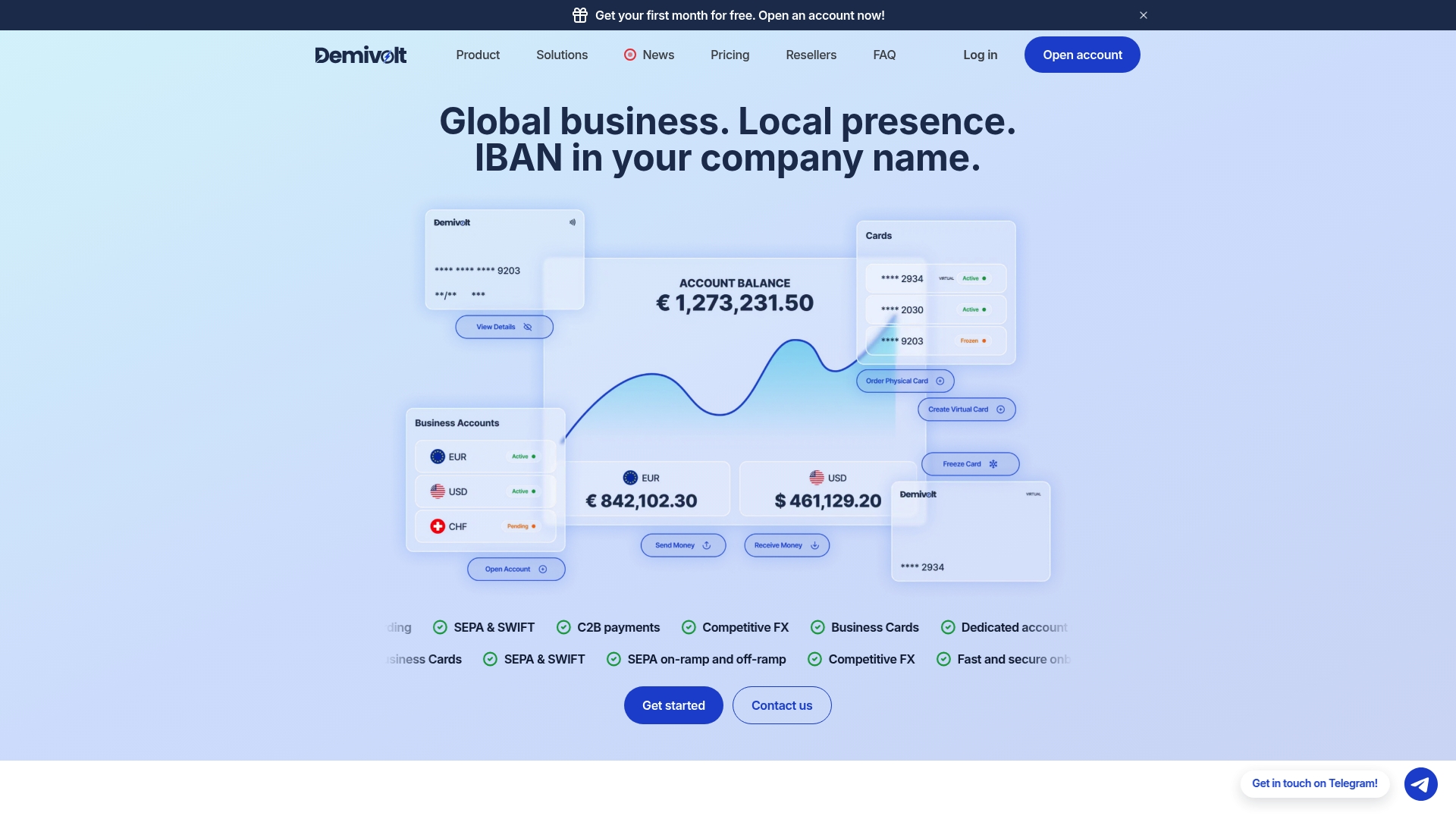
Demivolt gives businesses direct access to euro payment rails without the regulatory overhead of direct PSP membership. For finance teams that need to move quickly, the platform provides dedicated IBAN accounts, SEPA and SWIFT payment processing, and compliance infrastructure built for non-EEA entities operating in European markets.
Relevant capabilities for SCT Inst adoption:
- Dedicated IBAN accounts: Your business holds a named IBAN, enabling you to send and receive instant SEPA transfers in your own name rather than through a pooled account.
- SEPA payment processing: Inbound and outbound SCT Inst transfers processed through regulated infrastructure, with reconciliation data accessible via dashboard or API.
- IBAN validation: Pre-validate beneficiary IBANs before payment submission using Demivolt’s free IBAN validator, reducing VoP mismatches and rejection rates.
- Compliance support: Onboarding designed for non-EEA entities, with KYC and AML controls built into the account setup process.
- Multi-account structures: Manage separate euro accounts for different business units or payment flows, with role-based access controls for treasury and finance teams.
To get started, open a business account at Demivolt or explore the full suite of SEPA tools available to Demivolt clients. Account setup is designed to be fast, transparent, and compliant with EU regulatory standards from day one.
This article is general information, not a substitute for advice from a qualified financial advisor. Consult a qualified financial professional about your own circumstances before acting on anything here.
Sources
The following official sources were used in preparing this article and are recommended for verification and deeper reading:
- What are instant payments? (ECB explainer)
- How can I send a payment from my bank instantly to another bank | Central Bank of Ireland
Recommended
- Demivolt | Blog – SEPA transfer best practices for SMEs: faster, safer payments
- Demivolt | Blog – SEPA payments explained: efficient euro transfers for EU businesses
- Demivolt | Blog – SEPA vs SWIFT: Choosing the right payment rails for SMEs
- Demivolt | Blog – SWIFT payment guide: faster transfers for European SMEs