

TL;DR:
- Digital identity in banking verifies users and helps prevent fraud across onboarding and transactions.
- New authentication methods like passkeys and EUDI Wallet enhance security and meet regulatory requirements.
Digital identity in banking is defined as the verified, technology-backed representation of a person or business that banks use to authenticate users, authorize transactions, and meet regulatory obligations. The role of digital identity in banking has expanded far beyond a simple login check. It now forms the backbone of fraud prevention, KYC/AML compliance, and customer onboarding. For SMEs and e-commerce businesses operating across borders, understanding how digital identity works in practice is not optional. It directly affects how fast you open accounts, how well you stay compliant, and how exposed you are to financial fraud.
How does digital identity verification enhance banking security?
Digital identity verification is the first and most critical line of defense against account fraud. When a bank confirms who you are at onboarding and at every subsequent transaction trigger, it creates a binding between a real-world identity and a digital session. That binding is what prevents criminals from slipping through.
The most significant shift in banking security measures right now is the move toward phishing-resistant authentication. The UK National Cyber Security Centre confirms that passkeys are as secure or more secure than traditional multi-factor authentication against credential phishing. That matters because traditional MFA, which combines a password with an SMS code or OTP app, is vulnerable to real-time phishing attacks where criminals relay stolen credentials during live sessions. Passkeys, built on the FIDO2/WebAuthn standard, cryptographically bind authentication to the legitimate service. A stolen credential simply cannot be replayed on a fake site.
Account takeover fraud is the other major threat digital identity addresses directly. The Federal Reserve’s account takeover mitigation toolkit defines account takeover as criminals accessing accounts to change credentials or execute unauthorized withdrawals. Stronger identity binding tied to device context and enrollment history reduces this risk significantly. The key insight is that digital identity programs must cover more than login. They must also govern credential recovery and profile changes, since those are the exact moments attackers exploit.
Here is where most banking security programs fall short:
- Login authentication is protected, but password reset flows still rely on email or SMS.
- Device change workflows often lack step-up verification, creating a backdoor.
- Contact detail updates such as changing a phone number or email are rarely treated as high-risk events.
Pro Tip: When evaluating a banking platform, ask specifically how it handles credential recovery and device changes. A bank that secures login but leaves recovery flows weak has a gap that attackers will find.
The NCSC also notes that phishing resistance depends not just on adopting passkeys but on correctly implementing account recovery. A passkey-protected login with an SMS-based recovery option is only as strong as that SMS link.
What is the compliance role of digital identity for SMEs and e-commerce?
Digital identity is the mechanism through which banks fulfill their legal obligations under KYC, Know Your Business (KYB), and AML/CFT frameworks. These are not optional checks. They are mandatory under international standards and EU law.

FATF Recommendation 10 requires financial institutions to identify and verify customers, including the natural persons who own or control legal entities, at onboarding and at specific transaction triggers. For an SME or e-commerce business, this means your bank must verify not just the company but also its beneficial owners. Digital identity solutions make this process faster and more accurate than paper-based alternatives.
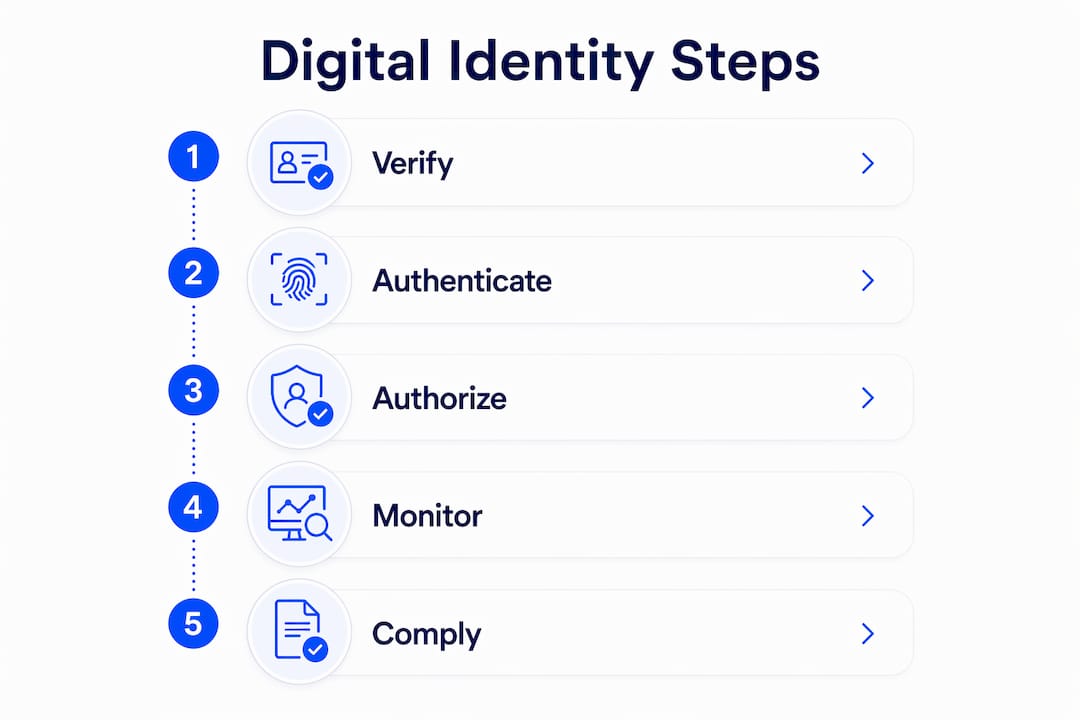
Here is how digital identity streamlines compliance workflows for business customers:
- Automated document verification uses machine learning to check passports, national IDs, and business registration documents in seconds rather than days.
- Biometric liveness checks confirm that the person submitting documents is physically present, blocking spoofing attempts with photos or videos.
- Ongoing monitoring flags changes in ownership structure or transaction behavior that trigger re-verification under AML rules.
- Audit trail generation creates a timestamped record of every verification step, which regulators can inspect during compliance reviews.
The importance of digital identity in finance becomes clearest when you consider the cost of getting compliance wrong. Regulatory fines for AML failures in Europe have reached hundreds of millions of euros in recent years. For an SME, even a minor compliance gap can freeze accounts or delay payments at the worst possible moment. Digital identity verification reduces that exposure by making compliance a built-in process rather than a manual afterthought. Platforms like Demivolt build these checks into compliant onboarding workflows from day one, so businesses do not have to manage compliance separately from their banking operations.
What is the EUDI Wallet and how does it affect banking?
The European Union Digital Identity Wallet, known as the EUDI Wallet, is a government-backed digital credential system that allows EU citizens and businesses to store and share verified identity attributes from their smartphones. It operates under the eIDAS 2.0 regulation and represents the most significant structural change to European banking authentication in a generation.
The deadline is firm. EU banks and regulated financial entities must accept EUDI Wallet credentials for strong user authentication by the end of 2027. This shifts trust from bank-controlled credentials to user-held, regulator-backed credentials. Banks can no longer rely solely on their own internal authentication systems. They must validate assurance from external wallets they do not control.
| Feature | Traditional bank authentication | EUDI Wallet authentication |
|---|---|---|
| Credential control | Bank owns and issues credentials | User holds credentials issued by government trust services |
| Data sharing | Full profile shared at onboarding | Selective disclosure of only required attributes |
| Repeated verification | Required at each new bank or service | Reusable verified attestations across institutions |
| Privacy model | Data stored centrally by bank | Privacy by design, minimal data exposure |
| Regulatory backing | Internal policy | eIDAS 2.0 regulation |
The efficiency gain is substantial. Reuse of verified credential attestations from digital wallets can reduce repetitive identity verification steps in banking onboarding by up to 90%. For an SME opening accounts with multiple banks or payment providers, that means hours of paperwork replaced by a single wallet-based verification.
The privacy model is equally important. The eIDAS 2.0 framework introduces selective attribute disclosure instead of bulk data sharing. A bank verifying your age or business registration number receives only that specific attribute, not your entire identity file. This protects businesses from unnecessary data exposure while still satisfying regulatory requirements.
Pro Tip: If your business operates across multiple EU countries, the EUDI Wallet will eventually let you onboard with banks and payment providers using a single verified credential set. Start tracking which platforms in your stack are building EUDI Wallet compatibility now.
Accepting EUDI Wallet credentials is not a simple feature addition for banks. It requires redefining identity assurance boundaries and governance since credentials are issued and verified by external trust services. Banks must manage assurance levels, liability allocation, and operational controls differently. This is an identity architecture change, not a UI update.
Traditional authentication vs. modern digital identity methods
The gap between traditional and modern authentication is wider than most business leaders realize. Passwords and OTP codes were designed for a threat environment that no longer exists.
| Method | Phishing resistance | User experience | Regulatory fit | Account takeover risk |
|---|---|---|---|---|
| Password only | None | Poor | Insufficient | Very high |
| Password plus SMS OTP | Low | Moderate | Partial | High |
| Password plus authenticator app | Moderate | Moderate | Partial | Moderate |
| Passkeys (FIDO2/WebAuthn) | High | Good | Strong | Low |
| EUDI Wallet credentials | Very high | Excellent | Full (EU) | Very low |
The practical priority for banks in 2026 is phishing-resistant authentication methods like passkeys, which offer stronger protection than most traditional MFA. Passkeys work by generating a cryptographic key pair at enrollment. The private key never leaves the user’s device. The bank only stores the public key. There is nothing to steal from the server side, and nothing to relay during a phishing attack.
Digital identity in banking is also evolving from login credentials to a continuous trust framework that spans onboarding, authentication, step-up controls, and risk management. That integrated approach matters for SMEs because it means your banking platform should be treating identity as a thread running through every interaction, not a one-time check at account opening. Platforms that handle cross-border payment security with this mindset build identity checks into payment authorization flows, not just login.
Key Takeaways
Digital identity in banking is the foundation of secure authentication, fraud prevention, and regulatory compliance, and SMEs that ignore its evolution will face growing security and compliance gaps.
| Point | Details |
|---|---|
| Passkeys beat traditional MFA | FIDO2/WebAuthn passkeys are phishing-resistant; SMS OTP and passwords are not sufficient for modern banking threats. |
| Compliance is identity-driven | FATF Recommendation 10 mandates digital identity verification at onboarding and transaction triggers for all business customers. |
| EUDI Wallet changes everything | EU banks must accept EUDI Wallet credentials by end of 2027, reducing onboarding friction by up to 90%. |
| Recovery flows are the weak link | Phishing resistance fails if credential recovery and device change workflows fall back to weaker authentication methods. |
| Identity is a continuous framework | Effective digital identity programs cover onboarding, login, step-up controls, and ongoing risk monitoring, not just initial verification. |
Why I think most SMEs are dangerously behind on digital identity
Most business leaders I speak with treat banking identity as a solved problem. They set up their accounts, passed KYC, and moved on. That mindset made sense five years ago. It does not make sense now.
The threat model has changed. Attackers are not trying to brute-force passwords anymore. They are running real-time phishing kits that intercept OTP codes mid-session. They are calling bank support lines and using social engineering to trigger credential resets. They are targeting the gaps that most businesses never think about, specifically the moments when identity is weakest: password recovery, device changes, and contact detail updates.
The EUDI Wallet deadline is also closer than it feels. End of 2027 sounds distant, but banks need to rebuild identity governance architectures to accept external credentials. That work takes time. SMEs that bank with platforms already building toward eIDAS 2.0 compliance will have a smoother transition. Those that do not will face rushed re-onboarding processes at the worst possible time.
My honest advice is to treat digital identity as a strategic input to your banking decisions, not a technical detail. When you evaluate a banking platform, ask how it handles passkey authentication, how it manages credential recovery, and whether it has a roadmap for EUDI Wallet acceptance. Those questions separate platforms that are building for the next five years from those that are patching the last five.
— dd
How Demivolt approaches digital identity and secure banking
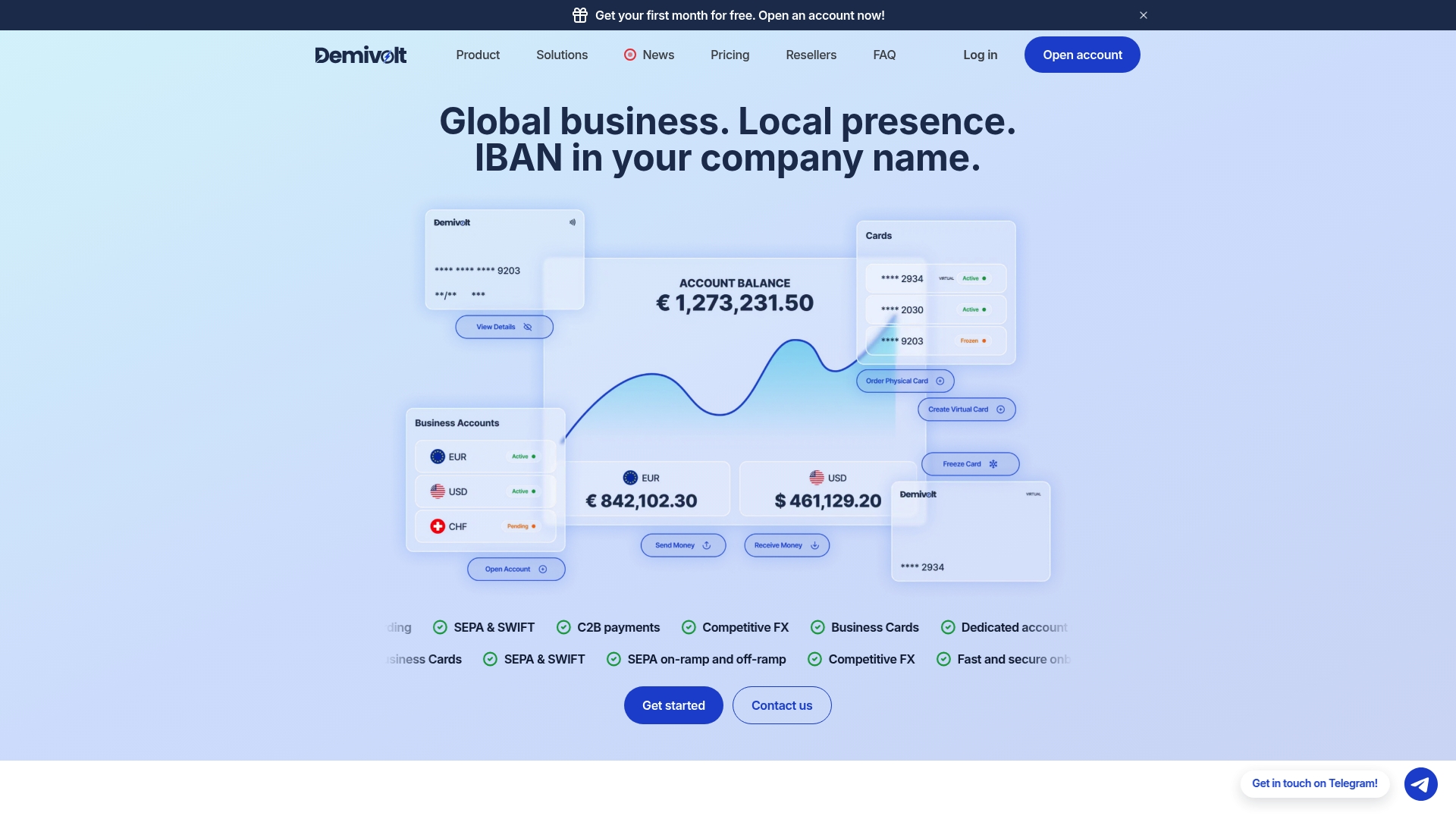
Demivolt is built for businesses that cannot afford compliance gaps or identity-related fraud. The platform’s onboarding process meets EU regulatory standards from day one, with identity verification built into account setup rather than bolted on afterward. For SMEs and e-commerce businesses managing cross-border payments, that means faster account activation and a clear audit trail for every verification step.
Demivolt’s free IBAN validator tool supports secure transaction workflows by confirming account number validity before payments are sent, reducing misdirected payment risk. The broader SEPA tools suite supports compliant payment operations across EU markets. If your business needs a banking platform that treats identity governance as infrastructure rather than an afterthought, explore what Demivolt offers for business banking built around compliance and security.
FAQ
What is the role of digital identity in banking?
Digital identity in banking is the verified representation of a user or business that banks use to authenticate access, authorize transactions, and fulfill KYC/AML obligations. It spans onboarding, login, step-up authentication, and ongoing risk monitoring.
How do passkeys improve banking security?
Passkeys use FIDO2/WebAuthn cryptography to bind authentication to a specific device and service, making credential phishing impossible. The UK National Cyber Security Centre recommends passkeys over traditional MFA wherever possible.
What is the EUDI Wallet and when must banks accept it?
The EUDI Wallet is an EU government-backed digital credential system under eIDAS 2.0. EU banks must accept EUDI Wallet credentials for strong user authentication by the end of 2027.
Why does digital identity matter for SME compliance?
FATF Recommendation 10 requires banks to verify the identity of business customers and their beneficial owners at onboarding and at specific transaction triggers. Digital identity verification automates this process and creates the audit trail regulators require.
How does digital identity reduce account takeover fraud?
Effective digital identity programs bind authentication to device context and enrollment history, and they apply step-up verification to high-risk actions like credential recovery and contact detail changes, which are the primary vectors for account takeover attacks.