

Monthly maintenance fees, per-transfer charges, card costs, and cash handling together determine almost all of a business account’s monthly cost, so compare those four items first on any pricelist. Expect a modest fixed fee (often single digits to around twenty euros a month), with the real cost gap opening up in transfer allowances, SWIFT charges, and card fees. Before signing up anywhere, line up each provider’s pricelist and check those same line items side by side.
TL;DR:
- The total cost of a business account depends heavily on transfer allowances, SWIFT charges, and card fees, which vary significantly between providers.
- Tiered plans typically start around 4.5 to 18 euros per month, with larger allowances and multiple cards available at higher tiers, suitable for different transaction volumes.
- Calculating your true monthly expense requires factoring in overage transfer fees, SWIFT costs, card maintenance, cash handling, and potential hidden charges like foreign exchange spreads.
- Building a transaction history-based spreadsheet helps compare providers accurately, as low headline fees often hide costly per-transaction or cross-border charges.
- Transparent, detailed pricelists enable better cost modeling, especially for cross-border businesses, and should be prioritized over simple headline fee comparisons.
DemivoltCompare Business Banking Costs ClearlyDemivolt brings accounts, SEPA and SWIFT payments, and business cards together for clearer financial control across operations.Explore Demivolt
Table of Contents
- Verslo Sąskaitos Kainodara: The Fee Components That Add Up
- What Plan Tiers Typically Include
- How to Compare the Total Monthly Cost
- Real-World Cost Examples
- Why Fee Transparency Should Drive Your Decision
- How Demivolt Approaches Business Account Pricing
- Sources
- FAQ
Verslo Sąskaitos Kainodara: The Fee Components That Add Up
Every business account price sheet breaks down into a handful of recurring charges. Understanding each one, and how providers trade them off against each other, is the difference between picking an account that fits your transaction pattern and paying for allowances you never use.
Monthly account maintenance fee. This is the base subscription cost tied to a plan tier. Lower tiers usually carry a smaller fixed fee but fewer included transfers and cards; higher tiers cost more upfront but bundle in enough allowances that heavy users come out ahead. SEB’s business plan pages list monthly fees starting around 4.5 euros for entry-level plans, scaling up as included services grow.
Transaction fees for SEPA, instant, and internal transfers. Most plans include a set number of free domestic SEPA transfers each month, then charge per transfer above that. Instant SEPA transfers typically cost more than standard same-day SEPA, since the receiving bank has to process them immediately rather than in a batch.
Incoming and outgoing wire (SWIFT) fees. International transfers outside the SEPA zone almost always cost more than SEPA transfers, and outgoing SWIFT fees are usually higher than incoming ones. If your business pays overseas suppliers or receives payments from clients outside the euro area, this line item deserves close attention.
Card issuance and maintenance. Physical cards often carry a one-time issuance fee plus an annual or monthly maintenance charge; virtual cards are frequently cheaper or free to issue. Watch for foreign exchange markups and ATM withdrawal surcharges, which rarely show up in the headline plan price.
Cash handling. Depositing or withdrawing cash through a branch or partner network usually triggers a percentage-based fee, sometimes with a minimum charge per transaction. This is one of the biggest cost surprises for businesses that still handle physical cash regularly.
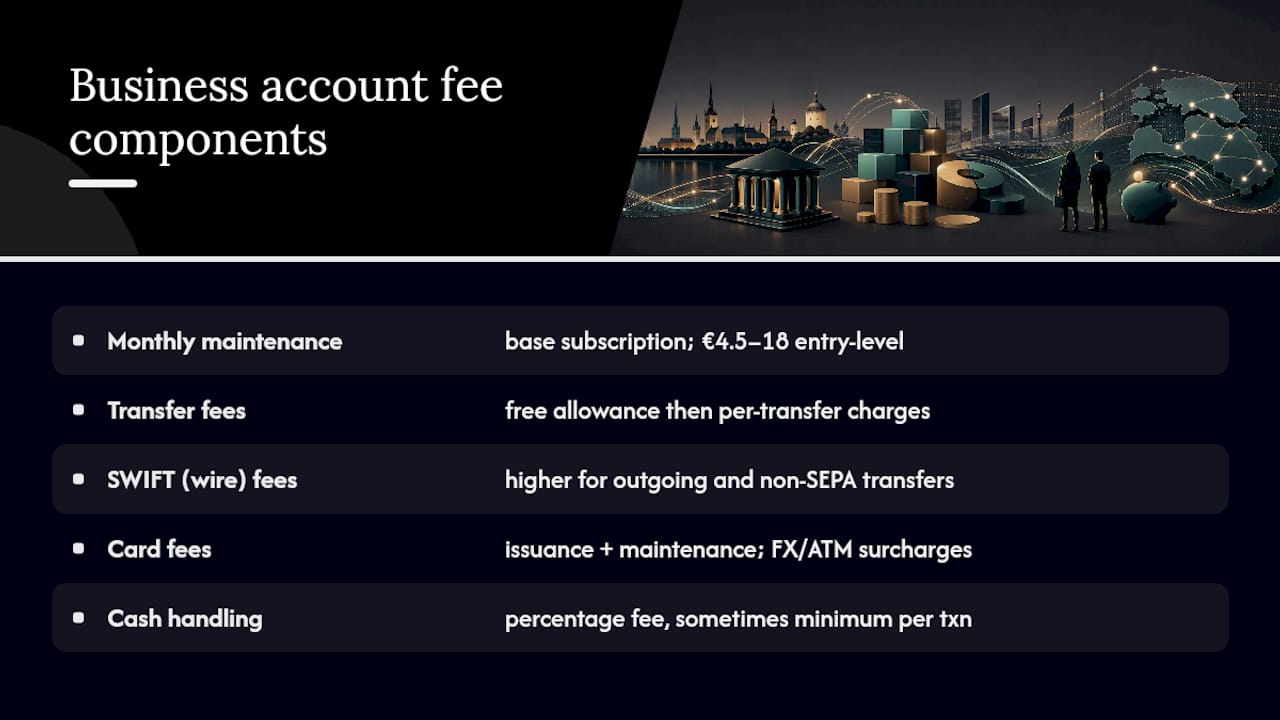
Account statements and reporting. Online statements are typically free, but paper statements and branch-printed extracts can run from roughly one to twelve euros, depending on the period covered.
Occasional charges. These include overdraft interest, dormant-account fees, and, less commonly, charges on very large balances. Luminor’s pricelist notes fees on balances above certain thresholds tied to policy interest rates. When the European Central Bank’s key rates shift, some banks pass that cost through on large deposits, which is worth knowing if your business tends to hold significant cash reserves.
Fee snapshot: Entry-level business plans in the Baltic market commonly start around 4.5 to 18 euros a month depending on included transfer counts, according to SEB’s and Luminor’s published pricelists.
What Plan Tiers Typically Include
Business account pricing almost always follows a tiered structure, whether you’re looking at a traditional bank or a digital-first provider. Recognizing the pattern helps you skip straight to the tier that matches your actual activity.
- Entry or basic plan. Low fixed monthly fee, a small number of free transfers (often in the single digits to low teens), and usually one card included. This suits freelancers and very small operations with light transaction volume.
- Growth or standard plan. A moderate monthly fee with a meaningfully larger transfer allowance and typically two or more cards. This tier fits SMEs processing regular client payments and payroll.
- Premium or business-plus plan. Higher fixed fee but generous or near-unlimited transfer allowances, multiple cards, and sometimes preferential SWIFT rates. Makes sense for businesses running high transaction volumes where per-item fees would otherwise stack up fast.
- Enterprise or custom plan. Negotiated pricing based on projected volume, often available once a business demonstrates consistent activity or holds a larger balance. Worth requesting once your monthly transfer count regularly exceeds what a premium tier includes.
Introductory first-year discounts are common but usually reserved for newly registered companies or accounts that meet a minimum deposit condition, so check the eligibility fine print before assuming you qualify. A bundled monthly plan beats pay-as-you-go pricing once your transfer count consistently exceeds the free allowance. If a basic plan includes ten free transfers and charges 0.50 euros per extra transfer, doing thirty transfers a month means twenty extra transfers, or 10 euros in overage fees. At that point, upgrading to a plan with a higher fixed fee but a larger allowance often costs less overall.
How to Compare the Total Monthly Cost
A pricelist with a low headline fee can still be the more expensive option once you add up how you actually use the account; understanding the details is key in what trading fees mean for your overall costs. Building an honest monthly estimate takes five inputs and a bit of arithmetic.
Start by gathering your own numbers:
- Average monthly SEPA and instant transfers, split by type
- Cash deposit and withdrawal volume, if any
- Number of physical and virtual cards needed
- Expected SWIFT transfers per month, incoming and outgoing
- Typical account balance, in case large-balance fees apply
Once you have those figures, the calculation is simple: take the plan’s fixed monthly fee, add per-transfer charges for anything above your free allowance, add card fees, add estimated cash handling costs, and add expected SWIFT fees. That total is your real monthly cost, not the number printed at the top of the pricelist.
Hidden costs tend to hide in three places: foreign exchange spreads on card payments, third-party ATM fees the provider doesn’t control, and charges triggered by “flagged activity” reviews on large or unusual transfers. When a pricelist is ambiguous, ask the provider directly: what counts as an instant transfer versus standard SEPA, is there a currency markup on card payments, and does the free transfer allowance reset monthly or roll over.
Pro Tip: Build a simple spreadsheet with your actual transaction history from the last three months, then plug those exact numbers into two or three providers’ pricelists side by side. The plan that looks cheapest on paper often isn’t the cheapest once your real volume is applied.
Real-World Cost Examples
Numbers make pricing structures concrete. Here are two typical business profiles, worked through using published plan structures.
- Freelancer, low volume. A single-card account with eight incoming SEPA payments and five outgoing transfers a month fits comfortably inside an entry-level plan. At a fixed fee of roughly 4.5 to 7 euros, with all transfers inside the free allowance, the monthly total lands close to the base plan price, plus a few euros if a paper statement is requested.
- Growing SME, moderate volume. A business making around 100 transfers a month, running two cards, and sending two SWIFT payments to suppliers each month needs a growth-tier plan. If the plan costs around 18 euros and includes 80 free transfers, the extra 20 transfers at roughly 0.50 euros each add 10 euros, and two SWIFT transfers at an estimated 15 to 25 euros each add another 30 to 50 euros. Total: somewhere between 58 and 78 euros a month.
The arithmetic is always the same: monthly fee, plus overage transfers, plus wire fees, plus card fees, equals your total. Add regular cash deposits and that total climbs fast, since cash handling fees are usually charged as a percentage rather than a flat rate. A business that shifts from two SWIFT payments a month to ten will see that cost line become the largest single item on the bill, often outweighing the base plan fee entirely.
Why Fee Transparency Should Drive Your Decision
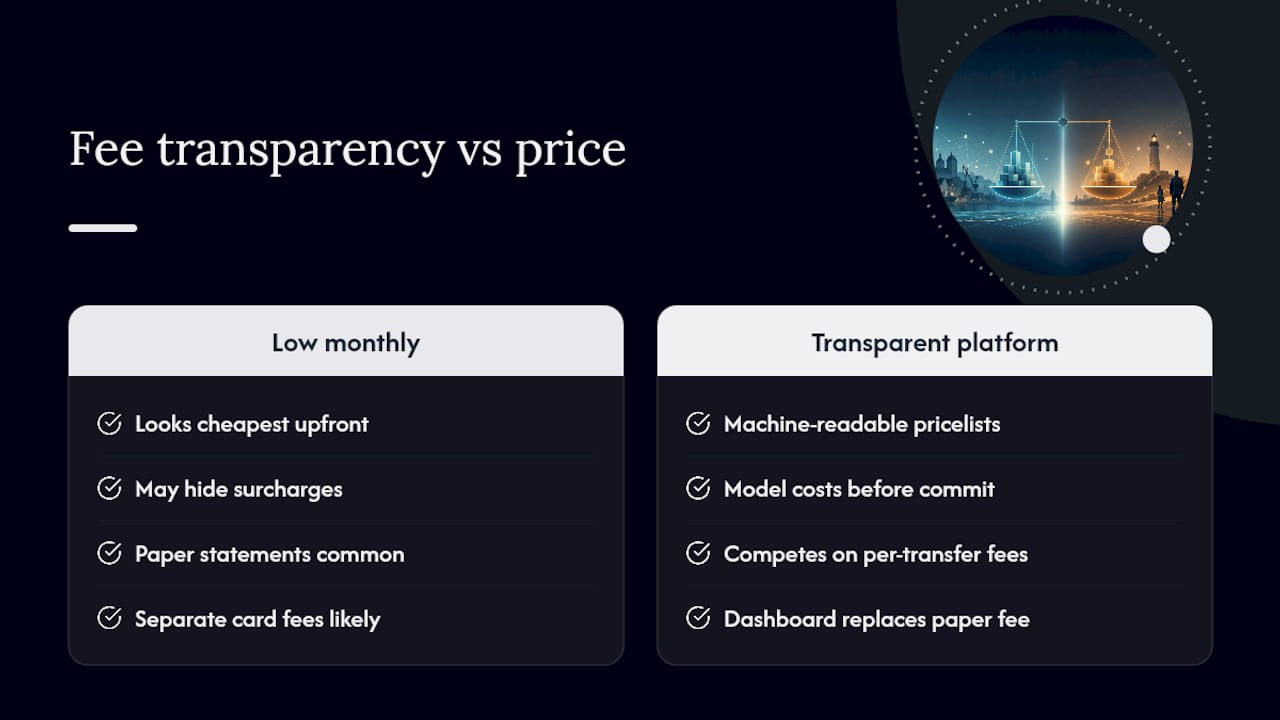
Transparent, machine-readable pricelists matter more than they get credit for. A pricelist you can actually parse, line by line, lets you model costs before you commit rather than discovering surcharges on your first statement.
Digital-first providers tend to compete hardest on per-transfer fees and reporting clarity, which is why an integrated card and payments setup can justify a slightly higher monthly fee if it removes several smaller charges elsewhere. When a single dashboard replaces a paper statement fee, a separate card provider fee, and a manual reconciliation process, the math often favors the platform with the higher sticker price. Readers weighing that trade-off should look at how online-first business banking changes the cost equation before assuming the cheapest monthly fee wins.
— dd
How Demivolt Approaches Business Account Pricing
Some providers give a clearer starting point than a traditional bank’s paper pricelist by offering dedicated IBAN accounts with transparent per-transaction fees, support for both SEPA and SWIFT payment rails, and the ability to run multiple accounts under one login instead of juggling separate relationships for each currency or entity.
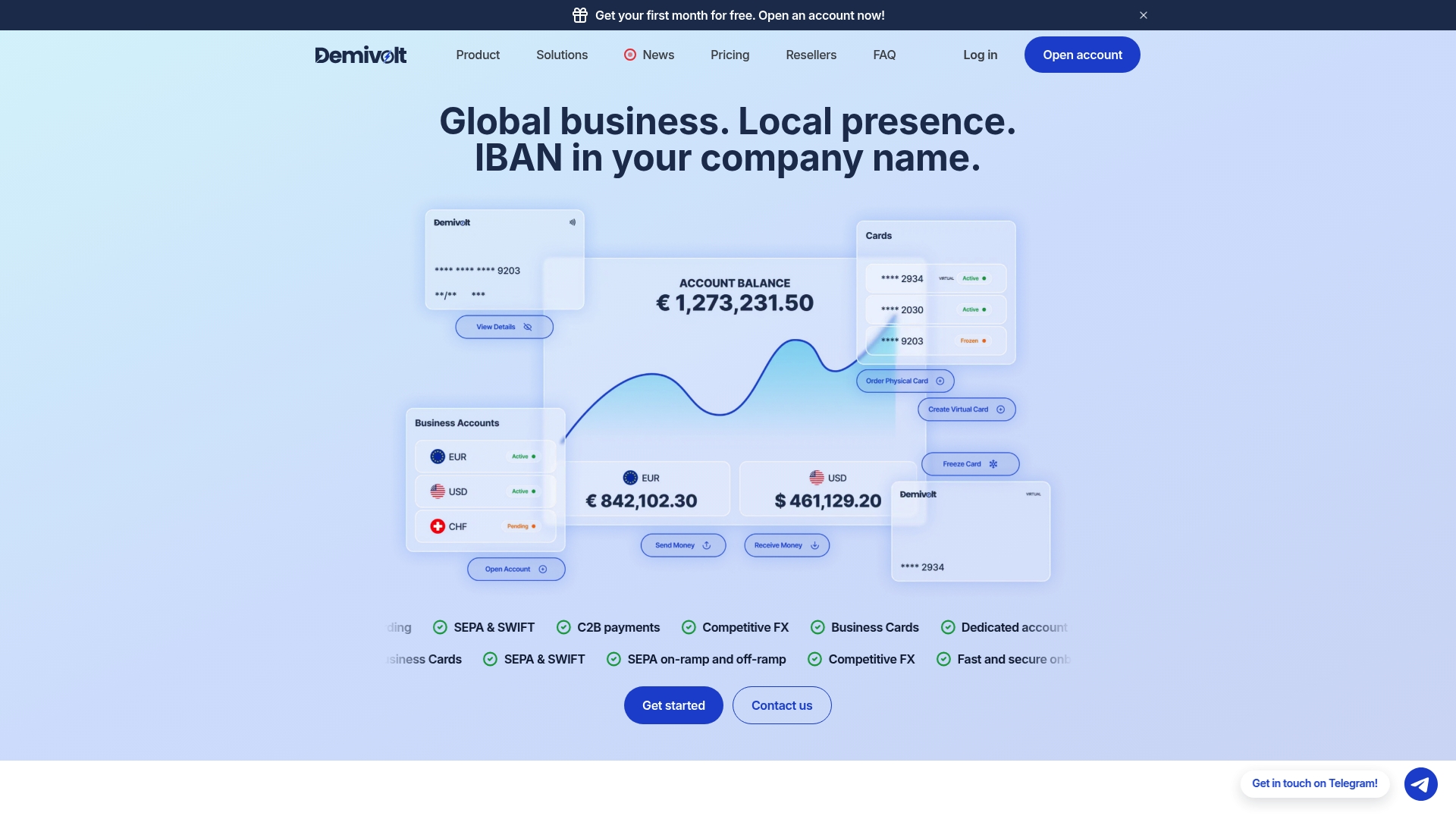
That structure matters most for businesses running cross-border operations, where a single unclear SWIFT fee or FX markup can quietly erase the savings from a low monthly plan. Demivolt’s multi-account setup lets finance teams separate operating funds, supplier payments, and reserves without opening accounts at multiple institutions, each with its own fee schedule to track. Role-based access also means transfer approval can be delegated without handing over full account control.
Before sending your next international payment, run the receiving account through the free IBAN validator to catch formatting errors that cause failed transfers and rejection fees. If you’re still mapping out how IBAN structure affects routing and cost, the IBAN explainer breaks down what each segment of the number actually does. Start by opening a Demivolt account and compare the real pricelist against whatever you’re paying today.
Sources
FAQ
What Is the Average Monthly Fee for a Business Account?
Entry-level plans typically start around 4.5 to 7 euros a month, while growth and premium tiers with larger transfer allowances run higher, based on SEB’s published plan pricing.
Are SWIFT Transfers More Expensive Than SEPA?
Yes. SWIFT transfers for payments outside the SEPA zone typically cost more per transaction than standard SEPA transfers, and outgoing SWIFT fees usually exceed incoming ones.
Do Business Accounts Charge for Cash Deposits?
Most providers charge a percentage-based fee on cash deposits and withdrawals, which is why businesses with heavy cash handling should compare this line item closely rather than focusing only on the monthly fee.
Can I Get a Free Business Account for the First Year?
Some providers offer first-year fee waivers, but eligibility is usually limited to newly registered companies or accounts meeting a minimum deposit requirement, per SEB’s plan terms.
How Do I Avoid Hidden Business Account Fees?
Ask providers directly about foreign exchange markups, third-party ATM charges, and whether free transfer allowances reset monthly, then confirm the answer against the actual pricelist rather than marketing copy. Tools like a free IBAN validator also help avoid failed-transfer fees caused by formatting errors.