

TL;DR:
- Secure payments protect small and medium-sized enterprises from fraud, chargebacks, and regulatory fines while building client trust. Implementing technologies like encryption, tokenization, and risk-based authentication strengthens defenses without compromising user experience. Ongoing compliance and operational controls are essential for maintaining effective payment security in a rapidly evolving threat landscape.
Secure payments are financial transaction processes that protect sensitive data, prevent fraud, and maintain trust between businesses and their customers. For small and medium-sized enterprises, understanding why secure payments are crucial is not optional. A single breach can trigger chargebacks, regulatory fines, and lasting damage to customer confidence. The good news: technologies like encryption, tokenization, and EMV 3-D Secure 2.3.1 give SMEs real tools to fight back. Standards like PCI DSS 4.0, fully enforced since 2025, set the compliance floor every business must meet.
Why secure payments are crucial: the technical foundations
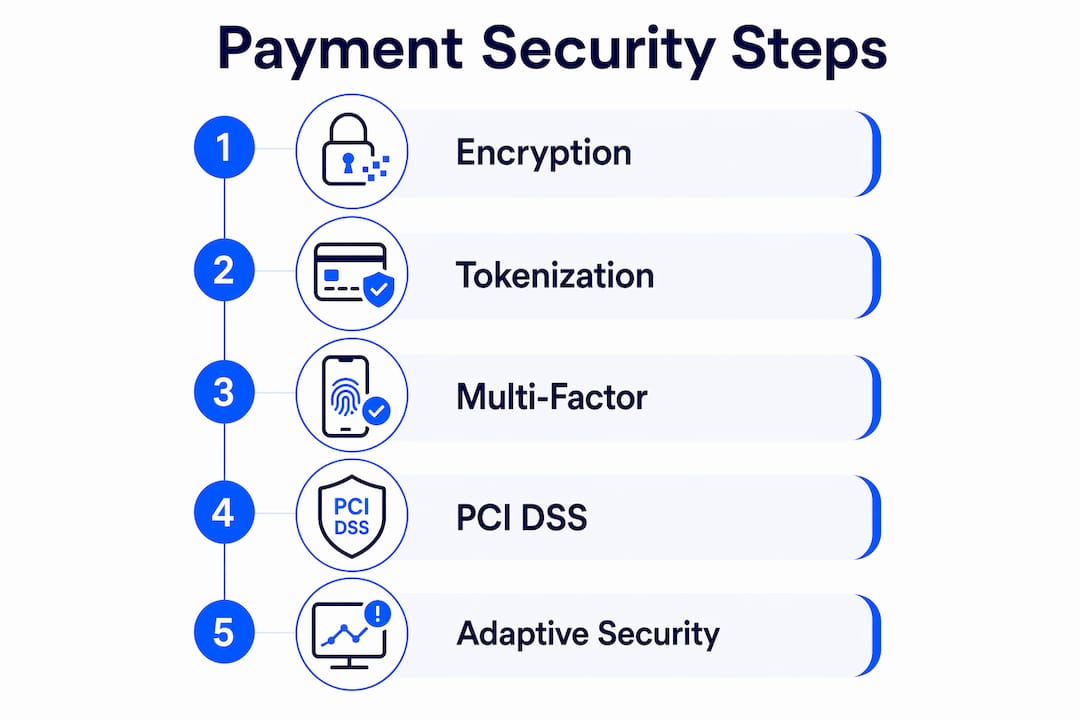
Payment security rests on three core technologies: encryption, tokenization, and multi-factor authentication. Each one addresses a different attack surface, and together they form a defense that no single layer can provide alone.

Encryption converts raw card data into unreadable ciphertext during transmission. Point-to-point encryption (P2PE) and end-to-end encryption (E2EE) both protect data from the moment a customer enters payment details until the transaction settles. Neither format leaves readable card numbers exposed in transit.
Tokenization replaces a card number with a surrogate value called a token. That token is useless to anyone who intercepts it outside the original payment system. Network tokenization reduces fraud by about 30% and increases approval rates by 3–4% compared to raw card numbers, according to Visa. That approval rate gain alone can meaningfully improve monthly revenue for a growing SME.
Multi-factor authentication (MFA) adds a second verification step before a transaction completes. EMV 3-D Secure 2.3.1 takes this further with risk-based customer verification that challenges only suspicious transactions, leaving low-risk purchases frictionless. This is the standard that separates modern payment security from legacy password-only flows.
| Security Feature | What It Does | Key Benefit for SMEs |
|---|---|---|
| P2PE / E2EE Encryption | Encrypts data from point of capture | Eliminates raw card data exposure in transit |
| Network Tokenization | Replaces card numbers with tokens | Reduces fraud by ~30%, lifts approval rates 3–4% |
| EMV 3-D Secure 2.3.1 | Risk-based authentication at checkout | Blocks fraud without adding friction to good customers |
| PCI DSS 4.0 Compliance | Continuous logging, validation, assessments | Reduces fine exposure and breach investigation costs |
PCI DSS 4.0 requires stricter logging, encryption, validation, and regular assessments since its full enforcement in 2025. Businesses that skip quarterly assessments or let logging lapse face significantly higher fines when a breach investigation begins.
Pro Tip: Store tokens, not card numbers. If your payment processor supports network tokenization through Visa or Mastercard, activate it. You reduce your PCI DSS scope and your fraud exposure at the same time.
What are the real risks of insecure payments?
The risks of insecure payments go well beyond a single fraudulent charge. Payment security failures cause chargebacks, refunds, legal exposure, lost customer confidence, and operational disruptions. Each of those outcomes compounds the others.
Chargebacks are particularly damaging for SMEs. A chargeback does not just reverse a sale. It triggers a fee, consumes staff time, and, if your chargeback ratio climbs too high, can result in your merchant account being terminated. Authorized Push Payment (APP) scams add another layer of risk. These scams trick employees into sending money to fraudulent accounts. Combating APP scams requires automated name verification and first-payee cooldown periods, not just encryption.
Customers expect responsible handling of their payment details. Any breach damages long-term trust and revenue. That trust, once broken, rarely returns quickly. A 2023 IBM study found that the average cost of a data breach exceeded $4 million, a figure that would be fatal for most SMEs.
The business benefits of getting security right include:
- Fewer chargebacks: Strong authentication reduces disputed transactions at the source.
- Higher approval rates: Tokenized transactions are recognized as lower risk by card networks, improving authorization.
- Regulatory compliance: Meeting PCI DSS 4.0 and GDPR requirements protects you from fines that can reach millions of euros.
- Customer loyalty: Buyers return to merchants they trust with their financial data.
- Reduced operational disruption: Fewer fraud incidents mean fewer staff hours spent on dispute resolution.
The importance of secure payments is not just about avoiding loss. It is about building the kind of business customers choose to return to.
How do you balance security with a good user experience?
Over-securing a payment flow is a real problem. False declines, where legitimate transactions are rejected because a security system flags them incorrectly, cost merchants an estimated $443 billion globally in 2021 according to Javelin Strategy. That number dwarfs actual fraud losses in many categories. For SMEs, every false decline is a lost sale and a frustrated customer who may not come back.
The solution is adaptive security, not maximum security. Risk-based authentication with selective challenges improves fraud prevention while minimizing user friction. Instead of challenging every transaction, the system scores each one based on device fingerprint, location, purchase history, and transaction size. Only high-risk transactions trigger a verification step.
Passkeys and biometric authentication are replacing SMS one-time passwords as the preferred frictionless MFA method. They are faster, harder to phish, and produce less checkout abandonment than traditional challenge flows.
Payment security requires coordination among security teams, legal, and engineering to balance user experience with protection. That cross-functional ownership is where most SMEs fall short. Security gets treated as an IT problem, not a business-wide responsibility.
| Approach | User Experience Impact | Fraud Prevention Effectiveness |
|---|---|---|
| Challenge-all authentication | High friction, elevated cart abandonment | Moderate, catches volume but misses sophisticated fraud |
| Risk-based adaptive authentication | Low friction for good customers | High, targets actual risk signals |
| No authentication (legacy flows) | Zero friction | Very low, highly vulnerable |
| Passkey / biometric MFA | Near-zero friction | High, resistant to phishing |
Pro Tip: Never implement a challenge-all policy as a shortcut to compliance. It will cost you more in lost conversions than it saves in fraud losses. Use a risk-scoring engine and set challenge thresholds based on your actual fraud data.
For a deeper look at how to coordinate security and compliance across your finance team, the cross-border payment security checklist from Demivolt covers the operational side in practical detail.
How to ensure payment security: steps smes can take now
Knowing how to ensure payment security starts with reducing your attack surface. The less raw card data your systems touch, the less damage a breach can cause. Here is a numbered sequence that reflects current best practice for SMEs in 2026.
-
Activate network tokenization. Work with your payment processor to replace raw card numbers with network tokens issued by Visa or Mastercard. This single step cuts fraud exposure and improves authorization rates.
-
Implement EMV 3-D Secure 2.3.1. Deploy 3DS2 with a risk-based authentication engine. Configure it to challenge only transactions that exceed your risk threshold, not every purchase.
-
Encrypt from point of capture. Use a P2PE or E2EE certified terminal or payment gateway so card data is never readable on your network. This dramatically reduces your PCI DSS scope.
-
Use real-time payment rail controls. If you process payments over FedNow or RTP, configure fraud controls at the rail level. These networks support real-time screening that can stop fraudulent transfers before they settle.
-
Maintain continuous PCI DSS 4.0 compliance. Run quarterly vulnerability assessments, maintain complete transaction logs, and validate your encryption and access controls on a regular schedule. Failing PCI DSS hygiene during an investigation leads to significantly higher fines and business disruption.
-
Add operational controls for APP fraud. Implement name-matching verification on outbound payments and set cooling-off periods for first-time payees. These controls catch social engineering attacks that technical encryption cannot stop.
-
Treat security as an ongoing process. Maintaining security as a continuous process rather than a one-time project is the only way to stay ahead of evolving threats. Schedule monthly security reviews, not annual ones.
For a complete operational framework, Demivolt’s payment security checklist for SMEs walks through each of these steps with specific configuration guidance.
Key takeaways
Secure payments protect SMEs from fraud, chargebacks, regulatory fines, and customer loss, making payment security a core business function, not an IT checkbox.
| Point | Details |
|---|---|
| Tokenization cuts fraud significantly | Network tokenization reduces online fraud by ~30% and lifts approval rates by 3–4%. |
| PCI DSS 4.0 is fully enforced | Quarterly assessments and continuous logging are now mandatory, not optional. |
| Adaptive authentication beats challenge-all | Risk-based MFA stops fraud without creating friction that drives away good customers. |
| APP scams need operational controls | Name verification and first-payee cooldowns stop fraud that encryption alone cannot catch. |
| Security is a continuous process | Monthly reviews and layered defenses outperform one-time compliance projects. |
The uncomfortable truth about payment security for smes
Most SMEs I have worked with treat payment security as a compliance exercise. They check the PCI DSS box, set up SSL, and move on. That mindset is exactly what sophisticated attackers count on.
AI-enabled phishing, social engineering, and malware injection are increasing in complexity every year. The threat landscape in 2026 looks nothing like it did in 2020. Attackers are now using generative AI to craft convincing payment diversion emails that bypass traditional spam filters. A single successful APP scam can drain a small business’s operating account in minutes.
What I have seen work is treating payment security the same way you treat your best customer relationship: with ongoing attention, not a set-it-and-forget-it attitude. Layered defenses and continuous measurement are what separate businesses that recover quickly from those that do not recover at all.
The other thing most SMEs miss is the revenue upside. Security that enables business growth by reducing fraud and false declines is not a cost center. It is a revenue driver. When your tokenized transactions get approved at higher rates and your customers trust you enough to save their payment details, you are compounding loyalty with every transaction.
Cross-functional ownership is the piece that makes it real. When your legal team, finance team, and engineering team all share accountability for payment security outcomes, the gaps close fast. When only IT owns it, the gaps stay open.
— dd
How Demivolt helps smes build secure payment operations
Demivolt is built for SMEs that cannot afford to treat payment security as an afterthought. The platform provides dedicated IBAN accounts, SEPA and SWIFT payment management, and role-based user controls that limit who can authorize outbound transfers. Every account is held in segregated funds, meeting EU regulatory standards from day one.
Two tools worth bookmarking: Demivolt’s free IBAN Validator checks account numbers against ISO 13616 standards before you send a payment, catching errors that lead to misdirected funds. The full SEPA tools suite supports compliant, accurate cross-border transactions. For SMEs ready to move their payment infrastructure to a regulated, digital-first platform, Demivolt’s business banking is the place to start.
FAQ
What is payment security and why does it matter for smes?
Payment security is the set of technologies and processes that protect financial transactions from fraud, data theft, and unauthorized access. For SMEs, a single breach can trigger chargebacks, regulatory fines, and permanent customer loss.
How does tokenization reduce payment fraud?
Tokenization replaces a real card number with a surrogate token that has no value outside the payment system. Visa reports that network tokenization reduces online fraud by approximately 30% compared to raw card number processing.
What is PCI DSS 4.0 and does it apply to my business?
PCI DSS 4.0 is the current payment card industry data security standard, fully enforced since 2025. Any business that stores, processes, or transmits cardholder data must comply, regardless of size.
What are authorized push payment scams and how do i stop them?
APP scams trick employees into sending money to fraudulent accounts by impersonating suppliers or executives. Automated name verification and cooling-off periods for first-time payees are the most effective operational controls against this type of fraud.
How do i balance strong security with a smooth checkout experience?
Use risk-based authentication rather than challenging every transaction. EMV 3-D Secure 2.3.1 with a risk-scoring engine applies friction only to high-risk transactions, keeping the checkout experience fast for legitimate customers.