

A separate project account (atskira projekto sąskaita) can mean two things: a dedicated bank account that holds only the money of one project, or separate accounting entries that make the project’s income and costs easy to tell apart from everything else. In Lithuania, funding programmes often ask for both, and the contract with the funding agency decides which one you need. The safest approach is to do both from day one: open a dedicated account, then tag every entry in your books to the project.
Demivoltdemivolt.comKeep Project Funds Clearly SeparateDemivolt offers business accounts with dedicated IBANs and role-based access, helping businesses maintain a distinct money trail for project funds.Explore business accountsTL;DR
- Separate project accounting is a rule under Lithuanian project financing rules (PAFT, paragraph 151). A dedicated bank account is a separate requirement that depends on the programme and the payment method.
- If you receive an advance, expect to give the agency the number of a bank account opened for project funds, in your company’s name.
- Keep the contract or invoice, the acceptance act and the proof of payment for every project expense.
- Use sub-accounts or project codes in your ledger, and keep shared costs allocated by a documented rule.
- A business account with its own IBAN and role-based access lets you give each project its own money trail. See the Demivolt section below.
Table of Contents
- What “separate project account” means in practice
- When you need a dedicated bank account
- How to separate the books
- Documents that prove a cost was incurred
- Shared costs and several projects at once
- Fixing a mistaken transfer
- A practical setup checklist
- How project accounts work on a Demivolt business account
- Costs on a Demivolt account
- Open a dedicated account for your project
- Our perspective
- FAQ
- Sources
What “separate project account” means in practice
Readers use the phrase for three different things, and mixing them up causes most of the mistakes.
- A separate bank account. A real account with its own IBAN used only for one project’s receipts and payments.
- A separate ledger account or sub-account. An entry structure inside your accounting system that groups the project’s transactions.
- Separate documentation. A project file where each cost is linked to its invoice, acceptance act and payment.
The formal rule sits in the second category. Under paragraph 151 of the PAFT, the project implementer and any partner must keep the project’s financial accounting separate from the general accounting, and project entries must be easy to distinguish from other operations or projects. The training material from Inovacijų agentūra for the “Verslo pradžia” call recommends separate chart-of-accounts sub-accounts or other identifying features.
The bank account is a different question, and the answer depends on how the money reaches you.
When you need a dedicated bank account
A dedicated account is most often tied to advance payments. For an advance under “Verslo pradžia,” the implementer must provide the number of a bank account opened for accounting for project funds, together with documents showing that the account is in the implementer’s name. This follows PAFT paragraph 153 as cited in the Inovacijų agentūra material. The same material states that the maximum advance not yet assessed is 30% of the project funding allocated for implementation (PAFT paragraph 155).

Local action groups (VVG) describe the same logic. One group’s guidance for project implementers says a separate account for support funds has to be opened at a financial institution, and that this requirement does not apply to projects using reimbursement without an advance.
So the working rule is:
| Situation | What to expect |
|---|---|
| Advance payment from the agency | Dedicated project account in the implementer’s name, with proof |
| Reimbursement of costs you already paid | Often no dedicated account is required, but separate accounting still is |
| Programme with its own rules (for example cross-border programmes) | Read the financial guidance: a separate account or sub-account may be listed as eligible |
The ENI CBC financial guidance for Lithuania, for instance, lists a separate bank account or sub-account in euros as eligible, and also calls for a separate accounting system or a suitable accounting code for all project transactions.
Check three things in your grant agreement before you act:
- the payment method (advance, reimbursement, simplified payment or a combination);
- whether the account must be opened before the contract is signed;
- whether bank fees on the project account are eligible costs.
The Kelmė local action group guidelines illustrate why the payment method matters: projects there are paid by reimbursement, simplified payment, or a combination of both, and an advance may be written into the project contract. The same guidelines set a funding ceiling of 28,864.81 EUR, a maximum funded share of 92.5% of eligible expenses and a minimum own contribution of 7.5%. Those figures belong to that one call, so read your own call’s numbers rather than assuming they are universal.
Are bank fees an eligible cost?
Often yes, when the account is opened for the project. The APF reporting rules classify bank fees as eligible under “Other expenses” (category 8) when a separate account is opened for the project. This is one more reason to choose an account with a clear, published fee schedule: you can budget the exact cost and justify it in your report. Always confirm eligibility in your own funding programme’s rules.
How to separate the books
Lithuanian accounting law already gives you the structure to do this. Under Article 8 of the Law on Financial Accounting (FAĮ), every entity except those using simplified accounting must maintain a general ledger. Each register entry must include the date of the operation, the content, the amount and a reference to the accounting document. If you use an accounting information system, each entry also carries a unique number.
The FAĮ treats a general ledger account as a grouping item for information, at the level of detail the entity chooses. That gives you room to create project-level sub-accounts without breaking any rule. A practical setup:
- Create a project code in your accounting software and apply it to every income and expense entry.
- Add sub-accounts for the project’s main cost groups, matching the budget lines in your application.
- Record the funding separately from your own contribution, so you can show the funded share and the own share at any time.
- Link each entry to a document: invoice number, acceptance act, payment order.
- Reconcile monthly the project account balance (or the project ledger balance) with your bank statement.
Timing matters too. The FAĮ requires transactions to be supported by accounting documents and recorded on the day they occur or as soon as possible, no later than the day statements are prepared; cash operations by the last day of the month. Project entries should follow the same discipline, because a late entry is harder to defend during a payment request review.
Documents that prove a cost was incurred
Funding agencies check the paper trail, not only the amount. The APF reporting rules require documents supporting all three conditions for an expense: a signed contract and/or invoice, an acceptance act showing delivery of goods or services, and proof of payment. Reports are submitted as an .xlsx form with copies of supporting documents, organized by expense category and budget line. Information already given in interim reports does not need to be resubmitted in the final financial report, except for the final activity report, which covers the entire implementation period.
The ENI CBC guidance is more detailed about what each line of an expenditure report must show:
- which beneficiary incurred the cost;
- the amount in national currency with the exchange rate and the total eligible amount;
- the budget item number;
- the document number and issue date;
- the supplier’s name and registration date;
- the method of payment.
That guidance also asks for the project number on original invoices. If your suppliers can add the project number or code to each invoice, your reconciliation becomes much easier. An automated invoice processing workflow can help your finance team capture invoice data and match it to project codes before payment.
How long to keep it all
Under Lithuanian rules, accounting documents and registers are kept for 10 years, according to the retention schedule approved by the Chief Archivist of Lithuania, as summarized by a Lithuanian accounting firm. Your grant agreement may require a different or longer period for project files, so read its retention clause and keep whichever period is longer.
Shared costs and several projects at once
Most companies do not run one project in isolation. Salaries, rent, software and management time are shared across projects and normal business. The research on Lithuanian rules gives no single allocation formula for these costs, so the approach has to come from your grant agreement and your own documented method. A defensible method has these elements:
- A written allocation rule, such as hours worked on the project or a share of floor area, approved before the cost is booked.
- The same rule applied consistently to every period and every project.
- The calculation attached to the entry, so a reviewer sees how the amount was reached.
- No double funding. The Kelmė guidelines state that project activities cannot be financed or co-financed from other state, municipal or EU sources, and that activities must be completed by 2028-12-31 for that strategy period. A cost charged to one project cannot be charged to another.
If your accounting data sits in several systems, FAĮ Article 8(5) lets you post the totals from other systems into your registers at least once per quarter, provided the amounts can be substantiated. Treat that as a minimum, not a target: for projects, monthly is safer.
Fixing a mistaken transfer
Money sometimes lands in the wrong account. The Sports Support Fund training material (2021-03-25) describes the correct procedure when funds are mistakenly moved from the project account to the main institutional account: restore the funds between the accounts, write a free-form accounting note explaining the circumstances and reasons, and make corresponding entries in the project’s accounting records. The lesson applies beyond sports funding: correct the movement itself, document why it happened, and keep the project ledger consistent with the bank.

The simplest way to avoid this is access control. Limit who can approve payments from the project account, and set payment limits for people who only need to pay specific suppliers. For the wider picture of payment controls, see our guide on payment risk management for businesses in Lithuania.
A practical setup checklist
Before you sign the project contract:
- Read the payment method clause and the account clause.
- Open the project account if an advance is planned, in your company’s name.
- Prepare the account proof the agency asks for.
- Create the project code and sub-accounts in your ledger.
- Agree on the shared-cost allocation rule.
During the project:
- Pay project costs only from the project account where possible.
- Ask suppliers to include the project number on invoices.
- Collect the acceptance act for each delivery.
- Reconcile the account against the ledger every month.
- Keep a project file with contract, invoice, act and payment proof together.
At reporting time:
- Build the expense summary by category and budget line.
- Attach copies of supporting documents.
- Check that bank fees are reported under the correct category if they are eligible.
- Keep the file for the full retention period.
How project accounts work on a Demivolt business account
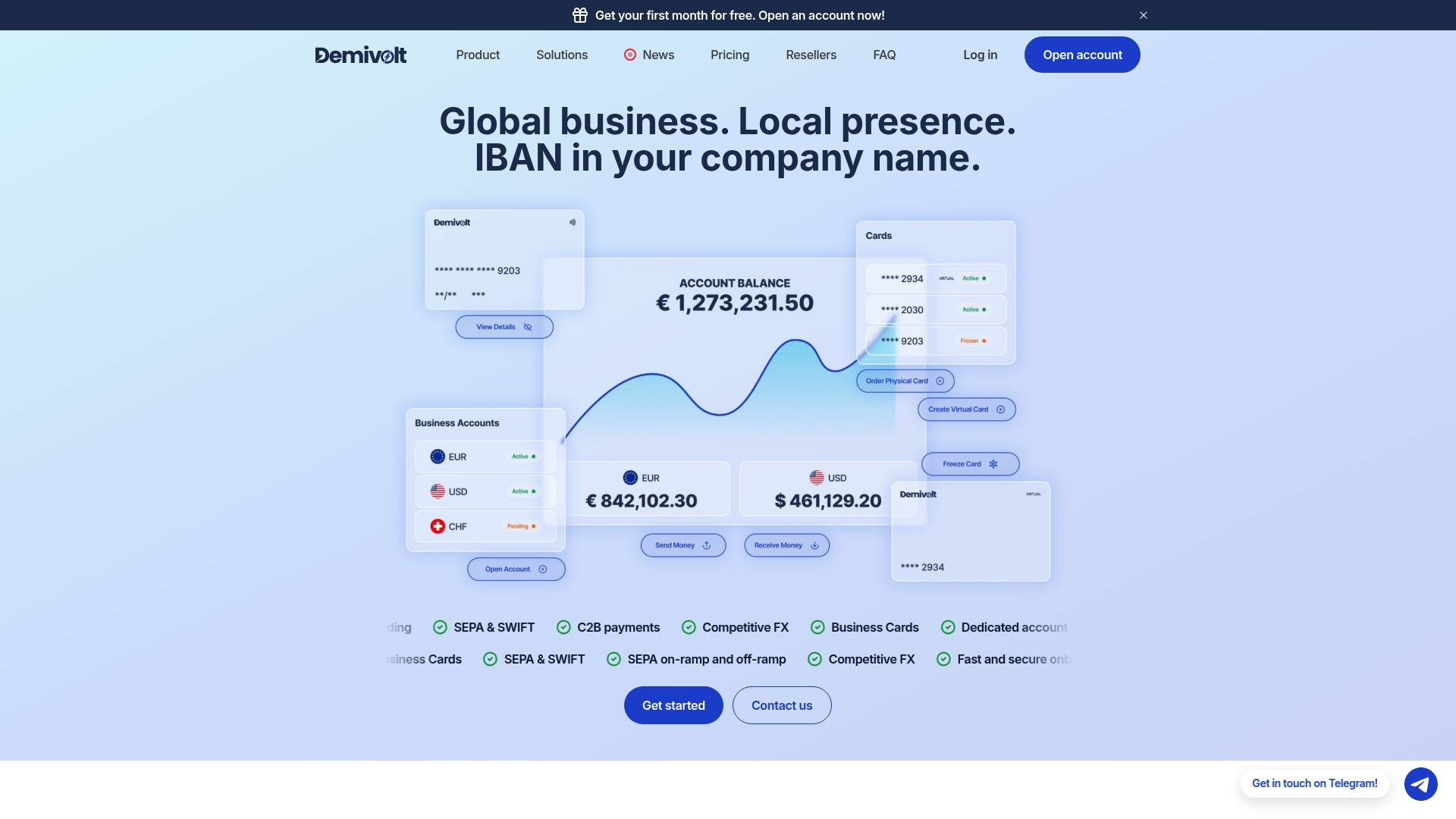
If you manage several projects, clients or funding programmes at the same time, a single mixed account makes the audit trail harder. Demivolt is a regulated European fintech platform whose business accounts support dedicated IBANs and multi-account structures, so each project can have its own account and its own payment history. Role-based user management lets you decide who can view, prepare or approve payments for each account, and client funds are held in segregated accounts. For more on structuring several accounts, read our practical guide to linking business bank accounts in Lithuania.
Another pattern is relevant when a project involves several parties and payments tied to milestones: our article on escrow and split payments for businesses in Lithuania explains how to structure them. If your team pays project suppliers by card, card expense management shows how to keep card spending traceable.
Whether a specific funding agency accepts a particular institution for its project account is set in your own grant agreement, so confirm the account requirements there before you open it.
Costs on a Demivolt account
Predictable fees make budgeting simple, and bank fees can sometimes be reported as eligible project costs. These are the published fees:
| Item | Fee |
|---|---|
| Account opening | 0 |
| Account verification | 0 |
| Dedicated Client Manager | 0 |
| Monthly maintenance | 0 per month |
| Account closure | 0 |
| Transfers between Demivolt accounts | 0 |
| SEPA In | 0 € |
| SEPA Out | 0.40 € per transfer |
| SWIFT In | 25.00 € |
| SWIFT Out | 30.00 € |
You can estimate the cost of your outgoing euro payments with the SEPA fee calculator.
Open a dedicated account for your project
We built our business accounts for companies that need clear control over their money: dedicated IBANs, SEPA and SWIFT payments, virtual and physical Visa business cards, and role-based access. Our onboarding is risk-based, fast and transparent. If you are a consultant or advisor who helps clients with funded projects, the reseller programme lets you refer clients and earn recurring commissions.
To get started, visit Demivolt or contact us, and tell us how many projects you run so we can discuss the right account structure.
Our perspective
Project money is easiest to defend when it has a clear path: it arrives in one place, it leaves from one place, and every payment has a document behind it. We see companies lose weeks at reporting time because the project’s payments were mixed with everyday operating costs.
Our view is that a dedicated account per project is good financial hygiene, even when a funding agency does not demand one. A dedicated IBAN gives you a clean statement for each project. Role-based access means the person who prepares a payment is not always the person who approves it. Segregated client funds and a regulated, EU-compliant setup give finance leaders the transparency that auditors and funding agencies look for.
Transparent pricing supports this approach. When the fee for each SEPA or SWIFT payment is published, you can budget bank costs with the project and report them with confidence. For advisors, the same structure makes onboarding several clients repeatable.
dd
FAQ
Do I always need a separate bank account for a funded project?
Not always. Separate project accounting is required under PAFT paragraph 151, but a dedicated bank account is tied to the payment method. For advances, expect to provide an account opened for project funds. For reimbursement without an advance, some programmes do not require one. Your grant agreement has the final word.
Can I use my main business account and just tag the transactions?
In some programmes, reimbursement-based projects allow it, as long as your ledger separates the project’s entries clearly. Even then, many finance teams prefer a dedicated account because the bank statement becomes a clean record of the project. Read your contract’s account clause first.
Which documents prove an expense for a funding agency?
The APF rules ask for a signed contract and/or invoice, an acceptance act showing delivery, and proof of payment. Reports go in an .xlsx form with copies of the supporting documents, grouped by expense category and budget line. Keep all of it together in one project file.
Are bank fees on the project account reimbursable?
Under the APF reporting rules, bank fees fall under “Other expenses” (category 8) when a separate account is opened for the project. Other programmes set their own rules, so check the eligible-cost list in yours before budgeting the fees.
Sources
- Inovacijų agentūra training material on “Verslo pradžia” payment requests
- Ignalinos rajono VVG: guidance for project implementers
- ENI CBC financial guidance for Lithuania
- Kelmės miesto VVG guidelines, 2026
- Kelmės miesto VVG strategy guidelines, 2023-2029
- APF report preparation and submission rules
- Law on Financial Accounting, Article 8
- Company accounting and document retention in Lithuania
- Sports Support Fund project training slides, 2021
- Invoice processing automation guide