

Managing expenses with cards means moving every employee purchase onto company-issued cards, each with its own owner, limits and documentation rule, instead of personal cards, cash and reimbursements. In Lithuania this works well when you combine four things: a clear card policy, spending controls set per card, receipts that satisfy the tax authority, and a monthly reconciliation routine that ends before the bookkeeping deadline. This guide walks through each step and shows where a regulated business account with card programmes fits.
Demivoltdemivolt.comBring Business Card Spending Into ViewDemivolt offers virtual and physical business cards alongside business accounts, helping companies manage card expenses within their payment setup.Explore DemivoltTL;DR
- Issue each card to a named person with a named approver, and set single-transaction and monthly limits plus merchant-category restrictions.
- Keep payment evidence and a proper expense document for every purchase. Lithuanian tax guidance treats cash-register receipts differently above €100 (and above €150 for fuel).
- Record transactions on the day they occur, or at the latest by the 15th of the following month.
- Reconcile every month, investigate exceptions such as split purchases, and treat recurring, online and foreign-currency payments as their own category.
- Account and card fees should be visible in advance, because they are part of your cost of controlling spend.
Table of Contents
- What card-based expense management covers
- Why cards beat reimbursements and shared cards
- Step 1: Assign cards and approvers
- Step 2: Set limits and merchant restrictions
- Step 3: Make receipts easy and compliant
- Step 4: Record and reconcile on time
- Step 5: Prevent misuse, errors and missing documents
- Business travel on company cards
- Online, recurring and cross-border card spend
- Our perspective: control belongs at the account, not in the spreadsheet
- What the payments underneath cost
- Put it into practice with Demivolt
- A 30-day rollout plan
- FAQ
- Sources
What card-based expense management covers
A card programme is more than a plastic card. It is a repeatable cycle: the company issues a card, the employee pays, the transaction is coded and documented, the approver reviews it, and finance reconciles it against the statement and the ledger. A professional guide to procurement card programs describes the same recurring cycle: transaction coding and documentation, approver review, statement reconciliation and investigation of exceptions.
For a Lithuanian company, the process should answer five questions before the first card is issued:
- Who may hold a card, and for which purposes (software subscriptions, advertising, travel, supplies)?
- What limits apply to each card?
- Who approves, and how fast?
- What document must be attached to each purchase?
- Who reconciles, and by which day of the month?
Write the answers into a short policy of one or two pages. A policy that employees can read in five minutes is followed. A policy that lives in a 30-page handbook is not.
Why cards beat reimbursements and shared cards
Personal cards and cash create three recurring problems: you see the spend only after the employee files a claim, the employee carries your cost on their own balance, and documents arrive late or never. A single shared company card solves the cash-flow issue but removes accountability, because nobody can say who made a given purchase.
Individual company cards fix both. Every transaction carries a name, a limit applies before the payment rather than after, and virtual cards can be created for one vendor or one subscription and closed when the contract ends. Finance sees spend as it happens, not at month-end.
Step 1: Assign cards and approvers
Issue each card to one named individual and designate an approver, as the procurement card guidance recommends. The approver is usually the line manager, not finance, because the manager knows whether the purchase was needed.
A workable structure for a small or mid-sized company:
- Physical cards for employees who pay in person, such as field staff, buyers and travelers.
- Virtual cards for online tools, advertising platforms and subscriptions, ideally one card per vendor.
- Team or project sub-accounts so each budget has its own balance and its own reporting.
- Role-based access, so an employee sees their own card, a manager sees the team, and finance sees everything.
Multi-account structures and role-based user management are the part of a business account that makes this practical. With Demivolt business accounts you can open separate accounts for different purposes and assign roles to users, so permissions follow responsibilities.
Step 2: Set limits and merchant restrictions
Limits turn a policy into a control. Set them when the card is issued, not after the first incident.
| Control | What it does | Typical use |
|---|---|---|
| Single-transaction limit | Declines any one payment above a set amount | Prevents one-off overspend |
| Monthly limit | Caps total spend per card per month | Fixes the budget per person or vendor |
| Merchant-category restriction | Allows or blocks categories such as fuel, travel or entertainment | Keeps the card to its purpose |
| Single-vendor virtual card | Works only for one subscription or supplier | Stops unexpected renewals |
| Card freeze | Pauses the card immediately | Lost card or suspicious activity |
The research behind these controls is simple: single-transaction and monthly limits and merchant-category restrictions are the standard core of a card program. Review limits every quarter. Limits that were right at launch become either too tight (employees start paying personally again) or too loose.
Merchant blocking works by merchant category code, and banks may add their own blocks on top. Our article on merchant blocking and MCC rules explains what a category restriction does and does not catch.
Step 3: Make receipts easy and compliant
In Lithuania the question is not only whether the employee has a receipt, but whether the document is enough to recognize the expense for tax purposes. The State Tax Inspectorate (VMI) sets out the practical thresholds in its guidance on documents supporting expenses:
- An ordinary cash-register receipt supports an expense up to €100 including VAT.
- A fuel receipt supports an expense up to €150 including VAT, and must contain the mandatory details identifying the purchaser.
- Above those amounts, you need an invoice or another full accounting document.
- When the seller issues both a cash-register receipt and an invoice, the expense is recognized on the basis of the invoice. The buyer keeps the receipt as proof of payment, and it does not have to be physically attached.
The last point matters for card users. The card statement shows that a payment happened, but the statement alone is not the expense document. You need both: payment evidence and the document that describes what was bought.
The underlying rule comes from the regulation on accounting documents: transactions between two or more entities must be supported by accounting documents, while other transactions may be supported by accounting or other documents that establish their time, content and amount.
A practical receipt routine
- The employee photographs the receipt or downloads the invoice right after the purchase.
- They attach it to the transaction and add a short purpose note.
- For online services, they make sure the invoice is issued to the company name and company code, not to the individual.
- The approver confirms within a fixed number of days, for example five working days.
Automated matching can shorten this loop. Receipt-capture software that matches documents to card transactions is becoming common; see our news item on AI receipt matching for expenses for one example of where the market is heading.
Step 4: Record and reconcile on time
Lithuanian rules set a clear clock. Under the same accounting documents regulation, transactions must be recorded on the day they occur or as soon as possible, and no later than the 15th of the following month. Companies using simplified accounting may set other deadlines.
That gives you a monthly calendar:
| When | Task | Owner |
|---|---|---|
| Daily or weekly | Employees attach receipts and purpose notes | Cardholder |
| Within 5 working days | Approver reviews and codes the transaction | Line manager |
| Last working day of the month | Chase missing documents | Finance |
| By the 10th of the next month | Reconcile the statement with the ledger | Finance or accountant |
| By the 15th | All transactions recorded | Accountant |
The tenth-day target is our suggestion, not a legal date: it leaves five days of buffer before the legal limit.
The procurement card guidance notes that reconciliation backlogs often become the chronic weak point of a card program, and that software can capture receipts, flag policy exceptions and route approvals. If your accountant is external, give them read access or a scheduled export so they never wait for a spreadsheet.
Step 5: Prevent misuse, errors and missing documents
Most problems with card spend are ordinary: forgotten receipts, personal purchases, duplicated payments and split purchases. Controls that address them:
- Limits and category restrictions stop most policy breaches before the payment is authorized.
- Split-purchase checks: the approver or finance looks for several payments to the same vendor just under a limit. The guidance lists split purchases among the exceptions administrators should investigate.
- A consequence for missing documents: for example, the card is paused after a set number of undocumented transactions.
- Separation of duties: the person who approves a card should not be the person who reconciles it.
- Fast freeze: any cardholder can pause a card at once if it is lost.
Fraud and disputes need their own routine. Our guides on card fraud prevention for businesses in Lithuania and chargeback management cover them in detail. If a payment appears twice on the statement, it is often an authorization hold rather than a double charge, as explained in why the same card payment shows twice.
Business travel on company cards
Travel is where card spend and tax rules meet. VMI’s guidance on business trips says a trip is documented by an order or decision that states its purpose, location, duration and planned expense types. Documents supporting the trip expenses may be issued in the company’s or the traveler’s name.
Two recent changes affect how you budget trips:
- From October 1, 2026, daily allowances are not paid for one-day business trips within Lithuania. For first or last trip days shorter than four hours, 20 percent of the prescribed rate is paid.
- From January 1, 2026, the full prescribed foreign-trip daily allowance is tax-exempt when the employee’s salary reaches €1,902.45, or the applicable hourly rate reaches €11.6325.
A card does not replace the travel order. Create the order first, then issue or fund the card for the trip, and attach tickets, hotel invoices and the order to the same record. For travel-specific limits, our article on five travel card controls lists what finance teams should set.
Online, recurring and cross-border card spend
This is the category most policies forget, and it is often the largest for digital and e-commerce companies.
Subscriptions and advertising. Use one virtual card per vendor, with a monthly limit slightly above the expected invoice. If the vendor raises the price or adds a service, the payment is declined and you see it immediately. Store the invoice in the company’s name each month, not only the first one.
Foreign-currency purchases. The card statement shows the converted amount, but the invoice may be in dollars or pounds. Record both the invoice currency and the amount charged, and let your accountant decide which rate to use for the ledger. Keep the foreign invoice as the supporting document.
Foreign suppliers and VAT. Whether a purchase from abroad carries Lithuanian VAT, foreign VAT or reverse-charge treatment depends on the supplier and the service. Do not leave this to the cardholder: route every foreign invoice to your accountant for treatment.
Tokenized and wallet payments. Cards added to mobile wallets or stored by merchants use tokens rather than card numbers. Our guide on card tokenization for businesses explains what this covers, which helps when you decide whether employees may store company cards in wallets.
Payment risk generally. Card spend is one part of the wider picture described in our article on payment risk management in Lithuania.

Our perspective: control belongs at the account, not in the spreadsheet
We see the same pattern in the companies we onboard. They start with one card and a spreadsheet, and the spreadsheet works until the third or fourth cardholder joins. Then receipts go missing, nobody knows which subscription is billed to which card, and the accountant spends the first week of every month chasing documents.

Our view is that expense control should be built into the account structure from the start. Separate accounts for separate purposes, roles that match responsibilities, and cards issued against those accounts mean the policy is enforced by the infrastructure rather than by reminders. Client funds held in segregated accounts and a regulated, compliance-first onboarding give finance leaders a stable base to build on, especially for cross-border companies that pay in several currencies and to several countries.
We also think pricing should be readable in one table. If you cannot predict what a payment costs, you cannot budget for it, and a control process that hides its own cost is not much of a control.
— dd
What the payments underneath cost
Card spend sits on top of an account, and the account’s transfer fees matter when you fund cards, pay suppliers or receive customer payments. These are the fees Demivolt publishes:
| Item | Fee |
|---|---|
| Account opening | €0 |
| Account verification | €0 |
| Dedicated Client Manager | €0 |
| Monthly maintenance | €0 per month |
| Account closure | €0 |
| Internal transfers between Demivolt accounts | €0 |
| SEPA In | €0 |
| SEPA Out | €0.40 per transfer |
| SWIFT In | €25.00 |
| SWIFT Out | €30.00 |
If you move money between team or project accounts, internal transfers carry no fee. For a planned volume of euro payments, the SEPA fee calculator shows the cost of outgoing transfers.
Put it into practice with Demivolt
Demivolt is a regulated European platform that gives companies dedicated IBAN accounts, SEPA and SWIFT payments, virtual and physical Visa business cards, multi-account structures and role-based user management. For companies that want to run the process above on one platform, the card programmes page describes how cards are issued and organized, and the payments page covers the transfers behind them.
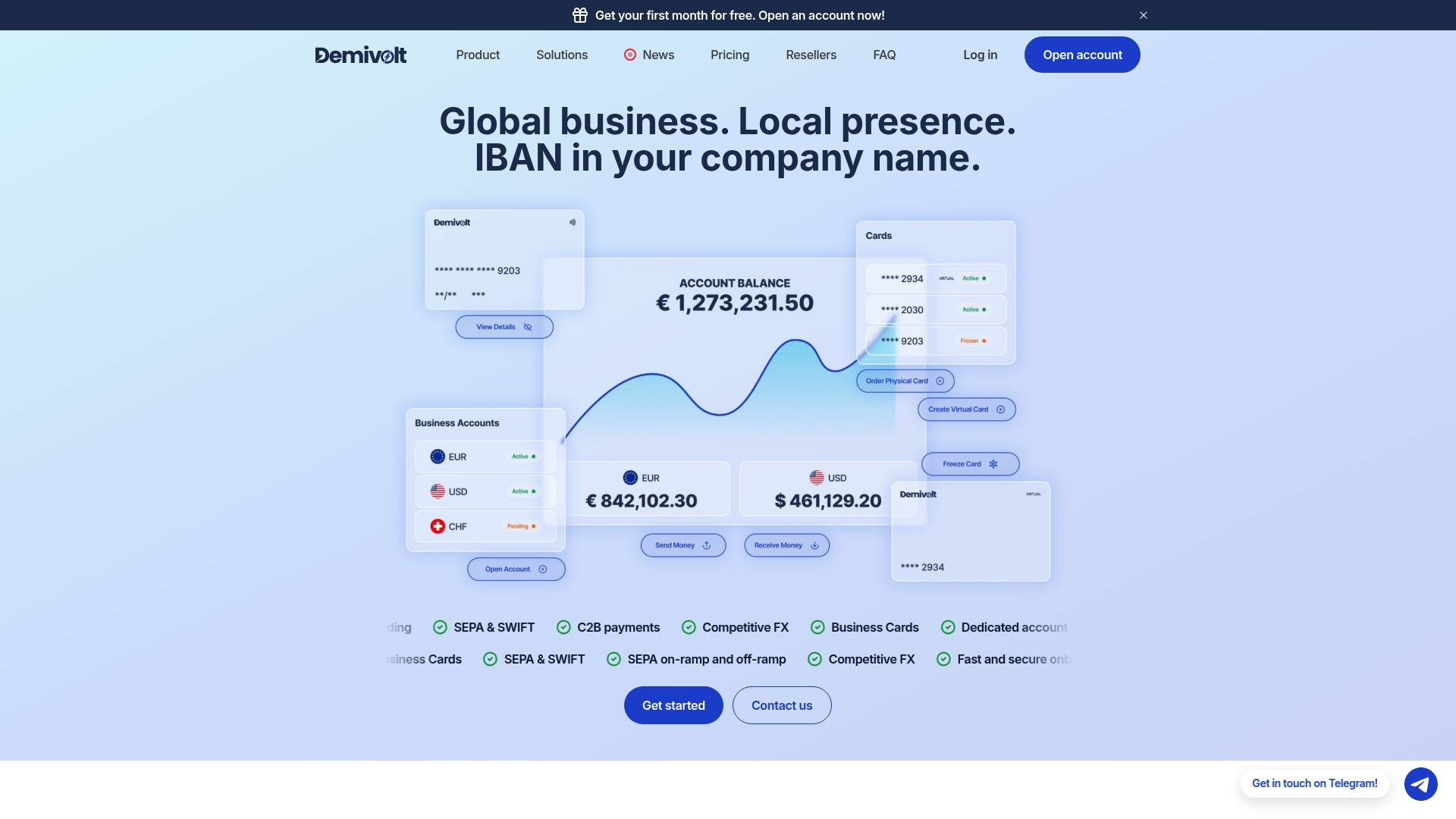
Onboarding is risk-based and designed to be fast, secure and transparent. Opening an account costs nothing, and a dedicated client manager is included at no charge. To start, get started with a Demivolt account or contact us with your expected card volumes, cardholders and countries, and we will help you set up the structure. Advisors and accountants who manage card processes for several clients can also look at our reseller program.
A 30-day rollout plan
- Week 1: write the one-page policy. Decide who may hold a card, the standard limits, and the documentation rule.
- Week 2: open the account structure and assign roles. Issue cards to a pilot group of three to five people, plus one virtual card for your largest subscription.
- Week 3: run the receipt routine. Check how many transactions have documents attached after five working days.
- Week 4: reconcile the first month with your accountant, list exceptions, adjust limits and expand to the remaining cardholders.
Measure two numbers from the start: the share of transactions with a document attached within the deadline, and the number of days from month-end to closed reconciliation. If both improve, the programme works.
FAQ
Do we need an invoice for every card purchase in Lithuania?
Not always. VMI guidance allows an ordinary cash-register receipt to support an expense up to €100 including VAT, and a fuel receipt up to €150 with the required purchaser details. Above those amounts, or when the seller also issues an invoice, the invoice is the expense document and the receipt is kept as proof of payment. Confirm edge cases with your accountant.
How tight should card limits be?
Set them from actual history: the largest normal single purchase and the usual monthly total per person or vendor, with a modest margin. Review them quarterly. If employees often ask for temporary increases, the limit is too low. If they never reach it, it is probably too high.
Are virtual cards better than physical cards for expenses?
For online tools, advertising and subscriptions, virtual cards are usually easier to control, because each can be tied to one vendor and closed when the contract ends. Physical cards suit in-person purchases and travel. Most companies use both.
When must card transactions be recorded in the books?
On the day they occur or as soon as possible, and no later than the 15th of the following month. Companies using simplified accounting may set other deadlines. Build your internal calendar a few days ahead of that date.
Sources
- Procurement Card Program: How to Set One Up and Administer It
- VMI: documents supporting expenses
- Regulation on accounting documents and records (e-Seimas)
- VMI: business trip concept and expense attribution
- VMI: daily allowances for one-day trips from October 1, 2026
- VMI: tax-exempt foreign-trip allowance, 2026