

The fastest, lowest-friction way to get a regulated business account with IBAN, SEPA, SWIFT, and card issuance is to onboard with a regulated European electronic money institution (EMI) like Demivolt rather than pursue a traditional branch relationship. Digital-first EMIs typically approve straightforward applications and issue a dedicated business IBAN within days, not weeks, while keeping client funds segregated under EU-aligned safeguarding rules.
This route works because EMIs are built for remote onboarding and multi-currency accounts, without the branch visits and credit underwriting that slow down conventional banks. Your next step is concrete:
- Gather your core document packet: incorporation certificate, register extract, UBO declarations, and passports for directors and beneficial owners as outlined in this U.S. Business Bank Account Guide for Non-Residents.
- Request a business account evaluation from a regulated EMI such as Demivolt to confirm eligibility before you submit a full application.
- Ask directly whether the IBAN offered is a named corporate IBAN with full SEPA and SWIFT eligibility, not a shared virtual IBAN.
Key Takeaways
Regulated European EMIs give SMEs and fintechs faster IBAN, SEPA, and SWIFT access than traditional banks, with compliance safeguards built into onboarding.
| Point | Details |
|---|---|
| Choose a regulated route | A regulated EMI or fintech offers faster IBAN issuance than a traditional bank branch for most SMEs. |
| Prepare documents early | Company formation papers, UBO declarations, passports, and source-of-funds evidence prevent onboarding delays. |
| Expect variable timelines | Simple profiles can clear in 24 to 48 hours; complex ownership structures may take weeks due to EDD. |
| Confirm rail access directly | Ask whether SEPA and SWIFT connectivity is direct or sponsored before committing to a provider. |
| Test the account after activation | Run inbound transfers, card transactions, and statement checks before relying on the account operationally. |
| Consider Demivolt for speed and compliance | Demivolt issues regulated business IBANs with SEPA, SWIFT, and card issuance under segregated-fund safeguards. |
Table of Contents
- What Are Your Options for Regulated Business Banking?
- How Do You Open the Account, Step by Step?
- How Demivolt Supports Your Onboarding
- Sources
What Are Your Options for Regulated Business Banking?
Three categories cover almost every realistic path for a company that needs an IBAN, payment rails, and card issuance: a regulated European fintech like Demivolt, a broader EU-licensed EMI, or a traditional bank branch. Each serves a different operational reality, and picking the wrong one wastes months.
Demivolt and comparable EMIs both issue business IBANs remotely, but they diverge on card programs, onboarding speed, and how directly they connect to SEPA and SWIFT. Traditional banks still win on lending and treasury depth, but that strength comes at the cost of speed. Non-resident businesses that need an IBAN quickly usually get faster approvals through EMIs than through branch-based banks, which typically require in-person verification and longer underwriting cycles.
| Provider | Best for | IBAN / SEPA | SWIFT / BIC | Card issuance | Onboarding speed & KYC | Regulatory model | Estimated pricing |
|---|---|---|---|---|---|---|---|
| Demivolt | SMEs, e-commerce merchants, fintechs needing compliant multi-currency IBANs and card issuance | Dedicated business IBAN, direct SEPA | SWIFT/BIC connectivity supported | Virtual and physical Visa business cards | Fast digital KYC, days for standard profiles | EU-regulated, segregated client funds | Transparent setup and per-transaction fees |
| EU-licensed EMI (category) | Businesses wanting remote onboarding and multi-currency accounts without bank credit facilities | IBAN issuance, SEPA participation varies by provider | Often indirect/sponsored SWIFT access | Varies; not all issue physical cards | days to a few weeks depending on complexity | EMI license, safeguarded (not insured) funds | Setup and monthly fees vary by provider |
| Traditional bank branch (category) | Companies needing credit facilities, treasury tools, and a local relationship | IBAN and direct SEPA membership | Direct SWIFT membership common | Physical cards standard; virtual less common | Weeks to months, heavier documentation | Full banking license, deposit protection schemes | Higher setup costs, bundled account fees |
The operational gap that trips up most finance teams is direct versus indirect rail access. A bank with its own SWIFT membership settles cross-border payments through its own infrastructure. Direct SEPA participation legally requires an EMI or payment institution license in the EU/EEA, while SWIFT membership demands supervised regulatory status, CSCF security compliance, and a correspondent bank relationship for clearing. An EMI that lacks these can still route payments, but through a sponsor bank, which adds a layer of dependency.
Pro Tip: When a provider claims “IBAN issued,” ask three follow-up questions: is it a named corporate IBAN or a shared virtual one, does it support SEPA Instant Credit Transfer, and does it allow SEPA direct debit collection. The answers separate a functional business account from a limited placeholder.
How Do You Open the Account, Step by Step?
Opening a regulated business account follows a predictable sequence, and knowing the gating factors ahead of time keeps your timeline realistic instead of hopeful.
- Pre-application document pack. Assemble incorporation documents, a recent company register extract, articles of association, UBO declarations, passports for directors and owners, proof of address, and a short business plan describing your transaction profile.
- Formal application and digital KYC. Submit documents through the provider’s portal; most regulated EMIs run identity verification and sanctions screening within the same session.
- Underwriting and enhanced due diligence (EDD). Complex ownership structures, high-risk jurisdictions, or unclear source-of-funds evidence trigger EDD, which extends review.
- Technical onboarding. Once approved, the provider issues your IBAN and configures BIC/SWIFT connectivity for cross-border transfers.
- Card program setup and testing. Virtual cards typically activate immediately; physical card issuance and delivery take longer.
Document requirements track closely with what regulators expect from the provider itself. EBA guidelines direct payment institution and EMI applicants to submit a full programme of operations, business plan, and evidence that directors hold appropriate experience_EN.pdf), scaled to the size and complexity of the business. That same proportionality flows down to you as the applicant business: a simple e-commerce merchant faces a lighter document review than a multi-jurisdiction holding structure.
Realistic timelines vary widely by profile:
- Simple, single-jurisdiction companies: approval timelines can be very short for straightforward EMI applications.
- Layered ownership or multiple UBOs: approval may take significantly longer due to enhanced due diligence processes.
- Direct SWIFT membership: added time, since SWIFT requires proof of a financial operating license, official undertakings, and user-category evidence before granting live messaging access.
- SEPA scheme participation follows its own adherence process, with BIC and IBAN registration handled electronically once eligibility is confirmed.
Once your account activates, run operational tests before relying on it for payroll or supplier payments: a small inbound transfer, a SEPA credit transfer, a SWIFT test message if applicable, a card transaction, a direct debit, and a statement download to confirm fee postings match what you were quoted. Our KYC compliance guide covers what verification teams check at each stage in more detail.
Why regulated EMIs are the pragmatic call for most SMEs

Regulated EMIs strike a workable balance: fast IBAN issuance, real SEPA and SWIFT connectivity, and card programs, without the multi-week credit underwriting a full bank demands. The trade-off is real, too. An EMI issues accounts and cards well but doesn’t extend credit facilities, so plan lending and treasury needs separately from your payments infrastructure.
How Demivolt Supports Your Onboarding
Demivolt gives finance teams a direct path to regulated business banking without the branch visits or drawn-out underwriting that traditional banks require. Where a full-service bank might take weeks to open a simple deposit account, Demivolt is built for founders and CFOs who need IBAN, SEPA, and SWIFT capability live in days, not months.
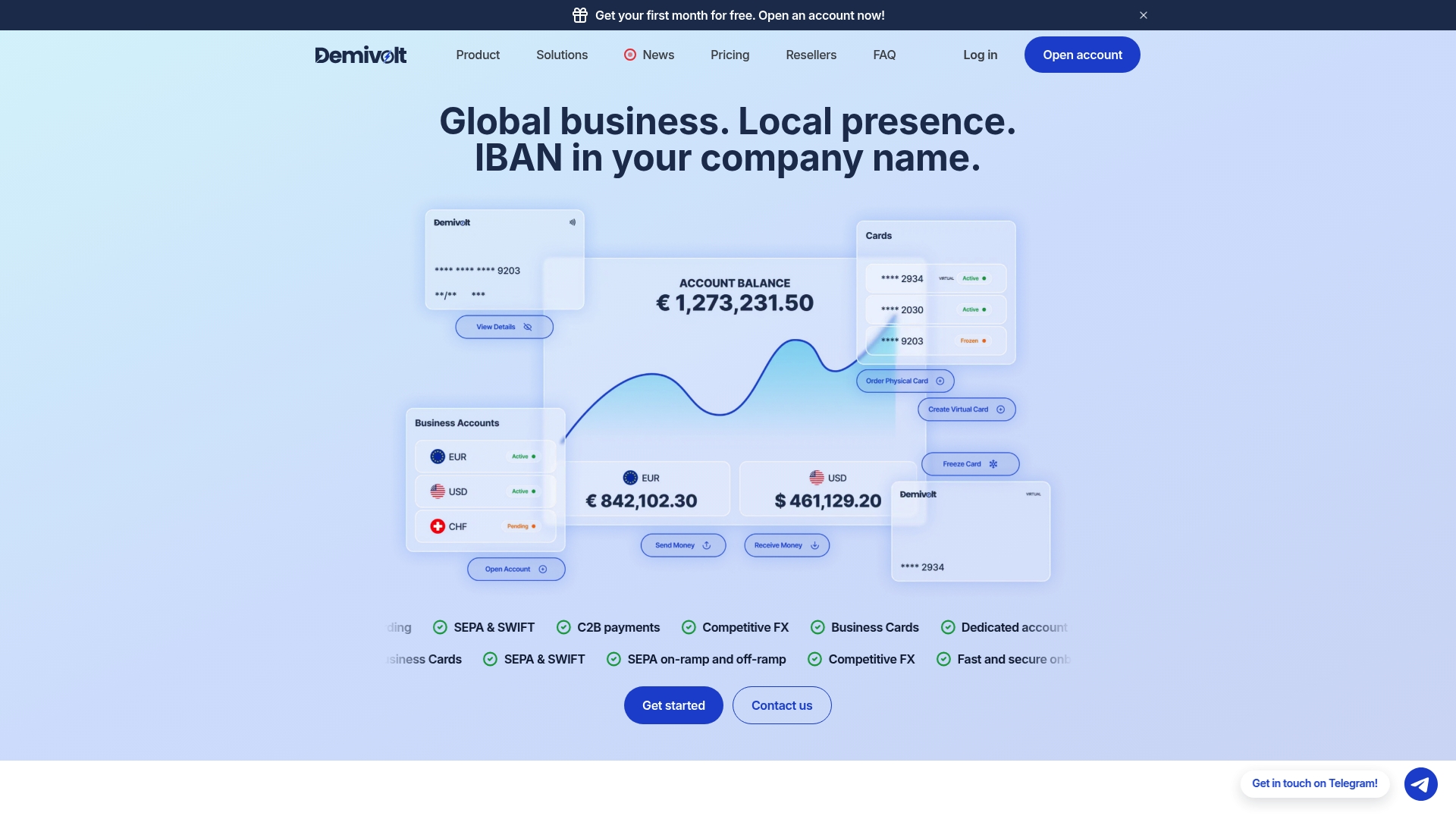
Demivolt issues dedicated business IBANs, processes SEPA and SWIFT payments, and provides virtual and physical Visa business cards under one account. Multi-account structures and role-based user management let finance teams separate operating funds, payroll, and card spend without opening accounts at multiple institutions. Client funds are held in segregated accounts under Demivolt’s regulatory framework, and onboarding runs through a document review and digital KYC process designed to move quickly for straightforward company profiles.
If you’re preparing your document pack now, verify your IBAN format is correct before submitting payment instructions, and start a Demivolt business account evaluation to see how quickly your company can move from application to a live IBAN with active SEPA and SWIFT connectivity.
Sources
Recommended
- Demivolt | Blog – Open a business bank account online in Europe: step-by-step
- Demivolt | Blog – Types of Business Bank Accounts: Find the Right Fit for Your SME
- Demivolt | Blog – How Many Bank Accounts Should a Business Have?
- Demivolt | Blog – IBAN Accounts Explained: Guide for SMEs Managing Cross-Border Payments