

TL;DR:
- Demivolt is a regulated B2B payment platform that supports cross-border operations with IBAN, SEPA, SWIFT, and card issuance. It offers segregated client funds, API access, and multi-account management, making it suitable for EU-focused and complex organizational needs. Its infrastructure balances compliance, control, and ease of integration for US-based international operators.
For US-based B2B finance teams, the strongest revoliqpay.com alternatives are Demivolt (recommended for regulated cross-border infrastructure), Stripe (developer-first payment processing), Wise Business (multi-currency accounts and international transfers), Payoneer (global payouts and marketplace collections), Rapyd (payment orchestration across emerging markets), and Marqeta (card-issuance programs). Demivolt stands out as the recommended pick for operators who need compliant IBAN/SEPA/SWIFT support, segregated client funds, and virtual or physical Visa card issuance under a regulated European fintech framework.
- Regulated banking platforms (Demivolt): dedicated IBANs, SEPA/SWIFT rails, card issuance, segregated accounts
- Developer-first processors (Stripe): ACH, card networks, broad API surface, fast onboarding
- Multi-currency transfer platforms (Wise Business): low-cost FX, local account details, SWIFT corridors
- Global payout platforms (Payoneer): cross-border payroll, marketplace payouts, multi-currency wallets
- Payment orchestrators (Rapyd): emerging-market rails, local payment methods, single API
- Card-issuance specialists (Marqeta): virtual/physical card programs, real-time spend controls
The single most important filter: confirm that any shortlisted provider holds a current regulatory license, maintains segregated client funds, and publishes its API documentation and developer sandbox before you begin procurement. PCI DSS compliance and SEPA/SWIFT rail support are the baseline, not differentiators.
Table of Contents
- How do the top Revoliq Pay alternatives compare side by side?
- How do you pick the right alternative for your business?
- MoR vs payment facilitator vs regulated bank account: which model fits your business?
- Why Demivolt is a strong alternative to Revoliq Pay
- What does payment platform pricing actually cost your business?
- What security and compliance certifications should you require?
- How does platform usability affect finance team operations?
- How fast will funds actually settle?
- What transaction limits and volume caps should you plan for?
- What contract terms should you negotiate before signing?
- Key Takeaways
- Why regulated infrastructure matters more than most operators realize
- Demivolt offers regulated B2B payment infrastructure built for cross-border operations
- Useful sources and vendor pages
How do the top Revoliq Pay alternatives compare side by side?
| Provider category | Best for | Payment rails | Card issuance | Global coverage | Onboarding speed | Compliance/licensing | APIs & integrations | Pricing model |
|---|---|---|---|---|---|---|---|---|
| Regulated banking platform | B2B cross-border, IBANs, card programs | SEPA, SWIFT, ACH, card networks | Virtual + physical, program management | Multi-currency, EU-focused | Moderate KYC, structured | Regulated fintech, segregated funds | Published docs, sandbox | Account + transaction fees |
| Developer-first processor | SaaS, e-commerce, high-volume | ACH, card networks, SEPA | Virtual cards, limited programs | 130+ currencies | Fast, self-serve | PCI DSS, varies by region | Extensive SDKs, webhooks | Per-transaction, interchange-plus |
| Multi-currency transfer platform | Cross-border payroll, FX-sensitive | SWIFT, local rails, ACH | Debit cards (limited) | — | Fast, light KYC | Regulated (EMI license) | API available, limited SDKs | Per-transfer FX margin |
| Global payout platform | Marketplace payouts, freelancer networks | ACH, SWIFT, local rails | Prepaid cards | 200+ countries | Moderate | Regulated, varies by market | API, plugins | Per-transaction + withdrawal fees |
| Payment orchestrator | Emerging markets, local methods | Local rails, card networks | Virtual cards | — | Fast to moderate | Varies by region | Single API, broad integrations | Per-transaction |
| Card-issuance specialist | Fintech card programs, spend controls | Card networks | Virtual + physical, real-time controls | US-focused, expanding | Moderate, program approval | Regulated (BIN sponsorship) | Developer-first API | Interchange-plus, program fees |
Common business profiles and which category fits:
- SaaS vendor with EU subscribers: a regulated banking platform or multi-currency transfer platform covers SEPA collections and local IBANs without requiring a full banking license.
- US B2B with cross-border payroll: a global payout platform or multi-currency transfer platform handles corridor-specific settlement and FX conversion at scale.
- Marketplace needing vendor payouts: a payment orchestrator or global payout platform manages split settlements and local disbursements across multiple markets.
Pro Tip: Watch for reserve and chargeback policies buried in the contract. Some processors hold a percentage of rolling reserves for 90–180 days, which directly affects your working capital. Ask for the reserve policy in writing before signing, and confirm how VAT or sales tax handling is allocated between you and the provider.
How do you pick the right alternative for your business?
Provider selection typically comes down to three constraints: compliance burden, developer resources, and speed to market. Match your primary constraint to the provider category first, then evaluate on secondary criteria.
Prioritized decision checklist:
- Regulatory license and custody: confirm the provider holds a current license (EMI, banking, or equivalent) and maintains segregated client funds
- Supported payment rails: verify SEPA, SWIFT, ACH, and card network coverage for your specific corridors
- Card-program requirements: clarify whether you need virtual cards only, physical issuance, or a full BIN-sponsored program
- Pricing transparency: request a full fee schedule including FX margins, card issuance fees, and monthly account costs
- API documentation and sandbox: published docs and a working sandbox are strong predictors of faster integration
- Settlement timing: confirm T+1 vs T+2 vs same-day settlement windows for each rail
- Onboarding timeline: ask for the median KYC-to-live timeline, not the best-case estimate
- Customer support SLA: request a sample SLA document and confirm escalation paths
Questions to ask vendors during discovery:
- What is your median KYC-to-live timeline for a business of our size and structure?
- Can you share a sample contract with reserve and termination clauses included?
- What is your escalation path and maximum response time for a payment processing failure?
- How do you handle regulatory changes that affect our corridors mid-contract?
- What is the upgrade path if our monthly transaction volume doubles within 12 months?
Red flags to stop the conversation:
- No published API documentation or sandbox access
- Opaque interchange-plus pricing with no itemized fee schedule
- No segregated client accounts or unclear fund custody arrangements
- KYC timelines stated only as “varies” with no median or range
- Termination clauses requiring 90+ days notice with no exit for cause
MoR vs payment facilitator vs regulated bank account: which model fits your business?
The model you choose determines who owns compliance, who holds funds, and how much operational control you retain.

Merchant-of-Record platforms act as the legal seller of record, absorbing VAT, GST, and cross-border invoice settlement on your behalf. That shifts significant accounting overhead off your internal team, which is why businesses with limited international accounting capacity often find the MoR model more cost-effective. The tradeoff is reduced commercial control: the MoR sets checkout terms, manages refunds, and takes a larger revenue share.
Model tradeoffs at a glance:
- MoR: outsources tax and settlement compliance; higher per-transaction cost; limited contract flexibility; best for digital goods sold internationally
- Payment facilitator: fast onboarding, developer-friendly processing, broad card-network coverage; you retain tax liability; chargeback exposure stays with your business
- Regulated banking platform: account-level control, segregated funds, IBAN/SEPA/SWIFT access; compliance tasks remain with the merchant; strongest fit for B2B cross-border payouts and card programs
Enterprise payment platforms commonly advertise acceptance across 200+ markets and support for 130+ currencies, which illustrates the scale gap between a full-service global processor and a corridor-specific banking platform. That scale comes with pricing complexity and onboarding friction that smaller B2B operators rarely need.
Pro Tip: If your primary use case is EU-corridor B2B payouts rather than consumer checkout, a regulated banking platform with native IBAN issuance will typically give you lower per-transfer costs and cleaner reconciliation than a consumer-oriented MoR.
Two use cases that clarify the choice: a SaaS vendor selling EU subscriptions benefits most from an MoR that handles VAT registration across member states automatically. A US B2B operator running large cross-border payouts to European suppliers needs account-level IBAN control and SWIFT access, which points directly to a regulated banking platform.
Why Demivolt is a strong alternative to Revoliq Pay
Demivolt balances regulated infrastructure, multi-rail support (IBAN/SEPA/SWIFT), and card issuance in a single platform, making it a practical choice for US-based B2B operators who need compliant cross-border capabilities without building that infrastructure from scratch.
Core capabilities:
- Dedicated IBAN accounts for inbound and outbound multi-currency settlement
- SEPA and SWIFT payment processing for EU and international corridors
- Virtual and physical Visa business cards with role-based spend controls
- Multi-account structures supporting complex organizational hierarchies
- Role-based user management for finance team access control
- Published API documentation and developer sandbox for integration teams
- White-label Banking-as-a-Service (BaaS) options for platforms and fintechs
Trust signals that matter in vendor due diligence: Demivolt operates as a regulated European fintech, maintains segregated client funds, and publishes its compliance framework and payment compliance resources publicly. Segregated accounts mean your business funds are not commingled with operational capital, a standard that many payment facilitators do not meet.
Two use cases where Demivolt fits well: a fintech launching a regional card program that needs BIN-level controls and virtual card issuance at scale; and an SMB managing multi-currency collections from EU clients that needs local IBANs and clean reconciliation without a full banking license. Onboarding follows a structured KYC process aligned with EU regulatory standards. Integration teams can access API documentation and a sandbox environment before committing to a full deployment.
What does payment platform pricing actually cost your business?
Pricing structures across payment platform alternatives vary considerably, and the fee model differences between flat-rate, per-transaction, and interchange-plus arrangements have a direct impact on your total cost at volume.
Three cost layers to evaluate for any provider:
- Account fees: monthly or annual platform fees, user seat costs, and multi-account charges
- Transaction fees: per-payment percentage or flat fee on card transactions, ACH transfers, SEPA credits, and SWIFT wires
- Card and issuance fees: virtual card creation fees, physical card production and shipping, and monthly card program management fees
Regulated banking platforms typically charge a monthly account fee plus per-transaction fees on outbound payments, with card issuance billed separately. Developer-first processors tend to use a per-transaction model with no monthly fee, which looks attractive at low volumes but becomes expensive at scale. Interchange-plus pricing, where the processor passes through the card network’s interchange rate and adds a fixed margin, is generally the most transparent model for high-volume B2B operators.
FX margin is a cost that many operators undercount. A provider advertising “no transfer fee” may still apply a 0.5%–2% margin on currency conversion, which compounds significantly on large cross-border payouts. Always request the FX rate methodology in writing alongside the published fee schedule.
What security and compliance certifications should you require?
Licensing is the floor, not the ceiling. Beyond a regulatory license, the certifications that matter most for B2B payment operations are PCI DSS, SOC 2, and ISO 27001.
PCI DSS (Payment Card Industry Data Security Standard) is mandatory for any provider that processes, stores, or transmits card data. Confirm the provider’s current PCI DSS compliance level and ask for their Attestation of Compliance (AoC) document. SOC 2 Type II certification demonstrates that a provider’s security controls have been independently audited over a sustained period, not just at a point in time. ISO 27001 covers information security management and is particularly relevant for platforms handling sensitive financial data across multiple jurisdictions.
For US B2B operators with EU counterparties, GDPR compliance is also a contractual requirement. Confirm that the provider acts as a data processor under a signed Data Processing Agreement (DPA) and that data residency terms align with your obligations. Providers that cannot produce a current DPA on request are a procurement red flag.
How does platform usability affect finance team operations?
A payment platform’s usability directly affects how quickly your finance team can onboard, reconcile, and manage exceptions without escalating to technical support.
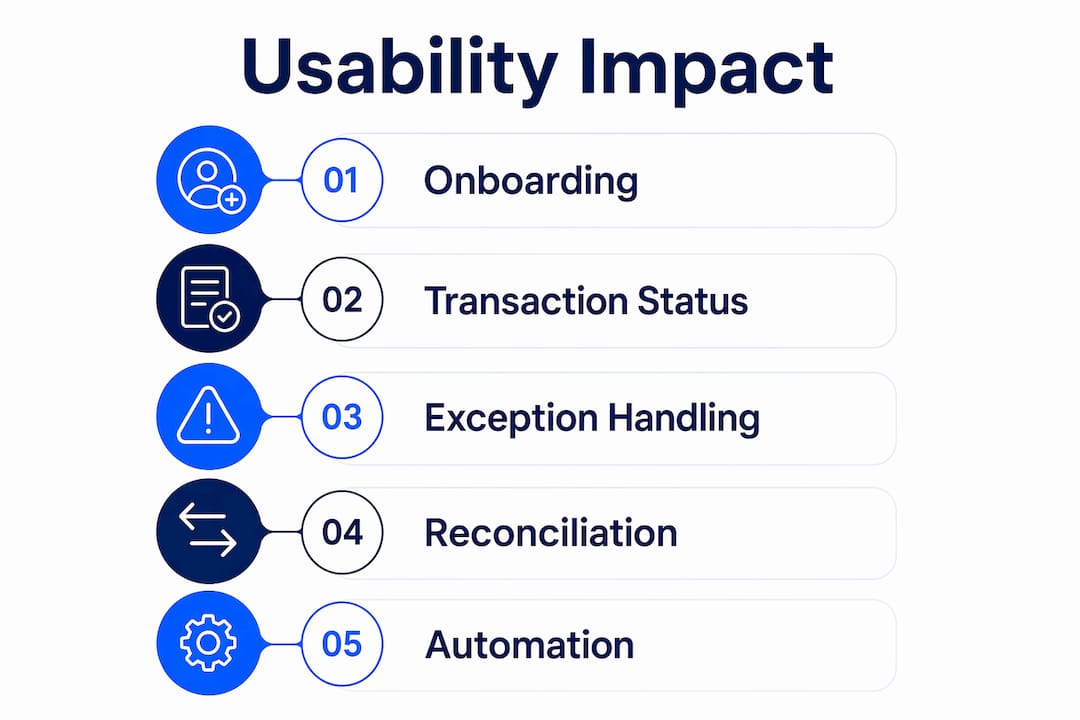
The most operationally useful platforms share three characteristics: a dashboard that surfaces transaction status, failed payments, and pending settlements in a single view; role-based access controls that let you grant read-only access to auditors without exposing payment initiation functions; and export formats (CSV, API, webhook) that connect cleanly to your accounting or ERP system. Platforms that require a support ticket to pull a custom date-range report add friction that compounds at month-end close.
Payment reconciliation is where usability gaps become expensive. A platform that auto-matches incoming SEPA credits to open invoices saves meaningful time compared to one that delivers a flat transaction log and leaves matching to your team.
How fast will funds actually settle?
Settlement speed varies by rail, provider, and account structure, and the difference between T+0 and T+2 settlement has real working capital implications.
SEPA Credit Transfers settle within one business day across the eurozone. SWIFT wires typically settle in 1–3 business days depending on correspondent banking chains and the destination country. ACH transfers in the US settle in 1–2 business days for standard ACH, with same-day ACH available for eligible transactions. Card transactions typically fund in 1–2 business days after batch settlement, though some processors hold funds longer for new accounts or high-risk categories.
Ask any shortlisted provider for their settlement schedule by rail, not just a headline “fast settlement” claim. Confirm whether settlement timing changes during the first 90 days of account operation, as many providers apply extended holds during the initial period.
What transaction limits and volume caps should you plan for?
Most regulated platforms impose transaction limits at the account, card, and daily levels, and those limits are not always published upfront.
For card programs, virtual card transaction limits and monthly spend caps are set at the program level and can often be adjusted by request. For SWIFT wires, individual transaction limits vary by provider and may require enhanced KYC documentation above certain thresholds. ACH has a per-transaction limit for same-day ACH that is set by Nacha (currently $1,000,000 per transaction for same-day ACH as of the most recent rule update).
Scalability matters beyond limits. A provider that works well at $500,000 monthly volume may introduce manual review queues, account manager approval steps, or pricing renegotiations at $5 million. Ask explicitly about the upgrade path and whether volume tiers trigger automatic pricing adjustments or require a contract amendment.
What contract terms should you negotiate before signing?
Contract flexibility is a material operational consideration, not a legal formality.
Month-to-month arrangements are available from most developer-first processors and some regulated banking platforms. Annual contracts typically offer lower per-transaction pricing in exchange for volume commitments. The terms to scrutinize most carefully are: the reserve policy (percentage held, duration, and release conditions), the termination clause (notice period, fees for early exit, and whether termination for cause is available without penalty), and the pricing adjustment clause (how much notice the provider must give before changing fees).
Providers that require 90+ days notice for termination with no exit-for-cause provision create significant switching costs. A clean contract includes a 30-day termination right for cause, a published reserve release schedule, and a pricing change notice period of at least 30 days.
Key Takeaways
For US B2B finance teams evaluating revoliqpay.com alternatives, the right provider category is determined by your primary constraint: compliance and account control point to regulated banking platforms, while speed and developer resources point to payment facilitators or orchestrators.
| Point | Details |
|---|---|
| Match model to constraint | Choose a regulated banking platform for IBAN/SEPA/SWIFT control; choose a payment facilitator for fast developer onboarding. |
| Verify three trust signals | Confirm regulatory license, segregated client funds, and published API docs before shortlisting any provider. |
| Ask about reserves upfront | Request the reserve policy and termination clause in writing during discovery to avoid working capital surprises. |
| Settlement speed by rail | SEPA settles in one business day; SWIFT in 1–3 days; ACH in 1–2 days. Confirm provider-specific schedules. |
| Demivolt as regulated alternative | Demivolt offers dedicated IBANs, SEPA/SWIFT processing, Visa card issuance, and segregated accounts for B2B cross-border operations. |
Why regulated infrastructure matters more than most operators realize
The payment platform market has a visibility problem. Most comparison guides focus on per-transaction pricing and checkout conversion rates, which are the right metrics for consumer e-commerce. For B2B finance teams running cross-border payouts, card programs, and multi-currency collections, those metrics are secondary. What actually determines operational risk is whether the provider holds your funds in segregated accounts, whether their regulatory license covers your specific corridors, and whether their API documentation is complete enough for your integration team to work independently.
The tradeoff between speed and control is real. A developer-first processor gets you live in days but leaves tax liability, chargeback exposure, and FX risk on your balance sheet. A regulated banking platform takes longer to onboard but gives you account-level transparency, cleaner reconciliation, and a compliance framework that scales with your business. The shortlist in this article reflects that tradeoff honestly: Demivolt for operators who prioritize regulated infrastructure and card issuance, with Stripe, Wise Business, Payoneer, Rapyd, and Marqeta covering the adjacent use cases where speed or specific rails take priority.
Demivolt offers regulated B2B payment infrastructure built for cross-border operations
After evaluating the alternatives above, the next step is confirming which provider can actually go live with your specific corridors, card requirements, and compliance obligations. Demivolt is built for exactly that conversation.
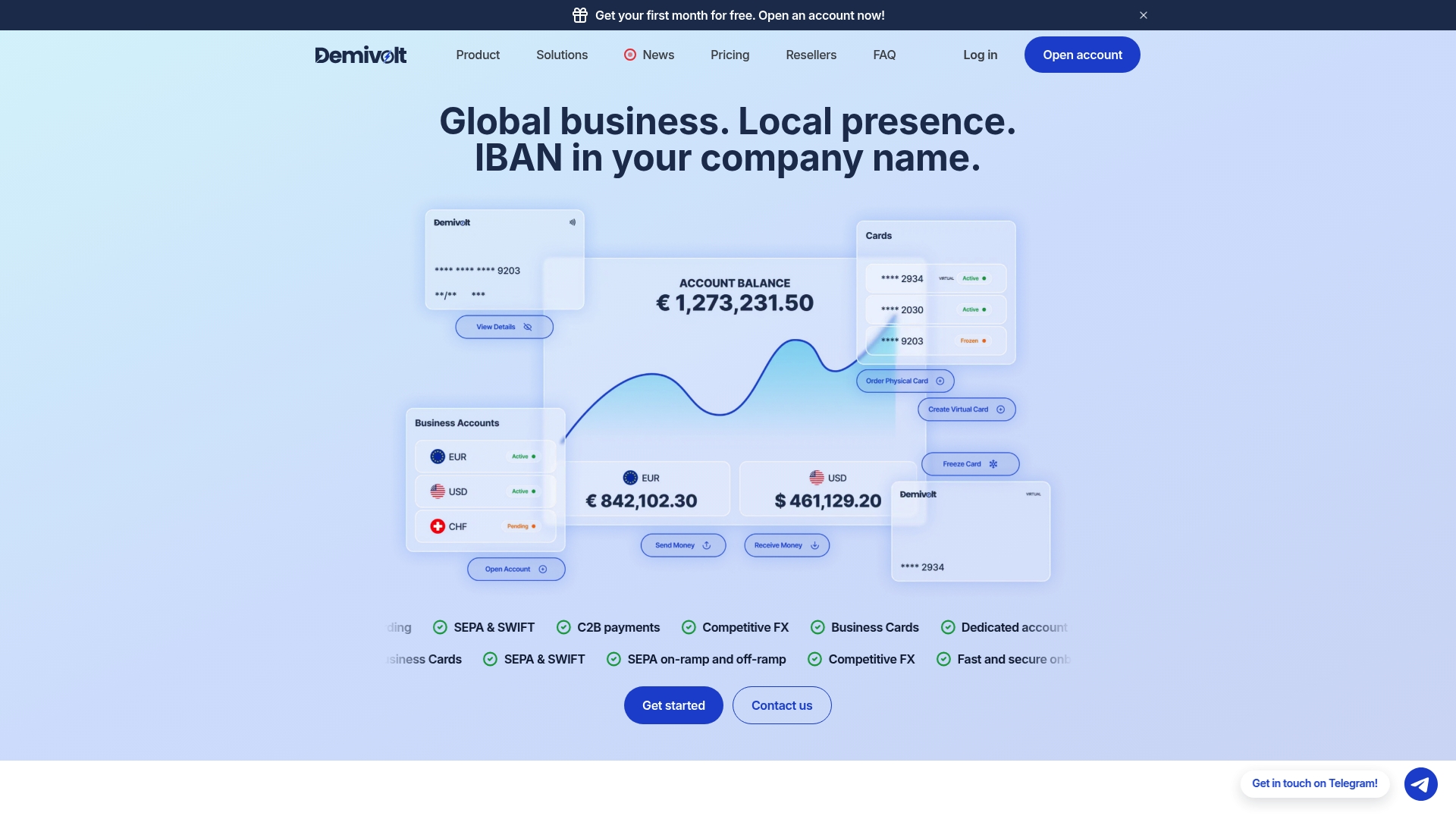
Demivolt gives B2B finance teams dedicated IBAN accounts, SEPA and SWIFT payment processing, virtual and physical Visa business cards, and segregated client funds under a regulated European fintech framework. Multi-account structures and role-based user management mean your team gets the access controls and reporting visibility that month-end close actually requires. Use the free IBAN validator to verify international account details before your first transfer, or explore the full SEPA and payments toolkit to see the infrastructure in practice. To open a business account or request a demo, visit Demivolt and connect with the team directly.
Useful sources and vendor pages
- Stripe Alternatives: A Brief Overview — covers MoR vs payment gateway tradeoffs and provider categories
- FastSpring: Stripe Alternatives In-Depth Guide — explains MoR feature sets and decision framework by business constraint
- NerdWallet: Best Payment Processing Companies — fee structure comparisons and settlement speed benchmarks
- PayPal Enterprise Payments — global market and currency coverage claims for enterprise processors
- Demivolt: Payment Compliance Guide — KYC, AML, and licensing definitions for vendor screening
- Demivolt: Payment Reconciliation Guide — reconciliation best practices and platform-level reporting expectations
- Demivolt: SEPA vs SWIFT Explained — rail differences, settlement windows, and practical guidance for B2B operators
- Demivolt: Benefits of Digital Payment Platforms — operational benefits and international compliance considerations