

What Is an Acquirer? How Card Acquiring Works for Businesses

An acquirer is the bank or other licensed institution that lets a business accept card payments. It signs up the merchant, sends each card payment for approval, receives the money from the cardholder’s bank and pays it to the merchant. The acquirer is the merchant’s side of every Visa or Mastercard payment. The card issuer is the cardholder’s side. Knowing which role a provider plays tells you who holds the risk, who sets the fees and who you depend on.
Demivolt is an Electronic Money Institution (EMI) regulated by the Bank of Lithuania, not a bank. It provides business accounts, payments, card programmes and compliance services. Visa and Mastercard card acquiring is coming soon and is not yet available. This guide explains acquiring so you can plan your payment setup and understand where card issuing, which Demivolt supports through card programmes, fits alongside it.
DemivoltExplore Demivolt’s Card ProgrammesFor businesses launching their own branded Visa cards, Demivolt provides BIN sponsorship, programme governance and oversight.VisitTL;DR
- An acquirer is a licensed institution that recruits merchants, authorises their card payments, settles with them and handles chargebacks.
- Acquirers sit on the merchant side of a four-party card payment. Issuers sit on the cardholder side.
- Processors, gateways and payment facilitators are often involved, but the acquirer remains responsible to the card scheme.
- The merchant service charge is made up of interchange, scheme fees and the acquirer’s own margin.
- Acquiring serves merchants. Card issuing and BIN sponsorship serve companies that want to launch their own cards, and the two should not be confused.
Table of Contents
- What an acquirer is and what it does
- Does a business need an acquirer?
- How a card payment moves through the acquirer
- Acquirer, issuer, processor, gateway: who is who
- What acquiring costs: the merchant service charge
- Acquiring versus card issuing
- Choosing an acquiring set-up: questions to answer first
- Other meanings of acquirer
- Where Demivolt fits
- Perspective
- FAQ
- Sources
What an acquirer is and what it does
The UK Payment Systems Regulator (PSR), the body that oversees payment systems in the UK, describes acquirers as banks or other organisations licensed by card payment system operators to recruit merchants so that they can accept card payments. The same PSR document lists what acquirers do:
- onboarding and underwriting merchants, meaning checking who they are and how risky their business is;
- supporting authentication, authorisation, clearing and settlement of each payment;
- settling funds with the merchant;
- facilitating chargebacks and refunds;
- monitoring compliance with card scheme rules, including the PCI DSS data security standard;
- ending the relationship when needed.
A study published by the Federal Reserve Bank of Philadelphia groups these into four core functions: signing up and underwriting merchants, providing the means to authorise valid transactions, facilitating clearing and settlement through the payment network, and providing information such as statements.
The terms “acquirer”, “acquiring bank”, “merchant bank” and “merchant acquirer” all point to the same role. The US bank regulator, the OCC, defines an acquiring bank as one that contracts with merchants for the settlement of card transactions, either directly or through agents.
Does a business need an acquirer?
If you want to accept Visa or Mastercard payments, yes, in one form or another. US regulators state that merchants accepting card-association-branded payments must be sponsored by a member acquiring bank. Third parties may handle processing or merchant sign-up, but the acquiring bank stays the risk-controlling entity. Visa’s own framework says the same in global terms: acquirers are responsible for the acts of their payment facilitators and sponsored merchants.
In practice, a business reaches an acquirer in one of two ways:
- A direct merchant agreement. You contract with the acquirer, which underwrites you individually. This tends to suit businesses with larger volumes, more complex flows or several markets.
- A payment facilitator. An intermediary signs you up on the acquirer’s behalf and distributes the settled funds to you. The PSR notes that in this model there is typically no direct contract between the merchant and the acquirer. Visa’s framework adds that depending on annual Visa sales volume, a sponsored merchant may be required to sign a direct agreement with an acquirer.
This matters as you grow. A facilitator model is quick to start with. A direct relationship gives you more control over pricing, settlement terms and data as volumes rise.
How a card payment moves through the acquirer
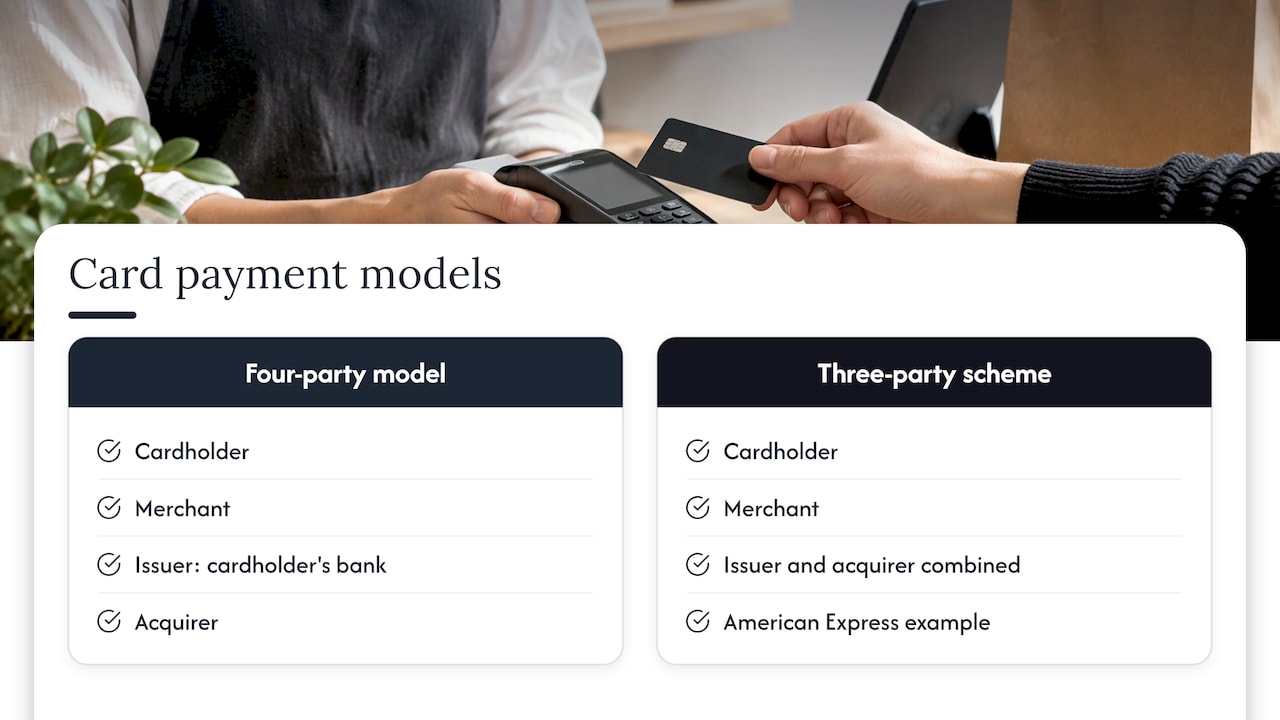
Most card payments run on a four-party model. The four parties are the cardholder, the merchant, the issuer (the cardholder’s bank) and the acquirer. Three-party schemes such as American Express combine the issuer and acquirer in one entity, according to the OCC.
Authorisation
The terminal or checkout captures the card details and sends them to the acquirer. The acquirer forwards the request through the card scheme to the issuer, which approves or declines it. The PSR describes this flow in its card acquiring review. An approval does not move money. As the Philadelphia Fed explains, authorisation only confirms that the issuer agrees to a future settlement with the acquirer and its merchant.
Clearing
Clearing is the exchange of final transaction data. Merchants batch their transactions, usually at the end of the day, and pass them to the acquirer. The OCC describes data flowing from merchant to acquirer to card scheme to issuer, with fee calculation and currency conversion handled along the way.
Settlement
Settlement is the movement of funds, in the opposite direction: issuer, scheme, acquirer, merchant. The acquirer credits the merchant’s account net of interchange and chargebacks, as the US FFIEC handbook describes. The PSR notes that merchants typically receive funds one, two or several days after the transaction, and settlement can be net (fees deducted first) or gross (full value, with fees billed separately). When you compare providers, check which of the two applies, because it changes how you reconcile your account.
Acquirer, issuer, processor, gateway: who is who
These four terms are often mixed up. A simple way to separate them is by what each one does for the payment.
| Role | Works for | What it does |
|---|---|---|
| Acquirer | The merchant | Holds the merchant relationship with the card scheme, underwrites the merchant, settles funds and bears the scheme liability |
| Issuer | The cardholder | Provides the card, approves or declines the payment and funds the settlement |
| Payment processor | The acquirer or issuer | Handles the technical routing, authorisation messages and clearing files |
| Payment gateway | The merchant | Securely passes card details from the website or app to the processor |
One company can play several roles. A provider may offer the gateway, the processor and the acquiring licence in one contract, or it may combine only some of them. The question to ask of any provider is which entity holds the scheme licence and which one is liable if something goes wrong. The PSR notes that payment facilitators face similar credit, regulatory and reputational risks as acquirers because the acquirer recovers upheld chargebacks from them.
What acquiring costs: the merchant service charge
The fee a merchant pays on each card sale is called the merchant service charge (MSC). The PSR breaks it into interchange fees, scheme fees and the acquirer’s net revenue, which covers the acquirer’s costs plus its margin. Interchange and some scheme fees vary by card type, card scheme, location, channel (online or face-to-face) and authentication method.
Three practical points follow from this:
- Online and cross-border payments cost differently. Card-not-present sales and cards issued in another region usually sit in different fee categories from domestic in-person payments.
- The blended rate hides the split. A single headline percentage combines all three components. A pricing model that separates them shows what you pay the acquirer for itself.
- Platform bundles are a different thing. Some platforms fold acquiring into one per-sale fee. A breakdown of per-sale platform fees shows how a flat percentage plus a fixed amount per sale compares with a split fee structure.
Settlement currency is the other cost driver for cross-border sellers. If you sell in several markets, local acquiring can lift conversion rates because payments are processed domestically rather than as foreign transactions. Where you hold the settled funds also matters. A business account with a dedicated IBAN and multi-currency support lets you receive and manage money in the currencies you trade in. Our guide on paying in local or home currency abroad covers the currency side of that decision.
Acquiring versus card issuing
Acquiring and issuing are two sides of the same card network, and they involve different responsibilities.
- An acquirer serves merchants who accept cards. Its core risk is paying merchants before it receives funds from the issuer. The OCC notes that this exposes the bank to credit and liquidity risk, which is why agreements let the bank review transactions for fraud before paying out.
- An issuer serves cardholders. It provides the card and holds the cardholder’s funds or credit line.
A company that wants to launch its own branded cards is on the issuing side. Few such companies are card scheme members themselves. Instead, they work with a licensed scheme member that sponsors a BIN, the number range that identifies the issuer of a card. This is the card issuing partner model. The scheme assigns BINs to its licensed member, the member provides sponsorship, programme governance and oversight, and an approved technology partner handles processing, while the company concentrates on the product and customer experience. Our article on how card issuing works for businesses walks through the roles in detail.
It is the same idea as the facilitator arrangement on the merchant side: a licensed member holds the scheme relationship and extends it to a business that does not. The difference is the direction. Acquiring is about taking card money in. Issuing is about giving cards out.
Choosing an acquiring set-up: questions to answer first
Before you approach any acquirer or facilitator, settle these points on your side.
- Business model and risk profile. Acquirers underwrite each merchant individually. Prepare a clear description of what you sell, to whom, in which countries, with what refund and chargeback record.
- Volumes and average ticket. These affect whether a facilitator or a direct agreement is more suitable and how fees are structured.
- Markets and currencies. Decide where your customers are and in which currencies you want to settle.
- Settlement account. You need an account to receive the funds. It should show incoming payments clearly so that reconciliation is simple.
- Compliance readiness. Expect KYB (know your business) checks, sanctions screening and ongoing monitoring. Having policies and documents ready shortens the process.
Companies that are themselves licensed or applying for a licence face a further layer: partner and sponsor due diligence. Preparing for it is a project of its own, and our compliance services cover business model assessments, AML/CTF frameworks, KYC/KYB procedures and preparation for bank, sponsor and partner due diligence. Licensed fintechs can see how this fits together on our page for fintech and payment companies.
Other meanings of acquirer
In corporate finance, an acquirer is a company that buys another company, and the target is the acquiree. That is unrelated to card payments. In payments, “acquirer” always means the institution on the merchant side of the card network. A related term is the on-us transaction, where the acquirer and issuer are the same entity or group, so the payment is not cleared through the card scheme. The PSR notes these are now rare in the UK.
Where Demivolt fits
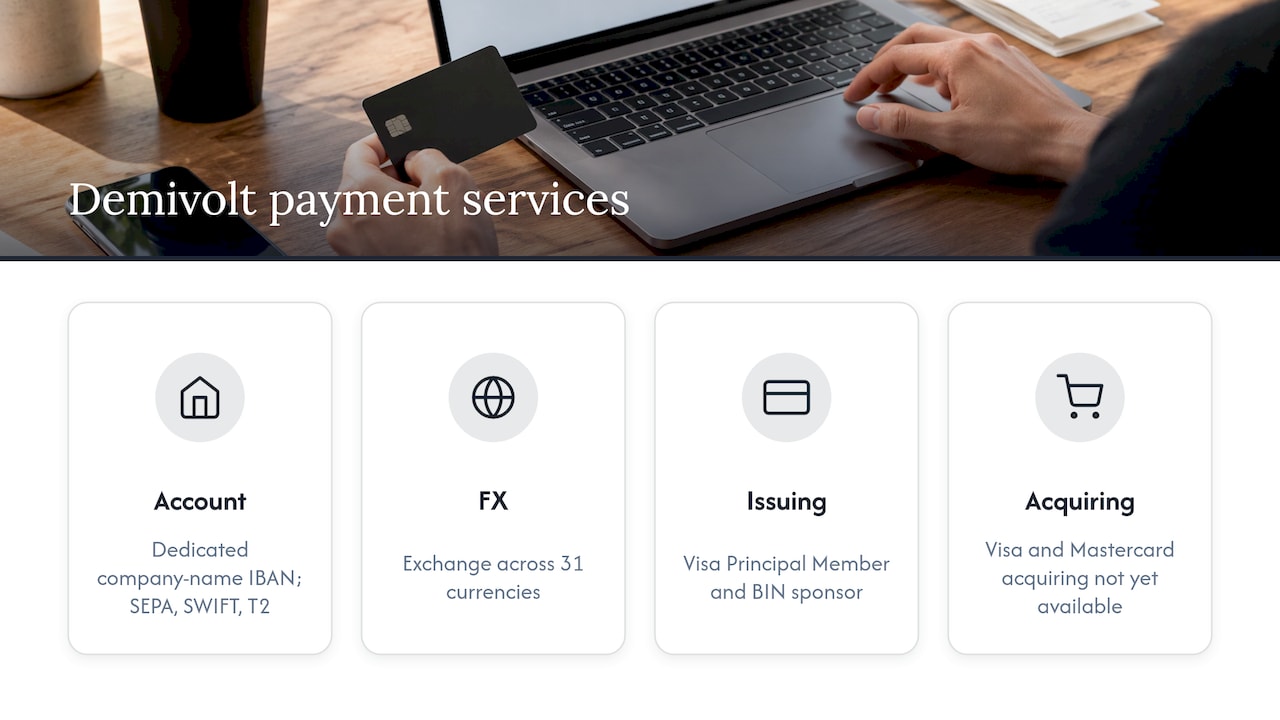
If you are planning how your company will take and move money, the account and payment layer is the foundation. Demivolt provides a regulated business payment account with a dedicated IBAN in your company’s name, SEPA, SWIFT and T2 payments, currency exchange across 31 currencies, sub-accounts, role-based permissions and physical and virtual cards for business expenses. Receiving customer payments directly into your business IBAN is part of our payments offer.
For companies that want their own branded Visa cards, Demivolt is a Visa Principal Member and acts as BIN sponsor, with programme governance and oversight and issuing and processing through approved technology partners. Visa and Mastercard card acquiring is coming soon and is not yet available.

Each business is reviewed individually on its structure, activity and payment flows. Low- to medium-risk applications typically take a few business days, and higher-risk ones may take longer. A dedicated client manager is free. As examples for lower-risk businesses based in Lithuania, account opening and monthly maintenance are 0 €, SEPA In is 0 € and SEPA Out is 0.40 €, with fees for other jurisdictions and business models set case by case. You can estimate transfer costs with the free SEPA Fee Calculator and check account numbers with the IBAN Validator. To get started, see business accounts, payments or card programmes.
Perspective
Payment roles are easiest to understand when you look at who holds the licence and who is responsible. In acquiring, the acquirer answers to the card scheme for every merchant it sponsors. In issuing, the scheme member answers for every card issued under its BIN.
We work on the account, payments and issuing side of that picture. As an EMI authorised by the Bank of Lithuania under licence No. 77 and a Visa Principal Member, we issue IBANs on our own infrastructure and are a direct SEPA participant through CENTROlink. Client funds are safeguarded and held separately from our own funds with partner credit institutions.
Our view is that businesses do better when the account, the payments and the cards sit under one regulated framework. Money received and sent is visible in one dashboard, permissions are set by role, and a dedicated client manager is a single point of contact. For companies launching cards or preparing for licensing, our compliance services sit under the same roof, so the regulatory groundwork and the product are prepared together.
Demivolt Team
FAQ
Is an acquirer the same as a payment processor?
No. The acquirer holds the merchant relationship with the card scheme and carries the liability for the merchant. A processor is a technical provider that routes authorisation messages and clearing files for an acquirer or issuer. One company can offer both, but the roles are distinct.
Who is the acquirer in a card payment?
The acquirer is the institution the merchant has contracted with, directly or through a payment facilitator, to accept card payments. It receives the funds from the cardholder’s bank through the card scheme and credits the merchant. The cardholder’s bank is the issuer, a different party.
How long does it take for an acquirer to pay a merchant?
It depends on the agreement. The PSR notes that merchants typically receive funds one, two or several days after the transaction. Settlement can also be net or gross of fees, so check both terms in your contract.
What is the card issuing partner model?
It is an arrangement in which a licensed card scheme member sponsors a BIN and oversees the programme, so that another company can launch its own cards without scheme membership. An approved technology partner usually handles processing. Our card programmes follow this structure for companies launching branded Visa cards.
Does Demivolt offer card acquiring?
Not yet. Visa and Mastercard card acquiring is coming soon. Today, Demivolt offers business accounts, payments, card programmes and compliance services.
Sources
- PSR card-acquiring market review, final report, Annex 1 (November 2021)
- PSR card-acquiring market review, interim report, Annex 1 (September 2020)
- OCC Comptroller’s Handbook, Merchant Processing
- FFIEC IT Examination Handbook, Merchant Acquiring
- Federal Reserve Bank of Philadelphia, The Merchant-Acquiring Side of the Payment Card Industry
- Visa Payment Facilitator Model
Recommended
- Cross-Border Merchants Turn to Local Acquiring to Boost Conversion Rates
- Card Issuing Explained: How It Works for Businesses
- Marketplace Business Accounts & Payments
- Card Tokenization for Businesses: How It Works and What It Covers
This article is for general information only and does not constitute financial, legal or tax advice. Demivolt UAB is an electronic money institution authorised and regulated by the Bank of Lithuania (EMI licence No. 77).