

Financial infrastructure is the complete system of institutions, technical platforms, legal frameworks, and data standards that enables money to move, settle, and be recorded reliably across a financial system. For corporate banking, it is the difference between a payment that clears in seconds and one that fails at the worst possible moment. Every treasury operation, cross-border supplier payment, and automated payroll run depends on this underlying architecture functioning without interruption.
The core elements your business interacts with, directly or through providers, include:
- Institutions: commercial banks, central banks, and regulated payment service providers
- Financial market infrastructures (FMIs): payment systems, central counterparties (CCPs), and securities settlement facilities
- Payment rails: ACH, Fedwire, CHIPS, card networks, and SWIFT for cross-border flows
- Enabling technologies: APIs, core banking ledgers, and distributed data layers
Pro Tip: When evaluating any financial services provider, ask specifically which payment rails they connect to directly versus which they access through a third-party correspondent. That single answer reveals how many settlement hops your funds take and where counterparty risk accumulates.
Table of Contents
- What does financial infrastructure actually cover?
- How do the key components clear, settle, and record funds?
- Why strong financial infrastructure matters for your business
- Systemic and regulatory risks in the United States
- How to evaluate a digital-first financial infrastructure provider
- How Demivolt maps to financial infrastructure needs
- Key Takeaways
- What practitioners get wrong about financial infrastructure migration
- Demivolt gives your business direct access to compliant payment infrastructure
- Useful sources and further reading
What does financial infrastructure actually cover?
The World Bank defines financial infrastructure as the underlying foundation of a country’s financial system, encompassing institutions, information, technologies, rules, and standards that enable financial intermediation. That definition is broader than most finance teams realize.
Practitioners typically split it into two tracks:
Soft infrastructure covers the legal and informational layer:
- Contract law and insolvency frameworks
- Credit bureaus and credit reporting systems
- Collateral registries
- Regulatory licensing and supervisory standards
Hard infrastructure covers the technical and operational layer:
- Real-time gross settlement (RTGS) systems
- Central securities depositories (CSDs)
- CCPs and trade repositories
- Core banking ledgers and account management systems
- API connectivity layers and messaging standards (ISO 20022, SWIFT MT)
The World Bank’s financial infrastructure topic page explicitly includes enabling technologies such as APIs and distributed ledgers in this definition, reflecting how digital innovation has expanded the concept well beyond physical clearing houses. For businesses assessing providers, both tracks matter. A provider with strong technical connectivity but weak regulatory standing creates legal exposure. The reverse creates operational bottlenecks.
How do the key components clear, settle, and record funds?
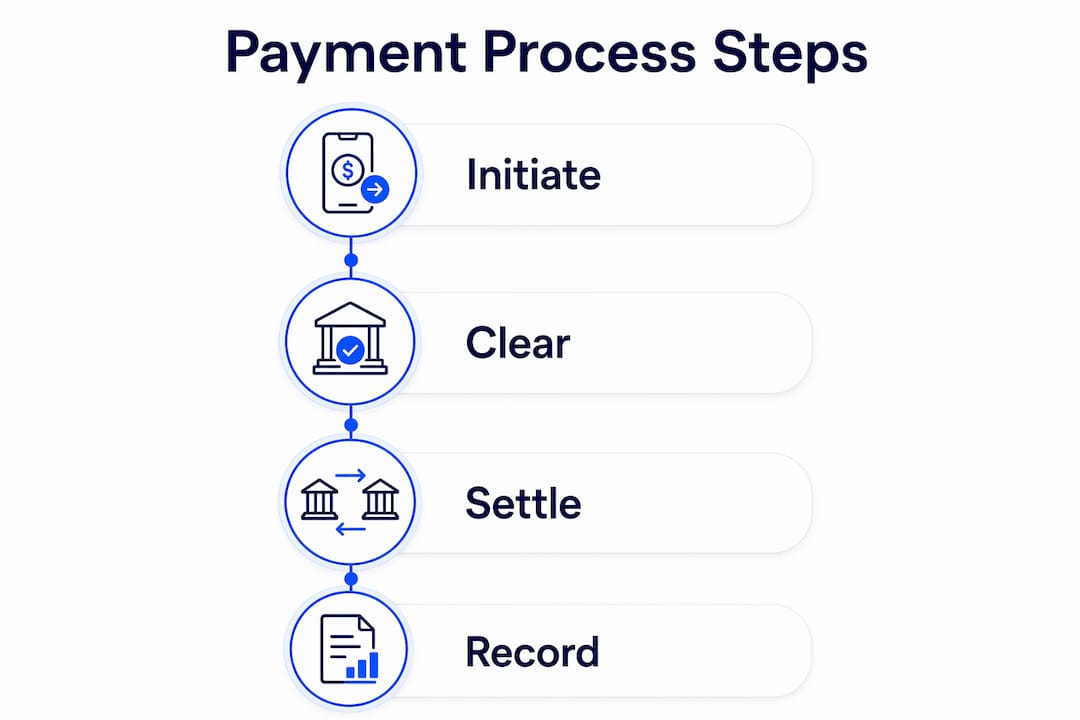
Understanding the components means understanding three distinct steps that every corporate payment goes through.

Clearing is the process of reconciling orders between transacting parties before settlement. Settlement is the actual transfer of funds, making the transaction final and irrevocable. Recording is the update of account ledgers to reflect the new balances. These three steps happen in sequence, and each involves different infrastructure.
| Component | Primary Function | Typical Business Impact |
|---|---|---|
| Fedwire Funds Service | RTGS for large-value, same-day USD transfers | Treasury sweeps, interbank settlements |
| ACH Network | Batch processing for payroll, vendor payments, direct debits | Mass payroll, recurring AP/AR |
| CHIPS | Private-sector large-value netting and settlement | High-volume corporate and bank-to-bank flows |
| SWIFT | Secure messaging for cross-border payment instructions | International supplier payments, FX settlements |
| Card Networks | Authorization, clearing, and settlement for card transactions | Corporate card programs, expense management |
| CCPs | Novation and netting of derivatives and securities trades | Counterparty risk reduction in financial contracts |
| CSDs | Custody and transfer of securities ownership records | Collateral management, securities settlement |
| Core Banking Ledger | Account balance maintenance and transaction recording | Real-time account visibility, reconciliation |
| API Layer | Connectivity between business systems and payment rails | Automated payment initiation, data feeds |
A typical corporate payment flow illustrates how these connect: your ERP initiates a payment instruction via API, the instruction routes to your bank’s core system, the bank submits to ACH or Fedwire depending on value and timing, the receiving bank’s system updates its ledger, and your treasury platform pulls a confirmation via API for reconciliation. Each handoff is a potential point of delay or failure, which is why fintech platforms transforming payment infrastructure focus heavily on reducing those handoffs.
Pro Tip: ISO 20022 is the messaging standard replacing legacy SWIFT MT formats across Fedwire and CHIPS. If your provider has not confirmed ISO 20022 readiness, build that question into your next vendor review.
Why strong financial infrastructure matters for your business
The business case for investing in quality financial infrastructure is direct. Countries with weaker financial infrastructure tend to have lower levels of private credit relative to GDP, which signals that infrastructure quality shapes access to capital at the macro level. At the firm level, the effects are equally concrete.
Key business benefits include:
- Faster settlement windows: RTGS and real-time payment rails reduce days payable outstanding and improve working capital predictability
- Lower counterparty risk: CCPs and segregated settlement accounts reduce exposure when a counterparty defaults
- Reconciliation efficiency: API-connected ledgers eliminate manual matching and reduce failed payment rates
- Cross-border capability: SWIFT connectivity and multi-currency accounts let treasury teams manage FX exposure and pay international suppliers without correspondent bank delays
- Access to credit: Clean payment histories and structured account data support credit applications and covenant reporting
Corporate use cases where infrastructure quality is most visible include mass payroll runs (where a single ACH batch failure affects hundreds of employees), cross-border supplier payments (where correspondent bank chains add days and fees), and treasury sweeps (where Fedwire timing determines overnight investment positions). The difference between a provider with direct rail access and one relying on multiple intermediaries shows up in settlement certainty and cost per transaction.
Systemic and regulatory risks in the United States
FMIs are systemically important and lack easy substitutes. When a CCP or critical payment system experiences an outage, the consequences cascade across banks and can freeze markets. The Federal Reserve directly oversees systemically important payment systems and financial market utilities under the Dodd-Frank Act, and the Bank of England’s operational resilience framework illustrates the supervisory standard that central banks globally apply to FMIs.
For businesses, the practical risk checklist when evaluating vendors includes:
- Regulatory licenses: Is the provider licensed by a recognized authority (OCC, state banking regulator, FinCEN registration)?
- Segregation of client funds: Are customer funds held in segregated accounts, separate from the provider’s operating capital?
- SOC 1 / SOC 2 attestations: Has an independent auditor verified controls over financial reporting and security?
- Disaster recovery and incident response: Does the provider publish recovery time objectives (RTOs) and recovery point objectives (RPOs)?
- SLAs with settlement guarantees: Are settlement windows contractually defined, with remedies for failures?
- Cybersecurity posture: Does the provider maintain penetration testing schedules and vulnerability disclosure programs?
How to evaluate a digital-first financial infrastructure provider
Finance and procurement teams benefit from a structured approach. Use this framework when assessing short-listed providers:
- Regulatory and compliance review: Confirm licenses, jurisdictional coverage, AML/KYC program documentation, and sanctions screening procedures.
- Security and resilience assessment: Request SOC 1 and SOC 2 Type II reports, business continuity plans, and incident response runbooks.
- Functional capability check: Map the rails the provider supports (ACH, Fedwire, SWIFT, card networks) against your actual payment flows. Confirm ISO 20022 readiness.
- Operational SLA review: Verify settlement windows, cut-off times, and what happens when a payment fails. Ask for historical uptime data.
- Commercial terms analysis: Understand per-transaction fees, monthly platform fees, FX spreads, and any settlement float the provider retains.
| Evaluation Dimension | Questions to Ask | Acceptable Answer |
|---|---|---|
| Regulatory compliance | Which regulators license you? | Named authority with verifiable registration |
| Fund segregation | How are client funds held? | Segregated accounts, confirmed in writing |
| Security attestations | Do you hold SOC 2 Type II? | Current report available on request |
| Settlement SLA | What is your ACH/wire settlement window? | Contractually defined, with breach remedies |
| API connectivity | Which standards do your APIs support? | REST/ISO 20022, sandbox available |
| Fee transparency | Are all fees itemized in the contract? | Full fee schedule, no hidden FX spreads |
Typical implementation timelines for a new provider range from four to twelve weeks depending on integration complexity. Simple API connections to existing ERP systems sit at the shorter end. Full core banking migrations with data transfer and reconciliation testing take longer. Fee structures generally combine a monthly platform fee, per-transaction charges, and FX spreads on cross-border payments. Setup fees vary by provider and scope.
How Demivolt maps to financial infrastructure needs
Demivolt is a regulated, digital-first platform built to cover the infrastructure requirements that corporate banking teams encounter most often. Its architecture maps directly to the components covered in this article.
Key capabilities and their infrastructure equivalents:
- Dedicated IBAN accounts: Each business gets a unique IBAN, enabling direct participation in SEPA and SWIFT payment flows without correspondent bank intermediaries
- SEPA and SWIFT connectivity: Inbound and outbound payments across both networks, supporting European and international supplier payments from a single platform
- Segregated client funds: Customer funds are held in segregated accounts, meeting the regulatory standard that vendor due diligence checklists require
- Multi-account structures: Treasury teams can organize accounts by entity, currency, or function, supporting cash pooling and reconciliation workflows
- Role-based user management: Granular access controls let finance teams separate payment initiation from approval, a basic internal control requirement
- API-first integrations: The platform connects to external banking and ERP systems, supporting automated payment initiation and real-time data feeds
On compliance, Demivolt operates under EU regulatory standards, with onboarding processes designed to meet AML/KYC requirements transparently. The role of fintech in modern financial infrastructure is precisely what Demivolt represents: a regulated layer that gives businesses direct access to payment rails without building correspondent banking relationships from scratch.
Pro Tip: Before going live with any new provider, run a parallel reconciliation period of at least two weeks. Process a subset of real transactions through both your existing system and the new platform simultaneously, then compare outputs. Discrepancies caught here are far cheaper to resolve than those found after full cutover.
For businesses with cross-border operations, Demivolt’s SWIFT capability and multi-account support address the two most common pain points: payment routing delays and reconciliation complexity across currencies.
This article provides general information about financial infrastructure and is not legal, regulatory, or financial advice. Businesses should confirm current regulatory requirements with qualified legal or compliance professionals for their specific situation.
Key Takeaways
Financial infrastructure quality directly determines a business’s settlement certainty, counterparty risk exposure, and cross-border payment efficiency, making provider selection a strategic decision, not just a procurement task.
| Point | Details |
|---|---|
| Two-track evaluation | Assess both soft infrastructure (legal, compliance) and hard infrastructure (rails, APIs, ledgers) when reviewing providers. |
| FMI systemic importance | FMIs lack easy substitutes; always request SOC 2 attestations, segregation proof, and SLAs before signing. |
| US payment rails | ACH, Fedwire, CHIPS, and SWIFT serve distinct use cases; confirm your provider supports the rails your payment flows actually require. |
| Implementation timeline | New provider integrations typically take four to twelve weeks; plan parallel reconciliation before full cutover. |
| Demivolt as a starting point | Demivolt offers IBAN accounts, SEPA/SWIFT connectivity, segregated funds, and API integrations for businesses building compliant payment infrastructure. |
What practitioners get wrong about financial infrastructure migration
The conventional wisdom treats financial infrastructure migration as a technology project. It is not. It is a controls project that happens to involve technology.
Most treasury teams focus their evaluation on API documentation and fee schedules. Those matter, but they are the last things to check, not the first. The questions that actually determine whether a migration succeeds are about settlement finality, fund segregation, and incident response. What happens to your funds if the provider’s operating account is frozen? What is the contractual remedy if a payment settles outside the agreed window? Who do you call at 11 PM when a payroll batch fails?
The evolution of financial technology from disruption to infrastructure has produced a generation of providers with excellent interfaces and thin regulatory foundations. The providers worth trusting are the ones who answer the hard questions without hesitation, publish their SOC reports without being asked twice, and can name the specific regulator who oversees their payment operations. That is the filter that separates infrastructure from software.
Demivolt gives your business direct access to compliant payment infrastructure
Businesses that have worked through the evaluation framework in this article consistently identify the same gap: finding a provider that combines genuine rail connectivity, regulatory compliance, and practical API integrations without requiring a six-month enterprise procurement cycle.
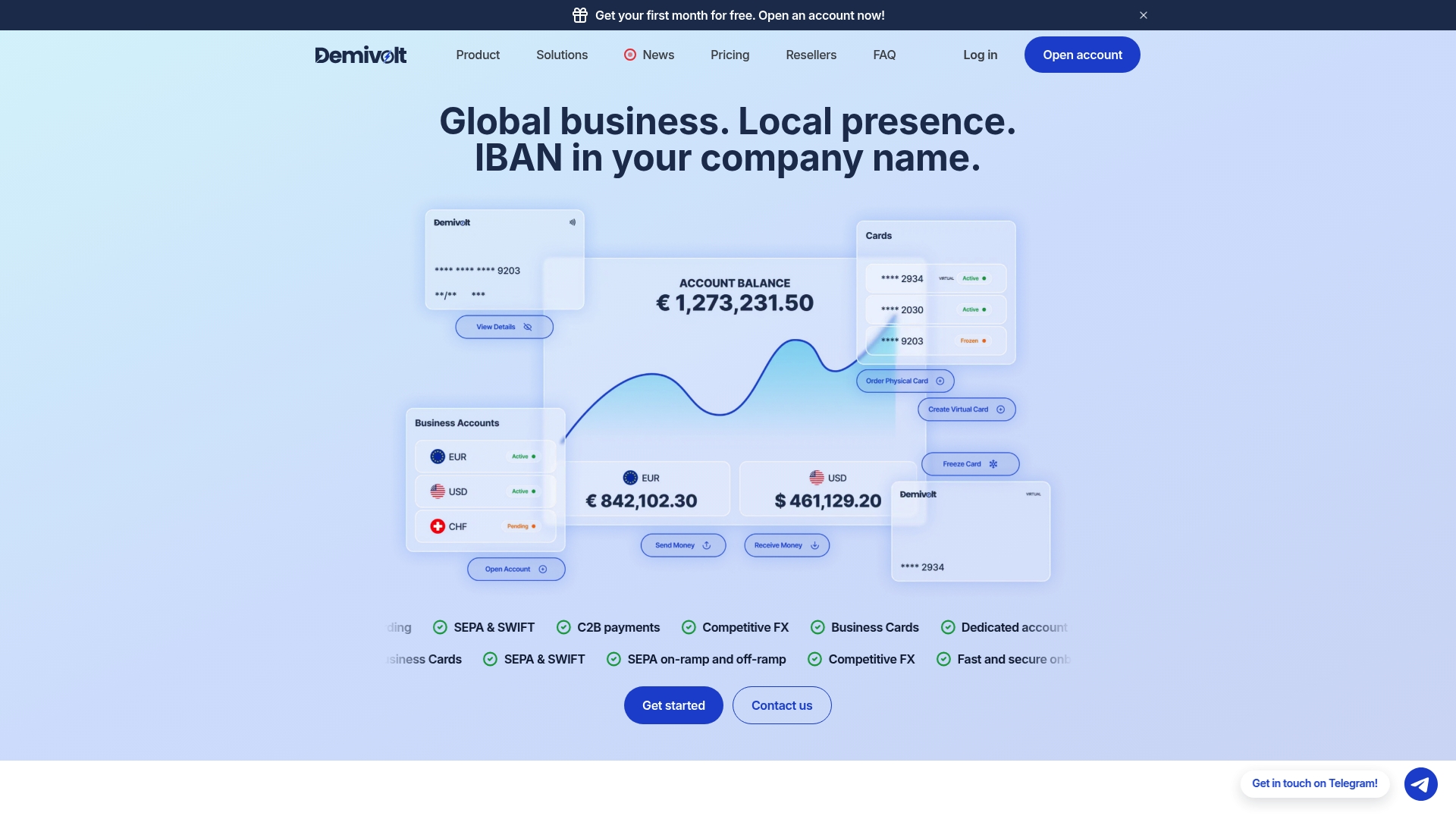
Demivolt is built for exactly that situation. The platform gives your business dedicated IBAN accounts, SEPA and SWIFT payment capability, segregated client funds, and API-first connectivity under EU regulatory oversight. Cross-border payments, multi-entity account structures, and role-based controls are available from day one, not after a lengthy implementation. Use Demivolt’s IBAN validator to verify payment details before initiating transfers, or explore the full suite of free SEPA tools to test connectivity and formats. Contact Demivolt to request a demo or start your account setup.
Useful sources and further reading
- World Bank: Stable Financial Systems — foundational definition of financial infrastructure and its role in financial system stability
- World Bank: Financial Infrastructure Topic Page — covers soft and hard infrastructure components including APIs and distributed ledgers
- CPMI-IOSCO: Principles for Financial Market Infrastructures (via ECB) — the international standard for FMI governance, risk management, and operational resilience
- Reserve Bank of Australia: About Financial Market Infrastructure — explains FMI functions including netting, settlement finality, and resilience requirements
- Bank of England: Financial Market Infrastructures Explainer — accessible overview of what happens operationally when a payment is made
- Demivolt News and Resources — platform-level coverage of fintech trends, payment infrastructure, and compliance developments