

Pick a Banking-as-a-Service partner on program durability, compliance capacity, and total cost of ownership, not on the lowest number in the price sheet. Every BaaS provider charges some mix of three components: setup and integration fees, a recurring subscription or platform fee, and per-transaction charges. A provider like Demivolt that treats compliance and segregated funds as core infrastructure, rather than an add-on, tends to protect your business from the costs that never show up on the first quote.
TL;DR:
- Subscription fees often dominate costs for low-volume startups, while transaction fees become more significant as business volume grows.
- A provider’s compliance infrastructure, sponsor bank stability, and ability to adapt to regulatory changes are more critical than initial pricing alone.
- Model total cost of ownership over 12 and 36 months using your transaction estimates to avoid unexpectedly high long-term expenses.
- Negotiating flexible terms, exit rights, and bundled compliance tools can significantly reduce hidden costs and operational risks.
- Vertical-specific needs, such as FX spreads for trading firms or role-based controls for card issuance, influence the ideal BaaS pricing structure.
DemivoltBuild More Control Into Business BankingDemivolt provides dedicated IBAN accounts, SEPA and SWIFT payments, and business cards through regulated European financial infrastructure.Explore Demivolt
Table of Contents
- What a BaaS price sheet usually includes
- How to calculate a 12- and 36-month total cost
- How do you choose the right BaaS provider?
- Negotiation levers by business stage
- Why program durability outranks headline fees
- How regulatory change reshapes BaaS pricing
- Comparing pricing models across BaaS providers
- Contract terms that shift your real cost
- How pricing plays out across industry verticals
- What I’d tell a CFO signing off on this decision
- Demivolt: how we structure pricing conversations and next steps
- Sources
- FAQ
What a BaaS price sheet usually includes
BaaS pricing typically breaks into three buckets, and reading a proposal means sorting every line item into one of them.
- Setup and integration fees. One-off charges for sandbox access, API connectors, custom onboarding flows, or bespoke compliance workflows. These can range from minimal to substantial depending on how much custom development your use case demands.
- Subscription or platform fees. Recurring charges tied to a plan tier, the number of user seats, or a monthly minimum you pay regardless of activity.
- Per-transaction and usage fees. Variable costs on payments processed, cards issued, FX conversions, SWIFT transfers, or interchange revenue splits on card programs.
Beyond those three, watch for line items vendors bury deeper in the contract: API call tiers that charge once you exceed a threshold, reconciliation or file-export fees for pulling your own transaction data, and sandbox usage limits that force an upgrade before you’ve even launched. BaaS pricing typically consists of these three components precisely because providers need to recover licensing costs, platform maintenance, and per-transaction processing risk separately, and a proposal that hides one of them inside another is worth a second look.
How to calculate a 12- and 36-month total cost
Comparing two price sheets side by side rarely tells you which is actually cheaper. Volume and transaction mix change the answer, sometimes dramatically. Build a TCO model using this sequence:
- List every recurring fee (monthly subscription, seat charges, minimums) and annualize any one-off setup cost by dividing it across your first-year usage.
- Estimate realistic monthly transaction volume, average transaction value, and card issuance rate for the next 12 months, then extrapolate to 36 months using your growth plan.
- Apply the provider’s per-transaction, FX, and SWIFT rates to that volume to get variable costs.
- Add setup, subscription, and variable costs together for both the 12-month and 36-month horizons.
A low-volume startup processing a few hundred payments a month will usually find subscription fees dominate its TCO, since transaction fees stay small in absolute terms. A scaling business moving tens of thousands of transactions monthly flips that ratio. A 12- to 36-month TCO model run early prevents committing to a plan that looks cheap in year one but becomes the expensive option once volume climbs. The inputs that move the outcome most: average transaction value, monthly transaction count, and how many cards you issue and to whom.
How do you choose the right BaaS provider?
Run every proposal through a checklist that covers technical fit, compliance ownership, and financial durability before price even enters the conversation.
Evaluation checklist:
- Does the provider hold or partner with a durable, well-capitalized sponsor bank, or is it reliant on a single relationship with no disclosed contingency plan?
- Who owns compliance operations: does the provider supply KYC/AML tooling, or does that cost land on your team?
- How flexible is the product roadmap if your transaction mix or geography changes in 18 months?
- Can you export your data and account history on your own terms if you switch providers later?
Questions to put in your RFP:
- What is the realistic onboarding timeline from signed contract to live account, and is sandbox access included before that contract is signed?
- What SLA metrics govern uptime, payment processing time, and support response?
- What compliance tooling is bundled versus billed separately?
- What does full data export look like on exit, and is it free?
Pro Tip: Ask every shortlisted provider for their sponsor bank arrangement in writing. A vague answer here is the single biggest predictor of a forced migration eighteen months into a contract.
Red flags worth walking away from: opaque “incidental” fees that only appear on the invoice, no automated KYC/AML tooling forcing manual compliance work, and reliance on one sponsor bank with no stated backup plan. Buyer guides consistently list sponsor bank concentration risk and inflexible product plans as the top reasons programs fail mid-contract.
Negotiation levers by business stage
The right pricing structure depends heavily on where your business sits today, not just on which provider looks best on a comparison chart.
- Early-stage businesses: Favor low or waived setup fees and pay-as-you-go pricing over locked-in subscriptions. Outsource compliance tooling rather than building it, since the KYC compliance stack usually costs less to license than to hire for at low volume.
- Scaling SMEs: Push for lower per-transaction rates in exchange for committed volume, and negotiate caps on API usage charges before you hit them, not after.
- International and cross-border operations: Model FX spreads, SWIFT fees, and multi-IBAN maintenance charges into your TCO from day one, and confirm local payout routing actually covers the markets you serve.
- Levers worth asking for in any negotiation: tiered pricing that steps down automatically at volume thresholds, bundled compliance tooling instead of a separate line item, and onboarding credits that offset your first quarter of setup costs.
Why program durability outranks headline fees
Industry guidance is consistent on this point. PwC advises that program durability and regulatory capacity should be the primary filters when evaluating a BaaS partner, with pricing considered only after those pass. Stripe frames BaaS as middleware that absorbs regulatory and infrastructure responsibility so your business doesn’t have to build a bank internally, which is exactly why a provider’s compliance depth matters more than its cheapest tier. Adyen notes that full-stack providers combining licensing and technology tend to deliver more reliability and faster feature updates than pure middleware layers, a meaningful factor once you’re scaling.
Segregated client accounts, multi-account structures, and role-based user management aren’t compliance checkboxes. They’re what stops a sponsor bank problem or an audit finding from becoming your business’s operational crisis.
Some providers structure their infrastructure with dedicated IBAN accounts with segregated funds, multi-account setups for different business units or currencies, and role-based permissions so finance teams control who touches what. That combination reduces the concentration risk that buyer guides warn about when a program leans on a single sponsor bank with no fallback.
How regulatory change reshapes BaaS pricing
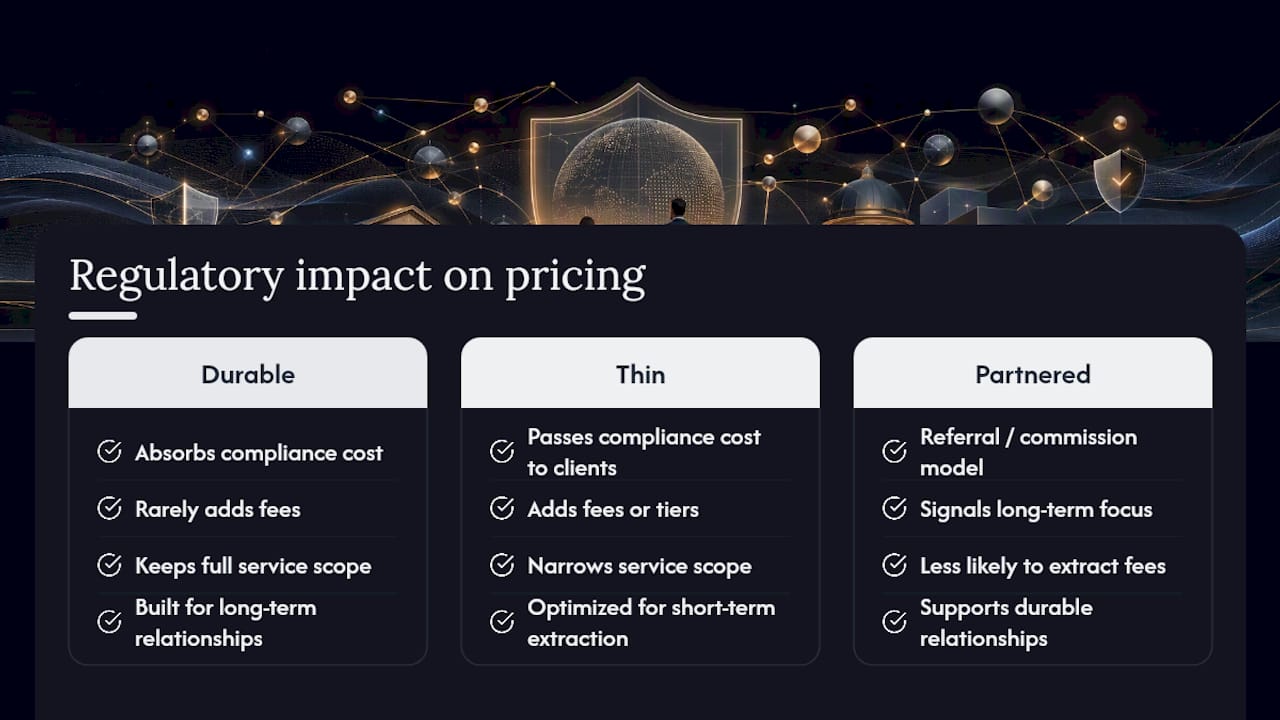
Regulatory shifts hit BaaS pricing directly, because compliance capacity is the most expensive thing a provider maintains. When know-your-customer and anti-money-laundering rules tighten across the EU, providers either absorb the cost of upgraded screening tools or pass it to customers as a new line item, sometimes disguised as an “enhanced compliance” tier.
The Banking-as-a-Service model works specifically because the BaaS provider, not your business, holds the banking license and carries the associated regulatory burden. That arrangement means your pricing is exposed to every rule change affecting that provider’s license, even when your own business practices haven’t changed at all. A provider with a durable, well-capitalized compliance function tends to absorb regulatory shifts into its existing operations. A thinner provider often reacts by adding fees or narrowing its service scope.
This is also where reseller and partner arrangements matter. If your provider works with advisors or partners on a referral and commission structure, that usually signals a business built for long-term relationships rather than one optimized to extract short-term fees before regulatory pressure forces a repricing. Ask any provider directly how the last regulatory change affected its client pricing. The answer tells you more about durability than any brochure will.
Comparing pricing models across BaaS providers
Three broad pricing philosophies dominate the BaaS market, and each suits a different kind of business.
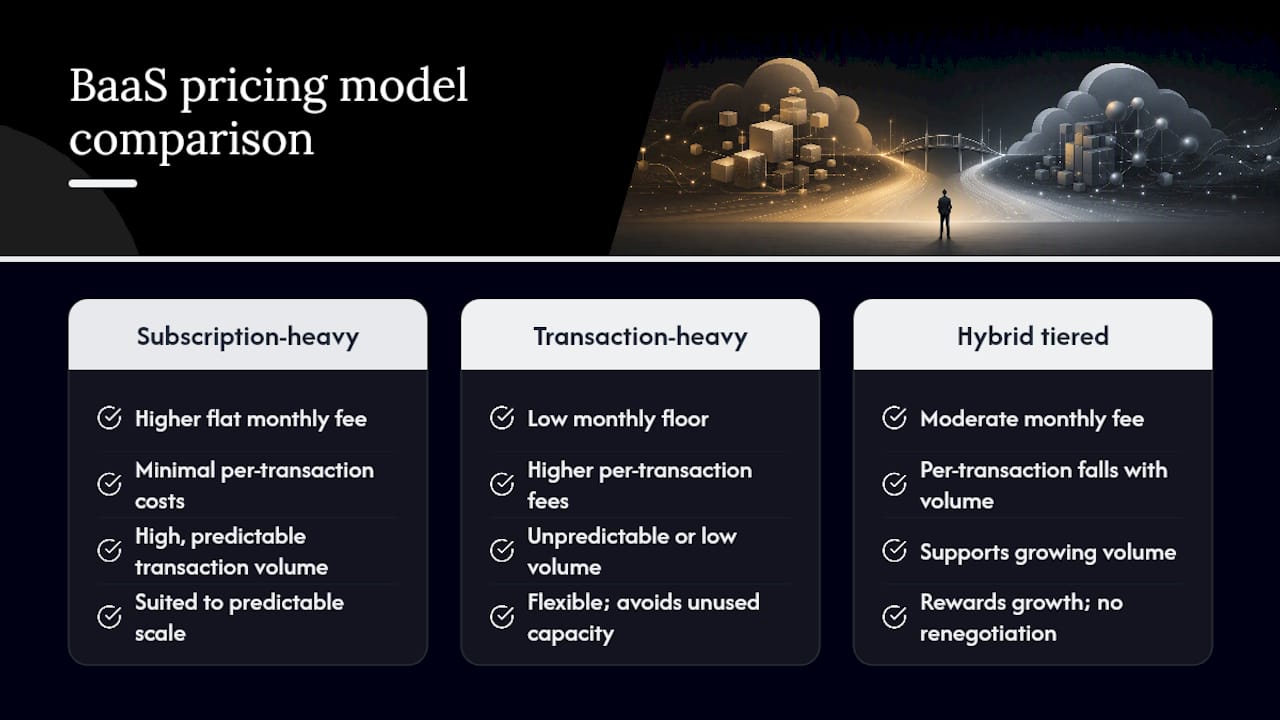
Subscription-heavy, low-transaction models charge a higher flat monthly fee but keep per-transaction costs minimal. These fit businesses with high, predictable transaction volume where variable fees would otherwise balloon.
Low-subscription, transaction-heavy models minimize the monthly floor but charge more per payment, card swipe, or FX conversion. Early-stage businesses with unpredictable or low volume often prefer this structure because it avoids paying for capacity they aren’t using yet.
Hybrid tiered models step down per-transaction rates as volume crosses defined thresholds, rewarding growth without requiring a contract renegotiation every time volume rises.
Value-added services complicate direct comparison further. A provider offering built-in KYC/AML screening, multi-currency IBAN issuance, and card program management within its base subscription can be cheaper overall than a lower-priced competitor that bills each of those separately. This is why comparing headline platform fees alone is misleading. A pricing pledge that itemizes what’s bundled versus billed separately gives you a fairer basis for comparison than a single quoted rate. Some providers bundle IBAN issuance, SEPA and SWIFT processing, and card issuing under one relationship, which simplifies exactly this kind of comparison for prospective clients.
Contract terms that shift your real cost
The number on the price sheet rarely reflects what you’ll actually pay once contract terms are factored in. Minimum commitment periods, auto-renewal clauses, and early termination fees all change your effective cost, especially if your business’s volume or geography shifts before the term ends.
Negotiate exit terms before signing, not after you need them. That means confirming, in writing, how quickly you can export transaction history and account data, whether bulk payouts are supported during an offboarding window, and whether the provider charges a fee for early termination. A cross-border compliance checklist built for procurement teams is a useful reference when drafting these questions internally.
Volume commitments cut both ways. Committing to a minimum transaction volume in exchange for lower per-transaction rates saves money if you hit the target, but creates a penalty risk if growth slows. Ask whether the provider offers a grace period or a step-down clause rather than a hard cliff. Service-level commitments belong in the contract too, not just the sales deck: uptime guarantees, payment processing time windows, and support response times should carry specific, measurable language, not vague assurances.
How pricing plays out across industry verticals
An e-commerce platform processing thousands of small transactions daily has almost the opposite pricing profile from a cross-border trading company moving fewer, larger payments. The e-commerce business is highly sensitive to per-transaction fees and FX spreads on frequent small payments, so a hybrid tiered model that rewards volume usually wins.
A cross-border trade business, by contrast, cares more about SWIFT fees, multi-IBAN maintenance, and payout routing into specific markets, since each transaction carries higher value and lower frequency. For that profile, IBAN infrastructure built for international payments matters more than shaving a fraction off the per-transaction rate.
A digital services company issuing corporate cards to a distributed team weighs card issuance fees and role-based spending controls more heavily than either of the above. Multi-account structures that separate departmental budgets, paired with virtual cards issued instantly per employee, often justify a higher subscription tier because they replace what would otherwise require a separate expense management tool entirely.
What I’d tell a CFO signing off on this decision
Bring three numbers to your board or procurement team: 12-month TCO, 36-month TCO, and the SLA metrics that govern uptime and support. Everything else is negotiable. Before signing, confirm your exit plan in writing: full data export, bulk payout capability, and a re-testable sandbox so switching providers later is a plan, not a scramble.
— dd
Demivolt: how we structure pricing conversations and next steps
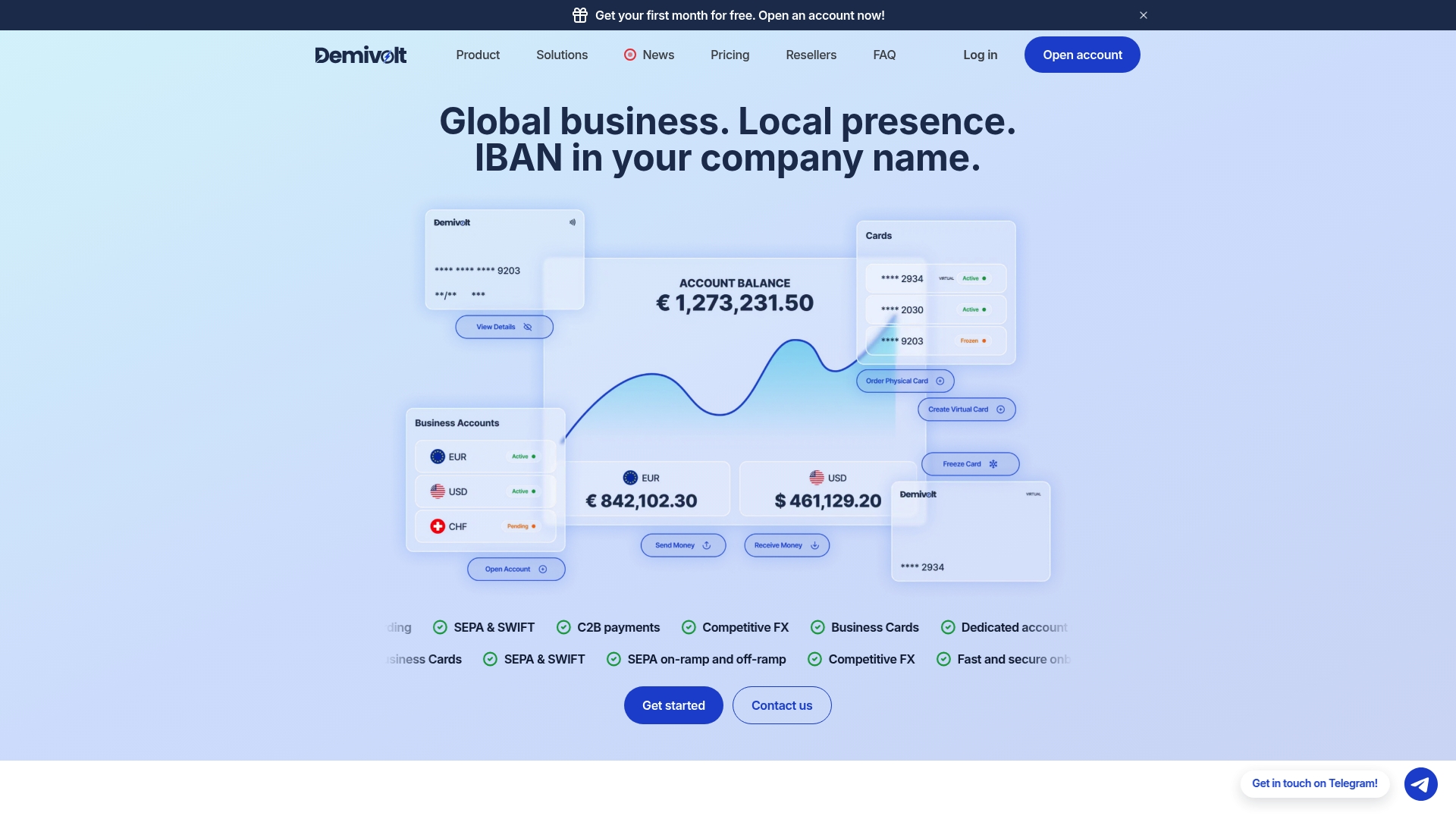
Some regulated European fintech platforms provide dedicated IBAN accounts, SEPA and SWIFT payment processing, virtual and physical business cards, multi-account structures, and role-based user management, all under segregated client funds and EU regulatory standards.
If you’re building a TCO comparison right now, start by validating the IBAN formats in any proposal you’re reviewing with Demivolt’s free IBAN validator, and read what an IBAN actually covers if you’re still mapping out your international payment structure. From there, request a tailored pricing worksheet from the provider’s team and ask directly for onboarding timelines and SLA terms before you commit. Advisors and partners can also refer clients through reseller programs and earn recurring commissions on the relationship.
Sources
- BaaS: what businesses need to know — PwC
- Understanding banking as a service and its benefits - Adyen
This article is general information, not a substitute for advice from a qualified financial advisor. Consult a qualified financial professional about your own circumstances before acting on anything here.
FAQ
What are the three main components of BaaS pricing?
Setup and integration fees, recurring subscription or platform fees, and variable per-transaction charges covering payments, card issuance, and FX.
How long does BaaS onboarding usually take?
Timelines vary by provider and service model, but sandbox access and a phased onboarding process, like the one Demivolt uses, typically get a business account live faster than negotiating a traditional bank integration from scratch.
What hidden costs should I watch for in a BaaS proposal?
Compliance tooling billed separately, reconciliation or data-export fees, and API usage tiers that trigger extra charges once you exceed a threshold are the most common surprises.
Should I choose the provider with the lowest subscription fee?
Not automatically. A lower subscription fee often pairs with higher per-transaction rates, so run a 12- and 36-month total cost model against your actual volume before deciding.
What should I confirm before signing a BaaS contract?
Confirm your exit terms in writing, including data export rights, bulk payout support, and any early termination fees, alongside clear SLA metrics for uptime and support response.