

TL;DR:
- Choosing a regulated Banking-as-a-Service provider with APIs, programmatic IBANs, and an internal ledger is essential for scaling payment platforms.
- Thorough vendor evaluation requires mapping payment rails, verifying compliance standards, and assessing card issuing needs early.
For finance leaders and platform operators, the right choice is a regulated Banking-as-a-Service (BaaS) provider that supports programmatic IBANs, SEPA/SWIFT rails, card issuing, and developer-first APIs, backed by an auditable internal ledger. Before evaluating vendors, assemble a scoping call with product, engineering, and finance to confirm required payment rails, compliance constraints, and card program needs.
Three immediate actions to take before that call:
- Map every payment rail your platform requires (ACH, Fedwire, SEPA, SWIFT) and confirm which the vendor supports natively.
- Verify the vendor’s compliance posture against ISO 20022 messaging standards and PCI DSS card data requirements.
- Identify whether you need white-label card issuing, virtual IBANs, or both, then ask Demivolt for a scoping session to validate fit.
Pro Tip: Bring your engineering lead to the first vendor call. Integration architecture decisions made in week one determine your reconciliation debt for years.
Table of Contents
- What does “business banking platform” actually mean for your use case?
- What must-have features separate capable platforms from the rest?
- How should you design integrations to avoid common engineering pitfalls?
- What security and compliance controls should you require from every vendor?
- What onboarding timelines and costs should you budget for?
- When should you build in-house versus buy a BaaS partner?
- How does Demivolt align with this checklist?
- What does a practical implementation checklist look like?
- Key Takeaways
- The part most teams get wrong
- Demivolt gives you regulated infrastructure with a clear next step
- Useful sources and authorities to consult during evaluation
What does “business banking platform” actually mean for your use case?
This article covers regulated BaaS infrastructure, not retail business checking products. The distinction matters because the evaluation criteria, compliance obligations, and integration complexity are fundamentally different.
In scope:
- Programmatic account creation, dedicated IBANs, and virtual IBANs with deterministic fund allocation
- SEPA, SWIFT, ACH, and Fedwire payment rails with defined settlement timings
- Card issuing (virtual and physical), BIN management, card lifecycle controls, and dispute handling
- Payment APIs, webhooks, idempotency, reconciliation pipelines, and ledgering
- Card program management, tokenization, and PCI DSS scoping
Out of scope: Consumer-oriented business checking products and retail SMB fintech accounts are not covered here. Those products serve a different buyer with different compliance requirements.
In the US market, vendor selection also turns on bank sponsorship arrangements, KYC/AML program ownership, and whether the provider holds its own licenses or operates under a sponsor bank’s charter. Understanding who owns regulatory responsibility between your platform and the BaaS provider is a prerequisite, not an afterthought.
What must-have features separate capable platforms from the rest?
A platform that cannot support the following capabilities will create reconciliation debt and compliance exposure at scale.
Accounts and IBANs:
- Programmatic account creation with full audit trails
- Virtual IBANs that allocate incoming funds deterministically, eliminating manual remittance matching
- Virtual account lifecycle management: create, rotate, and retire as operational objects
Payment rails and settlement:
- Native SEPA, SWIFT, ACH, and Fedwire support with documented settlement windows
- Multi-currency ledgers with clear FX margin disclosure
Card issuing:
- Virtual and physical card issuance, BIN sponsorship, tokenization, and dispute workflows
- Card lifecycle controls: freeze, unfreeze, spend limits, and merchant category restrictions
API maturity:
- OpenAPI specifications, consistent auth flows, idempotency keys, and reliable webhooks
- Sandbox environment with production-shaped payloads and failure-path coverage
- SDKs, pagination, and filtering for reporting endpoints
Reconciliation and ledgering:
- An internal canonical append-only ledger as the single source of truth; provider balance reports alone do not scale
- ERP and AR connectors, remittance metadata support, and event-driven reconciliation flows
Operational controls:
- Role-based access control (RBAC) and multi-account hierarchies
- Published SLA commitments for settlement, webhook delivery, and uptime
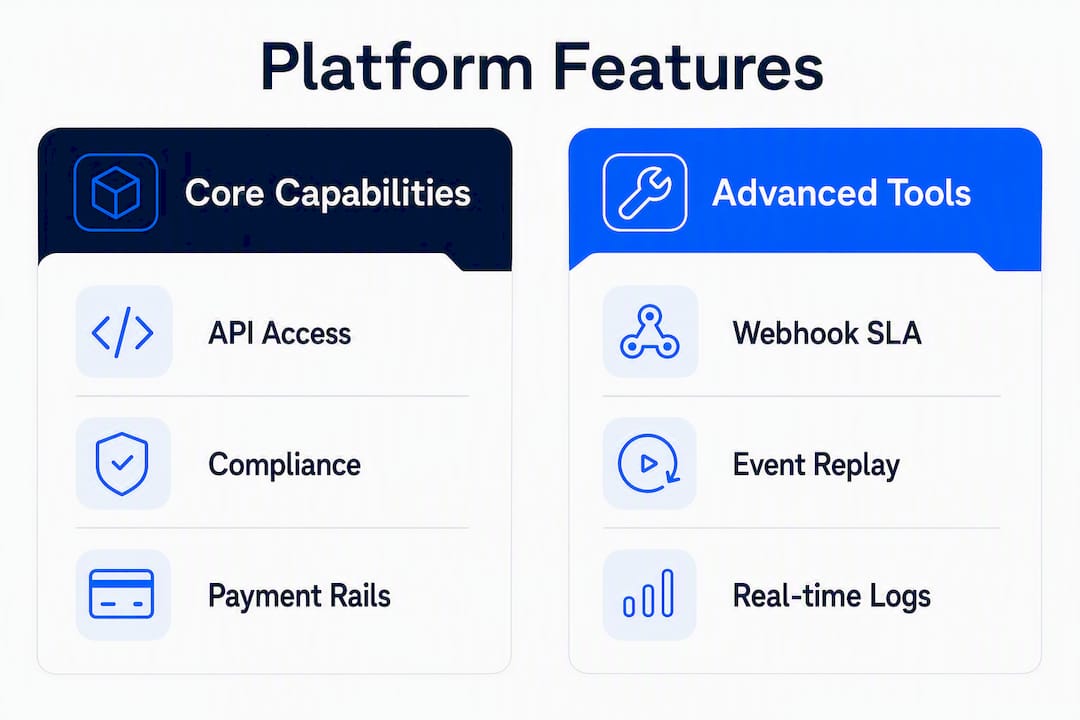
Pro Tip: Ask every vendor for their webhook delivery SLA and their policy on event replay. A provider that cannot replay missed events will cost your team hours of manual reconciliation.
How should you design integrations to avoid common engineering pitfalls?
Design event-driven integrations that treat provider webhooks as authoritative facts and commands as intent. Payments, settlements, and authorizations are inherently asynchronous; synchronous flows that wait for confirmation create brittle retry logic and reconciliation gaps.
Key engineering decisions to make before writing a line of code:
- Canonical ledger first. Your internal ledger must exist before you connect to any provider. Provider feeds are inputs, not the record of truth.
- Idempotency is client-side. Store idempotency keys in your domain and check them before execution. Do not rely solely on provider-side idempotency to prevent double-payments.
- Build a connector layer. Providers implement auth, token refresh, and error semantics differently; a middleware connector isolates your business domain from those quirks and reduces maintenance cost when switching vendors.
- Test failure paths in sandbox. Sandbox behavior often diverges from production. Run both happy-path and failure-path tests with production-shaped payloads before certifying any flow.
- Decouple user flows from settlement. A user-facing confirmation should reflect intent accepted, not settlement confirmed. Settlement is an asynchronous fact delivered via webhook.
Pro Tip: Instrument structured logging that automatically redacts PAN and PII fields, and correlate provider event IDs to your ledger entries. Post-mortem reconciliation without this correlation takes days instead of hours.

What security and compliance controls should you require from every vendor?
Require security-by-design from both vendor and buyer sides. Failure to isolate processing environments and redact PII increases PCI DSS and data-protection exposure, and can block market expansion into regulated jurisdictions.
Non-negotiable technical controls:
- Network segmentation between public-facing APIs and card processing environments
- Tokenization of PANs at the point of entry; minimal PAN exposure in any downstream system
- Structured log redaction for all PAN, PII, and account identifiers
- Encryption at rest and in transit; KMS or HSM usage for cryptographic key management
- RBAC with least-privilege access for card and account operations
PCI DSS scoping: Hosted card flows (iFrame or hosted fields) reduce your PCI scope to SAQ A. Server-to-server card flows require SAQ D or a full QSA assessment. Confirm which model the vendor supports and what their shared-responsibility documentation covers. For additional vendor-neutral guidance, the fintech security best practices guide from Bitecode covers segmentation and key management in practical terms.
Compliance and regulatory controls:
- KYC/AML and KYB program ownership: confirm in writing whether the vendor or your platform holds responsibility for each check
- Segregated client funds: verify the vendor holds client money in accounts separate from operational funds
- Append-only audit trail for all account and payment events
- Incident response SLAs and breach notification timelines in the contract
For multinational platforms, include a clause in your vendor RFP requiring GDPR-compatible data processing agreements and specifying data residency for US-originated transactions.
Regulatory compliance is not a feature you add later. Scope it in the contract before the first API call, or you will renegotiate under time pressure.
What onboarding timelines and costs should you budget for?
Expect a wide range depending on integration depth. Hosted payment page integrations can launch in as little as 1–3 days; server-to-server API integrations typically require 4–8 weeks; payment orchestration integrations take 6–12 weeks; direct acquiring or banking integrations often require 8–18 weeks or longer.
| Integration Model | Engineering Effort | Compliance Load | Timeline | Indicative Cost |
|---|---|---|---|---|
| Hosted payment page | Low | Minimal (SAQ A) | 1–3 days | Tens of thousands USD |
| Server-to-server API | Medium | Moderate (SAQ D) | 4–8 weeks | Mid-range cost |
| Payment orchestration | High | High | 6–12 weeks | $50k–$200k+ |
| Direct acquiring / EMI | Very high | Very high | 8–18+ weeks | High cost |
Key cost drivers to budget for:
- Setup and onboarding fees per account or card program
- Per-transaction fees and FX/settlement margins on cross-border flows vary by provider and volume
- Card BIN and program fees, reserve requirements
- PCI audit and GRC work: allocate 20–30% of project budget to security and compliance as a realistic baseline
SLA expectations: confirm sandbox provisioning timelines, production onboarding windows, settlement finality windows, and webhook delivery guarantees before signing.
When should you build in-house versus buy a BaaS partner?
Buy a regulated BaaS partner when time-to-market, compliance bandwidth, or engineering capacity is constrained. Plan to build when you need full control over the customer experience, have long-term volume economics that justify absorbing bank sponsorship risk, and have the engineering team to maintain it.
| Scenario | Recommended Approach | Key Trade-off |
|---|---|---|
| Fast launch (under 6 months) | Buy BaaS | Speed vs. long-term margin |
| Scalable control | Hybrid: buy rails, build orchestration and ledger | Flexibility vs. integration complexity |
| Enterprise-grade control | Build or direct acquiring | Full control vs. 12 month runway |
The hybrid pattern is often the right answer for growing platforms: buy core payment rails and card issuing from a regulated BaaS provider, then build your orchestration layer, canonical ledger, and analytics in-house. This approach avoids absorbing bank sponsorship risk while preserving differentiation in the customer experience. External banking integration makes sense earlier than most teams expect, particularly when cross-border compliance requirements would otherwise require dedicated legal and licensing work.
Payment orchestration adds smart routing and failover but requires 6–12 weeks to build, with onboarding and certification required for each provider. Factor that into your roadmap before committing.
How does Demivolt align with this checklist?
Demivolt meets the regulated BaaS requirements for programmatic IBANs, SEPA/SWIFT payment processing, card issuing, and multi-account role controls, with client funds held in segregated accounts under EU regulatory oversight.
Capabilities mapped to buyer requirements:
- Dedicated and virtual IBAN accounts with programmatic creation
- SEPA and SWIFT payment processing with transparent settlement timings
- Virtual and physical Visa business card issuance with card lifecycle controls
- API-first integrations with developer documentation and webhook support
- Multi-account structures and RBAC for finance teams and platform operators
- Segregated client funds and EU-regulated compliance framework
- White-label BaaS and reseller program for fintech partnerships and platform operators
Strong fit for: platforms and marketplaces managing sub-accounts, SMB aggregators issuing cards to business clients, fintechs needing a regulated IBAN and card program without a full banking license, and business advisors operating as resellers.
What does a practical implementation checklist look like?
Follow a phased rollout: design, connector build, reconciliation, pilot, then scale. Never go live without a canonical ledger and end-to-end reconciliation validated for the pilot cohort.
- Pre-integration: Finalize contracts, confirm SLA terms, and document compliance responsibilities in writing.
- Security and PCI scope: Decide hosted vs. server-to-server card flows and document your PCI scope before writing integration code.
- Sandbox testing plan: Define happy-path and failure-path test cases; run them with production-shaped payloads.
- Connector/middleware build: Build the provider adapter layer; isolate auth, token refresh, and error normalization from business logic.
- Idempotency strategy: Implement client-generated idempotency keys with pre-execution checks stored in your domain.
- Ledger design: Stand up the append-only canonical ledger before connecting live provider feeds.
- Monitoring and observability: Instrument structured logging with PAN/PII redaction and provider event correlation.
- Dispute and chargeback workflows: Define internal escalation paths and confirm vendor dispute SLAs.
- Go-live risk mitigation: Run a parallel pilot with a limited cohort; confirm reconciliation closes cleanly before full cutover.
Sample architecture (copy into your design doc):
Internal Payments API + Ledger Service → Orchestration Layer → Provider Adapters (SEPA, SWIFT, ACH, Card) → Event Bus (webhooks, settlement events) → Reconciliation Pipeline → Ops Dashboards
Migration notes: For teams moving from an existing banking provider, run parallel processing for at least two full settlement cycles. Map all token references, remittance metadata fields, and virtual IBAN assignments before cutover. Plan a data-mapping sprint to align legacy transaction IDs to the new canonical ledger.
Key Takeaways
A regulated BaaS platform with programmatic IBANs, a canonical internal ledger, and PCI-compliant card issuing is the correct infrastructure choice for finance leaders building payment products at scale.
| Point | Details |
|---|---|
| Validate rails before signing | Confirm SEPA, SWIFT, ACH, and Fedwire support and settlement timings in writing before any contract. |
| Canonical ledger is mandatory | Build your append-only internal ledger before connecting provider feeds; provider reports alone do not scale. |
| Budget 20–30% for compliance | Allocate 20–30% of project budget to PCI scope, audits, and GRC work as a realistic baseline. |
| Demand sandbox parity | Test failure paths with production-shaped payloads; never assume sandbox behavior matches production. |
| Demivolt as a regulated partner | Demivolt provides programmatic IBANs, SEPA/SWIFT, Visa card issuing, and segregated client funds for platforms and fintechs. |
The part most teams get wrong
The canonical ledger is consistently the most underestimated requirement. Teams arrive at a vendor scoping call focused on API documentation and card program pricing, and leave without asking a single question about ledger architecture or idempotency guarantees. Then, three months into production, they discover that provider balance reports and their own transaction records diverge by amounts they cannot explain.
The second failure mode is trusting sandbox behavior. Sandbox environments often omit institution-level edge cases, delayed settlement responses, and webhook retry behavior. A team that only tests the happy path in sandbox will encounter those gaps in production, under time pressure, with real client funds at stake.
During vendor selection, insist on three things: a written idempotency policy, a documented webhook replay mechanism, and a sandbox environment that includes at least one failure-path scenario per payment rail. If a vendor cannot provide all three before you sign, that tells you something about how they will respond when production breaks.
Demivolt gives you regulated infrastructure with a clear next step
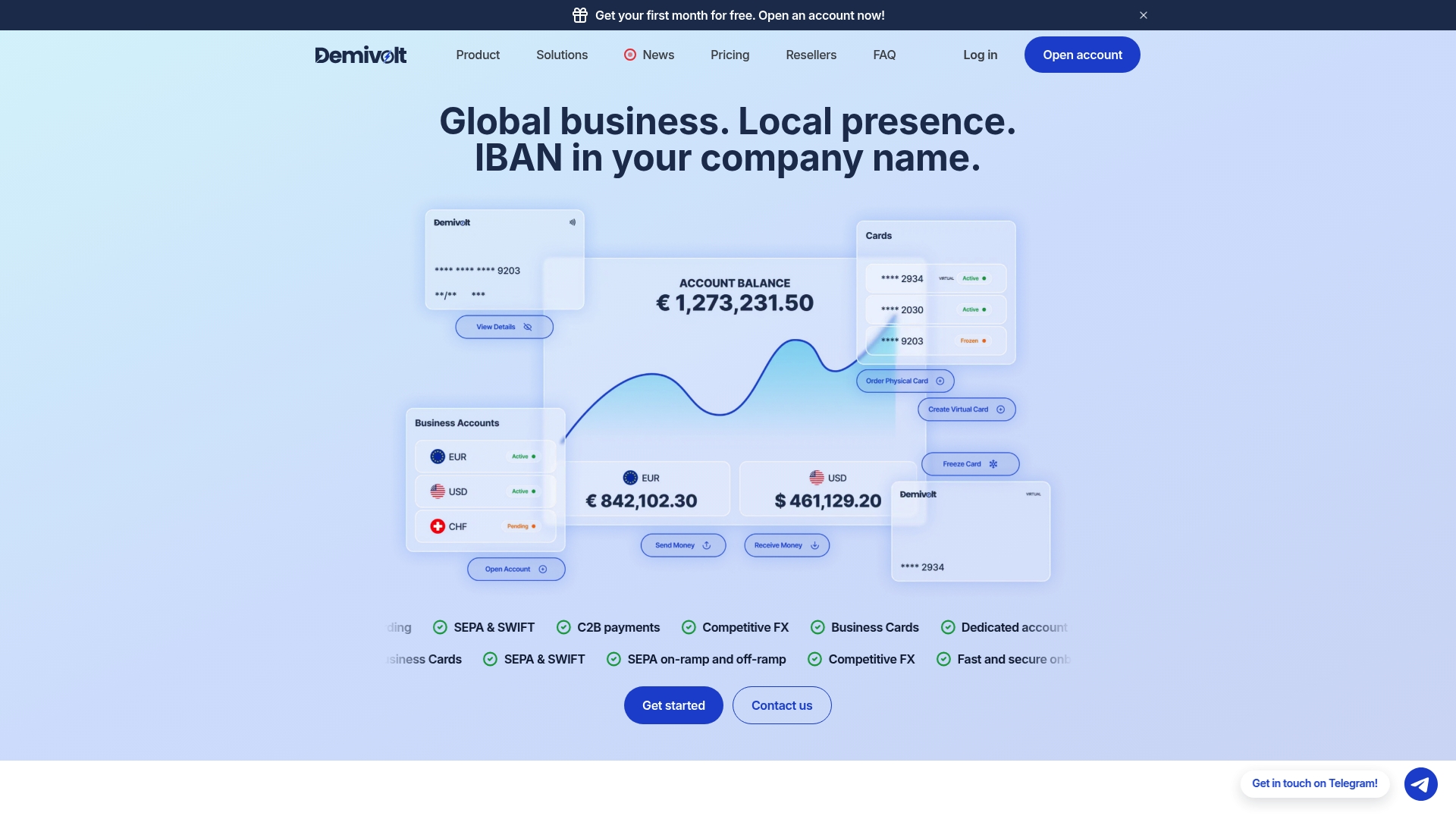
Demivolt delivers dedicated IBAN accounts, SEPA and SWIFT payment processing, virtual and physical Visa card issuing, and API-first integrations in a single regulated platform, with client funds held in segregated accounts. For platforms and fintechs that need to move fast without absorbing full bank licensing risk, that combination reduces both time-to-market and compliance overhead.
Start by validating your IBAN setup with the free IBAN validator to confirm account identifiers during onboarding and testing. Then visit Demivolt’s payment tools to explore the full suite of utilities available during evaluation. When you are ready to confirm rail coverage and card program fit, request a scoping call directly through demivolt.com.
Useful sources and authorities to consult during evaluation
- ISO 20022 messaging standard — the global standard for financial messaging; confirm vendor support before signing
- PCI DSS guidance (PCI Security Standards Council) — authoritative source for card data security requirements and SAQ scope decisions
- OCC (Office of the Comptroller of the Currency) — US bank charter and fintech licensing guidance
- FinCEN (Financial Crimes Enforcement Network) — US AML/KYC regulatory requirements and BSA obligations
- Financial data integration challenges — practical guide on data mapping and integration complexity for finance teams
- Demivolt cross-border compliance checklist — KYC/AML and client funds segregation guidance for B2B platforms