

TL;DR:
- Cloud-based business banking offers SMEs faster, more secure, and cost-effective financial services through internet infrastructure. It enables real-time data access, quick deployment of new products, and scalable operations, improving decision-making and operational efficiency. Transitioning requires organizational change but delivers significant savings and agility for growing companies.
Cloud-based business banking is defined as the delivery of business financial services through internet-hosted infrastructure rather than on-premise systems. The advantages of cloud-based business banking include lower costs, faster payments, stronger security, and real-time financial visibility. These benefits matter most to SMEs and e-commerce companies, where cash flow control and operational speed directly affect growth. Platforms like Demivolt are built on this model, offering dedicated IBAN accounts, SEPA and SWIFT payments, and EU-regulated compliance in a fully digital environment. This guide breaks down exactly what you gain when you move your business banking to the cloud.
1. Advantages of cloud-based business banking: the cost case
The most direct financial benefit of cloud banking is cost reduction. Transitioning to cloud banking can save firms 60–90% in banking costs, with typical SMEs saving more than £3,000 annually. That figure reflects the combined effect of lower transaction fees, reduced account maintenance charges, and the elimination of branch-dependent services.

Cloud infrastructure also cuts IT spending. Cloud-native banking infrastructure reduces IT operational costs by 30–50% by removing hardware maintenance and software licensing from your budget. For a growing SME, that money is better deployed in inventory, marketing, or hiring.
The deeper structural shift is from capital expenditure to variable operational expenditure. Cloud banking converts fixed infrastructure costs to variable operational costs, so your banking expenses scale with actual transaction volumes rather than a fixed monthly overhead. You pay for what you use, not for capacity you might need someday.
- No hardware to purchase or maintain
- Subscription pricing replaces unpredictable licensing fees
- Transaction and foreign exchange fees are typically lower than traditional bank rates
- Account setup and onboarding costs are minimal compared to legacy institutions
Pro Tip: Before switching platforms, calculate your current annual banking costs including wire fees, FX markups, and IT support time. That baseline makes the savings from cloud banking concrete and defensible to stakeholders.
2. How cloud banking accelerates your financial operations
Speed is the second major advantage. Businesses using cloud banking reduce time spent on core banking tasks by 70–80% through instant payments and automated reconciliation. That is not a marginal improvement. It means a task that took a full workday can be completed in under two hours.
The efficiency gains come from several compounding factors:
- Instant payment processing. SEPA and SWIFT transfers execute in real time or near real time, compared to the one to three business day delays common with traditional banks.
- Automated reconciliation. Cloud platforms match incoming and outgoing transactions against invoices automatically, reducing manual bookkeeping errors.
- API integration with accounting tools. Open APIs connect your banking data directly to accounting software and ERP systems, eliminating manual data entry.
- Automated fraud detection. Machine learning flags suspicious transactions without requiring manual review of every payment.
- Role-based access controls. Finance teams, accountants, and executives each see only the data relevant to their function, reducing approval bottlenecks.
Pro Tip: Connect your cloud banking platform to your accounting software via API on day one. The time saved on monthly reconciliation alone typically justifies the switch within the first quarter.
Demivolt supports this workflow with digital banking tools designed for businesses that process high transaction volumes across multiple accounts.
3. Security and compliance built into the platform
Cloud banking platforms carry security infrastructure that most SMEs could not afford to build independently. Industry-standard encryption, multi-factor authentication, and real-time transaction monitoring are baseline features, not premium add-ons. These tools protect against the fraud vectors that most commonly target small businesses: phishing, account takeover, and unauthorized wire transfers.
Regulatory compliance is equally built in. EU-regulated platforms operate under frameworks including PSD2 and GDPR, with audit trails generated automatically. That means your business benefits from compliance support without hiring a dedicated compliance officer. Demivolt, for example, holds client funds in segregated accounts and meets EU regulatory standards as a core operating requirement, not an optional feature.
Centralized data storage in certified cloud environments also reduces the risk of data loss from hardware failure or local system breaches. Cloud providers maintain redundant infrastructure across multiple data centers, so your financial records remain accessible and protected even during localized outages.
- End-to-end encryption on all transactions and stored data
- Automated audit logs for regulatory reporting
- Real-time fraud detection using behavioral analytics
- Segregated client accounts protecting funds from platform insolvency
- Multi-factor authentication as a standard login requirement
4. Scalability: cloud banking grows as your business does
Traditional banking infrastructure breaks under growth. Adding a new currency account, a new legal entity, or a new payment corridor at a legacy bank can take months and significant legal overhead. Cloud platforms remove that friction entirely.
Cloud-native platforms reduce new financial product deployment from 6–12 months down to 4–8 weeks. That speed difference is the gap between catching a market opportunity and missing it. For e-commerce companies expanding into new European markets, that timeline is the difference between launching in Q1 or Q3.
| Capability | Traditional banking | Cloud banking |
|---|---|---|
| New account opening | Days to weeks | Minutes to hours |
| New currency support | Months, often requires new agreements | Typically available on demand |
| New product deployment | 6–12 months | 4–8 weeks |
| Transaction volume scaling | Requires infrastructure investment | Elastic, no hardware changes |
| Multi-entity management | Separate relationships per entity | Unified dashboard, one platform |
Multi-currency accounts and virtual IBANs let you receive payments in local currencies without opening foreign bank accounts. That capability alone removes a significant barrier for SMEs doing cross-border business in Europe and beyond.
5. Real-time financial visibility and better decisions
The most underrated advantage of cloud banking is what it does to your financial data. Traditional banking gives you a lagged view: yesterday’s statement, last week’s balance, last month’s report. Digital banking replaces lagged financial reports with real-time data, giving you an accurate cash position at any moment.
That shift changes how you make decisions. You can see exactly how much cash is available before approving a purchase order. You can spot a payment shortfall before it becomes a missed payroll. You can identify which revenue streams are performing and which are stalling, in real time rather than in retrospect.
Cloud banking synchronizes data across business functions, breaking down the silos that typically separate finance, operations, and sales data. Deloitte identifies this integration as the core strategic value of cloud banking: it enables advanced analytics and revenue insights that fragmented systems simply cannot produce.
- Consolidated dashboards showing all accounts, currencies, and entities in one view
- Real-time cash flow tracking replacing end-of-day batch reporting
- AI-assisted credit scoring and spend categorization
- Predictive analytics for cash flow forecasting
- Instant alerts for unusual transactions or balance thresholds
The practical result is that your finance team spends less time gathering data and more time acting on it. That reallocation of attention is where cloud banking delivers its most lasting competitive advantage.
Key takeaways
Cloud-based business banking delivers cost savings of 60–90%, cuts IT overhead by 30–50%, and reduces daily banking task time by 70–80%, making it the most operationally efficient financial infrastructure available to SMEs in 2026.
| Point | Details |
|---|---|
| Cost reduction is substantial | Cloud banking cuts total banking costs by 60–90% and IT costs by 30–50% for most SMEs. |
| Speed gains are measurable | Automated reconciliation and instant payments reduce daily banking task time by 70–80%. |
| Compliance is built in | EU-regulated platforms handle audit trails, encryption, and fund segregation automatically. |
| Scalability removes growth barriers | New accounts, currencies, and products deploy in weeks rather than months. |
| Real-time data improves decisions | Live cash visibility replaces lagged reports, enabling faster and more accurate financial choices. |
Why cloud banking is a cultural shift, not just a tech upgrade
I’ve watched SME owners treat cloud banking as a software swap. They move their accounts, connect their tools, and expect the benefits to arrive automatically. They rarely do, at least not fully.
The real transformation happens when your team changes how it thinks about financial data. Cloud banking gives you real-time information, but that information only drives better decisions if your people know how to use it. Adopting cloud banking requires internal cultural change, including role adaptation and organizational mindset shifts. Deloitte’s research on this point is blunt: the technology is the easy part.
What I’ve found in practice is that the businesses extracting the most value from cloud banking are the ones that invest in training alongside the platform switch. They teach their finance managers to read live dashboards rather than monthly PDFs. They give operations leads access to real-time payment status rather than routing everything through accounting. They treat the platform as a shared financial operating system, not a back-office tool.
The cost savings and efficiency gains are real and they arrive quickly. The strategic advantage, the ability to move faster than competitors because your financial data is always current, takes longer to build. It requires deliberate change management, not just a new login.
My honest recommendation: before you switch platforms, map out which decisions in your business are currently delayed by slow financial data. Then build your cloud banking setup around solving those specific bottlenecks first. The technology will support whatever you ask of it. The question is whether your team is ready to ask.
— dd
Demivolt’s business banking tools for cloud-first companies
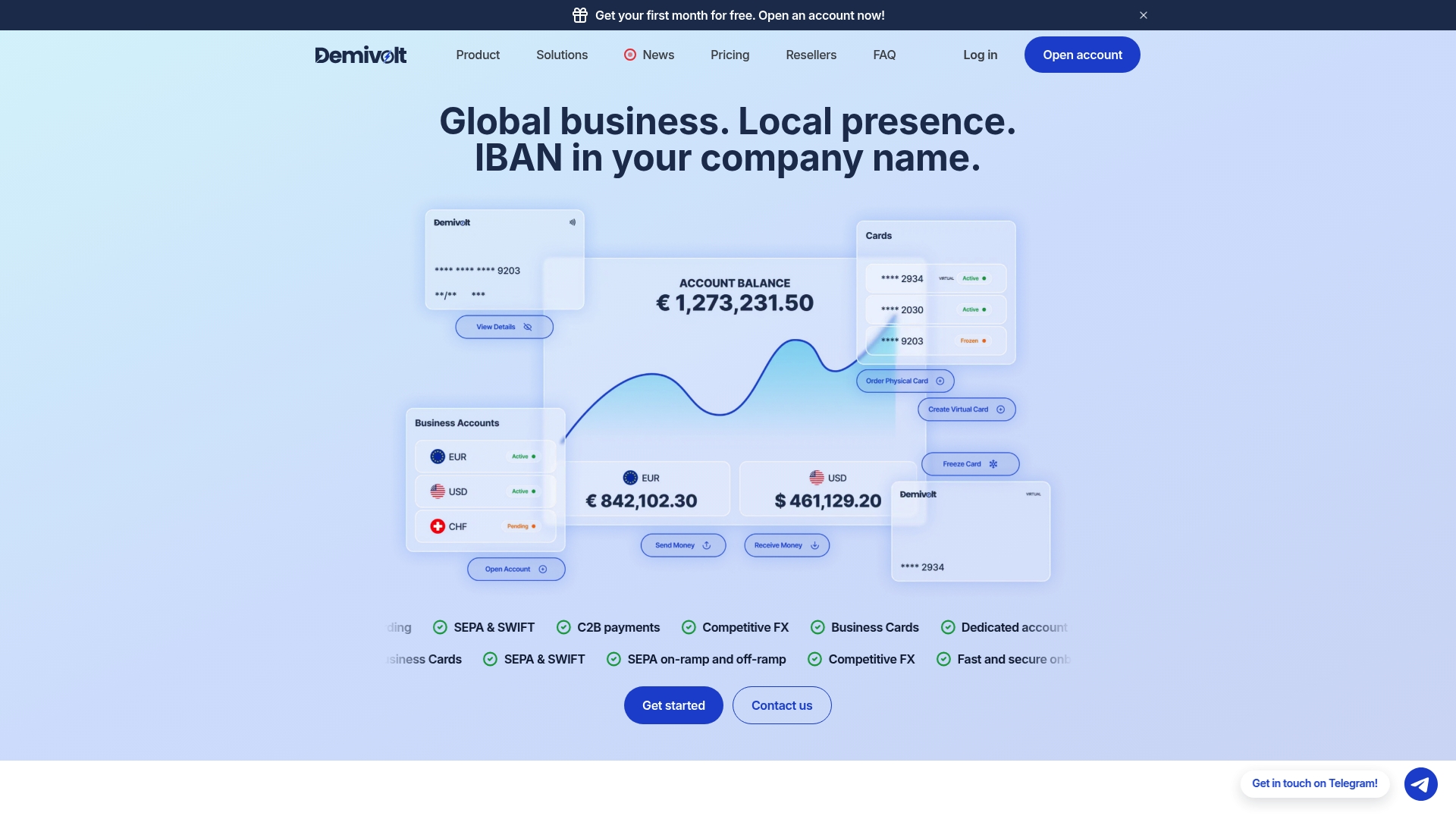
Demivolt is built for SMEs and e-commerce companies that need regulated, digital-first banking without the friction of traditional institutions. The platform offers dedicated IBAN accounts, SEPA and SWIFT payment management, virtual and physical business cards, and multi-account structures with role-based access, all under EU regulatory oversight.
For companies managing cross-border payments, Demivolt’s free IBAN Validator checks account numbers against the ISO 13616 standard before you send a payment, preventing costly errors on international transfers. The broader free tools suite supports the daily financial operations that cloud banking makes possible. If you’re evaluating your options, the SME banking guide on the Demivolt blog covers the full picture of what digital banking delivers for growing businesses.
FAQ
What are the main advantages of cloud-based business banking?
Cloud-based business banking reduces costs by 60–90%, cuts IT overhead by 30–50%, and speeds up daily banking operations by 70–80% through automation and instant payments. It also provides real-time financial visibility and built-in regulatory compliance.
Is cloud banking secure for SMEs?
Cloud banking platforms use end-to-end encryption, multi-factor authentication, and real-time fraud detection as standard features. EU-regulated platforms also maintain segregated client accounts and automated audit trails for compliance.
How quickly can a business switch to cloud banking?
Most cloud banking platforms complete account opening within hours or days. Deploying new financial products or adding currency accounts typically takes 4–8 weeks, compared to 6–12 months with traditional banking infrastructure.
What is the difference between cloud banking and traditional business banking?
Traditional banking relies on on-premise systems with fixed costs, slow product deployment, and lagged financial reporting. Cloud banking delivers variable pricing, real-time data, and elastic capacity that scales with your transaction volume.
Does cloud banking support international payments?
Cloud banking platforms support multi-currency accounts, virtual IBANs, SEPA transfers, and SWIFT payments, making them well suited for SMEs and e-commerce companies operating across borders.
Recommended
- Demivolt | Blog – Online Business Banking Benefits 2026: SME Guide
- Demivolt | Blog – Modern business banking trends: boost efficiency & compliance
- Demivolt | Blog – Why digital banking empowers SMEs for smarter cross-border finance
- Demivolt | Blog – Business account benefits for European SMEs in 2026