

Yes, running daugybinės verslo sąskaitos, or multiple business accounts makes sense once your operating costs, tax obligations, and payroll are large enough to blur together in a single ledger. Start with three roles: operating, payroll, and tax reserve, opened through a regulated platform with clear fee terms and API access. Add more accounts only when a specific cash flow or compliance need justifies the extra reconciliation work, not because more accounts sound more organized.
TL;DR:
- Multiple accounts are justified only when each has a specific purpose, such as operating, payroll, tax, or project-specific needs, and not for the sake of organization.
- Subaccounts within one provider generally simplify management and reduce fees compared to holding fully separate accounts at different banks, especially for small businesses.
- Automation through bank feeds, API-driven scheduled transfers, and clear governance rules are crucial for maintaining control and minimizing errors across several accounts.
- Fewer, well-defined accounts with automation and strong access controls outperform numerous loosely managed accounts in security, reconciliation, and cost efficiency.
- Regularly review account use, reconcile weekly, and consolidate accounts when the time invested exceeds the operational benefit to avoid fee creep and drift.
DemivoltBring Multiple Accounts Under ControlDemivolt helps businesses manage dedicated IBAN accounts, payments, cards, and multi-account structures through one regulated platform.Explore Demivolt
Table of Contents
- What Is the Right Daugiasąskaitė Structure for Your Business?
- How Do You Open Additional Business Accounts Online?
- What Fees and Limits Should You Compare Across Accounts?
- Which Integrations Make Multiple Accounts Manageable?
- What Governance Rules Keep Multiple Accounts Secure?
- How Demivolt Supports Multi-Account Business Banking
- What Are the Biggest Risks of Running Multiple Accounts?
- When Should You Consolidate Instead of Adding More Accounts?
- What Tax and Compliance Rules Apply to Multiple Accounts?
- How Do You Track Cash Flow Across Several Accounts?
- The Real Lesson Behind Multi-Account Structures
- Get Multi-Account Banking Built for This From Day One
- Sources
- FAQ
What Is the Right Daugiasąskaitė Structure for Your Business?
A daugiasąskaitė struktūra, or multi-account structure, works best when each account has exactly one job. Businesses that split funds into purpose-driven accounts get clearer budgeting and better risk control than those running everything through one checking account, according to Fit Small Business. No banking regulation caps how many accounts a company can hold, so the real constraint is administrative capacity, not legal limits.
Core account roles to open first
- Operating account: daily inflows and outflows, supplier payments, and day-to-day expenses.
- Payroll account: funded on a fixed schedule so salary runs never compete with vendor payments.
- Tax reserve account: holds VAT and corporate tax set-asides, untouched until filing deadlines.
- Emergency or savings account: three to six months of operating costs, ideally in an account that earns interest given current ECB policy rates.
- Merchant or receipts account: isolates customer payments before they’re swept into operating funds.
- Project-specific account: opened only for time-limited contracts or grants that require separate reporting.
Subaccounts under one provider are usually easier to manage than fully separate accounts at different banks. You get one login, one support relationship, and often free internal transfers. Separate accounts at different institutions add insurance diversification and reduce concentration risk, but they multiply the number of logins, fee schedules, and reconciliation exports you handle each month. For most SMEs, subaccounts win on simplicity; separate banks only make sense once balances grow large enough that deposit protection limits matter.
A naming convention prevents confusion once you pass three or four accounts. A pattern like OPS-2026, PAY-2026, TAX-2026, and PRJ-ClientName-2026 keeps bookkeeping software and bank statements aligned without guesswork. A guide on account roles covers this in more depth.
Pro Tip: Number your accounts in the order money actually flows through your business, not alphabetically. It makes tracing a transaction three months later far faster.
How Do You Open Additional Business Accounts Online?
Opening a second or third business account online typically takes days, not weeks, if your documents are ready in advance. Banks and fintechs apply the same Know Your Customer standards to every account you open, so having a complete file speeds up each subsequent application.
- Gather company documents: certificate of registration, articles of association, and a recent extract from the commercial register.
- Prepare beneficial owner and director IDs: passports or national ID cards for every person with 25% or more ownership or signing authority.
- Confirm proof of address: a recent utility bill or lease agreement for the registered business address.
- List authorized signatories: who can initiate payments and who can approve them.
- Submit online for standard accounts: most digital-first providers verify within one to three business days; branch-based onboarding can take one to two weeks.
- Expect extra checks for multi-currency or dedicated IBAN accounts: providers often ask for a business plan or expected transaction volumes to assess FX exposure. See Demivolt’s step-by-step onboarding guide for the full document checklist.
What Fees and Limits Should You Compare Across Accounts?
Fees quietly erase the benefits of a multi-account setup when nobody checks them against transaction volume. Business moving money between five accounts weekly can accumulate more in transfer fees than it saves in bookkeeping clarity, especially with providers charging per-transaction rather than flat monthly rates.
- Monthly maintenance fees: charged per account, so five accounts can mean five separate charges even at low balances.
- SEPA and SWIFT transfer costs: SEPA transfers usually run under $1 per transfer, while SWIFT transfers can run $25 to $30 per transaction on each side.
- Card issuance fees: virtual cards tied to specific accounts for expense control sometimes carry per-card charges.
- Minimum-balance penalties: some accounts waive maintenance fees only above a balance threshold.
- Subaccount fees: often lower or waived entirely when opened under one provider, unlike standalone accounts at separate banks.
Before opening an extra account, ask the provider three questions: What’s the all-in monthly cost including transfers I’ll actually make? Is there a minimum balance that triggers a penalty? Can I get a written fee schedule, not a verbal estimate? Demivolt’s SEPA fee calculator is a useful way to model outgoing transfer costs before committing to a structure.
Which Integrations Make Multiple Accounts Manageable?
Automation is what separates a manageable multi-account structure from an administrative burden. Linking each account to accounting software and setting rules for recurring transfers cuts the manual work that usually kills multi-account plans within a few months, a point QuickBooks makes clearly in its guidance on account structuring.
- Connect bank feeds to your accounting platform so every account posts transactions automatically.
- Create categorization rules so recurring vendor payments and payroll runs sort themselves without manual tagging.
- Set up API-driven scheduled transfers, such as moving a fixed percentage of revenue into the tax reserve account each week.
- Test transfer rules with small amounts before trusting them with full payroll or tax sweeps.
- Monitor reconciliation weekly, not monthly, so errors surface while they’re still easy to trace.
Pro Tip: Build your tax sweep as a percentage of incoming revenue, not a fixed dollar amount. It scales automatically with your busiest and slowest months.
What Governance Rules Keep Multiple Accounts Secure?
Every account you add is another point of failure if access controls aren’t defined from day one. Separate who can initiate a transfer from who can approve it, and require dual approval above a threshold you set deliberately, such as $5,000 or $10,000 depending on your cash flow.
- Assign one person as the internal reconciler who owns the transfer log and flags mismatches weekly.
- Require multi-factor authentication on every account login, no exceptions for convenience.
- Use a password manager for shared credentials instead of spreadsheets or sticky notes.
- Document an incident fallback plan: who to call and what to freeze if credentials are compromised.
Better internal payment and reconciliation processes measurably reduce financial risk for businesses, a connection Ekonomika draws between slow invoice handling and avoidable losses. For password and access hygiene specifically, Tickerly’s account security guide offers practical steps that apply just as well to banking logins as to trading platforms.
How Demivolt Supports Multi-Account Business Banking
Every practical need covered so far, clear account roles, fast onboarding, predictable fees, and automation, maps directly onto what a regulated platform needs to offer. A regulated platform may provide dedicated IBAN accounts for defined roles, multi-currency support for cross-border receipts, and role-based user management so initiators and approvers stay separate by design.
- Dedicated IBANs for operating, payroll, tax, and project accounts under one login.
- Subaccount and role management built for the naming conventions and approval thresholds described above.
- API integrations for scheduled transfers, bank feeds, and reconciliation automation.
- Segregated client funds held under EU regulatory standards.
| What to check in any provider | Why it matters |
|---|---|
| Compliance and licensing status | Confirms the platform meets EU regulatory standards |
| Segregated client funds | Protects your money independently of the provider’s own balance sheet |
| Onboarding turnaround time | Determines how fast you can add a new account role |
| SEPA/SWIFT fee transparency | Prevents fee surprises once transaction volume grows |
Review Demivolt’s business accounts page against this checklist before opening your next account.
What Are the Biggest Risks of Running Multiple Accounts?
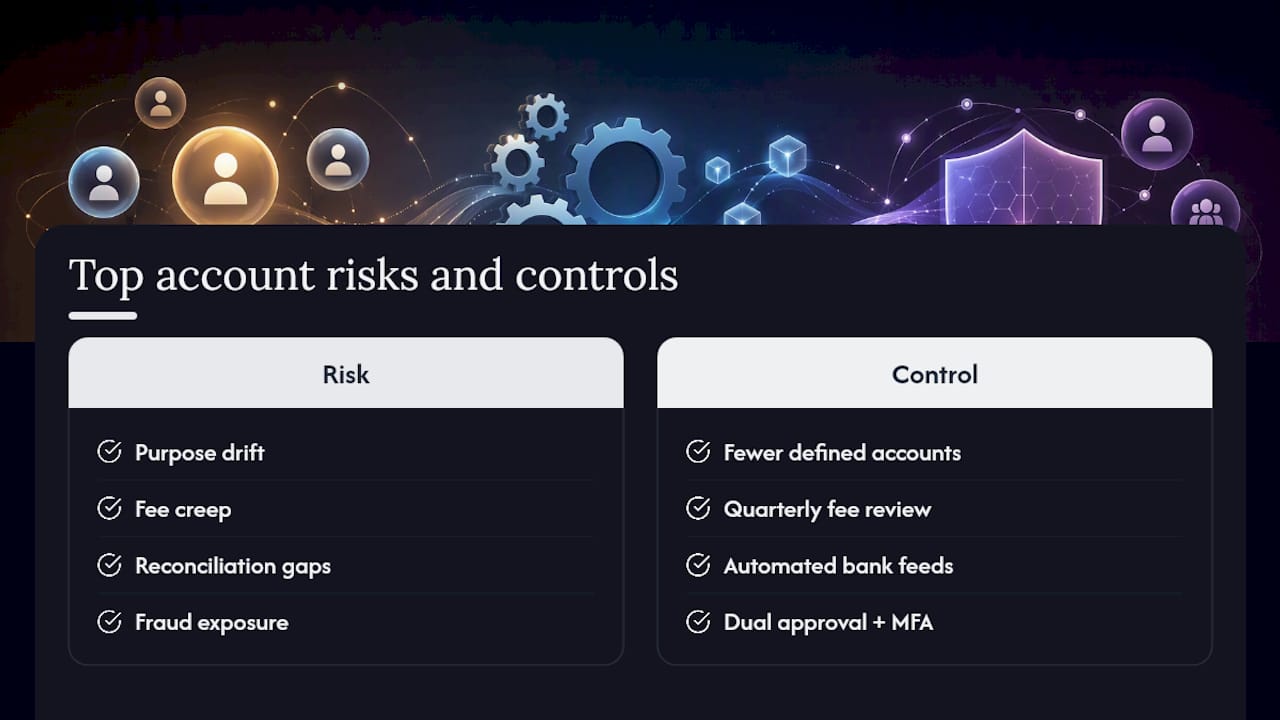
The most common pitfall isn’t fraud. It’s drift: accounts opened for a specific purpose slowly become dumping grounds for whatever transaction doesn’t fit elsewhere. Within a year, the “project account” holds unrelated vendor payments and nobody remembers why.
Fee creep is the second major risk. Five accounts at $10 a month in maintenance fees is $50 monthly, or $600 a year, before a single transfer happens. Review your fee schedule quarterly, not annually, so creep gets caught early.
Reconciliation blind spots grow with every account added. If one person reconciles five accounts manually, errors compound faster than they get caught. Automated bank feeds and a single reconciler role, as covered above, directly address this.
Fraud exposure increases with account count simply because there are more logins, more signatories, and more transfer paths to monitor. Dual approval thresholds and MFA are non-optional once you pass two or three accounts.
Currency mismatch catches businesses receiving international payments who never opened a matching multi-currency account. Converting every foreign receipt into your home currency immediately locks in exchange-rate losses that a dedicated IBAN in the client’s currency would have avoided.
The mitigation for nearly every one of these risks is the same: fewer, better-defined accounts with automated rules, rather than many loosely managed ones.
When Should You Consolidate Instead of Adding More Accounts?
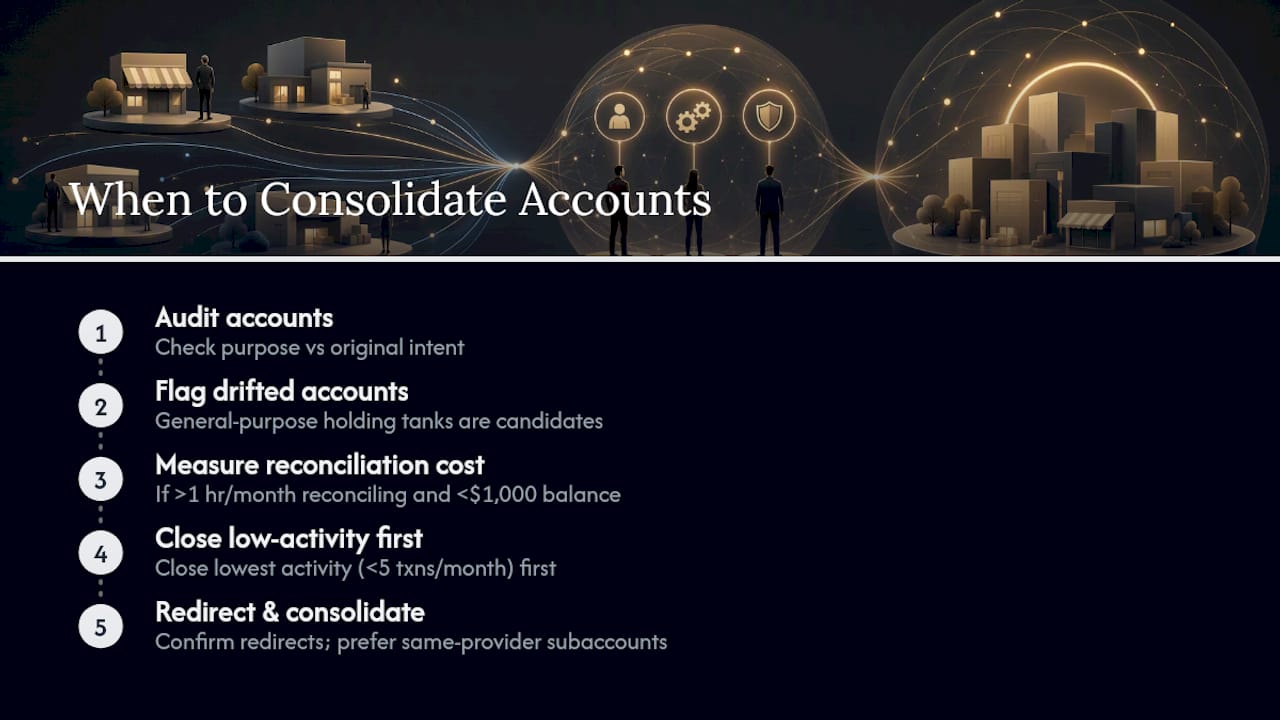
Consolidation makes sense the moment reconciliation time exceeds the benefit the extra account provides. If your bookkeeper spends more than an hour a month reconciling an account that holds under $1,000, that account is probably not earning its keep.
Start consolidation by auditing every account’s actual purpose against its original intent. Accounts that have drifted into general-purpose holding tanks, as described above, are the first candidates to merge back into operating or tax reserve accounts.
Close accounts in order of lowest activity first. An account with fewer than five transactions a month rarely justifies a separate maintenance fee or reconciliation cycle. Before closing, confirm any outstanding direct debits or standing orders have been redirected, since a missed payroll transfer or tax payment during a transition causes far more damage than the account consolidation was meant to prevent.
Consolidating under one provider, rather than closing accounts at different banks entirely, often preserves the benefits of separation, roles, naming, and auditability, while cutting the number of logins, statements, and fee schedules you track. This is where subaccount structures earn their advantage over standalone accounts scattered across institutions: you can merge administrative overhead without losing the purpose-driven separation that made the structure useful in the first place.
What Tax and Compliance Rules Apply to Multiple Accounts?
Holding money across several accounts doesn’t change your underlying tax obligations, but it does change how easily you can prove where money went. Tax authorities expect a clear audit trail from invoice to payment, and a dedicated tax reserve account makes that trail far easier to produce during a review.
Lithuanian businesses must retain proper VAT invoices, or PVM sąskaitos faktūros, and follow specific documentation rules, a requirement SIPA outlines for companies issuing and receiving these invoices. A tax reserve account that automatically receives a fixed percentage of VAT collected on each sale simplifies filing and reduces the risk of a cash shortfall at the filing deadline.
Cross-border transactions add another layer. Money moving between accounts in different currencies or jurisdictions can trigger reporting requirements depending on transaction size and destination. Keep a simple internal transfer log noting the purpose of every inter-account transfer, since tax authorities and auditors both expect a documented reason for money movement, not just a bank statement showing it happened.
Payroll accounts carry their own compliance weight: funds must be available on schedule regardless of what’s happening in the operating account, and payroll tax withholdings should sit in a reserve separate from general operating cash to avoid the compounding penalty risk of late remittance.
How Do You Track Cash Flow Across Several Accounts?
Cash flow visibility is the first thing that breaks when businesses add accounts without a plan. The fix is a single consolidated view, updated daily or weekly, rather than five separate login checks.
Connect every account to one accounting platform through bank feeds, as covered in the automation section above, so balances update automatically instead of requiring manual entry. A weekly cash position summary, listing balance and pending transfers for each account role, catches shortfalls before they become missed payments.
Set a minimum balance alert on every account, not just the operating one. A payroll account that silently drops below its funding threshold because of a delayed sweep is far more dangerous than a low balance in a project account nobody’s actively drawing from.
Reconcile against forecast, not just against the previous statement. Comparing actual balances to what you projected two weeks earlier reveals whether your automated transfer rules are actually keeping pace with revenue, or whether they need adjusting as the business grows.
The Real Lesson Behind Multi-Account Structures
Most advice on multiple business accounts focuses on the split itself, how many accounts, what to call them, when to open a fifth one. That misses the actual point. The value isn’t in the number of accounts; it’s in whether each one has automated rules governing what flows in and out of it without a human remembering to move money manually every week.
Conventional advice also underrates governance relative to structure. Businesses spend hours debating whether to open a fourth account and almost no time defining who approves a $5,000 transfer versus a $500 one. That imbalance is backwards. A three-account structure with strict dual-approval rules and automated tax sweeps will outperform a six-account structure with no access controls, every time.
Prioritize this order: define account roles first, set automation and naming conventions second, and only then consider adding accounts beyond the core three. A platform that supports role-based access and API-driven transfers from the start, rather than bolting automation on later, saves the rework that catches most growing businesses off guard.
— dd
Get Multi-Account Banking Built for This From Day One
Demivolt is built specifically for the structure this article describes: dedicated IBANs for each account role, role-based access so initiators and approvers stay separate, and API integrations that support the automated transfer rules covered above. Where a traditional bank often treats a second or third business account as an afterthought with rising fees, Demivolt’s business accounts are designed as a multi-account structure from account opening, with transparent SEPA and SWIFT pricing you can check against your own volume using the SEPA fee calculator.
If cross-border receipts are part of your business, Demivolt’s payments infrastructure supports multi-currency inflows without forcing an immediate conversion. Businesses managing accounts on behalf of clients or partners can explore the reseller program for recurring revenue on referred accounts. Start by reviewing which of your current account roles, operating, payroll, tax reserve, could move to a single regulated platform, and request account details through a business accounts page.
Sources
- Using Multiple Bank Accounts for Your Small Business — Fit Small Business
- Should you have multiple bank accounts? — QuickBooks
- Key ECB interest rates — European Central Bank
- Ekonomika
- PVM sąskaita faktūra — Everything businesses must know — SIPA
FAQ
How many business accounts should a small business have?
Most SMEs manage well with a few key accounts such as operating, payroll, tax reserve, and sometimes a merchant or project account. Add more only when a specific cash flow need justifies the extra reconciliation work.
Can a business have accounts at different banks?
Yes, there’s no legal limit on how many accounts or institutions a business can use, according to Fit Small Business, though managing several providers increases administrative overhead compared to subaccounts under one platform.
What documents do I need to open an additional business account?
You’ll typically need company registration documents, articles of association, director and beneficial owner IDs, proof of business address, and a list of authorized signatories.
Does Demivolt charge for opening a business account?
Account opening, account verification, and monthly maintenance carry no published fee on Demivolt’s site; SEPA and SWIFT transfers carry small per-transaction costs listed on Demivolt’s site.
How do I stop multiple accounts from becoming hard to manage?
Standardize naming conventions early, automate transfers between accounts through bank feeds and API rules, and assign one person to own reconciliation on a weekly cadence.