

TL;DR:
- A multi-account structure divides business resources into separate accounts based on function, environment, or team, enhancing security, cost management, and compliance. Organizing accounts by function creates stable governance boundaries, facilitates accurate cost attribution, and isolates faults effectively, especially for growing SMEs and e-commerce businesses. Automating account provisioning and involving finance teams early ensures governance, compliance, and financial clarity from the start.
A multi-account structure is a setup that divides business resources across multiple accounts based on function, environment, or team to improve security, cost management, and compliance. Finance and operations managers in SMEs and e-commerce businesses are increasingly adopting these setups because a single shared account creates billing chaos, audit risk, and security exposure. The multi-account structure examples in this article are drawn from real-world cloud and financial infrastructure patterns, giving you a practical framework you can map directly to your organization’s needs.
1. Common multi-account structure examples and their core components

The most widely adopted multi-account structures organize accounts into functional Organizational Units (OUs) rather than by team or product line. This approach keeps governance stable even as your business evolves.
A standard layout includes four core OUs:
- Management account: Handles consolidated billing, organization-wide policies, and governance. No workloads run here. It is the control plane.
- Security OU: Contains a Log Archive account (immutable audit logs) and an Audit account (read-only access for compliance reviews). These two accounts are non-negotiable for any regulated business.
- Infrastructure OU: Houses shared services like networking, DNS, and internal tooling. Centralizing these prevents duplication across workload accounts.
- Workloads OU: Nested accounts for Production, Staging, and Development environments. Each environment gets its own account, not just a separate folder or tag.
- Sandbox OU: Isolated accounts for developer experimentation. These carry relaxed policies but are completely separated from production data.
Organizations with 5 to 10 accounts use basic layouts like this. Larger organizations layer additional OUs for compliance, data residency, or regional separation. The key insight is that account boundaries, not tags or resource groups, provide the cleanest isolation.
Pro Tip: Name accounts with a consistent convention from day one. A pattern like "[company]-[env]-[function](for example,acme-prod-payments`) prevents confusion as your account count grows.
2. How multi-account setups benefit financial and operational management
Understanding multi-account structures means recognizing that account boundaries are the most effective cost and risk isolation tool available to finance teams. Here is why the structure pays off operationally:
- Clear cost attribution. Each account maps to a cost center. Account boundaries simplify cost tracking and make it easier for finance teams to allocate expenses accurately without relying on tagging discipline.
- Controlled spending in non-production environments. Budget alerts and spending limits on Staging and Development accounts prevent runaway costs from experiments or misconfigured jobs.
- Compliance through segregation. Sensitive workloads, such as payment processing or customer PII, sit in dedicated accounts with stricter access controls. Auditors can review a single account rather than sifting through a shared environment.
- Simplified audit and log management. Centralizing logs to an immutable Log Archive account means no single team can tamper with audit trails. This is a requirement for SOC 2, PCI DSS, and EU data protection frameworks.
- Fault isolation. A misconfiguration or security incident in a Development account cannot propagate to Production. Fault isolation through multiple accounts supports operational stability in ways that VPC separation alone cannot achieve.
Multi-account management becomes genuinely valuable once your organization surpasses 30 developers or faces compliance demands. Below that threshold, a well-governed single account may suffice, but the migration cost later is significant.
3. E-commerce multi-account structure examples in practice
E-commerce businesses have specific account separation needs that differ from pure SaaS or internal enterprise setups. The following comparison table shows a practical account layout for a mid-size e-commerce operation.
| Account | Purpose | Policy strictness |
|---|---|---|
| Storefront Production | Customer-facing website and checkout | Strict SCPs, no destructive actions |
| Backend Services | Order management, inventory, fulfillment APIs | Strict SCPs, isolated from storefront |
| Marketing and Analytics | Ad tracking, attribution tools, A/B testing | Moderate, no access to customer PII |
| Payment Processing | Third-party payment gateway integrations | Strictest controls, PCI DSS scope |
| Feature Development | New feature builds and QA testing | Relaxed policies, no production data |
| Security and Logging | Centralized CloudTrail, GuardDuty, audit logs | Read-only for most teams |
| Sandbox | Developer experiments, proof-of-concept builds | Minimal restrictions, time-limited |
Separating the storefront from backend services is the most impactful decision an e-commerce business can make. A breach or outage in the backend services account does not automatically take down the customer-facing checkout. Similarly, keeping the payment processing account in its own PCI DSS scope boundary reduces the compliance surface area dramatically. Marketing and analytics tools, which often carry third-party scripts and integrations, belong in their own account precisely because they represent a higher injection risk.
For cross-border e-commerce operations, a dedicated compliance account for each operating region also makes sense. This is where cross-border payment compliance requirements and data residency rules get enforced at the account level rather than relying on application-layer controls.
4. Automating account provisioning and governance baselines
Manual account setup is the fastest way to create governance failure. Automatic account provisioning is critical because manual processes lead to teams bypassing controls and creating shadow infrastructure.
The standard automation stack for multi-account management includes:
- AWS Control Tower or a custom landing zone: Deploys baseline guardrails automatically when a new account is created. Every account gets CloudTrail, AWS Config, and GuardDuty from day one.
- IAM Identity Center (SSO): Centralizes identity management across all accounts. Users log in once and assume roles in specific accounts based on their job function. This eliminates the need for individual IAM users in each account.
- Service Control Policies (SCPs): SCPs enforce organization-wide guardrails that cannot be bypassed even by account administrators. Finance teams use SCPs to block expensive instance types in development accounts or restrict deployments to approved regions.
- Infrastructure as code (Terraform or AWS CDK): Account configurations are version-controlled and repeatable. No manual clicking in the console.
- Automated budget alerts: Each account has a budget threshold. When spending approaches the limit, alerts fire to the account owner and the finance team simultaneously.
Integrating account vending automation early supports agility and prevents shadow IT from emerging as teams bypass slow manual processes. The cost of retrofitting automation after 50 accounts exist is substantially higher than building it into the first account.
Pro Tip: Set a hard spending limit on Sandbox accounts using AWS Budgets with an automatic action that stops EC2 instances when the threshold is breached. This eliminates surprise bills from forgotten experiments.
5. Choosing the right structure for your business size and compliance needs
Not every SME needs a seven-account hierarchy on day one. The right multi-account setup depends on three factors: team size, regulatory environment, and operational complexity.
- Small teams (under 15 people, no compliance mandates): Start with three accounts. Management for billing, Production for live workloads, and a combined Dev/Staging account. Add accounts as complexity grows.
- Mid-size teams with compliance requirements: Add a Security OU with Log Archive and Audit accounts immediately. Separate Production from Staging. This is the minimum viable structure for SOC 2 or PCI DSS readiness.
- E-commerce businesses handling payment data: Isolate payment processing into its own account to minimize PCI DSS scope. Add a dedicated Marketing account to contain third-party script risk.
- Multi-region or cross-border operations: Add regional accounts or a dedicated compliance account per jurisdiction. This supports data residency requirements under GDPR or local financial regulations.
Organizing OUs by function rather than business unit prevents frequent restructuring. Business units change names, merge, and split. Functions like Security, Infrastructure, and Workloads remain stable. Build your OU hierarchy around what stays constant, not what changes with the org chart.
A phased adoption approach works better than a greenfield rebuild for most SMEs. Start by migrating non-production workloads first, validate the governance baseline, then move production. This reduces risk and gives your team time to learn the new structure before it carries live customer traffic.
For SMEs operating in the EU, dedicated business accounts aligned to specific functions also apply directly to financial account management, not just cloud infrastructure. The same principle of functional separation that governs cloud accounts applies to your banking structure.
Key takeaways
Multi-account structures work best when organized by function rather than team, with automation enforcing governance baselines from the first account created.
| Point | Details |
|---|---|
| Organize by function, not team | Functional OUs like Security and Infrastructure stay stable; business unit OUs require constant restructuring. |
| Account boundaries beat tags | Separate accounts provide cleaner cost attribution and fault isolation than resource tags or VPC separation alone. |
| Automate from account one | Manual provisioning creates governance gaps; use Control Tower or Terraform to deploy baselines automatically. |
| E-commerce needs payment isolation | PCI DSS scope shrinks significantly when payment processing lives in its own dedicated account. |
| Start small, scale deliberately | Three core accounts suffice for small teams; add accounts as compliance demands and team size grow. |
Why most SMEs get multi-account structures wrong from the start
The most common mistake I see finance and operations teams make is organizing their account structure around the current org chart. It feels logical. Marketing gets a marketing account, the dev team gets a dev account, and so on. Six months later, after a reorg or an acquisition, the entire structure needs rebuilding and the governance policies are a mess.
Functional boundaries are more stable than organizational ones. Security is always security. Infrastructure is always infrastructure. Build around those constants and your structure survives the inevitable business changes.
The second mistake is treating automation as a phase two problem. Every team I have worked with that deferred account vending automation ended up with a sprawl of manually configured accounts, each slightly different, each carrying its own undocumented exceptions. The technical debt from that inconsistency costs more to fix than building the automation pipeline would have cost originally.
The third mistake is underestimating the finance team’s role in this process. Multi-account management is not purely a cloud architecture decision. It is a financial governance decision. When finance teams are involved from the start in defining cost center boundaries and budget alert thresholds, the resulting structure actually reflects how the business tracks money. That alignment is what makes the structure useful rather than just technically correct.
For SMEs managing cross-border compliance alongside cloud infrastructure, the same discipline applies to your banking accounts. Functional separation in your financial accounts mirrors the same logic that makes cloud multi-account structures effective.
— dd
How Demivolt supports multi-account financial management
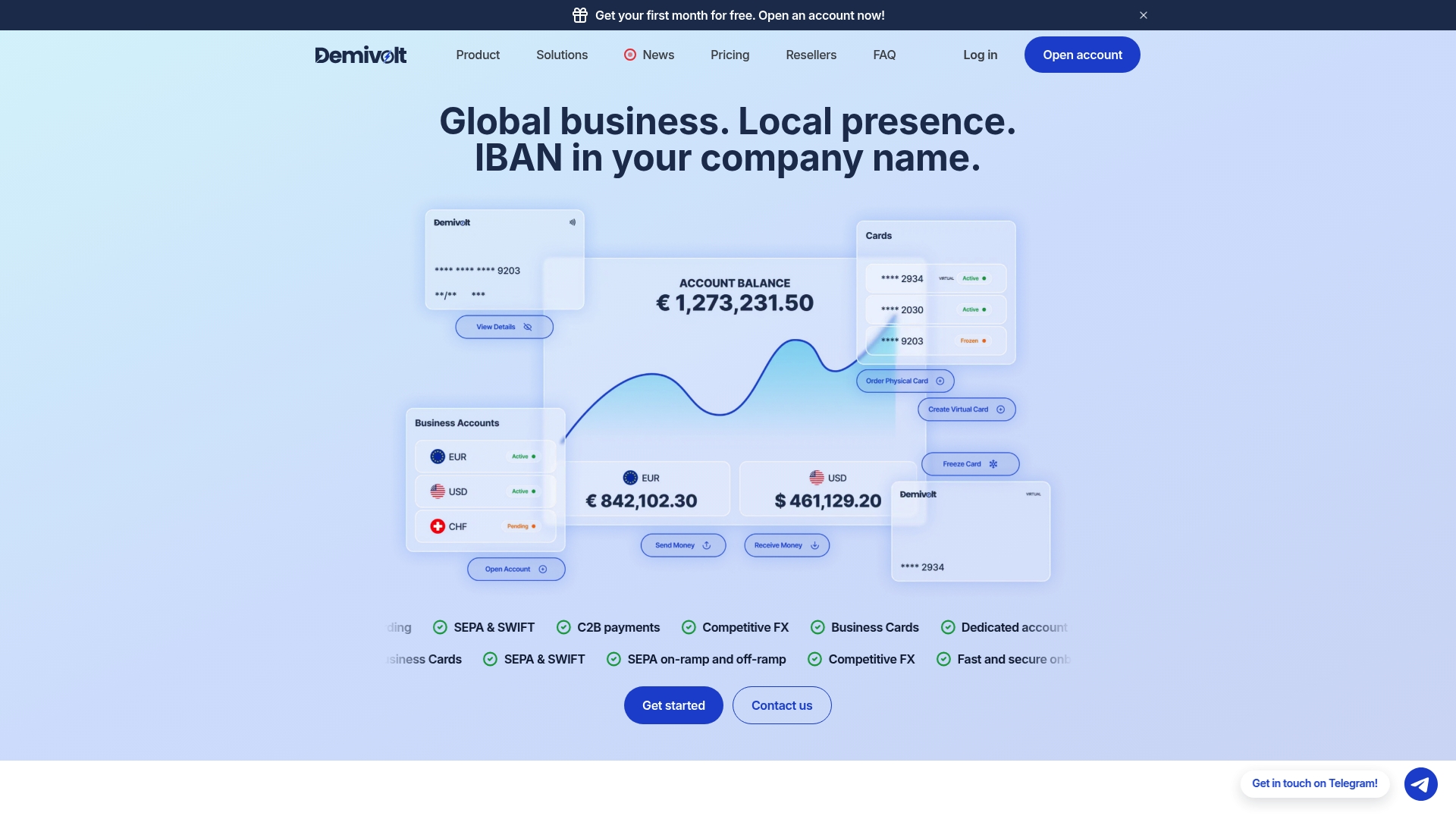
Finance and operations managers who apply multi-account principles to their cloud infrastructure often find the same logic applies to their banking setup. Demivolt is built for exactly this. The platform lets SMEs and e-commerce businesses open dedicated IBAN accounts for specific functions, whether that is separating operating expenses from payroll, isolating payment processing funds, or managing cross-border SEPA and SWIFT transactions in distinct accounts. Role-based user management mirrors the IAM Identity Center model: each team member accesses only the accounts relevant to their function. For businesses managing payments across EU jurisdictions, Demivolt’s free SEPA tools and compliance-first onboarding reduce the operational overhead of maintaining clean, auditable financial records across multiple accounts.
FAQ
What is a multi-account structure?
A multi-account structure divides business resources across multiple accounts organized by function, environment, or team to improve security, cost control, and compliance. Each account acts as an isolation boundary, preventing issues in one area from affecting others.
How many accounts does an SME need?
Most SMEs start with three accounts: a Management account for billing, a Production account for live workloads, and a Development account for testing. Compliance requirements or team growth typically trigger the addition of Security and Infrastructure accounts.
What are the main benefits of multi-account management?
The primary benefits are clear cost attribution per account, fault isolation between environments, simplified compliance audits, and the ability to enforce spending limits on non-production accounts without affecting production workloads.
Why should e-commerce businesses separate payment processing accounts?
Isolating payment processing into a dedicated account reduces the PCI DSS compliance scope to a single account rather than the entire infrastructure. This lowers audit complexity and limits the blast radius of any security incident.
Should OUs be organized by business unit or function?
Organize OUs by function, not business unit. Functional OUs remain stable over time, while business unit structures change with reorganizations and acquisitions, forcing costly governance restructuring.
Recommended
- Demivolt | Blog – How to manage multiple accounts: A step-by-step guide for SMEs
- Demivolt | Blog – Multi-account setup process guide for SMEs
- Demivolt | Blog – Types of Business Bank Accounts: Find the Right Fit for Your SME
- Demivolt | Blog – Business account verification: compliance and efficiency for SMEs