

The best banking for multiple accounts is a regulated provider that issues dedicated IBANs per entity, supports both SEPA and SWIFT rails, and layers in multi-account structures with role-based access and card programme capability. For a CFO managing cross-border invoicing, that combination is what actually protects reconciliation and reduces regulatory exposure, not just what looks good on a features page.
- Credibility with partners: entity-named IBANs read as local and legitimate, not like a third-party collection account.
- Simpler reconciliation: dedicated accounts per entity or currency cut down the manual matching work your finance team does every month.
- Compliance built in, not bolted on: licensed rails with embedded KYB and transaction monitoring lower your regulatory risk from day one.
Run the decision checklist further down this page before you talk to any provider, then request onboarding timelines directly.
Key Takeaways
Regulated business banking with dedicated IBANs, SEPA/SWIFT support, and role-based multi-account access reduces reconciliation friction and regulatory exposure for cross-border SMEs.
| Point | Details |
|---|---|
| Choose dedicated IBANs | Entity-named accounts improve partner credibility and simplify invoice matching. |
| Require both rails | SEPA and SWIFT coverage together avoids gaps in domestic and international collections. |
| Prioritize fund segregation | Segregated client funds and EU licensing should outweigh cost in early vendor scoring. |
| Plan onboarding realistically | Expect days for straightforward setups, weeks for multi-entity KYB and KYC review. |
| Demivolt fits the checklist | Demivolt offers dedicated IBANs, SEPA/SWIFT rails, card programmes, and role-based access under EU regulatory compliance. |
This article is general information, not a substitute for advice from a qualified financial advisor. Consult a qualified financial professional about your own circumstances before acting on anything here.
Table of Contents
- Why Dedicated IBANs and Multi-Account Structures Matter for Cross-Border B2B
- What Features Should You Require From a Multi-Account Provider?
- How Demivolt Maps to That Checklist
- What Do Fees and Onboarding Actually Look Like?
- Integrating Multi-Account Banking Into Your Operations
- What Questions Should You Ask Before Choosing a Provider?
- How Demivolt Simplifies Multi-Account Banking for Growing Businesses
- Sources
Why Dedicated IBANs and Multi-Account Structures Matter for Cross-Border B2B
Dedicated, entity-named IBANs and structured multi-account setups reduce reconciliation friction and materially improve how your business reads to partners and banks abroad. A generic pooled or third-party collection account signals something else entirely: practitioners routinely note that relying on shared collection accounts can look unprofessional and slow down B2B relationships, while local-like account details reduce payment friction with European counterparties.
The operational case is just as strong as the commercial one:
- Invoice matching gets faster when each entity, currency, or revenue stream has its own account trail.
- Chargeback and dispute risk drops because payments land where you expect them, not in a shared pool.
- AML and KYC traceability improves, since each account maps cleanly to a specific business relationship.
Building this compliance logic directly into the payment stack, rather than retrofitting it later, scales better and produces auditable trails compared with manual, bolted-on processes.
Pro Tip: Organize accounts by purpose first, not by convenience. Separate accounts for domestic collections, EUR settlement, and USD invoicing will save your bookkeeper hours every close cycle compared with one account handling everything.
What Features Should You Require From a Multi-Account Provider?
Before you shortlist anyone, check the account infrastructure itself. A provider worth considering should offer:
- Dedicated IBANs per entity or account, not a shared pool identifier
- Both SEPA and SWIFT rails, so domestic European transfers and international wires run through the same platform
- Multi-currency balances to avoid unnecessary conversion on every incoming payment
- Virtual and physical card programme support for team spend
- Role-based access with audit logs, so you can see exactly who approved what
- Segregated client funds and clear EU licensing, so your cash sits outside the provider’s own balance sheet
Beyond the account itself, integration depth separates a usable platform from a spreadsheet with extra steps:
- REST APIs for payments and account data
- Webhooks for real-time reconciliation events
- ERP or accounting connectors that eliminate manual export/import
- Card programme APIs for issuing and controlling spend limits
On the compliance side, look for embedded KYB and KYC at onboarding, ongoing transaction monitoring (often called KYT), and a tamper-proof audit trail that satisfies your own auditors, not just the provider’s.
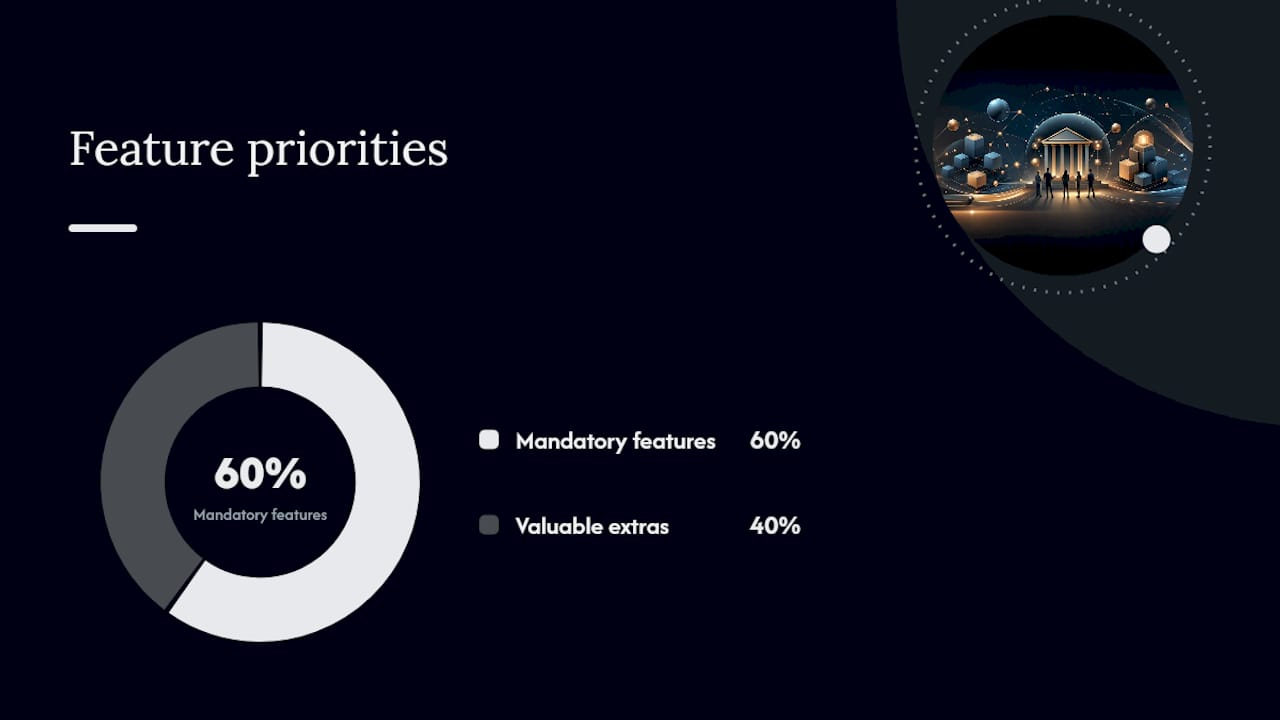
Treat multi-rail routing, role-based permissions, and fund segregation as mandatory. Treat FX rate tools and advanced spend analytics as valuable extras, not deal-breakers, when comparing shortlisted providers.
How Demivolt Maps to That Checklist
Demivolt was built around exactly this checklist rather than around a single generic account type. The platform issues dedicated IBAN accounts per business need, supports SEPA and SWIFT for both inbound and outbound transfers, and structures multi-account setups with role-based user management so finance leads can control who initiates and who approves.
- Dedicated IBANs and multi-currency structures: covered directly, with entity-level account separation available for growing operations.
- Card programmes: virtual and physical Visa business cards issue against defined spend controls.
- Regulatory footing: operates under EU regulatory standards with client funds held in segregated accounts, separate from Demivolt’s own operating capital.
- Documentation: onboarding steps, product docs, and technical guides are published rather than locked behind a sales call.
Embedding compliance directly into the transaction layer, rather than layering it on after the fact, is what lets a platform scale without a costly retrofit later.
That principle is what built-in compliance infrastructure is designed to solve, and it is the same reasoning behind Demivolt’s account architecture. The platform also runs a reseller program for advisors and partners who refer clients, which reflects a B2B-first posture rather than a consumer afterthought.
What Do Fees and Onboarding Actually Look Like?
Pricing for regulated multi-IBAN banking typically breaks into a handful of predictable components:
- Account fees — often a flat monthly or per-entity charge
- Transaction fees — separate rates for incoming and outgoing SEPA versus SWIFT
- Card issuance and scheme fees — per card and sometimes per transaction
- FX margins — applied when converting between currencies
- Integration or API fees — occasionally tiered by usage volume
Onboarding follows a fairly consistent path across regulated providers: document submission, KYB and KYC review, account approval, then IBAN issuance and API activation. Best case, that whole sequence can close within days; conservative estimates, especially for multi-entity structures, run into a few weeks.
- Prepare your legal documentation and beneficial ownership records before you apply.
- Have a KYC-ready list of directors and beneficiaries on hand to avoid review delays.
- Budget separately for any reconciliation automation or ERP integration work beyond the account itself.
Integrating Multi-Account Banking Into Your Operations
Integrations are what turn dedicated IBANs into an operational system instead of a manual chore, and they’re essential once you’re running more than two or three entities; for guidance on structuring separate legal entities and accounts, see Running More Than One Business? Keep the Lines Clean. Centralized payment orchestration with multi-rail routing across SWIFT, SEPA, and other rails reduces intermediaries and manual reconciliation work.
Plan for these building blocks:
- REST APIs and webhooks that push transaction events into your ledger in real time
- Batch payment APIs for payroll or supplier runs
- Invoice IDs and metadata tagged at the transaction level, feeding a centralized payment factory model
- Card programme APIs to manage limits, freezes, and spend categories without manual tickets
Pro Tip: Define your reconciliation data contract, meaning exactly what metadata each transaction needs, before your engineering team touches the API. It’s the single fastest way to avoid rework later.
What Questions Should You Ask Before Choosing a Provider?
Use these on every vendor call:
- What exact regulatory licences do you hold, and what is their scope?
- How are client funds segregated from your own operating capital?
- What does your audit trail capture, and can we export it?
- What are your API uptime and support SLAs?
- What’s your realistic onboarding timeline for our entity structure?
- How do you handle payment disputes and reversals?
Watch for these red flags:
- Vague or evasive answers about fund segregation
- No documented compliance process you can actually read
- Missing or incomplete audit logs
- Pricing that isn’t disclosed until late in the sales process
- Missing support for a payment corridor you actually use
Weight compliance and fund safety above raw cost, especially with real cross-border exposure. Before committing, run a proof-of-concept with modest pilot volumes and sandbox API access, and set clear go/no-go criteria in advance. It’s also worth remembering that market practice often favors splitting roles across providers to match domestic and international strengths, so don’t assume one provider needs to do everything forever.
A Pragmatic Take on Regulated Multi-IBAN Banking
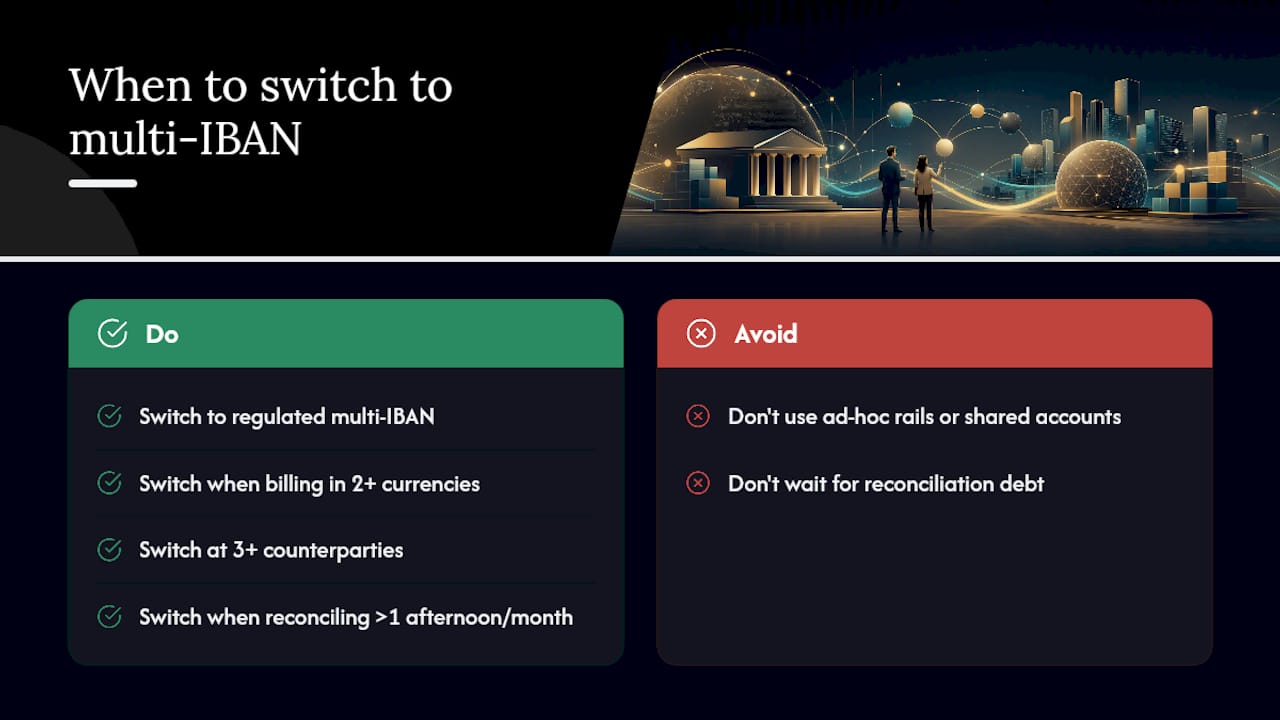
Regulated multi-IBAN banking isn’t a luxury reserved for enterprises. It’s a defensive investment the moment your invoicing crosses two currencies or three counterparties, because ad-hoc rails and shared accounts quietly accumulate reconciliation debt. Switch once you’re spending more than an afternoon a month untangling which payment belonged to which client.
How Demivolt Simplifies Multi-Account Banking for Growing Businesses
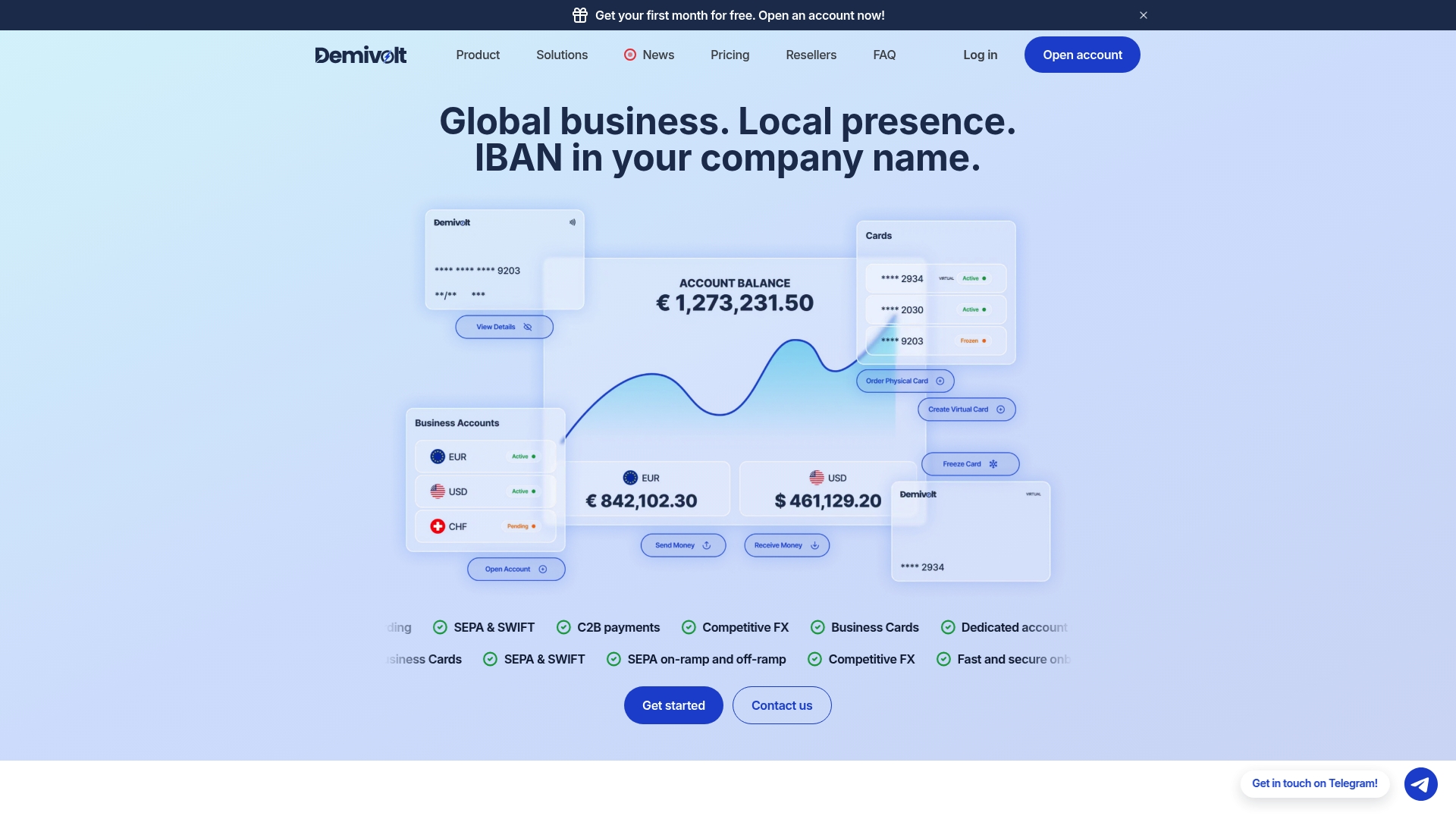
Everything covered above, dedicated IBANs, SEPA and SWIFT rails, role-based access, card programmes, is what Demivolt was built to deliver as a single regulated platform instead of a patchwork of workarounds.
- Check your account details instantly with the free IBAN validator before your next payment run.
- Explore the broader set of free SEPA tools built for teams testing payment flows.
- Open a business account and get a documented onboarding timeline directly from Demivolt.
If you’re ready to move past shared collection accounts and manual reconciliation, start the onboarding conversation now and get a clear timeline for your specific entity structure.
Sources
- Why Fintech Compliance Must Be Built Into Payments Infrastructure
- Optimizing Cross-Border B2B Payments for Speed, Cost, and Control
- International Business Banking: Accounts, Structures, and Best Practice for Cross-Border Companies
Recommended
- Demivolt | Blog – Types of Business Bank Accounts: Find the Right Fit for Your SME
- Demivolt | Blog – How to manage multiple accounts: A step-by-step guide for SMEs
- Demivolt | Blog – Modern business banking trends: boost efficiency & compliance
- Demivolt | Blog – Multi-User Business Banking Advantages for SMEs