

Compliance in B2B payments is the systematic adherence to regulatory, security, and operational standards that protect every transaction from initiation to settlement. It is not a one-time checkbox. It is a continuous discipline that determines whether your business can process payments legally, securely, and without interruption. The core role of compliance in B2B payments covers three interconnected priorities: preventing fraud, protecting sensitive financial data, and satisfying the legal obligations imposed by regulators like FinCEN, NACHA, and the Federal Reserve. Standards such as PCI DSS, AML, and KYC form the backbone of this framework, and failing to meet them carries consequences far beyond a single fine.
Key areas where compliance directly shapes B2B payment performance:
- Fraud prevention: AML and KYC controls identify suspicious activity before funds move.
- Data protection: PCI DSS governs how cardholder and payment data must be stored and transmitted.
- Transaction approval rates: Regulatory alignment with frameworks like PSD2 affects whether cross-border payments clear or get rejected.
- Operational continuity: Non-compliance can trigger processing agreement terminations, not just penalties.
- Legal exposure: Violations of the Bank Secrecy Act (BSA) or sanctions screening requirements can result in criminal liability.
IBM’s research puts the average global data breach cost at $4.45 million, a figure that reflects both direct financial loss and the downstream costs of remediation, legal action, and reputational repair. For B2B operations handling high-value transactions, the exposure is proportionally higher.
What regulatory bodies and laws govern B2B payment compliance in the US?
The US regulatory environment for B2B payments involves multiple overlapping authorities, each with a distinct mandate. Understanding who sets the rules, and which laws apply to your transactions, is the starting point for any credible compliance program.
Key regulatory bodies:
- FinCEN (Financial Crimes Enforcement Network): Administers the Bank Secrecy Act and oversees AML reporting obligations, including Suspicious Activity Reports (SARs) and Currency Transaction Reports (CTRs).
- Federal Reserve: Sets standards for payment system integrity and oversees large-value payment systems including Fedwire.
- NACHA: Governs ACH network rules, including authorization requirements and return rate thresholds for electronic payments.
- SEC: Regulates payment-related activities for broker-dealers and investment firms operating in B2B contexts.
- FTC: Enforces consumer and business data protection standards, including the FTC Act, which applies to deceptive or unfair payment practices.
| Regulation / Framework | Governing Body | Primary Focus |
|---|---|---|
| Bank Secrecy Act (BSA) | FinCEN / IRS | AML reporting, transaction monitoring |
| AML / KYC Rules | FinCEN | Identity verification, suspicious activity |
| PCI DSS | PCI Security Standards Council | Payment card data security |
| ACH Operating Rules | NACHA | Electronic payment authorization and returns |
| GDPR (cross-border) | EU / EEA regulators | Data privacy for EU-linked transactions |
| CCPA | California AG | Data privacy for California-based counterparties |
| PSD2 (reference) | European Commission | Open banking, strong customer authentication |
Cross-border B2B transactions add another layer. When a US company pays a European supplier, GDPR data handling requirements and PSD2 authentication standards may apply on the European side, even if the US entity has no direct EU presence. The CCPA similarly extends obligations to any business processing data from California residents, regardless of where the business is headquartered.
Regulatory changes are accelerating. The ISO 20022 migration, which requires structured address data in cross-border payment messages, is pushing businesses to remediate master data proactively. Payments that carry incomplete or unstructured address fields face rejection or delay, creating operational risk for companies that have not updated their data standards.
Which compliance standards matter most for B2B payment security?
Three frameworks sit at the center of B2B payment compliance: PCI DSS, AML/KYC, and data privacy law. Each addresses a different layer of risk, and together they cover the full surface area of a compliant payment operation.
PCI DSS (Payment Card Industry Data Security Standard) applies to any business that stores, processes, or transmits payment card data. The PCI Security Standards Council maintains these requirements, which include network segmentation, encryption, access controls, and regular vulnerability scanning. For B2B companies using virtual cards or corporate card programs, PCI DSS compliance is not optional.
AML and KYC frameworks require businesses to verify the identity of counterparties, monitor transactions for suspicious patterns, and file reports with FinCEN when thresholds or red flags are triggered. The Bank Secrecy Act underpins these obligations in the US. KYC goes beyond onboarding. It requires ongoing monitoring of customer profiles, so a counterparty that passes initial screening must still be re-verified when circumstances change.
Sanctions and PEP screening are non-negotiable for any business with international payment flows. OFAC (Office of Foreign Assets Control) maintains sanctions lists that must be checked before funds move. Politically exposed persons (PEPs) require enhanced due diligence because of their elevated risk profile. Missing a sanctions hit is not a paperwork error; it is a federal violation.
Data privacy laws including GDPR and CCPA govern how payment-related personal data is collected, stored, and shared. For B2B payments, this includes supplier bank account details, contact information, and transaction records.
Pro Tip: Coordinate UBO (ultimate beneficial ownership) verification with bank account verification as a single integrated workflow, not two separate checks. Treating them independently creates gaps that shell company fraud schemes exploit directly.
Payment compliance standards like PCI DSS, AML, and KYC are not static. They are updated regularly, and your compliance program must track those updates and adjust controls accordingly.
Best practices for maintaining B2B payments compliance at scale
Achieving compliance once is straightforward. Maintaining it across growing transaction volumes, new payment corridors, and evolving regulations is where most businesses struggle. The following practices address that challenge directly.
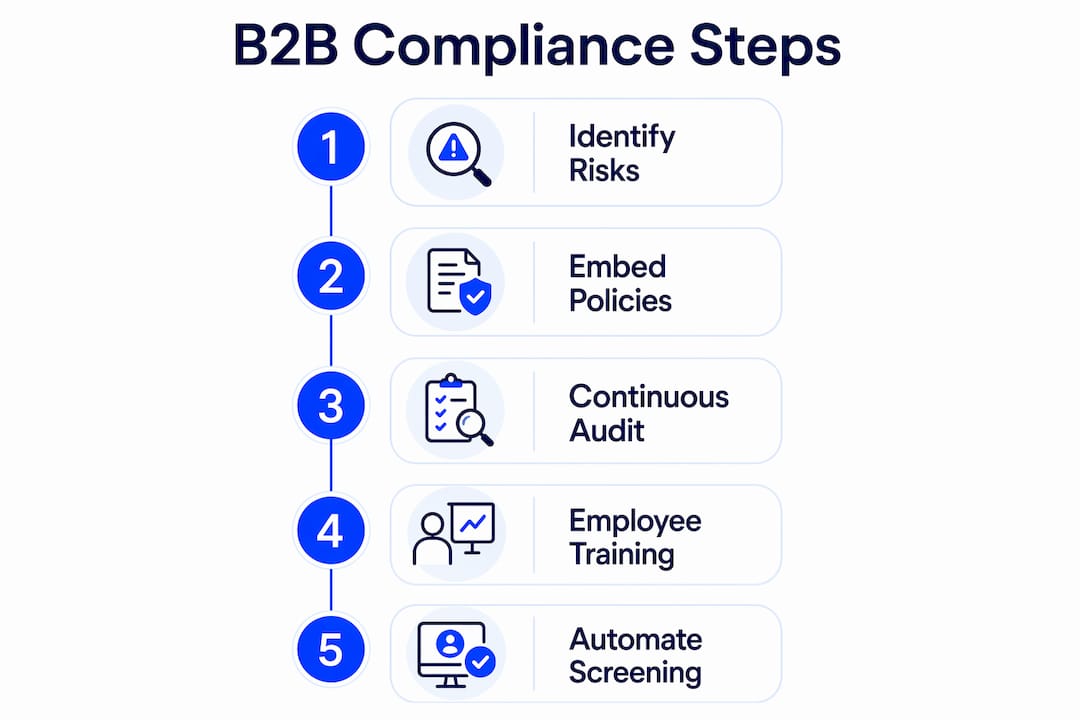
Embed policy logic into payment workflows. Real-time governance means compliance controls execute at the moment of payment, not after the fact. Dynamic spending rules, automated approval escalation, and threshold-based holds all reduce the window for non-compliant transactions to clear.

Maintain continuous audit trails. Every payment decision, including approvals, rejections, and policy overrides, should generate a timestamped record. This documentation supports both internal audits and regulatory examinations. Regulators increasingly expect to see not just what happened, but which policy authorized it.
Build a structured employee training program. Compliance failures often trace back to staff who did not know the rules or did not understand how they applied to their role. Training should be role-specific, updated annually at minimum, and tied to clear escalation procedures when a potential violation is identified.
Conduct regular compliance risk assessments. A risk assessment maps your current payment flows against applicable regulations and identifies gaps. It should be repeated whenever you enter a new market, add a payment method, or when a relevant regulation changes. The output should drive a prioritized remediation plan, not just a report.
Automate re-verification and sanctions screening. Continuous monitoring of bank account data and UBO information catches changes that occur after onboarding. A supplier who passed KYC at onboarding may appear on a sanctions list six months later. Automated screening catches that; manual periodic reviews often do not.
Pro Tip: Embed compliance controls directly into your payment orchestration layer so that policy enforcement runs silently in the background. When compliance is invisible to the end user, adoption is higher and workarounds are fewer.
For businesses managing cross-border compliance, the same principles apply, but the regulatory surface is wider. Multi-jurisdiction operations require mapping each payment corridor to its applicable rules before the first transaction clears.
Who is responsible for payments compliance in the B2B ecosystem?
Compliance obligations in B2B payments do not rest with a single party. They distribute across every entity that touches a transaction, and the scope of each party’s responsibility depends on their role and the transaction’s risk profile.
Compliance stakeholders in a typical B2B payment chain:
- Buyers: Responsible for verifying supplier identity, maintaining accurate payment records, and adhering to internal approval policies.
- Suppliers: Must provide accurate banking and ownership information, including UBO disclosures where required.
- Payment processors: Subject to PCI DSS, AML program requirements, and NACHA operating rules for ACH transactions.
- Banks and financial institutions: Hold primary AML/KYC obligations and must file SARs and CTRs with FinCEN.
- Fintech platforms: Regulated infrastructure providers like Demivolt operate under EU regulatory standards, maintaining segregated client accounts and meeting KYC requirements at onboarding and beyond.
- Corporate treasury teams: Responsible for policy enforcement, audit trail maintenance, and escalation procedures within their organizations.
Transaction size and risk profile shift the intensity of compliance obligations. High-value cross-border payments attract greater scrutiny than routine domestic invoices. Transactions involving counterparties in high-risk jurisdictions require enhanced due diligence regardless of amount.
One distinction that businesses frequently overlook: compliance is not a one-time onboarding exercise. The importance of compliance in payments extends through the entire relationship lifecycle. A counterparty’s risk profile can change after onboarding, and your compliance program must be structured to detect and respond to those changes.
For SMEs operating internationally, the international compliance checklist approach helps map obligations by jurisdiction and transaction type, making it easier to assign clear ownership within a lean team.
Financial traceability and the real cost of non-compliance in B2B payments
Financial traceability has moved beyond a regulatory formality. Enterprises now need to document not just transaction outcomes, but the specific policies and approvals that authorized each fund movement. Traceability provides continuous auditability that regulators and internal risk teams both depend on, and it is increasingly a condition of operating at scale in cross-border B2B payments.

The consequences of non-compliance extend well beyond the initial penalty. Industry experts warn that compliance failures rarely stay contained. A single enforcement action can trigger a cascade: forced audits, increased transaction monitoring requirements, elevated fees from banking partners, and in serious cases, termination of processing agreements. Reputational damage compounds the financial impact, often lasting years after the underlying issue is resolved.
Key risk considerations for B2B payment operations:
- Financial penalties: Regulatory fines for AML violations, BSA failures, or PCI DSS breaches can reach into the millions.
- Processing agreement termination: Payment processors and banks can exit relationships with non-compliant businesses, cutting off payment infrastructure.
- Reputational harm: Enforcement actions are public. Counterparties, investors, and banking partners all see them.
- Operational disruption: Forced audits and remediation programs consume internal resources and slow payment operations.
- Chain reaction risk: One compliance gap often reveals others, triggering broader regulatory scrutiny.
The average cost of a data breach globally sits at $4.45 million according to IBM’s research. For B2B companies processing high-value transactions, a single compliance failure can exceed that figure when legal costs, remediation, and lost business are included.
Integrated verification workflows address the most common source of these failures. When bank account verification and UBO checks run as a unified process rather than separate steps, the gaps that enable shell company fraud and account compromise are closed at the workflow level, before a payment clears.
How should you structure ongoing compliance monitoring and auditing?
Ongoing monitoring is what separates a compliance program that holds up under scrutiny from one that looks good on paper. The process has four core components, each of which must operate continuously rather than on an annual cycle.
Transaction monitoring runs in real time, flagging payments that match suspicious patterns: unusual amounts, unfamiliar counterparties, transactions just below reporting thresholds, or payments to high-risk jurisdictions. Automated systems handle the volume; human reviewers handle the escalations.
Periodic re-verification of counterparty data, including bank account details and UBO information, catches changes that occur after onboarding. The frequency should match the risk profile of the relationship. High-risk counterparties warrant quarterly re-verification; lower-risk suppliers may require annual checks.
Internal audits test whether your controls are actually working as designed. An audit should examine a sample of transactions, verify that approval workflows executed correctly, confirm that sanctions screening ran on every payment, and check that exceptions were documented and resolved. The audit findings should feed directly into your risk assessment and remediation cycle.
Regulatory change tracking keeps your program current. Assign clear ownership for monitoring updates from FinCEN, NACHA, the Federal Reserve, and relevant international bodies. When a rule changes, the impact on your payment workflows should be assessed and addressed before the effective date, not after.
Payment compliance programs that treat monitoring as a background function rather than a core operational discipline tend to accumulate undetected gaps. By the time those gaps surface in an audit or enforcement action, the remediation cost is far higher than proactive monitoring would have been.
Key Takeaways
Compliance in B2B payments requires continuous monitoring, integrated verification workflows, and real-time policy enforcement to prevent fraud, satisfy regulators, and protect operational continuity.
| Point | Details |
|---|---|
| Compliance is continuous | Regulatory obligations apply throughout the payment lifecycle, not just at onboarding. |
| Data breach costs are concrete | IBM reports the average global data breach costs $4.45 million, underscoring the financial stakes of compliance failure. |
| Non-compliance cascades | A single enforcement action can trigger audits, fee increases, and processing agreement termination. |
| Integrated verification closes gaps | Combining bank account verification with UBO checks in one workflow prevents shell company and account fraud. |
| Traceability is now a strategic requirement | Enterprises must document the policies and approvals behind each payment, not just the transaction outcome. |