

TL;DR:
- Using a multi-currency account helps SMBs avoid costly conversion fees and simplifies international payments. It allows holding, receiving, and paying in multiple currencies without immediate conversion, providing operational, cost, and treasury management benefits. Implementing such accounts can enhance local payment collection, reduce settlement times, and improve currency risk management.
If your business regularly receives revenue in foreign currencies, pays overseas suppliers, or holds currency exposure between invoice and settlement, a multi-currency account is not optional — it is a direct cost and efficiency lever. For U.S.-based SMBs with even one active international corridor, the combination of forced conversion fees, slow correspondent banking, and fragmented account structures typically erodes margins in ways that are easy to miss until you run the numbers.
Three scenarios where the importance of multi-currency accounts becomes concrete:
- You receive foreign-currency payments (EUR, GBP, CAD) and your bank converts them immediately at its own spread, often above the mid-market rate.
- You pay overseas suppliers and absorb a double conversion: your USD converts to an intermediary currency, then to the supplier’s local currency, each step carrying a fee.
- You hold currency exposure between invoice date and payment date, with no mechanism to time the conversion or lock a rate.
Quick diagnostic: List every currency you receive, every currency you pay out, and any open FX exposure. Then request all-in fee schedules from two or three regulated providers. That 30-minute exercise usually reveals the annual cost of your current setup.
Table of Contents
- What a multi-currency account actually is (and what it isn’t)
- Key benefits for international SMBs
- How multi-currency accounts work: the mechanics
- Who provides multi-currency accounts?
- Challenges and common pitfalls
- How to choose the right multi-currency account
- Typical fees and onboarding timelines
- Practical SMB use cases
- How multi-currency accounts support supplier relationships and scale
- Key Takeaways
- A low-risk way to start: the pilot approach
- Demivolt offers regulated multi-currency infrastructure for SMBs
- Useful sources and further reading
What a multi-currency account actually is (and what it isn’t)
A multi-currency account is a single account structure that can hold, receive, convert, and send multiple fiat currencies without forcing an immediate conversion at the moment of receipt. That last clause is the operational distinction that matters most.
The payment flow works in four steps:
- Receive. Funds arrive in the sender’s currency via local rails (ACH, SEPA, Faster Payments) or SWIFT, credited to a currency-specific balance within your account.
- Hold. The balance sits in the original currency. You decide when, and whether, to convert.
- Convert. When you choose to convert, you execute at the provider’s rate. Some providers offer forward contracts or rate locks for up to 24 months, which is a hedging tool, not a standard feature of every account.
- Pay. You send from the relevant currency balance, either via local rails or SWIFT, to a supplier, contractor, or marketplace.
What a multi-currency account is not: it is not the same as opening a single-currency foreign account at a local bank in another country, and it is not automatic hedging. Unless your provider explicitly offers forward contracts or options, holding a currency balance is an exposure, not a hedge.
Key benefits for international SMBs
The advantages of using multi-currency accounts go beyond the obvious FX savings. Here is where the operational value concentrates:
- Lower conversion costs. Avoiding forced immediate conversion eliminates the spread charged at receipt. Providers with transparent, competitive FX pricing typically charge a fraction of what legacy banks embed in their exchange rates.
- Local collection details. Local IBANs and routing numbers let your customers pay you over domestic rails, which is faster and cheaper than cross-border wires for both parties.
- Faster settlement. Domestic-rail collections (SEPA in Europe, ACH in the U.S.) settle in hours rather than the two to five business days typical of correspondent SWIFT chains.
- Cashflow control. Holding balances in the currency you received gives you the option to pay suppliers in that same currency, eliminating a round-trip conversion entirely.
- Conversion timing. The ability to wait for favorable exchange windows reduces the impact of FX volatility on your margins. This is particularly valuable for businesses with predictable monthly payables in a foreign currency.
- Supplier and customer relationships. Paying partners in their local currency signals operational sophistication and often improves supplier terms and acceptance rates.
- Treasury visibility. A consolidated dashboard across currency balances replaces the manual reconciliation of multiple local accounts.
A concrete example: A U.S. e-commerce business receives €40,000 from European customers each month. At a legacy bank applying a conversion spread, that can amount to significant losses monthly and annually, before any wire fees. Holding the EUR balance and paying a EUR-denominated supplier directly eliminates that conversion entirely.
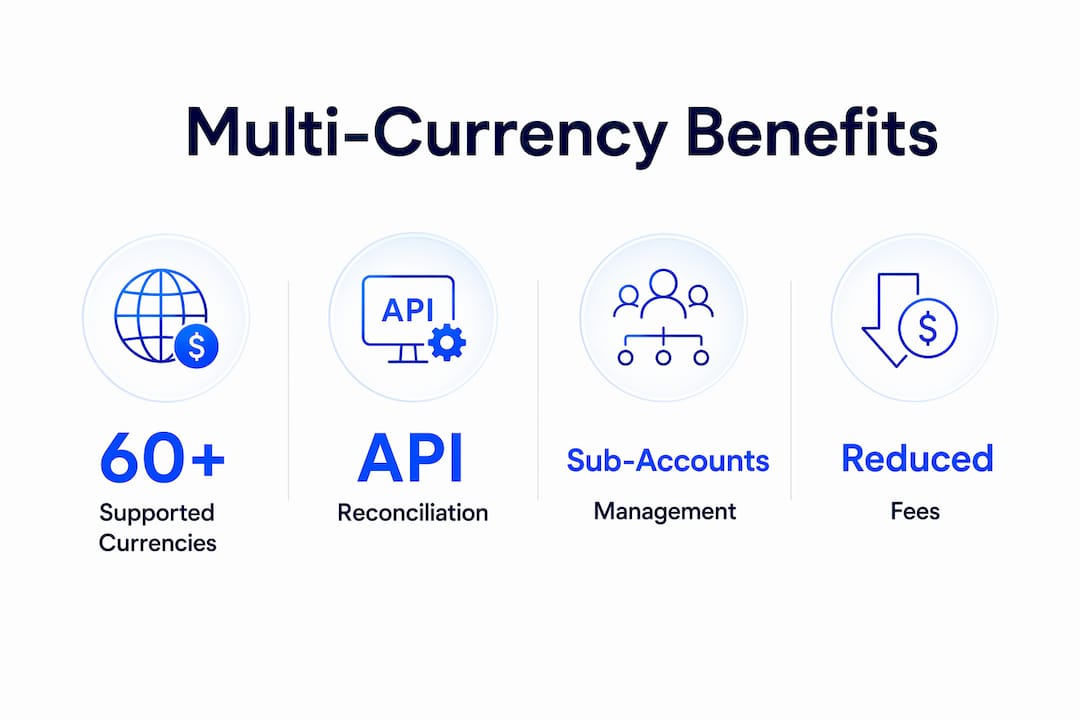
Modern platforms supporting 60+ currencies with API-driven reconciliation and sub-accounts have made this level of treasury control accessible to SMBs, not just enterprise treasury teams.
How multi-currency accounts work: the mechanics
Understanding the payment flow helps you identify exactly where fees appear and where you can reduce them.

Receipt: Your provider issues local receiving details — a U.S. routing number and account number for ACH, a European IBAN for SEPA, a UK sort code and account number for Faster Payments. Payers send domestically; you receive in their currency.
Holding and sub-accounts: Each currency sits in a dedicated balance or sub-account. API-driven reconciliation matches incoming transactions to invoices automatically on modern platforms, removing the manual ledger work that multiplies as corridors increase.
Conversion: You initiate conversion at a time of your choosing. The provider applies its FX rate (mid-market plus a spread, or a flat fee per conversion). Some providers allow rate locks or forward contracts for planned payables.
Payout: You send from the relevant balance via the most efficient rail available.
| Payment rail | Typical settlement | Notes |
|---|---|---|
| USD ACH | 1–2 business days | Domestic U.S.; low cost |
| EUR SEPA Credit Transfer | Same day to 1 business day | Within SEPA zone |
| GBP Faster Payments | Minutes to 2 hours | UK domestic |
| SWIFT (international) | 2–5 business days | Cross-border; intermediary fees apply |
Comparison example: A U.S. business sends an amount to a German supplier via a legacy bank wire. The bank converts USD to EUR at a certain spread with added wire fees, and the supplier’s bank may deduct additional fees. Total cost can be considerable. With a multi-currency account holding a EUR balance, the business sends via SEPA at a flat fee of €1–€5 with no conversion. The spread cost disappears entirely.
Who provides multi-currency accounts?
Provider type determines pricing model, product depth, onboarding speed, and API capability. The right fit depends on your business profile.
Incumbent banks (large U.S. commercial banks)
- Pros: Established relationships, broad credit products, FDIC coverage on USD balances.
- Cons: Slow onboarding (weeks to months), high FX spreads, limited API access, often require minimum balances.
- Best for: Businesses that need credit facilities alongside FX and can absorb higher fees.
Challenger banks and neobanks
- Pros: Fast digital onboarding (often days), competitive FX pricing, modern APIs, card issuance.
- Cons: Narrower product range, no lending, regulatory coverage varies by jurisdiction.
- Best for: Scaling SaaS companies, digital-first businesses, and founders who prioritize speed and API access.
FX-specialist platforms
- Pros: Deep FX tools (forwards, rate alerts, bulk payments), competitive spreads on large volumes.
- Cons: May not offer full banking infrastructure (cards, sub-accounts, BaaS).
- Best for: Businesses with high-volume, predictable FX payables who want hedging tools.
Payment processors and marketplaces
- Pros: Embedded in existing commerce flows, fast settlement to platform balance.
- Cons: Funds often held within the platform ecosystem; limited flexibility for treasury management.
- Best for: Marketplace sellers and platform operators who primarily need to collect and disburse within one ecosystem.
Embedded finance and BaaS providers
- Pros: White-label infrastructure, multi-account structures, role-based access, IBAN issuance, card programs.
- Cons: Typically B2B-only; requires integration effort.
- Best for: Fintechs, platforms, and SMEs that need regulated infrastructure with API-first design and compliance built in.
Challenges and common pitfalls
Multi-currency accounts reduce costs and complexity, but they introduce their own operational risks if you do not evaluate providers carefully.
- Hidden FX markups. A provider advertising “no fees” often embeds its margin in the exchange rate. Always request the all-in rate against the mid-market rate for your specific currency pair and volume.
- Reconciliation complexity. More currency balances mean more ledger lines. Without accounting software integration (QuickBooks, Xero, NetSuite), month-end reconciliation becomes a manual burden.
- Trapped liquidity. Funds held in a currency you no longer need can sit idle. Without sub-account visibility and easy conversion, liquidity gets stranded across balances.
- Regulatory and verification delays. KYC and compliance checks for business accounts can take days to weeks depending on the provider and your business structure. Factor this into your go-live timeline.
- Local payout limits. Some providers cap single-transaction or daily payout amounts on local rails. Verify limits against your largest expected transactions before committing.
- Cross-border payment friction. Routing errors, incorrect IBAN formats, and intermediary bank deductions remain common causes of failed or delayed payouts.
Pro Tip: Before moving significant volume, send a small test payout in each currency corridor you plan to use. Confirm the recipient receives the correct amount, in the correct currency, within the expected timeframe. This single step catches routing errors and hidden deductions before they affect a large transaction.
A practical mitigation: ask every provider for a sample fee schedule covering your top three currency pairs, request evidence of fund segregation and licensing, and confirm that your accounting software has a native or API integration before signing.
How to choose the right multi-currency account
Use this checklist when evaluating providers. A CFO or finance lead can work through it in a single vendor call.
Evaluation criteria
- Supported currencies. Does the provider support every currency you actively receive or pay? Confirm local receiving details (IBAN, routing number, sort code) for each.
- FX pricing model. Is the spread fixed, variable, or volume-tiered? Request the all-in rate for your top pairs against the mid-market rate.
- Fee structure. Monthly account fee, inbound receiving fee, outgoing transfer fee, card fees, and API access fees — get all of these in writing.
- API and integration. Does the provider offer a documented REST API? Does it integrate natively with your accounting software?
- Card support. Are virtual and physical cards available, tied to specific currency balances?
- Transaction limits. What are the single-transaction and daily limits for each rail and currency?
- KYC and onboarding timeline. How long does full verification take? When will local receiving details be issued?
- Customer support SLA. What is the response time for payment failures or disputes?
- Fund segregation and licensing. Are client funds held in segregated accounts? What regulatory license does the provider hold?
- Audit and security documentation. Can the provider supply evidence of audited controls and published uptime SLAs?
Questions to ask in a vendor call
- “Do you provide local USD ACH routing details, a European IBAN, and a UK sort code?”
- “What is your all-in FX spread for EUR/USD at our expected monthly volume?”
- “Do you offer forward contracts or rate locks, and at what cost?”
- “How long does KYC take for a U.S.-registered LLC?”
- “What accounting integrations do you support natively?”
- “What happens to our funds if your platform experiences an outage?”
- “Can you provide evidence of fund segregation and your regulatory license?”
- “What are your single-transaction and monthly limits for SEPA and SWIFT payouts?”
Red flags and trust signals
Red flags: No published fee schedule, FX rates disclosed only after sign-up, no evidence of fund segregation, unlicensed or unregulated entity, no API documentation, support only via email with no SLA.
Trust signals: Published regulatory license, segregated client accounts, audited controls, documented API with sandbox access, named customer references, transparent all-in pricing. For U.S. businesses evaluating European providers, confirm the provider holds an EU payment institution or e-money license and that client funds are protected under applicable regulations.
Typical fees and onboarding timelines
Fee structures vary significantly by provider type. The figures below are illustrative ranges drawn from publicly available provider information; always request a specific quote for your business profile.
| Fee type | Illustrative range | Notes |
|---|---|---|
| Monthly account fees can vary widely across providers, often lower for neobanks and higher for incumbent banks. | ||
| Inbound receiving fees vary per transfer; many providers offer free local-rail receiving. | ||
| Outgoing transfer fees for local rails like SEPA and ACH are typically low or free. | ||
| Outgoing transfer fees via SWIFT can include intermediary fees, adding to the cost. | ||
| FX conversion spreads vary depending on provider margin above the mid-market rate. | ||
| Card issuance fees vary; virtual cards are often offered without charge. | ||
| API access fees depend on usage volume and provider tier. |
Onboarding timeline — what to expect:
- Account application: 1–3 business days for digital-first providers; 2–4 weeks for incumbent banks.
- KYC and verification: 2–10 business days depending on business complexity and document readiness.
- Local receiving details issued: Same day to 5 business days after KYC approval.
- API integration and testing: 1–4 weeks depending on internal engineering resources.
- Go-live: Typically 2–6 weeks end-to-end for a neobank or BaaS provider; longer for incumbent banks.
Prepare your business registration documents, beneficial ownership information, and recent financial statements before starting the application. Incomplete submissions are the single most common cause of KYC delays.
Practical SMB use cases
E-commerce exporter
A U.S. business selling on European marketplaces receives EUR settlements weekly. Instead of converting each settlement to USD immediately, it holds the EUR balance and pays its German logistics supplier directly in EUR via SEPA. The round-trip conversion cost disappears, and the supplier receives payment faster.
SaaS company with global subscriptions
A SaaS business bills customers in USD, GBP, and EUR. Local receiving details in each currency allow customers to pay domestically, reducing failed payments caused by cross-border card declines. The business holds GBP and EUR balances and converts to USD monthly when rates are favorable.

Marketplace operator
A platform paying contractors across five countries uses sub-accounts per currency corridor to manage payroll disbursements. API-driven reconciliation matches each payout to a contractor record automatically, eliminating manual ledger work.
Remote contractor payroll
A U.S. consulting firm pays ten contractors in four currencies monthly. Paying each contractor in their local currency, rather than converting to USD and back, removes a conversion layer and typically delivers more to the recipient. Local-currency payroll also signals reliability, which matters for contractor retention.
Freelance consultant
A U.S.-based consultant invoicing European clients in EUR holds the balance until a favorable rate appears, then converts a batch. On a $10,000 equivalent invoice, avoiding a 2% forced conversion saves $200 per transaction. Over twelve invoices annually, that is $2,400 retained without changing anything else about the business.
Integration note: Multi-currency accounts pair most effectively with expense management tools (Expensify, Ramp) and accounting platforms (Xero, QuickBooks, NetSuite) when the provider offers a native integration or a documented API. Cards tied to specific currency balances let team members spend in local currency without triggering a conversion at point of sale. For businesses managing cross-border payment complexity, the combination of local receiving details, API reconciliation, and in-currency cards removes the three most common friction points simultaneously.
How multi-currency accounts support supplier relationships and scale
The operational value of a multi-currency account compounds as your currency corridors multiply. At one or two currencies, the savings are real but manageable manually. Beyond four or five active corridors, the reconciliation burden of fragmented local accounts becomes a material operational cost — one that API-driven sub-accounts and centralized dashboards eliminate directly.
For treasury teams, the primary operational value is automating reconciliation and avoiding trapped liquidity by centralizing sub-ledgers. A unified dashboard with role-based access, where a finance manager can view EUR, GBP, and CAD balances simultaneously and initiate payouts without switching platforms, is the infrastructure that supports scaling to new markets without proportional increases in finance headcount.
Compliance note for U.S. businesses: When using a European-regulated provider, confirm the provider’s payment institution license and the jurisdiction governing client fund protection. U.S. businesses may also have Bank Secrecy Act reporting obligations for foreign financial accounts above certain thresholds. Consult a qualified financial or legal professional for your specific situation — this article is general information, not professional advice.
Pro Tip: Set up role-based access from day one. Giving your finance team view-only access to all currency balances, and transaction-initiation access only to authorized signatories, prevents errors and supports your internal audit trail without adding administrative overhead.
For businesses evaluating multi-account structures and role-based controls, the setup process is straightforward on modern platforms and pays dividends immediately in reconciliation time saved.
Key Takeaways
Multi-currency accounts matter most when your business has regular foreign-currency receipts or payables — and the cost of not having one compounds with every corridor you add.
| Point | Details |
|---|---|
| When to adopt | If you have one or more active foreign-currency corridors, the FX and operational savings typically justify the switch. |
| What to ask providers | Request all-in FX spreads, local receiving details per currency, fund segregation evidence, and onboarding timelines before committing. |
| Pilot before migrating | Run one currency corridor through the new account for 30–60 days before moving core treasury flows. |
| Scale triggers faster ROI | Businesses managing four or more currency corridors gain the most from API reconciliation and centralized dashboards. |
| Demivolt’s role | Demivolt provides regulated IBAN accounts, SEPA and SWIFT processing, multi-account structures, and card programs for SMBs operating internationally. |
A low-risk way to start: the pilot approach
The most common mistake finance teams make is treating a multi-currency account migration as an all-or-nothing decision. It is not. Pick one currency corridor — the one where your current FX cost is highest or your payment delays are most frequent. Move a single recurring payout and a matching receipt to the new account for 30–60 days. Track the all-in cost, the settlement time, and the reconciliation effort against your current baseline.
That pilot gives you real data, not vendor projections. If the savings and operational improvement are clear after 60 days, expanding to additional corridors is straightforward. If something does not work as expected, you have limited your exposure to one corridor while you resolve it. The international payment checklist Demivolt publishes is a practical starting point for structuring that pilot evaluation.
Demivolt offers regulated multi-currency infrastructure for SMBs
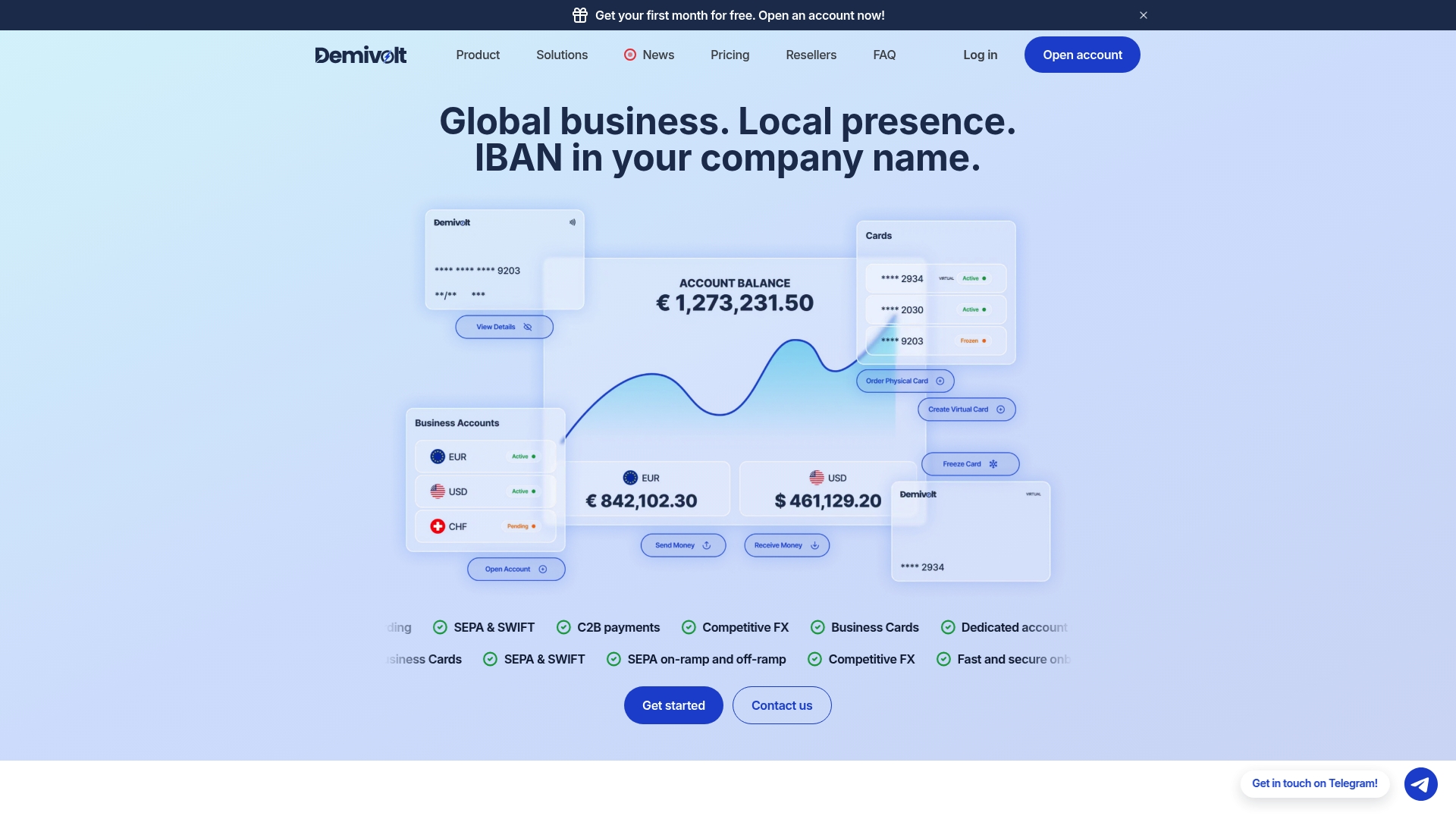
For SMBs that need more than a basic foreign-currency account, Demivolt provides regulated business banking built for cross-border operations: dedicated IBAN accounts, SEPA and SWIFT payment processing, virtual and physical Visa business cards, multi-account structures with role-based access, and API integrations that connect directly to your accounting and treasury tools.
A demo with Demivolt covers a fee review for your specific currency corridors, sample local receiving details for your target markets, and an estimated onboarding timeline for your business structure. KYC is transparent and document requirements are communicated upfront, so there are no delays from incomplete submissions. Before your first transfer, use Demivolt’s free IBAN validator to confirm receiving details and reduce failed payouts. To request a demo or start a pilot, visit Demivolt’s business banking platform.
Useful sources and further reading
- Experian: What Is a Multicurrency Bank Account? — Clear consumer-facing explainer covering account features, pros, cons, and who benefits most.
- OFX: How Multi-Currency Business Accounts Work — Practical U.S.-focused guide on mechanics and business use cases.
- Stripe: How Multicurrency Bank Accounts Work — Technical overview of settlement rails, currency balances, and integration considerations.
- Razorpay: Multi-Currency Account Essential Guide — Detailed breakdown of the receive-hold-convert-pay flow and local receiving details.
- Merge: What Is a Multi-Currency Account? Enterprise Guide — Enterprise and treasury-team perspective on API reconciliation, sub-accounts, and scale.
- WorldFirst AU: Benefits of Multi-Currency Accounts — Covers conversion timing, supplier payment benefits, and hedging tools.
- Demivolt: Business Banking for SMEs — Overview of Demivolt’s regulated banking services for SMEs with cross-border operations.
- Verto: 10 Benefits of Multi-Currency Accounts for Businesses — Concise benefit summary with business-focused framing.