

You can track an international wire transfer right now using the UETR (Unique End-to-End Transaction Reference) in your sending bank’s SWIFT GPI portal or payment tracker. If you don’t have the UETR yet, ask the sender for a copy of the MT103 or pacs.008 payment confirmation, or request the bank transaction reference number and ask your bank to initiate a formal SWIFT trace.
Three actions to take in the next 10 minutes:
- Find your UETR or transaction reference. Check your payment confirmation email, bank receipt, or sent-payment screen. The UETR is a 36-character code assigned at the moment the payment is created.
- Log into your bank’s payment portal. Most major U.S. banks offer a GPI-enabled tracker where you can enter the UETR or transaction reference for a live status update.
- Contact the sending bank if the portal shows nothing. Give them the reference number, value date, amount, currency, and beneficiary name. Never share full account numbers — reference and transaction metadata are enough to open a trace.
Key Takeaways
The fastest way to track an international wire transfer is to locate the UETR, check your bank’s GPI portal, and request the MT103 or pacs.008 if the portal shows no result.
| Point | Details |
|---|---|
| UETR is the primary identifier | Collect this 36-character code from your payment confirmation before contacting any bank. |
| Check your bank portal first | Most major banks offer GPI-enabled dashboards with timestamped status updates by UETR or TRN. |
| Request MT103 or pacs | This official SWIFT document contains all fields needed to trace or dispute a payment. |
| Escalate after 5 business days | Ask the sending bank to open a formal SWIFT trace if funds have not arrived within 5 business days. |
| Demivolt for traceable payments | Demivolt generates UETR-linked receipts and provides MT103/pacs on request for every SWIFT payment. |
Table of Contents
- What details do you need before you start a trace?
- How can I track an international wire transfer step by step?
- Where to look: bank GPI portals, SWIFT tools, and third-party trackers
- If the tracker shows no result, here is your escalation plan
- How long do international wires take, and what causes delays?
- How a regulated platform supports traceable international payments
- A practical perspective on payment tracing
- Demivolt gives your business full visibility on every SWIFT payment
- Sources
What details do you need before you start a trace?
Gathering the right identifiers before you call or email your bank cuts resolution time significantly. Payment-tracing guides recommend collecting the transaction reference, value date, amount, and beneficiary details before contacting the sending bank.
Primary identifier:
The UETR is the most important identifier for tracking cross-border transfers. It is a 36-character alphanumeric code assigned when the payment is created and travels with the payment across every bank in the chain. Banks use it in SWIFT GPI-enabled tracking to provide end-to-end status updates.
Secondary identifiers to collect:
- Transaction Reference Number (TRN), also called Field 20 in SWIFT messaging
- A copy of the MT103 or pacs.008 payment confirmation
- Value date, exact amount, and currency
- Beneficiary’s full legal name
- Beneficiary bank SWIFT/BIC code or IBAN
Where to find these details:
Your bank’s payment confirmation email or online receipt usually contains the TRN and sometimes the UETR. The MT103 or pacs.008 is the official SWIFT payment message that holds all of these fields in a structured format. If you are the receiver, ask the sender to forward their bank confirmation or request the MT103 directly from their bank.
Pro Tip: If the sender’s bank has migrated to ISO 20022, the document will be labeled pacs.008 rather than MT103. The tracking principles and identifiers, including the UETR, remain the same across both formats.
How can I track an international wire transfer step by step?
Follow this three-step sequence to locate a payment efficiently, whether you are the sender or the receiver.
Step 1: Identify and collect all identifiers
Before opening any portal or making any call, gather the UETR, TRN (Field 20), a copy of the MT103 or pacs.008, the value date, the exact amount and currency, and the beneficiary’s name and bank details. Having these ready prevents repeated back-and-forth with bank support teams.
Step 2: Check immediate visibility through your bank portal or a GPI tracker
Log into your bank’s online banking or corporate portal and navigate to the payment or wire transfer section. Enter the UETR or TRN to pull up the current status. Many major banks now offer GPI-enabled dashboards that show timestamped status updates at each point in the payment chain. If your bank offers a dedicated tracker, that is your fastest route to a confirmed status.

Step 3: Request a formal SWIFT trace if the portal shows no result
If the portal returns no result after 1–2 business days for a standard SWIFT wire, contact the sending bank and ask them to open a formal SWIFT trace. Provide the UETR, TRN, value date, amount, and beneficiary details. The bank will send a gpi.Cov or case investigation message through the SWIFT network. Expect a response within several business days, and note that some banks charge a tracing fee.
Sample message to send your bank:
Pro Tip: Escalate to a formal trace if the payment has not arrived within 5 business days for a major currency corridor (USD, EUR, GBP). Your bank will require the UETR or TRN, the value date, and the beneficiary’s bank details to open the case. Keep all correspondence in a single email thread to avoid duplicate investigations.
Where to look: bank GPI portals, SWIFT tools, and third-party trackers
Not every tracking option gives the same depth of information. The table below maps the three main routes and their practical limits.
| Tracking Method | What It Shows | Access | Key Limitation |
|---|---|---|---|
| Bank GPI portal (e.g., J.P. Morgan, Deutsche Bank) | Timestamped status at each hop, UETR-linked | Account holders only | Restricted by account type and geography |
| SWIFT Basic Tracker | End-to-end payment search, confirmation status | SWIFT members only | Not available to end-clients directly |
| Public/third-party trackers | High-level in-transit or delivered status | Open access | No detail on internal holds or posting delays |
Bank payment trackers are the most practical option for businesses. Institutional payment trackers let clients search by reference or transaction number for payment status, though access may be limited to eligible account types and geographies. Deutsche Bank’s international payments tracker accepts the UETR and provides client-visible status updates, making it a useful reference for corporate clients. Wells Fargo’s Payment Tracker similarly offers status lookups for clients with the appropriate permissions.
SWIFT GPI and the UETR are the gold standard. The SWIFT Basic Tracker is free for SWIFT members and supports end-to-end payment search, manual confirmation, and meets Universal Confirmations requirements. End-clients cannot access it directly, but your bank can query it on your behalf.
Public and third-party trackers can confirm whether a payment is in transit or delivered at a high level, but they often miss internal bank holds or posting delays. They are useful for a quick sanity check, not for dispute resolution. For additional public-tracker options and troubleshooting steps, this guide to tracking sent money abroad covers several alternatives.
Common SWIFT GPI status codes and what they mean:
- ACSP (Accepted, Settlement in Process): the payment is moving through the chain.
- ACSC (Accepted, Settlement Completed): the payment has reached the beneficiary bank.
- ACCC (Accepted, Credit Completed): the funds have been credited to the beneficiary’s account.
- RJCT (Rejected): the payment was returned; contact the sending bank immediately for the rejection reason.
When visibility stops, it usually means a non-GPI correspondent bank is in the chain, or the payment is under a compliance hold. A manual SWIFT trace is the only way to get detail in those cases.
If the tracker shows no result, here is your escalation plan
No result in a portal does not mean the payment is lost. It often means a non-GPI bank is handling one leg of the transfer, or a compliance review is underway.
Who to contact and when:
- Sending bank first. They initiated the payment and hold the MT103/pacs.008. They can query the SWIFT network and contact intermediary banks directly.
- Beneficiary bank second. If the sending bank confirms the payment left their system but the recipient has not received funds, the beneficiary bank can check whether the payment is pending posting or under a compliance hold.
- Correspondent banks. Your sending bank can identify which intermediary banks handled the payment and contact them through SWIFT case management messages.
What to request in writing:
- A copy of the MT103 or pacs.008 with all fields visible
- Timestamps from each bank in the chain
- Intermediary bank names and SWIFT/BIC codes
- The rejection or hold reason, if applicable
Timeline expectations: Manual traces typically take 1–5 business days for a response, though complex corridors or compliance holds can extend this. Some banks charge a tracing fee ranging from $15 to $50 per investigation. Follow up every 2 business days if you have not received an update, and always reference the same case number to avoid opening duplicate investigations.
For a security-focused checklist on what information to share (and what to withhold) during a trace, the international transfer security checklist from IdealRemit is a practical reference.
How long do international wires take, and what causes delays?
Standard SWIFT bank wires between major U.S. banks and international counterparts typically settle within a few business days, depending on the currency corridor and the number of correspondent banks involved. Specialist payment platforms often complete transfers within a couple of business days for major currency pairs.
Common causes of delay to check first:
- Intermediary banks: each additional correspondent bank adds processing time.
- Compliance and document checks: AML screening, sanctions checks, or missing KYC documentation can pause a payment.
- Currency corridor and cut-off times: some corridors have narrow processing windows; a payment submitted after a bank’s cut-off time processes the next business day.
- Weekends and public holidays: neither the sending nor the receiving country’s banking system processes on non-business days.
- Incorrect beneficiary details: a mismatched name, wrong IBAN, or incorrect SWIFT/BIC code triggers a return or a manual review.
Before sending, validate the beneficiary’s IBAN using a reliable checker to eliminate errors that trigger delays and traces. Demivolt’s free IBAN validator checks IBANs against the ISO 13616 standard before a payment leaves your account.
How a regulated platform supports traceable international payments
A business banking platform that supports traceable payments reduces the time your finance team spends chasing wires. The features that matter most are not cosmetic; they are operational.
What to look for in any provider:
- Full SWIFT payment support with UETR generation at payment creation
- MT103 or pacs.008 available on request for every outbound payment
- Timestamped payment logs accessible to authorized users
- Role-based access so finance staff can retrieve references without involving senior management
- Segregated client accounts that meet regulatory standards and protect funds in transit
- Dedicated support channels for trace requests, not generic customer service queues
Demivolt supports SWIFT payments with clear transaction receipts and access to MT103/pacs.008 documentation on request. Its role-based user management means the right team member can retrieve a payment reference immediately, without delay. For businesses operating across borders, the platform’s multi-account structure and consolidated payment logs give finance teams a single place to find the identifiers they need when a trace is required.
For a deeper look at how SWIFT payments work operationally, including ISO 20022 migration implications, the Demivolt SWIFT payments guide covers the technical context in plain language.
A practical perspective on payment tracing
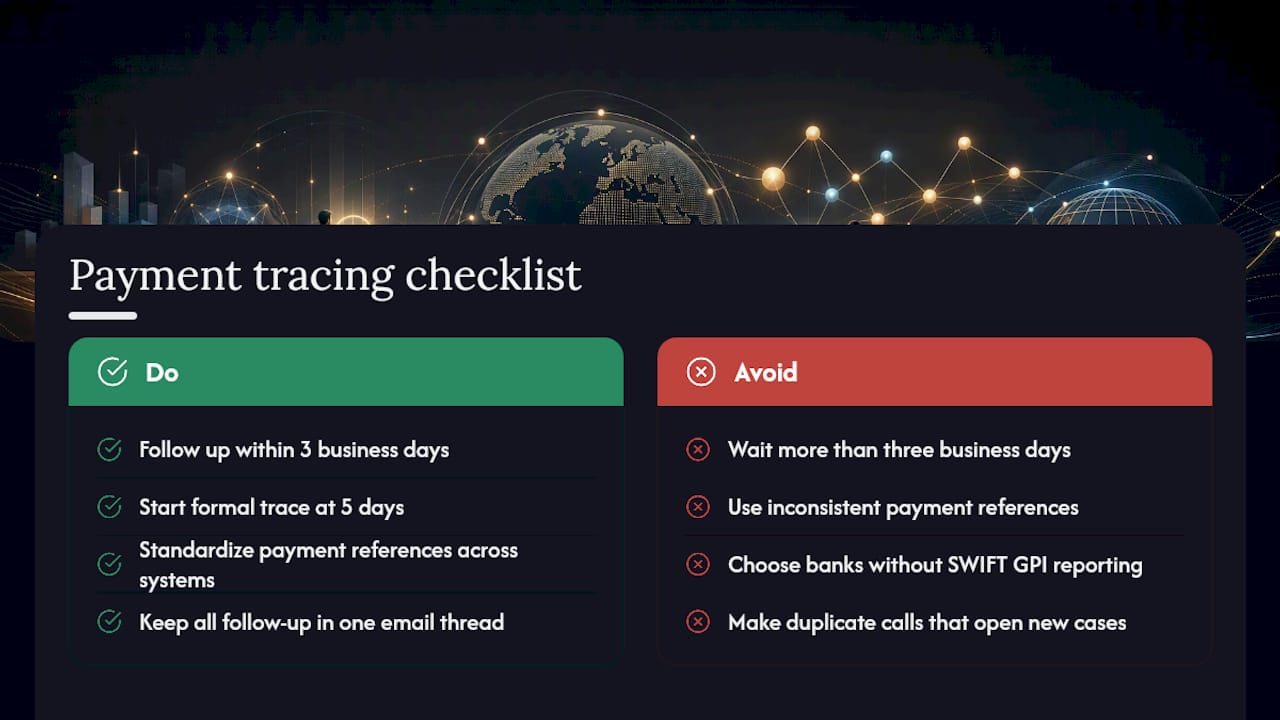
The most common mistake businesses make when a wire goes quiet is waiting too long before acting. Three business days of silence is the threshold for concern; five is the threshold for a formal trace. Waiting beyond that compounds the problem, because intermediary banks archive transaction records on rolling schedules.
There is a second, less obvious issue: businesses that use inconsistent payment references across invoices, bank instructions, and internal systems create tracing problems themselves. When a bank’s case management team searches for a payment, they match on reference fields. If your invoice reference does not match the TRN you gave the bank, the trace takes longer. Standardizing reference fields across your payment workflow is one of the highest-return operational changes a finance team can make.
A business bank that offers no GPI reporting is a meaningful signal. It suggests older infrastructure and a reliance on manual, free-text SWIFT messages rather than structured ISO 20022 data. That translates directly into slower trace resolution when something goes wrong. When evaluating a banking provider, ask specifically whether they generate a UETR for every outbound SWIFT payment and whether you can retrieve the MT103 or pacs.008 from your portal without calling support.
Finally, document every follow-up in a single email thread. Correspondent banks communicate through SWIFT case management messages, and your bank needs to reference a single case number. A second call that opens a duplicate case does not accelerate resolution; it creates two parallel investigations that may contradict each other.
Demivolt gives your business full visibility on every SWIFT payment
Tracking a wire should not require a phone call to your bank every time. Demivolt’s business banking platform gives finance teams direct access to the identifiers they need: every outbound SWIFT payment generates a clear transaction receipt, and MT103 or pacs.008 documentation is available on request. Role-based access means the right person on your team can retrieve a payment reference in seconds, not hours.
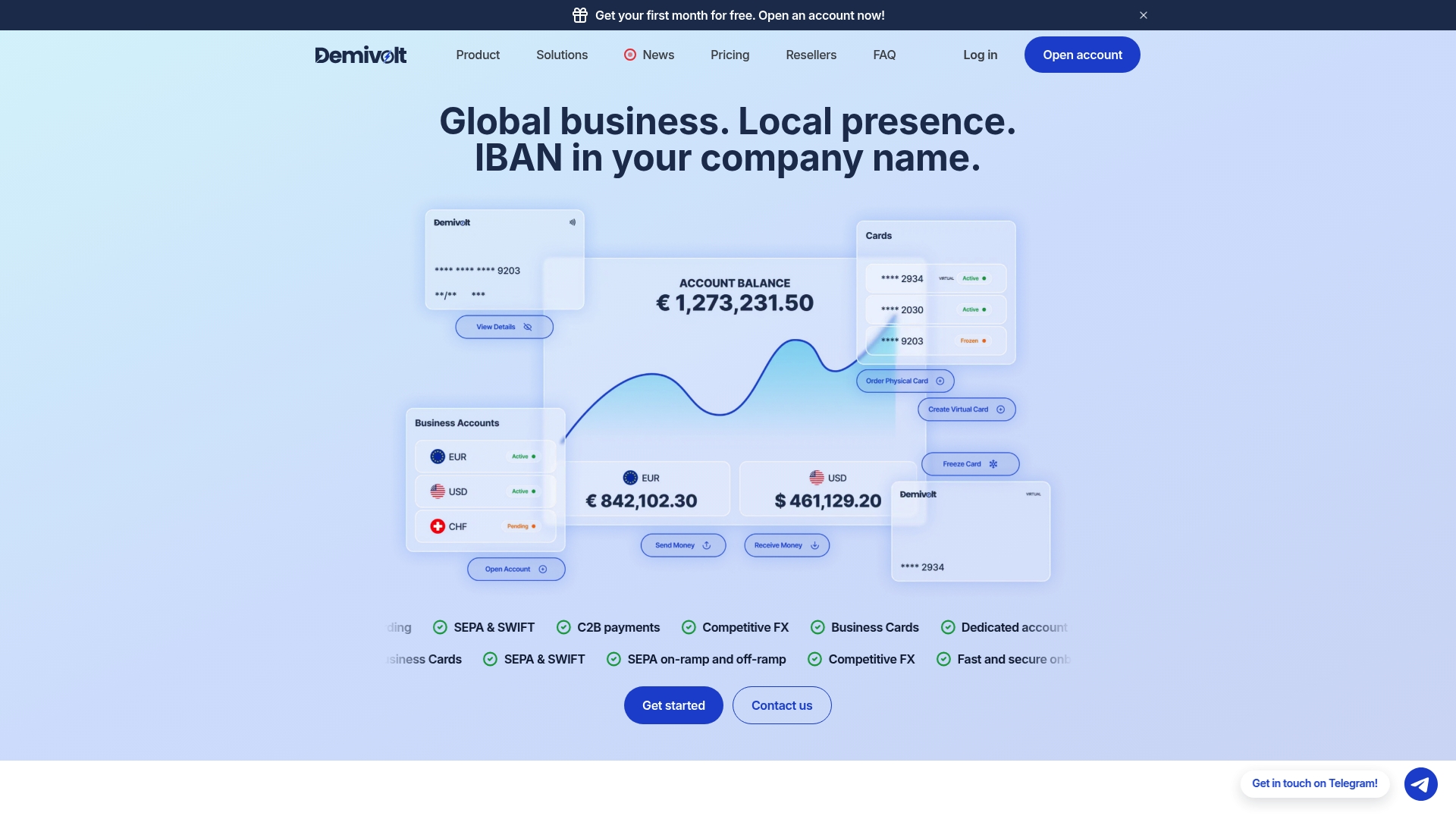
For businesses sending cross-border payments regularly, Demivolt’s consolidated payment logs and dedicated support channels reduce the time between “where is this wire?” and a confirmed answer. Validate beneficiary IBANs before payments leave your account using Demivolt’s free IBAN validator, and eliminate the most common cause of delays and failed traces before they start. Open a Demivolt business account to put traceable, compliant SWIFT payments at the center of your cross-border operations.
Sources
Use these official resources to verify payment statuses independently and learn more about SWIFT GPI and UETR tracking.
- The Basic Tracker | Swift
- How to Track an International Wire Transfer Using MT103
- How to Track an International Payment: Steps and Tips
- J. P. Morgan Payment Tracker
A note on privacy: When using any public or third-party tracker, enter only the UETR or transaction reference number. Never input full account numbers, beneficiary personal details, or sensitive KYC information into a public-facing tool. For dispute resolution, always rely on your bank’s official confirmation, not a third-party status screen.
This article is general information, not a substitute for advice from a qualified financial advisor. Consult a qualified financial professional about your own circumstances before acting on anything here.