

A payment API integration is the programmatic bridge that lets your platform accept, verify, and reconcile payments automatically instead of relying on manual bank checks. The recommended approach: a developer-first, server-verified integration that pairs a hosted or tokenized frontend with server-side webhooks as the final source of truth.
This structure minimizes your PCI DSS scope, closes the gap left by unreliable client-side redirects, and gives your finance team automated reconciliation instead of a spreadsheet.
- Do this first: request sandbox credentials and run a parallel sandbox-to-production workflow before writing a single line of production code.
- Why it works: server confirmation never depends on whether a customer’s browser stays open.
- Who this is for: teams building or maintaining checkout, subscription billing, or B2B invoicing flows.
Key Takeaways
A production-ready mokėjimų API integracija depends on server-verified webhooks, idempotency keys, and a frontend that keeps raw card data off your servers.
| Point | Details |
|---|---|
| Server confirmation wins | Never treat a client-side redirect as proof of payment; only a verified webhook confirms it. |
| Idempotency prevents double charges | Generate a unique key per payment attempt before sending any charge request. |
| Tokenization cuts PCI scope | Hosted forms or SDKs keep card data off your servers, shrinking your compliance burden. |
| Budget extra time for edge cases | Decline handling, 3DS, and webhook retries commonly add two to four weeks. |
| Demivolt fits regulated B2B needs | Pairs dedicated IBAN banking with payment rails, multi-account access, and reconciliation support. |
Table of Contents
- What Are the Steps in a Mokėjimų API Integracija Project?
- How Do Webhooks, Idempotency, and Refunds Work Together?
- Which Frontend Payment Method Reduces PCI Scope Most?
- What Should Be on Your Testing and Go-Live Checklist?
- What Security and Compliance Checks Matter Most?
- How Do You Choose the Right Payment API Provider?
- Frequently Asked Questions
- Sources
What Are the Steps in a Mokėjimų API Integracija Project?
A full mokėjimų API integracija follows a predictable five-step lifecycle. Skipping steps to save time is exactly what causes the production incidents that cost far more time later.
- Get your credentials. Request sandbox and production API keys along with your merchant ID, and immediately restrict who on your team can access the production secret key. Treat key access control as a security control, not an afterthought.
- Build in the sandbox. Configure a sandbox environment that mirrors production, then run negative testing: simulate decline codes, 3D Secure challenges, and network timeouts before you trust the happy path.
- Build the server side. Implement charge and authorization flows, refund endpoints, idempotency keys, webhook handlers, and reconciliation hooks. This is the core of the integration and where most of your engineering time goes.
- Embed the frontend. Add hosted payment forms or a tokenization SDK so raw card data never touches your servers, and handle the UX flow for 3D Secure prompts.
- Go live. Run user acceptance testing, turn on monitoring and logging, confirm webhooks fire correctly in live mode, and complete a go-live checklist before flipping the switch.
Timeline varies by scope. A card-only proof of concept with one provider typically takes a matter of days. A production system supporting multiple payment methods, alternative payment methods, and provider routing logic realistically takes several weeks, mostly because of edge-case handling and reconciliation testing rather than the happy-path code itself.
Pro Tip: Build your webhook handler and idempotency logic before you touch the frontend. Teams that build UI first often discover their backend can’t actually confirm a payment reliably, and have to redo the integration order.
How Do Webhooks, Idempotency, and Refunds Work Together?
Server-side webhooks are the canonical source of truth for payment status. A client-side redirect can fail the moment a customer closes their browser tab mid-transaction, but the payment provider’s server-to-server webhook still fires regardless. Always validate the webhook’s signature before trusting its payload; an unsigned or improperly verified webhook is an open door for spoofed payment confirmations.
Idempotency keys solve a different problem: duplicate charges. Generate a unique key per payment attempt and send it with every charge request, so a retried network call after a timeout doesn’t create a second charge for the same order.
- Map every refund state (pending, partial, completed, failed) to a corresponding accounting entry.
- Test partial refunds separately from full refunds; the logic for splitting a partial refund across tax and shipping often breaks silently.
- Reconcile settlement batches against provider statements on a schedule, not only when a customer complains.
- Handle out-of-order webhook events explicitly. A refund event can arrive before its originating charge event finishes processing.
Pro Tip: Log every webhook event with its raw payload before processing it. When a reconciliation mismatch shows up three weeks later, that raw log is the only way to reconstruct what actually happened.
Which Frontend Payment Method Reduces PCI Scope Most?
Your frontend choice determines how much PCI DSS burden your business carries. Full page redirects hand the entire card-entry experience to the provider and carry the lowest PCI scope, but they hurt conversion because customers leave your site. Hosted iframe fields keep the customer on your page while the card fields load from the provider’s domain, which cuts PCI scope dramatically while keeping the experience largely intact. Client-side tokenization SDKs go further, letting you fully control the checkout layout while the SDK converts card data into a token before it ever reaches your server.
- Hosted forms or tokenization SDKs mean raw card data never touches your servers, which is what shrinks your compliance scope.
- 3D Secure triggers automatically for many card transactions and requires your frontend to handle a redirect or modal challenge step.
- Never treat a successful client-side redirect as proof of payment. Confirm fulfillment only after your server receives and verifies the webhook.
Pro Tip: If your checkout conversion rate matters more than engineering speed, a tokenization SDK usually beats a redirect flow. If speed to launch matters more, start with a hosted form and upgrade later.
What Should Be on Your Testing and Go-Live Checklist?
Testing a payment integration means testing what happens when things go wrong, not just when they go right. Your test matrix needs to cover the full range of realistic failure modes before you trust the system with real transactions.
- Happy-path charge, authorization, and capture.
- Card decline codes, including insufficient funds and expired cards.
- 3D Secure failure and abandonment mid-challenge.
- Network timeouts and retried requests using the same idempotency key.
- Duplicate invoice IDs and partial captures.
- Refund flows, including partial refunds.
- Webhook retries and out-of-order delivery.
| Go-Live Task | Why It Matters |
|---|---|
| Rotate API keys | Sandbox keys should never reach production systems. |
| Enable monitoring and alerts | Catch failed webhooks or spikes in declines within minutes, not days. |
| Run UAT with real card flows | Sandbox test cards don’t always expose real-world processor quirks. |
| Verify settlement reports | Confirm the numbers match before your finance team closes the books. |
| Monitor for several days | Most integration issues surface in the first few days of live traffic. |
What Security and Compliance Checks Matter Most?
Reducing your PCI DSS obligations starts with your frontend choice. Hosted forms or provider SDKs that keep raw card data off your servers can shrink your Self-Assessment Questionnaire scope substantially, so ask any provider directly which SAQ level their integration model produces for your setup.
- Require TLS on every API call, and enforce a clear key rotation policy so leaked credentials have a short shelf life.
- Confirm the provider supports 3D Secure 2 and offers configurable fraud rules or a third-party fraud-scoring hook.
- Ask for webhook signing documentation and an explicit SLA on webhook delivery, not just uptime for their API.
- Request evidence of PCI DSS compliance status, developer documentation quality, and SDK coverage before committing engineering time.
A provider that can’t produce clear webhook signing docs, sandbox parity, and a PCI attestation on request is a provider you’ll be debugging blind six months from now.
How Do You Choose the Right Payment API Provider?
Not every provider fits a mid-market B2B business the same way. Settlement flexibility, multi-account structures, and role-based access matter more to a growing company than a slightly lower headline transaction fee.
| Criteria | What to Check |
|---|---|
| Documentation and SDKs | Clear quick-start guides, maintained SDKs, and real code samples. |
| Sandbox fidelity | Sandbox behavior matches production, including error codes. |
| Supported methods | Cards, bank payments, Apple Pay, Google Pay, and local alternatives. |
| Multi-currency settlement | Ability to settle in the currencies your business actually invoices in. |
| Reconciliation and reporting | Exportable settlement reports that match your accounting periods. |
| Compliance evidence | PCI DSS attestation and clear scope guidance for your setup. |
| Support and SLAs | Defined response times, not just a support email address. |
| Integration effort | SDK coverage versus building against a raw API from scratch. |
For businesses that need banking infrastructure alongside payment processing, not just a checkout widget, Demivolt is worth evaluating directly. It combines regulated European business banking with payment rails, multi-account structures, and role-based user management, which matters once your finance team needs actual reconciliation tooling rather than a transaction log.
Author Note on Realistic Expectations
Budget two to four extra weeks beyond your happy-path timeline for edge-case handling and UAT. Prioritizing server-side verification and monitoring over client-side shortcuts avoids most of the operational fires teams hit after launch.
How Demivolt Supports Your Payment API Integration
Demivolt gives you the piece most payment-only providers skip: a regulated business bank account sitting behind your payment rails, so incoming funds land in a dedicated IBAN account instead of a third-party holding pool waiting on a payout schedule.
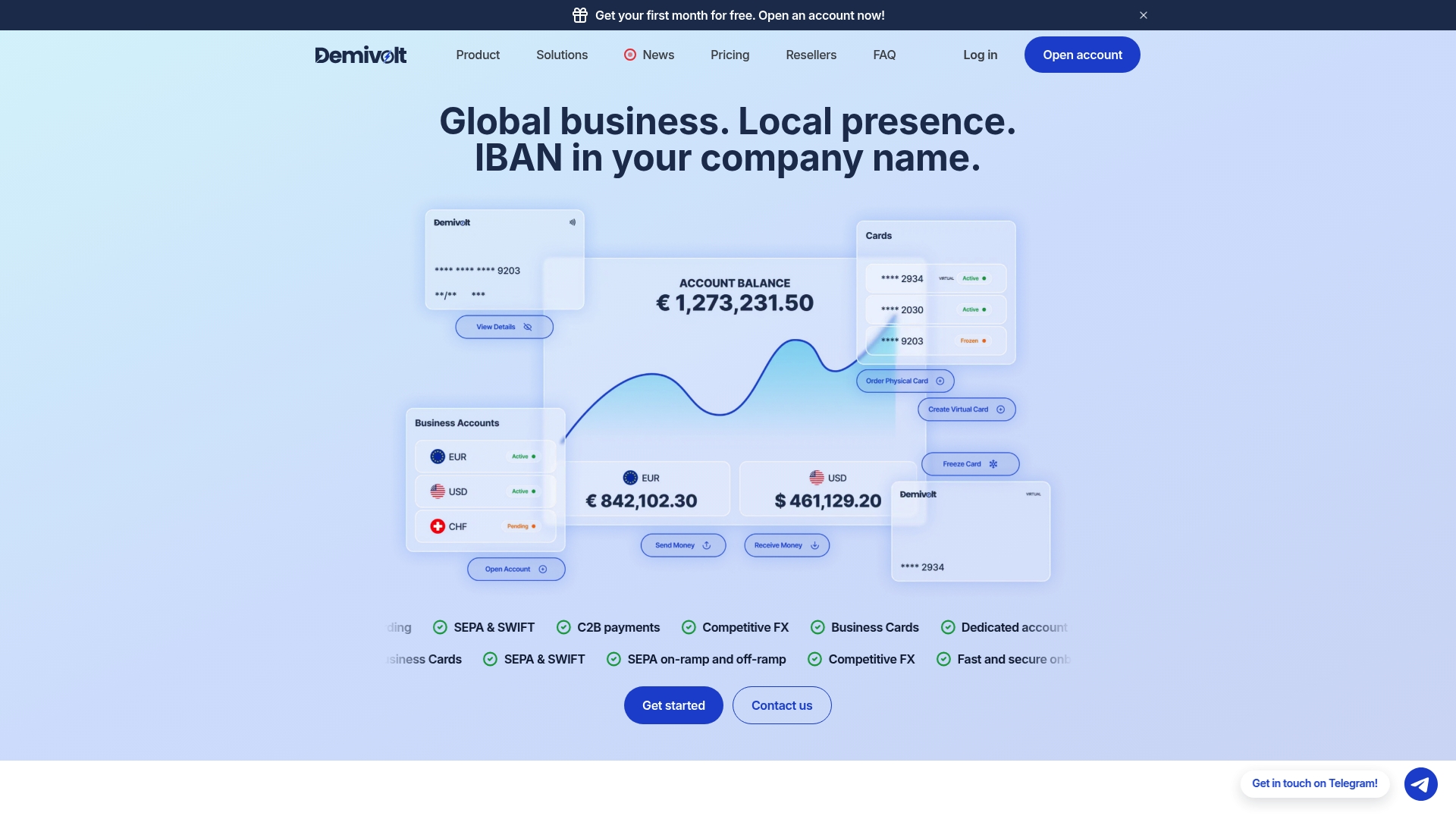
That matters for B2B businesses running SEPA and SWIFT transfers alongside card and bank payments, because reconciliation against your own IBAN is simpler than reconciling against a processor’s internal ledger. Demivolt’s multi-account structures and role-based user management also mean your finance lead and your developer can have separate access levels, which most standalone payment APIs don’t offer at all.
Before you finalize your provider list, run your account numbers through the IBAN validator to catch formatting errors before they cause a failed settlement. If dedicated business banking paired with payment infrastructure fits your integration plans, request API access and open a Demivolt business account to see how the two pieces work together.

Frequently Asked Questions
What is the difference between a sandbox and production API key? Sandbox keys let you simulate charges, refunds, and declines without moving real money, while production keys process live transactions. Never mix the two environments in the same codebase.
How long does payment API integration usually take? A single-provider, card-only build can take a matter of days. A full integration with multiple payment methods, provider routing, and thorough edge-case testing usually takes several weeks.
Do I need a payment orchestration layer if I only use one provider today? Not immediately, but building an abstraction layer early makes it far easier to add a second provider later without rewriting your checkout logic from scratch.
Should I build the integration in-house or hire outside help? It depends on your team’s bandwidth and existing payment expertise. Agencies like Proud Lion Studios handle payment integration projects for teams that want to move faster without pulling engineers off other work.
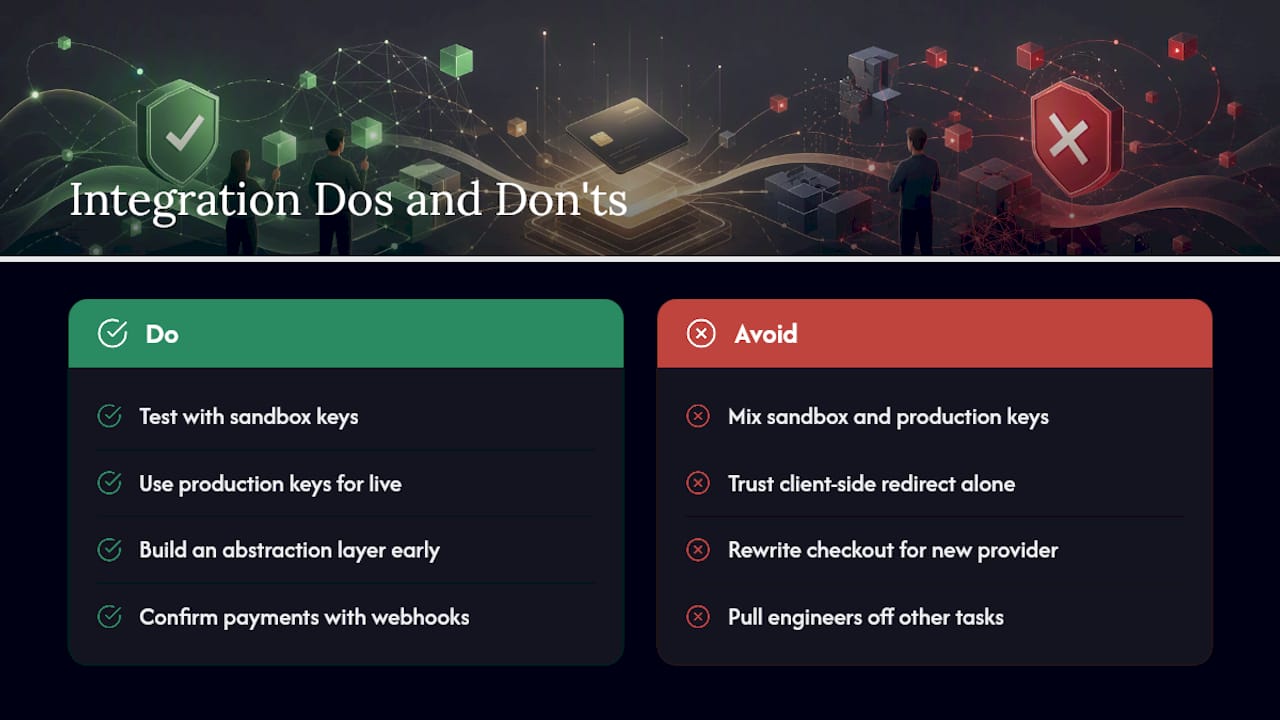
What’s the biggest mistake teams make during integration? Trusting a client-side success redirect as final proof of payment. If the customer’s connection drops before the redirect completes, your order system never learns the payment succeeded unless the webhook confirms it independently.
Sources
- API integracijos - kas tai ir kaip įdiegti svetainėje?
- Integracijos su bankais ir mokėjimo įstaigomis