

TL;DR:
- API banking allows businesses to embed banking services directly into their platforms through standardized digital interfaces. This shift enhances operational efficiency, speeds up customer onboarding, and enables product innovation without requiring a banking license. Adopting it is a strategic business decision focused on scalability, compliance, and competitive advantage.
API banking is defined as a system where banks expose financial services and data through standardized digital interfaces, allowing businesses to integrate banking functions directly into their own platforms. The industry term for this broader shift is “open banking,” but API banking specifically refers to the technical layer that makes it possible. Nearly 89% of businesses recognize API banking as strategically important for digital transformation. That figure reflects a fundamental shift: banking is no longer something you visit. It is something you embed. For SMEs and tech startups, understanding this distinction is the difference between building financial products fast and spending months on manual workarounds.

What is API banking and how does it work?
API banking works by exposing a bank’s core services through Application Programming Interfaces, or APIs. An API is a set of rules that lets two software systems talk to each other. In banking, this means a third-party app can request account data, initiate payments, or verify identity without ever touching the bank’s internal systems directly.
Banks treat APIs as growth infrastructure that connects core banking, payments, cards, and CRM through a standardized connectivity layer. That architecture matters because it replaces dozens of one-off integrations with a single, consistent interface. Your platform speaks one language, and the bank’s systems respond in kind.
The technical process follows a clear sequence:
- Partner with an API provider. Choose a bank or fintech platform that publishes a documented API. Demivolt, for example, offers API-enabled business banking built for SMEs operating across borders.
- Authenticate your application. Use protocols like OAuth 2.0 or mutual TLS (mTLS) to prove your app’s identity before any data moves. Layered security measures such as mutual TLS, OAuth 2.0, and API keys are required for production-grade security.
- Make API calls. Your application sends structured requests, such as “initiate a SEPA payment” or “retrieve account balance,” and receives a structured response in real time.
- Handle responses and errors. Build logic to process successful responses and gracefully manage failures, rate limits, or compliance flags.
- Go live and monitor. Deploy to production and track API performance, error rates, and latency continuously.
Pro Tip: Start with sandbox environments before connecting to live banking systems. Most API providers offer test credentials so you can validate your integration without touching real funds.
The abstraction layer is what makes this practical for non-bank businesses. You do not need to understand a bank’s internal architecture. You call an endpoint, and the API handles authentication, compliance checks, and data formatting on the bank’s side.
What are the primary benefits of API banking for SMEs and startups?
API banking delivers measurable operational gains that matter most to resource-constrained businesses. The benefits are not theoretical. They show up in onboarding speed, IT capacity, and product capability.
Key advantages include:
- Faster customer onboarding. API-based automation reduces customer onboarding times by up to 60% for embedded finance adopters. For a startup processing its first thousand customers, that speed difference is significant.
- Recovered IT capacity. A unified API architecture helps organizations reclaim about 30% of IT change capacity by reducing custom integration needs. That freed capacity goes toward building features, not maintaining plumbing.
- Embedded finance capability. Your platform can offer virtual cards, expense management, payment initiation, and account data directly inside your product. Users never need to leave your interface to complete a financial action.
- Reduced manual banking procedures. Automated payment reconciliation, real-time balance checks, and programmatic fund transfers replace spreadsheets and manual bank portal logins.
- Lower barriers to financial product development. Startups can launch lending, payments, or savings features without a banking license by partnering with licensed API providers who handle regulatory compliance.
The embedded finance angle deserves special attention. When a logistics startup embeds invoice financing directly into its shipment tracking dashboard, it is using API banking. The bank’s credit assessment and disbursement logic runs behind the scenes. The startup’s customers see a clean, native experience. That kind of product integration was impossible without APIs.
Pro Tip: Map your core user workflows before choosing which banking APIs to integrate. The most valuable API connections are the ones that remove a step your users currently complete outside your platform.
Cloud-based banking advantages for SMEs compound these gains further, since API-connected accounts can sync with accounting software, payroll systems, and ERP platforms automatically.
What models of API banking exist?
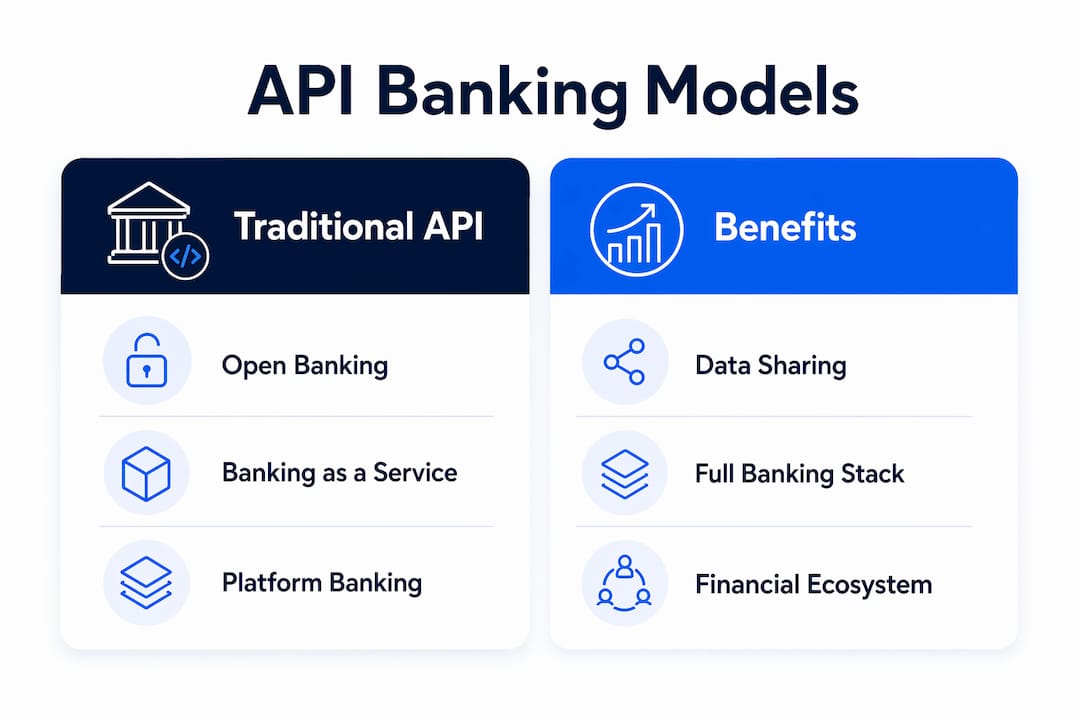
API banking models generally fall into three categories: open banking, banking as a service, and platform banking. Each serves a different business need and involves different relationships between banks, developers, and end users.
| Model | What it does | Who benefits most | Typical use case |
|---|---|---|---|
| Open banking | Banks share customer data with authorized third parties via regulated APIs | Fintech apps, personal finance tools | Account aggregation, credit scoring |
| Banking as a service (BaaS) | Licensed banks provide full banking infrastructure via API to non-bank businesses | Startups, e-commerce platforms | Embedded payments, virtual IBANs, card issuance |
| Platform banking | Banks build an API ecosystem integrating multiple third-party services | Enterprise businesses, large fintechs | Multi-service financial hubs, marketplace banking |
Open banking is the most regulated of the three. In the European Union, the PSD2 directive mandates that banks provide open APIs to licensed third-party providers. Open banking has transitioned from concept to regulatory requirement in many regions, making API readiness a compliance obligation, not just a competitive choice.
Banking as a service sits one layer deeper. A BaaS provider gives you the full banking stack, including IBANs, payment rails, and card programs, through API access. You build the product. The licensed bank operates the regulated infrastructure underneath.
Platform banking is the most expansive model. A bank becomes the center of a financial ecosystem, connecting its own products with third-party services like insurance, accounting, and lending through a shared API layer. For large enterprises, this creates a single financial control center.
Pro Tip: If you are an SME or startup building your first financial product, BaaS is almost always the right starting point. It gives you the most banking functionality with the least regulatory overhead on your side.
What challenges should businesses expect when adopting API banking?
API banking is not plug-and-play. Businesses that treat it as a simple technical task often run into compliance, security, and integration problems that slow their launch significantly.
The most common challenges include:
- Internal system fragmentation. Most SMEs have accounting software, CRM platforms, and payment tools that were never designed to share data. Connecting these to a banking API requires mapping data formats and building middleware, which takes time.
- Security architecture complexity. A single API gateway is not enough. Banking API security must implement layered authentication and encrypted communication beyond a single gateway to meet production standards. Skipping this step creates real liability.
- KYC and compliance requirements. Developers often underestimate integration complexity due to regulatory compliance and KYC requirements. Know Your Customer workflows involve document verification, sanctions screening, and ongoing monitoring. These are not features you build once and forget.
- Data privacy obligations. GDPR in Europe and equivalent regulations elsewhere require that any financial data flowing through your API integration is handled, stored, and deleted according to strict rules.
- Choosing the wrong API provider. Not all API providers abstract the same level of complexity. Fintech founders benefit most by partnering with API providers who handle compliance and authentication complexities on their behalf. Providers that expose raw banking infrastructure without compliance tooling shift the regulatory burden entirely onto you.
The compliance dimension is where most startups underestimate the work. Regulatory requirements around digital banking onboarding are detailed and jurisdiction-specific. Partnering with a provider that has already solved these problems is the fastest path to a compliant product. Understanding AI payment trends also helps businesses anticipate where API-driven financial infrastructure is heading next.
Key Takeaways
API banking is the technical foundation of modern financial product development, and businesses that adopt it with the right provider gain speed, compliance coverage, and product capability that manual banking cannot match.
| Point | Details |
|---|---|
| Core definition | API banking lets businesses embed banking functions directly into their platforms via standardized interfaces. |
| Security is non-negotiable | Production-grade API integrations require OAuth 2.0, mutual TLS, and layered authentication, not just an API key. |
| Three distinct models exist | Open banking, BaaS, and platform banking serve different business sizes and product goals. |
| Compliance is the hardest part | KYC, GDPR, and PSD2 requirements add significant complexity that the right API provider can absorb for you. |
| Speed gains are real | API automation cuts customer onboarding times by up to 60%, a measurable advantage for growth-stage businesses. |
Why API banking is a business decision, not just a tech one
Most articles about API banking treat it as a developer topic. That framing misses the point entirely. The decision to adopt API banking is a business architecture decision. It determines how fast you can launch financial features, how much compliance risk you carry, and whether your product can scale without adding headcount to handle banking operations manually.
The businesses I have seen struggle with API banking share one pattern: they started with the technology and worked backward to the business case. The ones that succeed do the opposite. They identify a specific customer problem, such as slow invoice payments or manual expense reporting, and then find the API that solves it. The technical integration follows naturally from a clear product goal.
The regulatory environment is also accelerating this shift. API banking is foundational for modern financial services, evolving from a technology trend into a compliance and strategic imperative. PSD2 in Europe already mandates open API access. Similar frameworks are advancing in the UK, Australia, and parts of Asia. Businesses that build API readiness now will not scramble to retrofit compliance later.
The practical advice I give to every SME considering this path: do not build what you can buy. The compliance infrastructure, the security architecture, the payment rails. These exist as services. Your competitive advantage lives in the product you build on top of them, not in recreating banking infrastructure from scratch.
— dd
How Demivolt supports API-enabled business banking
Demivolt is built for businesses that need banking infrastructure that connects, not banking that creates friction.
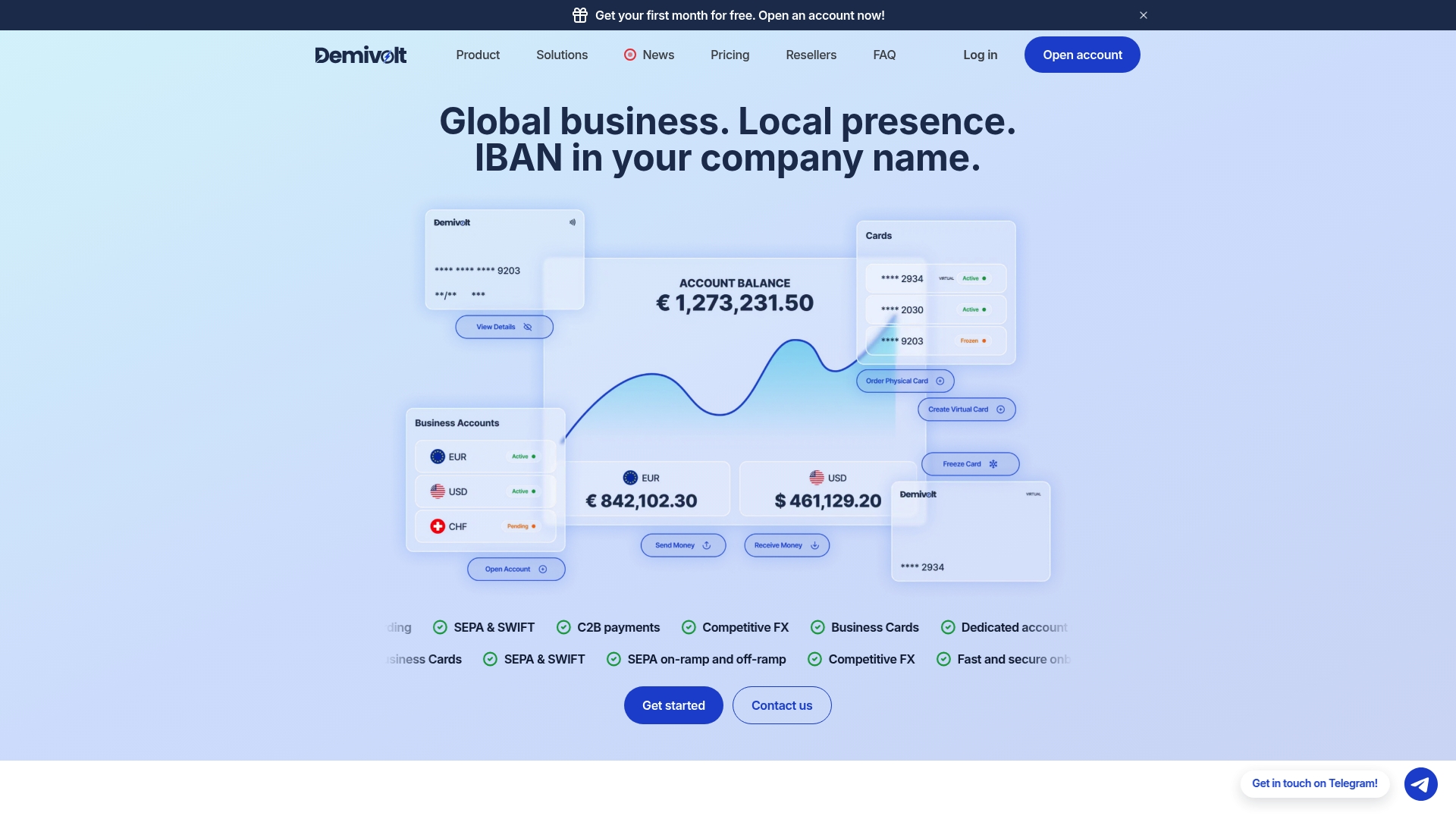
The platform gives SMEs dedicated IBAN accounts, SEPA and SWIFT payment management, and virtual and physical business cards, all within a compliant, EU-regulated environment. For businesses handling cross-border payments, Demivolt’s free IBAN validator catches account number errors before they become failed transactions. The broader suite of free SEPA tools helps finance teams verify payment details and stay compliant without manual checks. If you are building a financial product or need a business banking platform that integrates cleanly with your existing systems, Demivolt is worth a close look.
FAQ
What is API banking in simple terms?
API banking is a system where banks make their financial services available to third-party businesses through digital interfaces called APIs. This lets companies embed payments, account management, and other banking functions directly into their own products.
How does API banking differ from open banking?
Open banking is a regulatory framework that requires banks to share customer data with authorized third parties. API banking is the technical method that makes this sharing possible. Open banking is the policy; API banking is the implementation.
Is API banking safe for business use?
API banking is safe when implemented correctly. Production-grade integrations require layered security including OAuth 2.0, mutual TLS, and encrypted communication channels. Businesses should verify that their API provider meets these standards before going live.
What banking services can businesses access through APIs?
Businesses can access account data, payment initiation, card issuance, identity verification, and loan origination through banking APIs. The specific services available depend on the API provider and the regulatory permissions in place.
Do SMEs need a banking license to use API banking?
SMEs do not need a banking license to use banking APIs. By partnering with a licensed BaaS provider or regulated fintech platform, businesses can offer financial features to their customers while the licensed provider handles the regulatory obligations.
Recommended
- Demivolt | Blog – Modern business banking trends: boost efficiency & compliance
- Demivolt | Blog – Open banking explained: Control, compliance & SME benefits
- Demivolt | Blog – IBAN Accounts Explained: Guide for SMEs Managing Cross-Border Payments
- Demivolt | Blog – Business banking for SMEs: services, compliance & cross-border