

TL;DR:
- Multi-user business banking enables team members to access finances with role-specific permissions, reducing fraud risks. It improves oversight, streamlines approvals, and supports legal compliance through dual authorization and audit trails. The system benefits growing SMEs, partnerships, and distributed teams by enhancing control and operational efficiency.
Multi-user business banking is defined as a shared account structure that grants designated team members role-specific access to business finances, without giving everyone equal control. The advantages of multi-user business banking go well beyond convenience. For SMEs, this setup is the difference between a financial operation that scales safely and one that creates liability with every new hire. Role-based permissions, dual-authorization controls, and real-time transaction visibility give business owners the oversight they need without becoming a bottleneck in daily operations.

1. What are the key advantages of multi-user business banking?
Role-based access is the foundation of every benefit on this list. When you assign permissions by function rather than trust, you reduce the surface area for both fraud and honest mistakes. A bookkeeper can reconcile transactions without touching payroll. A department head can approve vendor payments without seeing the full account balance.
The industry term for this structure is “role-based access control,” or RBAC. It is a recognized standard in both financial services and IT security. Multi-user business banking applies RBAC directly to your company’s money, which is why it matters so much for SMEs managing growth.
Pro Tip: Set spending limits by role before you add users, not after. Retroactive restrictions create friction and signal distrust to your team.
Here are the core advantages business owners gain from a well-configured multi-user account:
- Reduced fraud exposure through permission tiers that block unauthorized large withdrawals
- Cleaner audit trails because every transaction ties to a named user with a defined role
- Faster approvals via dual-authorization workflows that do not require the owner’s direct involvement in every payment
- Better cash flow discipline through sub-accounts organized by purpose (payroll, taxes, operating expenses)
- Stronger legal defense because documented spending limits prove professional financial governance during IRS audits
- Team scalability without credential sharing, which destroys audit trails and increases fraud risk
2. How multi-user banking features improve team collaboration and control
The mechanics behind collaborative business banking are more practical than most owners expect. Each user gets a unique login tied to a defined role. The platform enforces what that role can and cannot do at the transaction level.
Common role types include:
- Full signers: Owners or CFOs with unrestricted access to initiate and approve transactions
- Operational users: Managers or accountants who can initiate payments up to a set limit but cannot approve their own transactions
- View-only members: Auditors, advisors, or board members who see balances and reports but cannot move funds
Real-time alerts notify the account owner when a transaction exceeds a threshold or when a new user is added. This keeps oversight active without requiring the owner to log in constantly. Permission tiers reduce friction while building trust through transparency, which is exactly what growing teams need.
Integration with accounting software like QuickBooks or Xero adds another layer of efficiency. Transactions categorized at the banking level flow directly into your books, cutting reconciliation time significantly.
3. How multi-user banking reduces risk and supports legal compliance
Unrestricted equal access among business partners is one of the most common financial mistakes SMEs make. When one partner can unilaterally drain a shared account, lack of guardrails often leads directly to business failure during disputes. Role-based controls prevent that scenario entirely.
Dual authorization is the single most effective fraud-prevention tool in multi-user banking. Dual-authorization requires two approvals before any large payment clears. This applies to both external fraud attempts and internal misuse, making it a critical control for any SME handling significant transaction volumes.
Documented financial controls do more than prevent fraud. They prove that your business operates professionally. During an IRS audit or a legal dispute, showing that spending limits existed and were enforced is far stronger evidence than a single-owner account with no oversight structure.
Multi-factor authentication (MFA) and unique login credentials for every user are non-negotiable. Shared credentials destroy audit trails and make it impossible to attribute a transaction to a specific person. MFA adds a second verification layer that protects the account even if a password is compromised.
Separation of duties is the underlying principle. The person who initiates a payment should not be the same person who approves it. This single rule, applied consistently, eliminates the most common vector for internal financial fraud in small businesses.
4. What operational efficiencies do SMEs gain from team banking?
The operational gains from multi-user banking features extend well beyond security. Financial organization improves immediately when you stop running everything through one account.
Sub-accounts let you separate funds by purpose. Tax reserves sit in one account. Payroll funds sit in another. Operating expenses draw from a third. This structure creates financial discipline and visibility that a single pooled account simply cannot provide.
Pro Tip: Name each sub-account by its function (e.g., “Q3 Tax Reserve” or “Payroll Buffer”) so every team member understands the purpose at a glance. Ambiguity in account naming leads to misallocated funds.
The table below shows how multi-user banking compares to a traditional single-owner setup across key operational dimensions:
| Dimension | Single-owner account | Multi-user account |
|---|---|---|
| Transaction approval | Owner required for every payment | Delegated by role and limit |
| Audit trail | Account-level only | User-level, timestamped |
| Fraud prevention | Relies on owner vigilance | Enforced by system controls |
| Team access | Credential sharing or none | Unique logins per user |
| Financial visibility | Owner only | Role-appropriate for each user |
Delegating financial tasks also removes the owner as a bottleneck. When a manager can approve vendor invoices up to $5,000 without escalating, the business moves faster. The owner stays informed through alerts but does not need to be present for routine transactions.
Remote and distributed teams benefit particularly from multi-user banking access across devices. A finance team member in a different city can process payroll on schedule without waiting for the owner to log in from headquarters.
5. Which businesses benefit most from multi-user banking?
Multi-user banking delivers the most value to SMEs with more than one person involved in financial decisions. That threshold is lower than most owners assume.
Businesses that benefit most include:
- Partnerships and co-owned businesses where equal signing authority creates conflict risk
- Growing startups that are adding finance, operations, or sales staff who need limited account access
- Service businesses with multiple client accounts or project-based billing that requires segregated funds
- E-commerce companies managing vendor payments, refunds, and payroll across different team members
- Professional firms (legal, accounting, consulting) where client fund separation is a compliance requirement
The best practice for setting up a multi-user account is to map your financial workflows before you assign roles. Identify who initiates payments, who approves them, and who only needs to view reports. Then build your permission structure around those functions, not around seniority or trust levels.
Spending limits should reflect actual operational needs. A marketing manager approving ad spend up to $2,000 per transaction needs a different limit than an operations director handling equipment purchases. Calibrating limits to job function prevents both under-authorization and over-exposure.
Sound financial management practices at the account level also make it easier to prepare accurate financial statements, which matters when you are seeking a loan or attracting investors.
For SMEs evaluating account structures, understanding the types of business bank accounts available is a useful starting point before configuring user roles.
Key Takeaways
Multi-user business banking reduces fraud, improves financial oversight, and gives SMEs the operational structure needed to delegate financial tasks without losing control.
| Point | Details |
|---|---|
| Role-based access controls risk | Assign permissions by function to prevent unauthorized withdrawals and protect payroll liquidity. |
| Dual authorization stops fraud | Requiring two approvals for large payments blocks both external attacks and internal misuse. |
| Unique logins preserve audit trails | Shared credentials make it impossible to attribute transactions and increase fraud exposure. |
| Sub-accounts improve cash flow | Separating funds by purpose (taxes, payroll, expenses) creates discipline and visibility. |
| Documented controls aid legal defense | Spending limits and supervisory records strengthen your position during IRS audits and disputes. |
Why most SMEs get multi-user banking wrong from the start
The most common mistake I see is business owners treating multi-user banking as an administrative task rather than a governance decision. They add users quickly, assign broad permissions to avoid friction, and skip spending limits because setting them feels like micromanagement. Six months later, they are dealing with a reconciliation mess or, worse, an internal dispute with no paper trail to resolve it.
The businesses that get this right treat the initial role setup as seriously as they treat hiring. They define what each user can do, set limits that match the job, and review permissions quarterly as the team changes. That discipline pays off in ways that go beyond fraud prevention. Teams operate with more confidence when they know exactly what they are authorized to do. Owners stop being the single point of failure for routine financial decisions.
The technology makes all of this possible, but the mindset has to come first. Multi-user banking is not a feature you turn on. It is a financial governance structure you build deliberately.
— dd
Demivolt’s multi-user banking platform for SMEs
Demivolt is built for exactly the kind of financial governance structure described in this article. The platform supports role-based user management, per-user transaction limits, and real-time alerts that keep owners informed without requiring them to approve every payment manually.
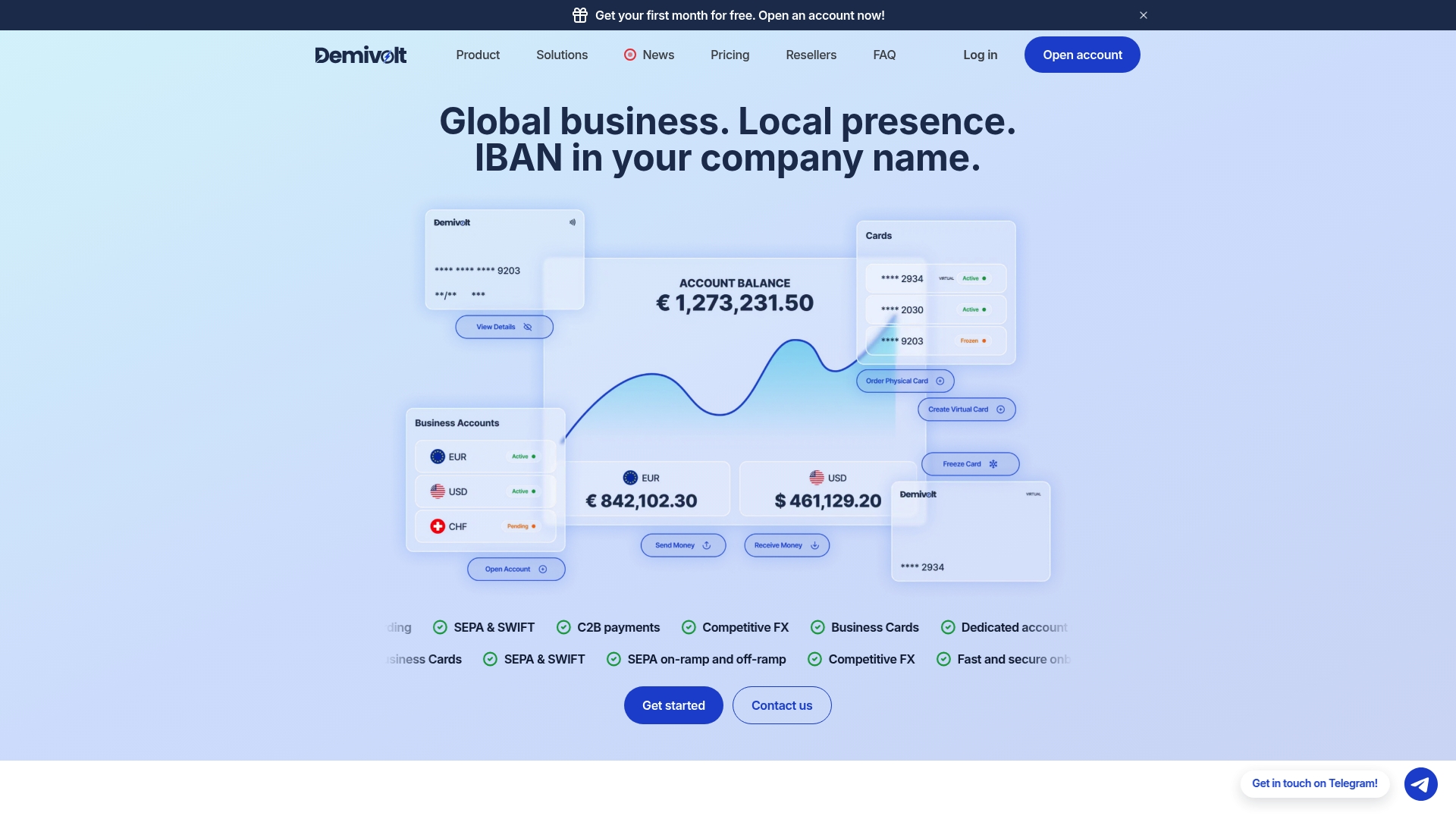
Demivolt’s accounts are protected by multi-factor authentication, and the platform distributes deposits across partner banks to provide up to $3 million in FDIC coverage. That coverage level is well above what a standard single-bank account provides. Demivolt also supports SEPA and SWIFT payments, dedicated IBAN accounts, and integration with external financial tools. Business owners can explore the full platform at Demivolt’s business banking hub or use the free SEPA tools to get started with cross-border payment management today.
FAQ
What is multi-user business banking?
Multi-user business banking is a shared account structure where multiple team members access business finances through individual logins with role-specific permissions. Each user’s access is defined by their function, not by equal ownership rights.
How does role-based access control reduce fraud?
Role-based access limits what each user can initiate or approve, so no single person can unilaterally move large sums. Dual-authorization requirements add a second approval layer for high-value transactions, blocking both internal misuse and external attacks.
Why are unique logins important in multi-user banking?
Shared credentials eliminate the audit trail that ties transactions to specific individuals. Unique logins with MFA are the only way to maintain accountability and meet compliance requirements.
Which SMEs benefit most from multi-user banking features?
Partnerships, growing startups, and businesses with distributed finance teams gain the most. Any SME where more than one person touches financial decisions needs role-based controls to prevent conflicts and errors.
Does multi-user banking affect FDIC insurance coverage?
FDIC coverage applies per depositor per bank per ownership category, so adding users does not automatically increase your coverage limit. Platforms that distribute deposits across multiple partner banks, as Demivolt does, can extend effective coverage well beyond the standard $250,000 threshold.