

TL;DR:
- Cross-border payments involve multiple fees, including foreign transaction, currency conversion, and wire transfer charges. Understanding each fee type helps prevent unexpected costs and enables better management of international transactions. Using regulated fintech platforms and paying in local currency can significantly reduce overall expenses.
Cross-border payments carry more than one fee. The types of international transaction fees you encounter depend on your payment method, the currencies involved, and how many institutions handle the transaction. For cardholders, the most common charges fall between 1% and 3% per transaction. Businesses and merchants face a wider range, with combined interchange, assessment, and processor fees often totaling 1%–3% of transaction value. Here is a clear breakdown of every major fee type you should know.
The main types of international transaction fees include:
- Foreign transaction fee: Charged by your card issuer, typically 1%–3% of the purchase amount
- Currency conversion fee: Applied when funds are exchanged between currencies, often embedded as an FX markup
- Dynamic currency conversion (DCC) fee: A merchant-initiated conversion that usually delivers worse rates than paying in local currency
- International ATM fee: A flat or percentage charge for withdrawing cash abroad
- Network assessment fee: Charged by card networks like Visa or Mastercard, typically 0.10%–0.15%
- Intermediary or lifting fee: Deducted by correspondent banks in SWIFT-based wire transfers
- Wire transfer fee: A fixed or variable charge to initiate an international bank transfer
What are the main types of international transaction fees?
Every cross-border payment passes through at least one institution that charges for its role. Understanding each fee type prevents surprises on your statement.
Foreign transaction fee Card issuers charge this fee whenever you use a credit or debit card for a purchase billed in a foreign currency or processed by a foreign bank. Bank of America, for example, charges a foreign transaction fee on many of its standard credit cards. The charge typically appears as a percentage of the purchase total, added automatically at settlement.
Currency conversion fee and FX markup This fee covers the cost of converting one currency to another. Banks and payment providers rarely use the mid-market rate. Instead, they apply a retail rate that includes a markup, and that spread is the actual cost. Cross-border fees often conceal implicit costs such as exchange-rate markups and intermediary deductions beyond any stated wire or transfer fee.

Dynamic currency conversion fee At an overseas point of sale or ATM, you may be offered the option to pay in your home currency. This is dynamic currency conversion. It sounds convenient, but DCC typically results in unfavorable exchange rates set by the merchant, making the transaction more expensive than simply paying in the local currency.
International ATM fee Withdrawing cash abroad triggers fees from two directions: your own bank and the ATM operator. Your bank may charge a flat fee per withdrawal plus a percentage of the amount. The ATM operator adds its own surcharge on top.
Network assessment fee Visa, Mastercard, and American Express charge assessment fees for using their payment rails, usually a small fraction of transaction volume, covering network maintenance, fraud prevention, and global transaction routing.
Merchant cross-border assessment fee Card networks apply a separate cross-border assessment when the issuing bank and acquiring bank are in different countries. Merchant network cross-border fees generally range from 0.2% to 1% of the transaction value, distinct from the cardholder’s foreign transaction fee.
Wire transfer and intermediary fees International wire transfers, particularly those routed through SWIFT, pass through correspondent banks. Each intermediary can deduct a handling charge, sometimes without notifying the sender. The result is the classic “sent $1,000, recipient received less” experience. These deductions are called lifting fees.

Pro Tip: Always check whether your card issuer charges a foreign transaction fee before traveling or making international purchases. Cards marketed as “travel” or “no foreign fee” cards eliminate this charge entirely, which can add up quickly on a multi-week trip or a high-volume business account.
How much do international transaction fees actually cost in the U.S.?
Fee structures vary significantly by payment type. The table below reflects typical ranges for U.S.-based users in 2026.
| Payment Type | Typical Fee Range | Fee Structure |
|---|---|---|
| Credit card (foreign transaction) | 1%–3% | Percentage of transaction |
| Debit card (foreign transaction) | 1%–3% | Percentage of transaction |
| Network assessment fee | 0.10%–0.15% | Percentage of volume |
| Merchant cross-border assessment | 0.2%–1% | Percentage of transaction |
| Combined credit card fees (interchange + assessment + markup) | 1.5%–3.5% | Percentage of transaction |
| International wire transfer | Flat fee + FX margin | Fixed + variable |
| International ATM withdrawal | Flat fee + 1%–3% | Fixed + percentage |
For cardholders, the foreign transaction fee is the most visible charge. For businesses processing international card payments, the combined cost of interchange, assessment, and processor markup fees typically ranges from 1.5% to 3.5% of the transaction value. Wire transfers add complexity because the FX margin is often the largest component, not the stated transfer fee.
Retail cross-border payments cost far more than wholesale B2B transactions. IMF 2025 data shows retail fees ranging from 1.5% to 6%, while wholesale B2B payments average approximately 0.1%. That gap reflects the difference in transaction volume, infrastructure access, and negotiating power between individual consumers and large institutions.
How to avoid or minimize international transaction fees
Reducing cross-border payment costs starts with choosing the right tools before the transaction happens.
- Use a no-foreign-transaction-fee card. Many travel credit cards and fintech-issued business cards waive the foreign transaction fee entirely. Confirm this in the card’s terms before you travel or pay internationally.
- Always pay in local currency. When a merchant or ATM offers to convert the charge to U.S. dollars, decline. Paying in local currency avoids DCC and lets your card issuer apply its own rate, which is almost always better.
- Compare fee policies across institutions. Banks, credit unions, and fintech platforms differ significantly in how they structure foreign transaction and wire fees. Checking the fee schedule before opening an account or initiating a transfer saves money over time.
- Use fintech platforms for wire transfers. Regulated fintech providers often offer transparent FX rates and lower margins than traditional banks for international transfers. The BIS has noted that cost management improves when businesses choose platforms with clear fee categorization.
- Avoid international ATM withdrawals when possible. If you must withdraw cash abroad, use ATMs affiliated with your bank’s network to reduce or eliminate the operator surcharge.
- For businesses, negotiate merchant processing rates. High-volume businesses can negotiate cross-border assessment fees with their payment processor, particularly when transaction volumes justify a custom pricing arrangement.
Pro Tip: Providers that advertise “zero transfer fees” often embed their margin in the exchange rate. Always compare the rate you are offered against the mid-market rate on a financial data site. The difference between those two rates is your real cost.
Currency conversion fees vs. foreign transaction fees: what is the difference?
These two charges are related but distinct, and a single international transaction can trigger both.
Currency conversion fee:
- Arises specifically from exchanging one currency for another
- Can be charged by your bank, the card network, or a third-party payment provider
- Often appears as an embedded FX markup rather than a separate line item
- Applies any time a currency exchange occurs, including wire transfers and DCC transactions
Foreign transaction fee:
- Charged by your card issuer for processing a payment outside the U.S. or in a foreign currency
- Appears as a stated percentage on your statement, usually 1%–3%
- Applies regardless of whether a currency conversion actually takes place
- Some issuers charge it even when the transaction is billed in U.S. dollars but processed by a foreign bank
The key distinction: a foreign transaction fee is an issuer charge for crossing a geographic or currency boundary. A currency conversion fee is the cost of the exchange itself. On a single overseas purchase, you may pay both. A card with no foreign transaction fee still exposes you to the issuer’s FX markup unless the card also guarantees mid-market rates.
How cross-border payment costs combine and where fintech fits in
The total cost of an international payment is rarely a single fee. It is a stack of charges from multiple parties.
- Interchange fee: Paid by the acquiring bank to the issuing bank on every card transaction
- Assessment fee: Charged by the card network (Visa, Mastercard, American Express) for using its rails
- Processor markup: Added by the payment processor on top of interchange and assessment
- FX spread: The difference between the mid-market rate and the rate applied to the transaction
- Intermediary or lifting fees: Deducted by correspondent banks in SWIFT-based wire chains
- Compliance and screening fees: Costs for sanctions screening and identity verification, sometimes passed to the end user
The correspondent banking model adds fees and delays because multiple intermediaries apply their own charges and compliance checks across jurisdictions. The Bank of England has noted that the more correspondent banks in a chain, the slower and more expensive the payment becomes, with fees deducted at each stage. For currency pairs with lower transaction volumes, the chain grows longer and costs rise accordingly.
Fintech platforms address this by offering direct clearing, transparent FX margins, and flat transfer fees. For businesses managing cross-border payments for SMEs, the shift from correspondent banking to fintech infrastructure can meaningfully reduce the total cost per transaction. The tokenization of payment rails is one emerging approach that further reduces intermediary touchpoints and associated fees.
How exchange rate fluctuations affect your total transaction cost
Exchange rate movement adds a layer of cost that sits entirely outside the stated fee structure. Even if you pay zero foreign transaction fees, a currency that moves against you between the time you initiate a payment and the time it settles can increase your effective cost.
For retail payments, foreign exchange-related costs can comprise more than half of the total costs paid by end users, according to G20 progress report estimates. This is especially relevant for businesses making recurring international payments, where rate volatility compounds across dozens or hundreds of transactions per month.
Locking in a rate at the time of payment, using forward contracts where available, or choosing a payment provider that settles in real time reduces exposure to mid-transaction rate shifts. For individuals, timing large purchases or transfers during periods of favorable rates can offset fee costs entirely.
How international transaction fees vary by region and country
Geography shapes fee levels in two ways: the currency corridor and the local financial infrastructure.
High-volume corridors, such as USD to EUR or USD to GBP, tend to carry lower FX spreads because liquidity is deep and competition among providers is strong. Less common currency pairs require more correspondent bank hops, which drives up both the time and cost of settlement.
Remittances illustrate the extreme end of this range. World Bank data shows remittance costs averaging 6.2% of the amount sent across approximately 100 countries, with the highest costs concentrated in low-income countries and emerging markets. The United Nations’ Sustainable Development Goals target a reduction to below 3% by 2030, reflecting how much room for improvement remains.
Within the EU, SEPA has dramatically reduced B2B transfer costs. Businesses operating across European borders benefit from near-zero transfer fees on euro-denominated transactions. Outside SEPA, even neighboring regions face significantly higher costs, underscoring how regulatory infrastructure directly determines what businesses and individuals pay.
Fees charged by international money transfer services
Services like PayPal and Western Union operate outside the traditional banking system but carry their own fee structures.
PayPal charges a percentage-based fee for international transfers, plus a currency conversion fee that includes a markup above the mid-market rate. The stated transfer fee and the embedded FX spread together form the real cost, which varies by destination country and funding source.
Western Union uses a combination of transfer fees and exchange rate margins. The fee structure depends on the destination, the amount sent, and the delivery method (bank deposit, cash pickup, or mobile wallet). Cash pickup corridors to high-demand destinations often carry lower transfer fees but wider FX spreads.
Both services illustrate a pattern common across money transfer providers: the advertised fee is rarely the complete picture. The exchange rate applied to the conversion is where providers frequently recover margin, particularly when they advertise low or zero transfer fees. Comparing the total cost, including the FX rate, against the mid-market rate gives a more accurate view of what the transfer actually costs.
Regulatory and legal factors that shape international transaction fees
Regulation influences fee levels in several direct ways.
Card network rules and interchange caps: In the U.S., the Durbin Amendment to the Dodd-Frank Act caps interchange fees on debit card transactions from large issuers. No equivalent cap applies to credit card interchange, which is why credit card foreign transaction fees tend to run higher than debit card fees at the same bank.
Anti-money laundering (AML) and sanctions compliance: Every international payment must pass through screening against OFAC sanctions lists and comply with Bank Secrecy Act requirements. These compliance costs are real and are passed to end users, either as explicit fees or embedded in the overall pricing structure.
SEPA regulation in Europe: The EU’s SEPA framework mandates that euro-denominated transfers within the SEPA zone carry the same fees as domestic transfers. This regulation is a primary reason why intra-EU B2B transfer costs are a fraction of those in non-SEPA corridors.
Consumer protection disclosures: The Electronic Fund Transfer Act and Regulation E require U.S. financial institutions to disclose fees for international remittances before the transaction is completed. This disclosure requirement gives consumers a legal right to see the exchange rate, fees, and the amount the recipient will receive before committing to the transfer.
Understanding the regulatory framework helps businesses and individuals identify which fees are negotiable, which are mandated, and where fintech platforms operating under different regulatory regimes may offer structural cost advantages. Demivolt’s international payments infrastructure for SMEs is built on EU-regulated rails, combining SEPA access with SWIFT capability and full compliance transparency.
Key Takeaways
International transaction fees are a stack of distinct charges from issuers, networks, intermediaries, and FX providers, and the total cost for retail cross-border payments typically ranges from 1.5% to 6% depending on the corridor and payment type.
| Point | Details |
|---|---|
| Foreign transaction fees | Card issuers charge 1%–3% per transaction for purchases in foreign currencies or processed abroad. |
| Combined card fees | Interchange, assessment, and processor markup together total 1.5%–3.5% for international credit card transactions. |
| Retail vs. wholesale costs | Retail cross-border payments cost 1.5%–6%; wholesale B2B payments average approximately 0.1%. |
| DCC adds hidden cost | Dynamic currency conversion delivers worse exchange rates; always pay in local currency to avoid it. |
| Remittance costs | World Bank data shows remittance fees average 6.2% of the amount sent across approximately 100 countries. |
Manage your international payments with Demivolt
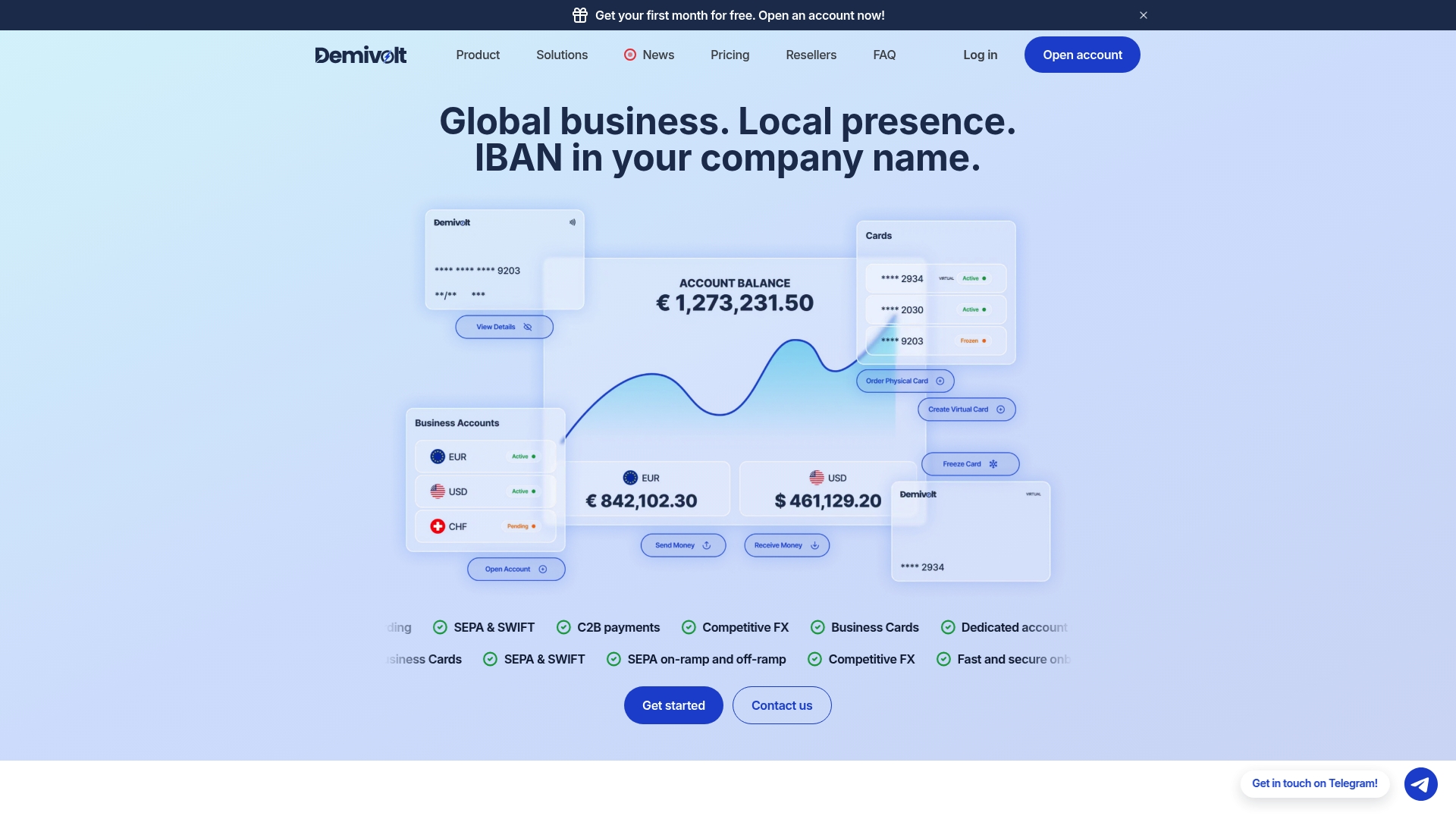
Demivolt gives businesses a regulated, transparent platform for managing cross-border payments without the opacity of traditional correspondent banking. With dedicated IBAN accounts, SEPA and SWIFT payment support, and virtual and physical business cards, your business controls exactly what it pays on every international transaction.
Validate your international account details instantly with Demivolt’s IBAN validator tool before initiating any transfer. Errors in beneficiary account details are one of the most common causes of payment delays and investigation fees.
Get started with Demivolt and bring full visibility to your cross-border payment costs.