

TL;DR:
- Demivolt offers a regulated platform with European IBANs, SEPA, SWIFT, and US payment rails suitable for cross-border SMEs. Alternatives include multicurrency platforms, US challenger accounts, and payout platforms, each suited to specific business needs. Proper evaluation considers regulations, fee structures, and long-term growth needs to choose the best fit.
For U.S.-focused SMEs evaluating wamo.io alternatives, Demivolt is the recommended starting point: it offers regulated European banking infrastructure with dedicated IBAN accounts, SEPA and SWIFT processing, and USD-capable payment rails in a single compliant platform. If your business operates across both U.S. and EEA corridors, that combination is difficult to find elsewhere without stitching together multiple providers.
Beyond Demivolt, the strongest substitute services fall into three categories worth testing next:
- Global multicurrency platforms — suited to businesses with high FX volumes and multi-currency treasury needs
- U.S.-centric challenger business accounts — best for companies operating primarily in USD with ACH/routing as the core rail
- Payments-first payout platforms — built for marketplaces, e-commerce, and businesses that need mass payouts more than a full banking stack
To pick the right one in two steps: first, confirm whether you need a U.S. routing number and ACH capability or a European IBAN (or both); second, map your accounting and ERP integrations to the platforms that support them natively. Those two filters alone will eliminate most mismatches before you spend time on KYC.
Table of Contents
- How do these wamo.io alternatives compare side by side?
- What does each alternative category actually offer?
- How do pricing and fees actually work across these platforms?
- How does account opening, KYC, and onboarding typically work?
- What regulation and fund safety differences should you check before switching?
- How do you choose the right alternative? A practical decision checklist
- Why is Demivolt the recommended pick for many U.S.-focused SMEs?
- What are the immediate next steps to switch accounts?
- How does customer support quality compare across these platforms?
- How do web and mobile app experiences differ?
- What additional banking features should you look for?
- How does account closure and switching work in practice?
- Key Takeaways
- Demivolt: regulated business banking for cross-border SMEs
How do these wamo.io alternatives compare side by side?
The table below maps the dimensions that actually drive switching decisions. Feature availability varies by plan tier, and pricing shown reflects publicly listed standard rates, which providers update periodically.
| Dimension | Demivolt | Global Multicurrency Platforms | U.S. Challenger Accounts | Payments-First Platforms | Fintechs with Embedded Cards |
|---|---|---|---|---|---|
| U.S. availability / onboarding | Yes | Yes | U.S.-only | Yes | Yes |
| USD account (routing/ACH) | Yes | Yes | Yes | Yes | Varies |
| IBANs / multi-currency balances | Dedicated IBANs | Multi-currency | No IBAN | Limited | Limited |
| SEPA support | Yes | Yes | No | Partial | Rare |
| SWIFT support | Yes | Yes | Limited | Yes | Limited |
| ACH support | Yes | Yes | Yes | Yes | Varies |
| Business cards (virtual/physical) | Virtual + physical Visa | Yes | Yes | Limited | Core feature |
| API & integrations | Yes | Yes | Yes | Yes | Yes |
| Fee profile | Transparent subscription + per-transaction | FX-margin-led | Low monthly, per-transaction | Per-payout model | Card-fee-led |
| Onboarding speed | Fast, compliance-first | Fast | Instant to 2 days | Fast | Fast |
| Transaction scale | SME to mid-market | SME to enterprise | SME | High-volume payouts | SME |
| Best for | Cross-border SMEs needing IBANs + USD rails | High FX-volume businesses | U.S.-domestic operations | Marketplaces, gig platforms | Expense-heavy teams |
Legend: “Yes” = natively supported on standard plans; “Partial” or “Limited” = available on higher tiers or with restrictions; “Varies” = provider-dependent.
As research confirms, platforms differ significantly in operational scope: some focus on localized EEA experiences while others are engineered to scale across multiple regulatory jurisdictions and currency corridors. That distinction matters most when your business needs both a U.S. routing number and a European IBAN in the same account structure.
Pro Tip: If your business runs frequent low-value FX conversions, prioritize the FX margin column over the monthly fee. A 0.5% margin difference on $200,000 in monthly FX volume costs more annually than most premium subscription tiers.
What does each alternative category actually offer?
Alternatives are commonly grouped by primary strength: payments-led platforms, full business banking, or embedded finance and API-first vendors. Here is what each category delivers in practice.
Demivolt (recommended)
Demivolt provides regulated business banking and payment infrastructure for SMEs operating across U.S. and European corridors. The platform issues dedicated IBANs, processes SEPA and SWIFT payments, supports ACH/USD routing, and issues virtual and physical Visa cards, all within a multi-account structure with role-based user management.
Pros:
- Dedicated IBANs with SEPA, SWIFT, and ACH on a single platform
- Regulated under EU electronic money rules with segregated client accounts
- White-label BaaS and API access for businesses that need embedded finance
Cons:
- Primarily European regulatory footprint; U.S. state-by-state licensing varies
- Not suited to businesses that need only domestic U.S. banking with no cross-border requirements
Best for: Cross-border SMEs, e-commerce exporters, digital-first businesses, and fintechs needing compliant European IBANs alongside U.S. payment rails.
Feature checklist:
| Feature | Demivolt |
|---|---|
| Dedicated IBANs | ✓ |
| USD routing / ACH | ✓ |
| SEPA payments | ✓ |
| SWIFT payments | ✓ |
| Virtual + physical cards | ✓ |
| Accounting integrations | ✓ |
| Role-based user management | ✓ |
| API access | ✓ |
Global multicurrency platforms
These platforms, including providers like Wise and Payoneer, prioritize FX efficiency and multi-currency balances. They typically offer local account details in multiple currencies, competitive FX margins, and integrations with accounting tools like QuickBooks and Xero.
Pros:
- Competitive FX margins on high-volume conversions
- Local account details in 10+ currencies
- Strong accounting software integrations
Cons:
- Limited dedicated IBAN issuance for individual clients
- Customer support can be slow during compliance reviews
Best for: High-volume exporters, freelancers receiving payments in multiple currencies, and businesses where FX cost is the primary driver.
U.S.-centric challenger business accounts
Platforms like Mercury, Novo, and Brex are built for U.S.-incorporated businesses. They offer FDIC-insured accounts (through bank partners), ACH and wire transfers, and integrations with U.S.-centric tools like Stripe, QuickBooks, and Gusto.
Pros:
- FDIC insurance through banking partners
- Instant or near-instant account opening for U.S. entities
- Deep integrations with U.S. payroll and accounting tools
Cons:
- No European IBAN or SEPA support
- Limited utility for businesses with significant EEA payment flows
Best for: U.S.-incorporated SaaS companies, startups, and domestic-first businesses with no cross-border EEA requirements.
Payments-first payout platforms
These platforms are optimized for mass payouts rather than full business banking. They handle supplier payments, contractor payouts, and marketplace disbursements at scale, often with API-first architectures. API-first approaches in payments are particularly relevant here, as they enable automation and smart routing across multiple rails.
Pros:
- Built for high-volume, multi-recipient payouts
- Strong API and webhook support
- Multi-currency payout corridors
Cons:
- Not a full business account replacement (no card programs, limited inbound payment features)
- Per-payout pricing can become expensive at scale
Best for: Marketplaces, gig economy platforms, and businesses that need automated mass payouts more than a banking stack.
Fintechs with embedded card programs
Card-led platforms focus on expense management, virtual card issuance, and spend controls. They suit finance teams that need granular card-level controls but may not require a full banking relationship.
Pros:
- Granular spend controls and real-time card management
- Strong receipt capture and expense categorization
- Fast card issuance
Cons:
- Weak on inbound payment rails and IBAN issuance
- Monthly fees can be high relative to banking features offered
Best for: Finance teams managing distributed employee spend, subscription businesses, and companies with high card transaction volumes.
How do pricing and fees actually work across these platforms?
The monthly subscription is rarely where the real cost sits. For businesses with frequent international transfers, FX and SWIFT fees quickly overtake monthly subscription savings. Understanding the fee buckets before you switch prevents expensive surprises.
The main fee categories to evaluate:
- Monthly subscription fee — flat or tiered; often waived at entry level but gates key features
- FX margin — the spread added to the mid-market rate on currency conversions; typically depends on provider and plan
- SWIFT transfer fee — charged per outgoing international wire; can range from a flat fee to a percentage of the transfer value
- ACH fee — usually low or free for standard ACH; same-day ACH may carry a per-transaction charge
- Incoming transfer fee — some providers charge for receiving SWIFT or SEPA payments
- Card transaction fee — foreign transaction fees on physical or virtual card spend
- Plan upgrade cost — the pricing jump when you need bulk transfers, multi-user roles, or accounting sync, which lower-tier plans frequently omit
Example cost calculation for a hypothetical quarterly spend profile:
Assume a business processes a significant volume in FX conversions per quarter and performs multiple SWIFT transfers and SEPA payments.
- At a 1.5% FX margin, the FX cost per quarter can be substantial
- SWIFT transfer fees per transfer add up to a notable amount per quarter
- Incoming SEPA payments may carry fees that accumulate over time
- Total quarterly transaction cost: approximately $2,500, before any monthly fee
Switching to a provider with lower FX margins and flat SWIFT fees can significantly reduce quarterly costs. That saving alone justifies a higher-tier subscription in most cases.
Pro Tip: Request a sample fee schedule from any provider before committing. Ask specifically: “What is your FX margin on USD/EUR conversions at our expected monthly volume?” A provider that cannot answer that question precisely is one to treat with caution.
Where to look on pricing pages:
- Check whether the listed FX rate is mid-market or includes a margin
- Confirm SWIFT fees are per-transfer flat, not percentage-based
- Verify whether incoming SEPA and SWIFT payments carry fees
- Identify which features are gated behind higher tiers (bulk transfers, API access, multi-user roles)
How does account opening, KYC, and onboarding typically work?
SMEs frequently choose providers based on onboarding ease, then later encounter operational limits that cause migration costs. A faster KYC process is only an advantage if the account you open actually supports the payment rails you need at launch.
Documents typically required for U.S.-operable business accounts and European IBAN-capable accounts:
- Certificate of incorporation or equivalent company registration document
- Proof of registered business address (utility bill, bank statement, or official correspondence)
- Government-issued ID for all beneficial owners (passport or national ID)
- Tax identification number (EIN for U.S. entities; VAT or local tax number for EU entities)
- Business activity description and expected transaction volumes
- Source of funds declaration for higher-risk business categories
Expected onboarding timelines:
- Instant to 24 hours — U.S. challenger accounts with automated KYC for straightforward U.S.-incorporated entities
- 1–3 business days — Global multicurrency platforms with standard compliance review
- 3–7 business days — Regulated European platforms with full KYC, including beneficial ownership verification
- 7–21 business days — Complex cases involving multiple jurisdictions, high-risk business categories, or incomplete documentation
Practical ways to accelerate approval:
- Submit all beneficial owner documents simultaneously, not sequentially
- Prepare a one-page business activity summary describing your revenue model, customer base, and expected payment corridors
- Provide 3–6 months of bank statements from your existing account to demonstrate transaction history
- Use a dedicated account manager escalation path when available; digital-only support channels can cause critical delays during compliance reviews
- Stage high-value or high-risk transfers for the weeks after initial verification, not the first week
What regulation and fund safety differences should you check before switching?
Jurisdiction and regulatory model determine where your money sits and what protections apply. These are not interchangeable across providers.
Typical regulatory models:
- Electronic money institution (EMI) — licensed to issue e-money and hold client funds; required to segregate client funds from operational funds. No deposit insurance equivalent, but segregation protects funds in insolvency.
- Bank partner model — the fintech holds funds at a licensed bank; FDIC insurance (up to $250,000 per depositor) may apply through the bank partner for U.S.-incorporated entities.
- Full banking license — rare among fintechs; provides direct deposit insurance and full banking powers.
Key regulatory standards to verify:
- EU Electronic Money Directive (EMD2) compliance for EEA-licensed providers
- PCI DSS certification for any provider issuing or processing card payments
- ACH network membership or sponsorship for U.S. routing and ACH transfers
- SWIFT BIC registration for international wire capability
Practical checklist before switching:
- Confirm whether client funds are held in segregated accounts, and request written confirmation
- Check whether FDIC insurance applies and, if so, up to what limit and through which bank partner
- Verify PCI DSS compliance level for card programs
- Read the terms and conditions for language on fund safeguarding, not just the marketing page
- Confirm the provider’s jurisdiction and which regulator handles complaints
Regulatory note: Wamo Solutions Ltd operates with connections to London and Malta, reflecting a dual-jurisdiction structure common among European fintechs. When evaluating any provider, the jurisdiction of the entity holding your funds determines which regulator you can escalate to, not the jurisdiction of the company’s headquarters.
How do you choose the right alternative? A practical decision checklist
Founders often focus on quick onboarding but later hit feature gaps that hinder scale. A structured evaluation prevents that pattern.
Prioritized evaluation checklist:
- USD routing and ACH — does the provider issue a U.S. routing number and support ACH debits and credits? If yes, confirm same-day ACH availability.
- Monthly FX volume — calculate your expected FX volume and compare the total cost at each provider’s margin, not just the monthly fee.
- Card program needs — do you need virtual cards only, or physical cards with spend controls and receipt capture?
- API and webhook support — confirm API documentation is publicly available and test a sandbox before committing.
- Dedicated account management — for businesses processing above a threshold volume, dedicated support reduces compliance-related downtime.
- Regulatory fit — match the provider’s license and jurisdiction to the markets you operate in and plan to expand into.
Red flags to watch for:
- FX margins not disclosed on the pricing page (ask directly before signing)
- No escalation path beyond a chatbot during KYC review
- Missing API documentation or sandbox environment
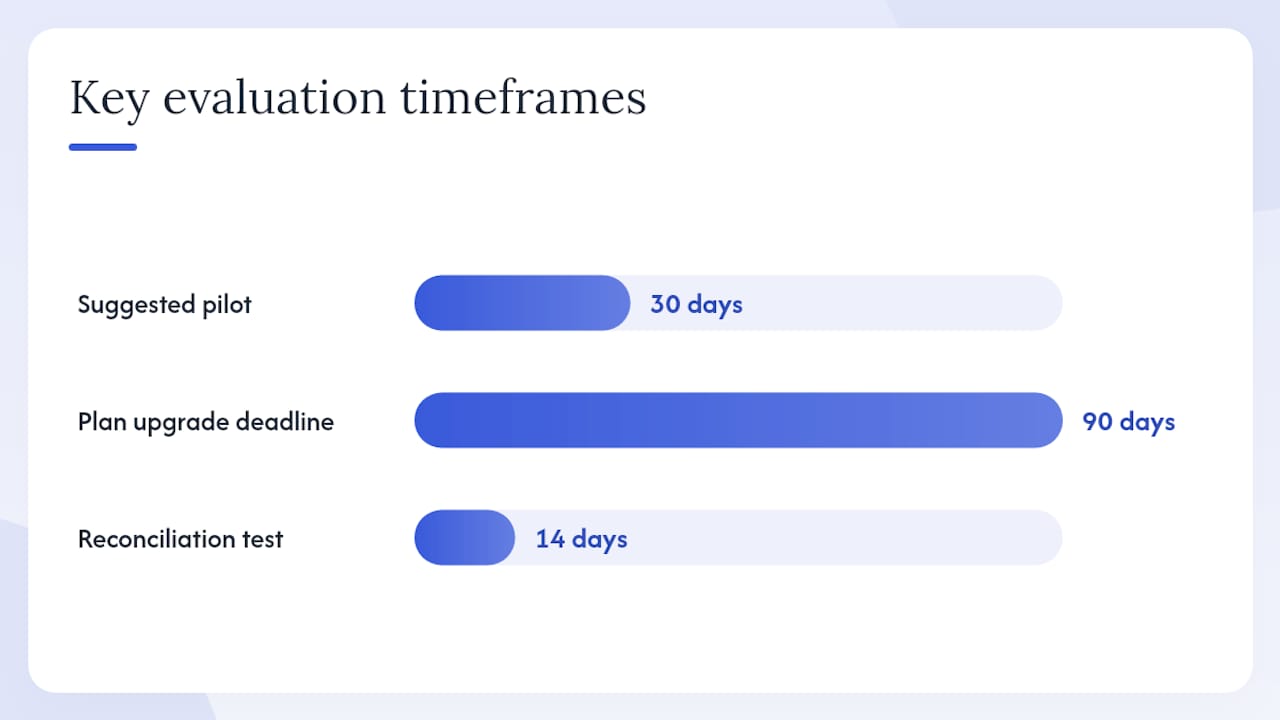
- Transaction caps that would require a plan upgrade within 90 days of launch
- No written confirmation of fund segregation or safeguarding model
Suggested 30-day pilot plan:
- Open a free or low-cost starter account and complete full KYC
- Run a pilot of inbound and outbound transfers across your primary rails (ACH, SEPA, or SWIFT)
- Test card payments and expense categorization with your accounting software
- Confirm reconciliation accuracy by syncing two weeks of transactions to your bookkeeping tool
- Evaluate support responsiveness by submitting a non-urgent query and measuring response time
For a structured checklist on secure cross-border payment setup, Demivolt’s published guide covers the key verification steps in detail.
Why is Demivolt the recommended pick for many U.S.-focused SMEs?
Transparency first: this article is published by Demivolt. The comparison above is built on publicly available feature and fee information, and Demivolt is recommended where its regulated infrastructure genuinely fits the stated use case.
For a U.S.-operating SME that also needs European IBAN accounts, SEPA processing, and SWIFT capability, Demivolt’s feature set maps directly to those requirements without requiring separate provider relationships.
Feature checklist tied to SME priorities:
- ✓ Dedicated IBANs (individual, not pooled)
- ✓ SEPA credit transfers and direct debits
- ✓ SWIFT international wire processing
- ✓ USD routing and ACH capability
- ✓ Virtual and physical Visa business cards
- ✓ Multi-account structures for project or entity separation
- ✓ Role-based user management for finance teams
- ✓ API integrations for accounting and ERP connectivity
- ✓ White-label BaaS for platforms embedding financial services
- ✓ Segregated client accounts under EU regulatory standards
Practical example: A U.S.-incorporated e-commerce business selling into European markets needs to receive EUR payments from European customers (SEPA), pay European suppliers (SWIFT), and manage USD operating expenses (ACH). With Demivolt, that business operates from a single platform with dedicated IBANs for EUR receipts, SWIFT for supplier payments, and USD rails for domestic expenses, rather than maintaining three separate accounts across two providers.
Demivolt’s regulated infrastructure gives cross-border SMEs a single compliant platform for IBANs, SEPA, SWIFT, and USD rails, removing the operational overhead of managing multiple banking relationships.
Pro Tip: If your business plans to expand into additional European markets within 12 months, prioritize a provider that issues dedicated IBANs per entity or account, not shared pooled IBANs. Dedicated IBANs simplify reconciliation and reduce the risk of payment misallocation as volume grows.
What are the immediate next steps to switch accounts?
Demivolt is the recommended regulated alternative for SMEs that need both European IBANs and U.S. payment rails. The two main reasons: EU regulatory compliance with segregated client accounts, and a single platform covering SEPA, SWIFT, and ACH without requiring separate provider relationships.
Action checklist to start switching:
- Compare pricing on your primary rails (ACH, SEPA, SWIFT) using your actual quarterly volume, not hypothetical minimums
- Open a starter or demo account and complete KYC with all beneficial owner documents ready
- Run a 30-day pilot covering inbound and outbound transfers plus card payments
- Test accounting software reconciliation (QuickBooks, Xero, or your ERP) during the pilot
- Prepare account-switching documents: notify existing payment partners of new account details, update direct debit mandates, and redirect recurring inbound payments
Expected timelines: KYC typically completes within 3–7 business days for straightforward applications. Full operational readiness, including card issuance and API integration, generally takes 1–2 weeks from account approval.
For support during migration, Demivolt’s partner and reseller program provides access to dedicated account management for businesses referred through advisory relationships. If you are working with a financial advisor or payments consultant, ask whether they participate in the program.
How does customer support quality compare across these platforms?
Support quality is one of the most consequential differences between providers, and one of the least visible during evaluation. The gap between a chatbot and a dedicated account manager becomes apparent only when a compliance hold delays a critical payment.
U.S. challenger accounts typically offer self-serve support through in-app chat and email, with response times measured in hours for standard queries. Escalation paths for compliance issues are often limited to email queues, which can extend resolution times during high-volume periods.
Global multicurrency platforms have invested in support infrastructure at scale, but ticket volumes mean that complex KYC or compliance queries can take multiple business days to resolve. Phone support is rare; live chat is common but often triaged by automated routing before reaching a human agent.
Regulated European platforms, including Demivolt, tend to offer dedicated account management for business clients above a certain volume threshold. That structure means a named contact who understands your account history, which materially reduces resolution time during compliance reviews. For businesses where payment delays carry direct revenue impact, that access is worth factoring into the total cost of the relationship.
How do web and mobile app experiences differ?
Platform usability affects daily operational efficiency more than most businesses account for during evaluation. A well-designed dashboard reduces the time your finance team spends on reconciliation, card management, and payment approvals.
U.S. challenger accounts generally lead on consumer-grade UX: clean mobile apps, instant notifications, and intuitive card controls. The trade-off is that the feature depth behind that interface is often limited, particularly for multi-user roles and bulk payment management.
Global multicurrency platforms offer feature-rich web interfaces but mobile apps that sometimes lag behind the web experience in functionality. Bulk payment uploads, multi-currency balance views, and FX conversion tools are typically better on desktop.
Demivolt’s platform is built for finance professionals rather than consumer-first UX. The interface prioritizes clarity in account structures, payment status tracking, and role-based access, which suits teams managing multiple accounts or entities. API access extends usability for businesses that want to automate payment workflows rather than manage them manually through a dashboard.
What additional banking features should you look for?
Beyond payments and cards, the features that separate providers at the SME level are lending access, interest on balances, and overdraft facilities.
U.S. challenger accounts have moved furthest on this dimension. Several offer revenue-based credit lines, interest-bearing accounts (typically through bank partners), and early access to receivables. These features are genuinely useful for cash-flow management, particularly for businesses with seasonal revenue patterns.
Global multicurrency platforms generally do not offer lending or overdraft. Interest on balances is rare and, where available, limited to specific currency accounts. Their value proposition is payment efficiency, not balance sheet management.
Regulated European EMIs, including Demivolt, operate under electronic money institution licenses that restrict deposit-taking and lending. That regulatory boundary is a deliberate compliance choice, not a product gap. For businesses that need credit alongside their payment infrastructure, the practical approach is to maintain a separate credit facility with a licensed bank and use the EMI platform for payment operations.
How does account closure and switching work in practice?
Switching business accounts carries more operational friction than most businesses anticipate. The process involves more than opening a new account; it requires migrating payment relationships, updating direct debit mandates, and ensuring no inbound payments are lost during the transition.
Most fintech providers allow account closure through an in-app request or email to support. Closure timelines typically range from 3–10 business days, during which remaining balances are returned to a nominated account. Fees for closure are uncommon among the platforms in this comparison, but verify the terms before initiating.
The practical switching checklist:
- Maintain both accounts simultaneously for at least 30 days during migration
- Identify all inbound payment sources (customers, payment processors, platforms) and notify them of the new account details
- Update all outgoing direct debit mandates and standing orders
- Confirm that any card programs are migrated before canceling the old card issuer
- Export transaction history and statements before closing the old account, as access is typically revoked at closure
One underappreciated risk: if your existing provider holds funds in a pooled account rather than a dedicated IBAN, reconciling the final balance during closure can take longer than expected. Providers with dedicated IBANs per client make this process cleaner.
Key Takeaways
The strongest wamo.io alternatives for U.S.-operating SMEs are those that match your specific payment rails, regulatory requirements, and integration needs, not simply the platform with the fastest onboarding.
| Point | Details |
|---|---|
| Regulation and fund safety | Verify whether your provider is an EMI with segregated accounts or a bank-partner model with FDIC coverage before switching. |
| USD routing plus IBANs | If your business needs both ACH/USD rails and European IBANs, only a small number of platforms support both natively on a single account. |
| FX and SWIFT economics | For businesses with significant cross-border volume, FX margins and SWIFT fees typically exceed monthly subscription costs. |
| Integrations and API access | Confirm API documentation and accounting software compatibility before committing; feature gaps discovered post-onboarding are expensive to fix. |
| Demivolt as the recommended pick | Demivolt provides dedicated IBANs, SEPA, SWIFT, and ACH on a regulated platform, making it the recommended choice for cross-border SMEs needing both European and U.S. payment rails. |
The case for choosing by long-term fit, not onboarding speed
The most common mistake SMEs make when switching business accounts is optimizing for the wrong variable. Fast onboarding feels like a win in week one. Six months later, the same business is managing a second provider relationship because the first platform did not support bulk transfers, multi-user roles, or the accounting integration their finance team depends on.
The platforms that look least impressive during evaluation, because they ask for more documents and take longer to approve, are often the ones built for businesses that actually grow. Regulated infrastructure, dedicated IBANs, and proper API access are not features you need on day one. They are features you need on day 180, when your transaction volume has tripled and your finance team is trying to reconcile payments across three currencies without a manual export.
The right evaluation question is not “which platform can I open an account with today?” It is “which platform will still be the right fit when my business is twice this size?” That reframe changes the answer for most SMEs.
Demivolt: regulated business banking for cross-border SMEs
Demivolt gives U.S.-operating SMEs a single regulated platform for dedicated IBANs, SEPA and SWIFT processing, ACH/USD rails, and virtual and physical Visa cards, without the operational overhead of managing separate European and U.S. banking relationships.
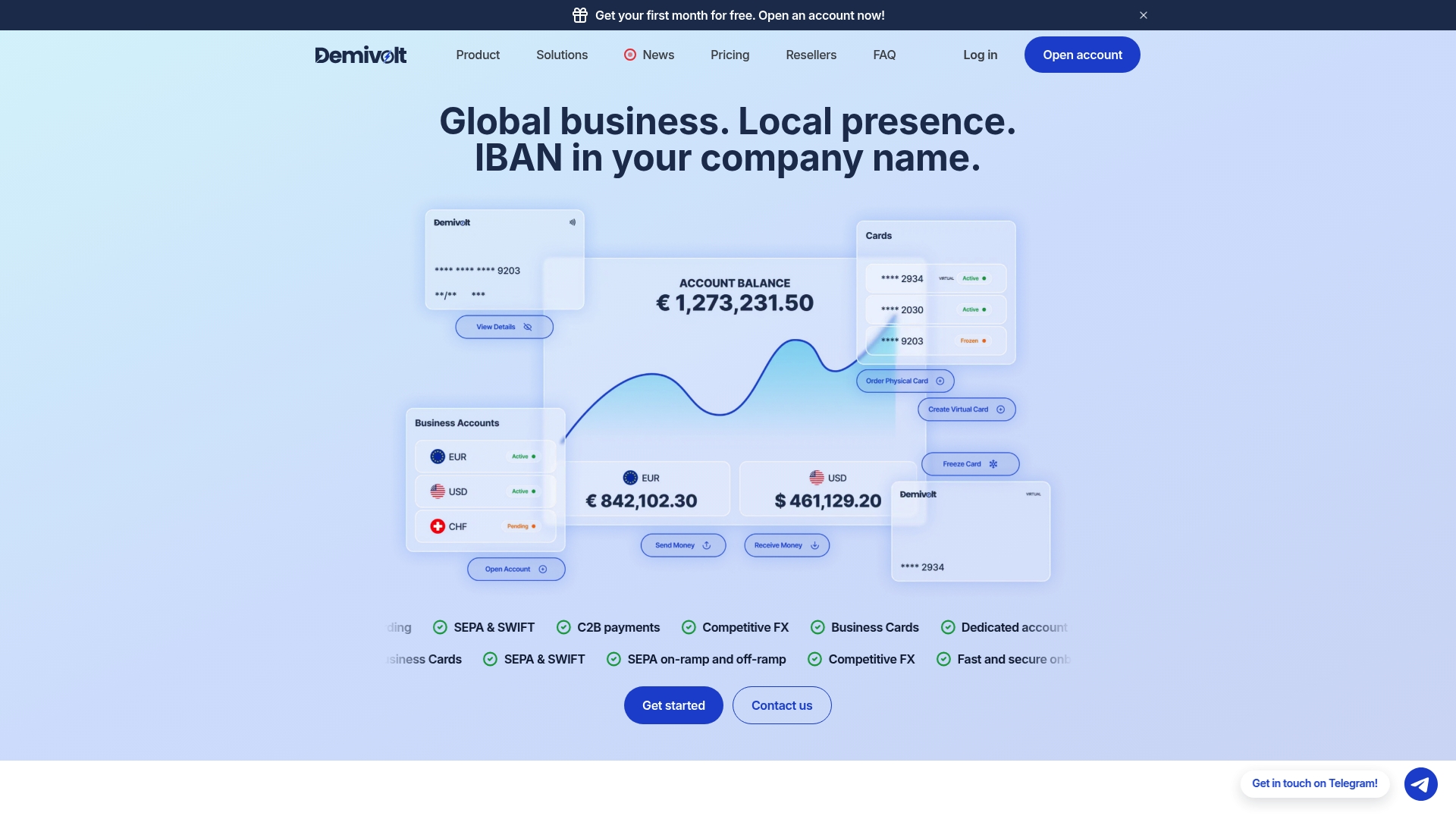
Getting started takes three steps: open a business account and complete KYC with your company registration and beneficial owner documents; request dedicated IBANs and enable your required payment rails (SEPA, SWIFT, ACH); and activate your card program or API integration to connect your accounting stack. For businesses evaluating SEPA payment flows, Demivolt’s free SEPA tools let you test and validate payment details before going live. Use the IBAN validator to verify beneficiary IBANs during your pilot transfers.
This article is published by Demivolt. The comparison reflects publicly available information and is intended to help SMEs make an informed decision. Contact Demivolt directly to discuss your specific payment corridors, volume requirements, and whether the partner or reseller program applies to your situation.
Sources and further reading
- Wamo Business Account review — Statrys: Detailed review covering feature gating on lower-tier plans, SWIFT fee levels, and long-term operational fit considerations.
- wamo vs Wise — BounceWatch: Side-by-side comparison of operational scope, FX economics, and platform positioning for EEA vs. global use cases.
- Wamo Business Account Review — TopMobileBanks: SME-focused review covering onboarding experience, admin efficiency, and integration capabilities.
- Top Wamo alternatives, competitors — CB Insights: Category-level overview of alternative provider types grouped by primary strength.
- wamo.io Alternatives — SaaSHub: Community-sourced alternative list with coverage notes and update history.
- APIs in payments unlock fintech innovation — Cray: Primer on API-first payment architectures and their relevance for SMEs evaluating integration capabilities.
- Demivolt: compliant financial services for SMEs: Overview of regulatory benefits and safeguarding models for SMEs choosing regulated providers.
- Digital banking onboarding: a compliance-first guide — Demivolt: Practical KYC and onboarding guidance for businesses opening regulated digital business accounts.
Recommended
- Demivolt | Blog – Top 5 lt.linkedin.com Alternatives 2026
- Demivolt | Blog – Top 4 finoviapay.com Payment Alternatives 2026
- Demivolt | Blog – Top 5 Vialet.eu Business Banking Alternatives 2026
- Demivolt | News – Waffo Secures US$30 Million in Total Funding to Expand Global Payment Infrastructure for Digital Businesses