

TL;DR:
- A compliance workflow for financial institutions is an automated process that documents evidence at the point of control execution. It requires integrating core systems, maintaining regulatory registrations, and writing policies to ensure accountability. Regular reviews and deterministic automation enhance auditability and help manage risks effectively.
A workflow for financial compliance is a structured, automated sequence of tasks that ensures financial institutions and SMEs meet regulatory requirements consistently and with a clear audit trail. Compliance officers at SMEs face pressure from regulators like FINRA, the SEC, FinCEN, and state-level authorities, all of whom expect documented evidence that controls actually operated as described. The difference between passing an exam and failing one often comes down to whether your financial compliance process captures proof at the point of execution, not after the fact. This guide walks you through the prerequisites, design steps, common mistakes, and automation strategies that make a compliance workflow hold up under scrutiny.
What does an effective workflow for financial compliance require?
Every financial compliance workflow starts with the right infrastructure in place before you map a single process. Without the correct tools and registrations, even a well-designed workflow will fail at the first regulatory review.

Core systems to integrate
Three categories of software form the backbone of any financial regulatory workflow: a CRM for client records and interaction history, a document management system for policy storage and version control, and an email archiving platform for communication retention. These systems must connect to each other so that evidence flows automatically into a central repository rather than sitting in silos.
Regulatory registration is equally non-negotiable. Fintech entrants must complete FinCEN MSB registration within 180 days of starting operations, and Money Transmitter Licensing timelines vary significantly by state. Missing these deadlines does not just create legal exposure. It invalidates your entire compliance posture.
Pro Tip: Map every regulatory obligation your business carries before you select a single software tool. The tools should serve the obligations, not the other way around.
Policy documentation and staff training are the third pillar. Written policies define what controls exist. Training records prove that staff understood and applied them. Regulators treat undocumented controls as controls that never ran.
| Tool category | Role in compliance |
|---|---|
| CRM | Client identity records, interaction logs, KYC data |
| Document management | Policy storage, version control, retention schedules |
| Email archiving | Communication capture for surveillance and audit |
| Workflow automation platform | Trigger management, task routing, SLA enforcement |
| IBAN and payment validators | Transaction accuracy and SEPA/SWIFT compliance checks |
Understanding what regulated fintech requires at the infrastructure level saves compliance officers from rebuilding workflows after a failed exam.
How do you design a step-by-step financial compliance workflow?
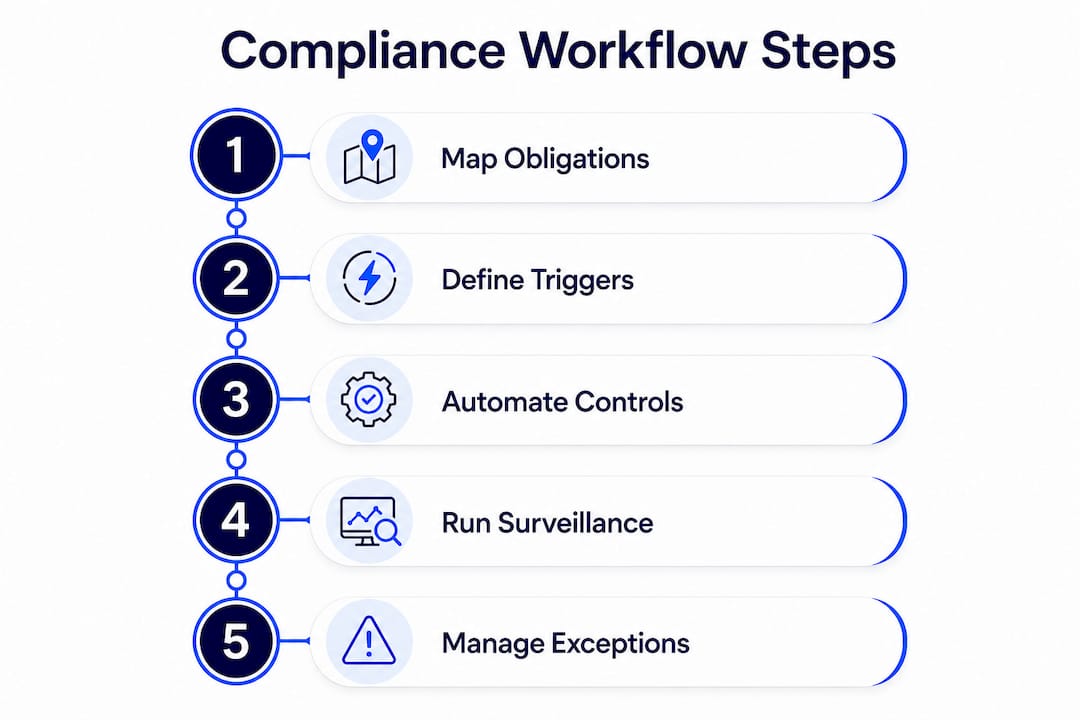
Designing a repeatable compliance workflow means translating regulatory obligations into specific controls, then wiring those controls to triggers that fire automatically. A typical automated compliance workflow covers seven core steps from policy acknowledgment through exam preparation.
The seven core steps
-
Map regulatory obligations to controls. List every rule that applies to your business, then assign a specific control to each one. A control without a mapped obligation is overhead. An obligation without a control is a gap.
-
Define triggers. Triggers are time-based (monthly reconciliation), system-event-based (a new account opened), or threshold-based (a transaction above a reporting limit). Each control needs at least one trigger that fires it automatically.
-
Automate policy acknowledgments. Staff must confirm they have read updated policies. Automated acknowledgment workflows send the document, record the signature, and log the timestamp without manual follow-up.
-
Run trade surveillance and communication archiving. Surveillance rules scan transactions and communications for patterns that match exception criteria. The system flags matches and routes them to the designated supervisor.
-
Configure exception routing with SLA enforcement. Exception tickets route automatically to supervisors based on severity, with a mandatory 24-hour SLA response time. Tickets that breach the SLA escalate to the next level without human intervention.
-
Capture evidence at the point of execution. Collecting evidence in real time is more effective than reconstructing it after the fact. Every control execution should generate a timestamped record that lands directly in your evidence repository.
-
Package evidence for exam preparation. Automated evidence packaging can reduce exam response times from days to under two hours by pulling requested documents directly from integrated systems.
Pro Tip: Build your exam package template before you need it. When a regulator sends a document request, you want to run a query, not search through folders.
| Workflow pattern | Best for | Key trigger type |
|---|---|---|
| Time-based | Periodic reporting, reconciliation | Calendar schedule |
| Event-based | KYC updates, account changes | System event |
| Threshold-based | AML alerts, large transaction reporting | Data condition |
The importance of compliance in payments extends to every trigger type. Payment workflows in particular need threshold triggers set at regulatory reporting limits to avoid missed filings.
What mistakes should you avoid in financial compliance workflows?
The most expensive compliance failures are not caused by missing regulations. They come from workflow design errors that make controls unreliable or unprovable.
-
Ignoring metadata on evidence capture. A document without a timestamp, author, and system source is not evidence. Regulators require proof that the control ran at the right time, by the right person, in the right system.
-
Stacking approvals instead of building repeatable controls. More approvals do not equal better compliance. The goal is a reliable check embedded in daily work, not a chain of sign-offs that creates bottlenecks and diffuses accountability.
-
Documenting after the task is complete. Retroactive documentation is the single most common audit finding at SMEs. If the record was created after the control ran, regulators will question whether the control ran at all.
-
Failing to define roles, handoffs, and escalation paths. Segregation of duties requires documented separation between the person who initiates a transaction, the person who authorizes it, and the person who tests the control. Blurring these roles is a SOX and AML red flag.
-
Skipping periodic review. Control design reviews must happen at least annually and after any regulatory or organizational change. A workflow that was compliant in january may not be compliant in october if the regulation changed.
Pro Tip: Run a quarterly “ghost audit” where one team member plays the role of the examiner and requests the same documents a regulator would. You will find gaps before the regulator does.
How does automation improve financial compliance management?
Automation changes compliance from a periodic scramble into a continuous, auditable process. The key distinction is between deterministic and probabilistic automation.
Deterministic, rule-based workflows execute fixed logic every time, producing the same output for the same input. That reproducibility is exactly what regulators need to see. A KYC check that runs the same screening logic on every new client, logs the result, and routes exceptions to a supervisor is auditable. An AI model that produces different risk scores for similar profiles is not.
Deterministic systems execute fixed logic, enabling traceable decisions. High-stakes compliance like KYC/AML requires this auditability. Stochastic AI models produce inconsistent outputs that regulators cannot verify, making them unsuitable as the primary engine for compliance decisions.
Automation delivers the most value in three specific areas:
- KYC/AML screening: Automated identity verification and sanctions screening run at onboarding and at scheduled intervals, with every result logged and timestamped.
- Loan underwriting controls: Rule-based credit policy checks fire at each stage of the underwriting process, creating a decision trail that satisfies fair lending requirements.
- Contract and communication review: Automated archiving captures all client communications and flags terms that match surveillance rules, reducing the manual review burden on compliance staff.
Human-in-the-loop checkpoints remain necessary for judgment calls. Automation handles the volume. Trained compliance officers handle the edge cases that fall outside the rule set. This combination produces workflows that are both fast and defensible.
Learning how to automate business payments while maintaining compliance gives SMEs a practical model for applying deterministic logic to high-volume, high-risk processes.
Key Takeaways
A well-built financial compliance workflow captures evidence continuously, fires controls automatically, and produces an audit-ready record without manual reconstruction.
| Point | Details |
|---|---|
| Start with infrastructure | Integrate CRM, document management, and email archiving before mapping any workflow. |
| Use three trigger types | Time-based, event-based, and threshold-based triggers cover the full range of compliance obligations. |
| Capture evidence in real time | Evidence collected at execution is more credible and complete than retroactive documentation. |
| Choose deterministic automation | Rule-based workflows produce traceable, reproducible decisions that satisfy regulatory audit requirements. |
| Review controls regularly | Annual reviews and post-change updates keep workflows aligned with current regulatory expectations. |
What I have learned from building compliance workflows at SMEs
The most common mistake I see compliance officers make is treating workflow design as a one-time project. They build the process, train the team, and move on. Six months later, a regulation changes or the company adds a new product line, and the workflow no longer covers the actual risk. Compliance programs that stay current are the ones where someone owns the review calendar and treats it as seriously as the workflow itself.
The second lesson is harder to sell internally: embed compliance into the work that already happens, rather than adding parallel steps. When a compliance check lives inside the payment approval process, it gets done every time. When it lives in a separate compliance system that staff log into once a week, it gets skipped. The secure onboarding workflow model is a good example of this principle applied to client intake.
Cross-team accountability matters more than most compliance officers admit. A workflow that only the compliance team owns will always lose to operational pressure. When finance, operations, and compliance share ownership of the same process, the controls actually run.
The regulatory environment in 2026 rewards SMEs that can show continuous compliance, not just point-in-time snapshots. Build for the exam you will face in three years, not the one you faced last year.
— dd
Demivolt’s tools for compliant financial operations
Compliance workflows depend on accurate payment data at every step. Demivolt offers free tools that fit directly into your financial compliance checklist, starting with the IBAN Validator, which checks IBAN accuracy against the ISO 13616 standard before a payment is processed. A single invalid IBAN in a high-volume payment run creates reconciliation gaps that complicate audit trails.
Demivolt’s SEPA compliance tools give compliance officers and financial managers a practical way to validate payment data at the point of entry, not after a failed transaction. For SMEs managing cross-border payments under EU regulatory standards, these tools reduce the manual verification burden and keep payment records clean for regulatory review.
FAQ
What is a workflow for financial compliance?
A financial compliance workflow is a structured, automated sequence of tasks that maps regulatory obligations to specific controls, triggers those controls automatically, and captures evidence at the point of execution for audit purposes.
What are the steps in a financial compliance process?
The core steps are: map obligations to controls, define triggers, automate policy acknowledgments, run surveillance, configure exception routing with SLA enforcement, capture evidence in real time, and package that evidence for exam preparation.
How does compliance workflow automation reduce audit risk?
Automated workflows capture timestamped evidence continuously and route exceptions to supervisors within defined SLA windows, reducing exam response times from days to under two hours.
What is the difference between deterministic and AI-based compliance workflows?
Deterministic workflows execute fixed rules and produce the same output every time, making them fully traceable. AI-based probabilistic models can produce inconsistent outputs, which regulators cannot reliably verify in a KYC/AML context.
How often should a financial compliance workflow be reviewed?
Control design reviews should happen at least once per year and immediately after any regulatory change or significant organizational change to keep the workflow aligned with current requirements.