

If you run finance for a logistics, freight, or cross-border trading business, the right move is to standardize on a regulated business banking platform that combines dedicated IBANs, SEPA and SWIFT rails, role-based account access, and API-driven reconciliation that ties every payment to a shipment record. That combination is what turns banking from a back-office chore into a compliance control that protects your business.
Three reasons this approach wins over a patchwork of legacy accounts and manual wires:
- Regulatory protection. Sanctions enforcement bodies like the Office of Foreign Assets Control hold freight intermediaries accountable for counterparty and routing checks, not just banks.
- Operational speed. SEPA and SWIFT rails paired with open APIs settle payments faster and give your team programmatic visibility instead of end-of-day statement reconciliation.
- Documentary alignment. Tying payments to shipping documentation closes the gap regulators increasingly scrutinize between what you invoiced and what you shipped.
“Freight forwarders are no longer treated as neutral intermediaries. Regulators expect them to verify counterparties, cargo origin, and routing, and to act on red flags.” This is the operating reality behind the growing enforcement trend against logistics intermediaries.
Pro Tip: Before you sign with any banking provider, ask for their sanctions-screening latency in writing. A platform that screens transactions in real time catches a flagged counterparty before funds move, not after.
Demivolt builds its business banking infrastructure around exactly this model: regulated European licensure, dedicated IBANs, SEPA and SWIFT payment rails, and role-based multi-account structures designed for companies that move money across borders every day.
Key Takeaways
Compliance-first banking, built on dedicated IBANs, SEPA/SWIFT rails, and documentary reconciliation, is what protects logistics SMEs from both payment fraud and sanctions enforcement exposure.
| Point | Details |
|---|---|
| Screen sanctions continuously | Integrate one centralized denied-party list across payments, shipping, and customs teams. |
| Reconcile invoices to shipments | Match payment records to bills of lading and tariff codes to close documentary gaps regulators scrutinize. |
| Verify vendor trust signals | Confirm EU licensure, segregated funds, audit logs, and API sandbox access before signing. |
| Watch subsidiary integration gaps | Unify compliance screening quickly after acquiring or opening foreign entities to avoid sanctions creep. |
| Choose regulated infrastructure | Demivolt offers dedicated IBANs, SEPA/SWIFT rails, role-based access, and segregated client funds for logistics SMEs. |
Table of Contents
- What Does “Bank Logistics” Actually Mean for Your Business?
- What Compliance Risks Are Specific to Logistics Companies?
- How Do You Evaluate a Banking Partner for Logistics Operations?
- How Does Demivolt Address These Logistics Banking Requirements?
- What Should You Expect During Onboarding, and What Will It Cost?
- How Do You Integrate Banking With Your TMS and Reconcile Shipping Documents?
- What Should You Do If a Payment or Shipment Raises a Red Flag?
- Why Compliance-First Banking Is a Growth Strategy, Not Just a Safeguard
- How Demivolt Supports Compliance-First Banking for Logistics SMEs
- Sources
What Does “Bank Logistics” Actually Mean for Your Business?
“Bank logistics” is not a term regulators or bankers use formally. In practice, it describes something specific: regulated business banking and payment infrastructure built for the operational realities of logistics, freight, and cross-border trading companies. Some finance teams call this banking logistics or financial logistics solutions. All three phrases point to the same underlying need.
That need breaks down into a defined set of capabilities:
- Dedicated business IBANs issued in your company’s name, not a pooled or intermediary account.
- SEPA and SWIFT payment rails for domestic European transfers and international wires.
- Virtual and physical business cards for fuel, tolls, customs fees, and driver expenses.
- Multi-account structures to separate operating cash, tax reserves, and subsidiary funds.
- Role-based access controls so a dispatcher can’t approve a six-figure wire.
- API integrations with your transport management system (TMS) or ERP for automated reconciliation and reporting.
A logistics finance function that treats banking as a commodity purchase, rather than an operational and compliance system, is setting itself up for reconciliation headaches and audit exposure later.
Definition box: Bank logistics, as used here, has nothing to do with the World Bank’s Logistics Performance Index or operational supply-chain benchmarking. This guide covers the banking and payments infrastructure that logistics companies use to move and control money, not the efficiency of freight movement itself.
Pro Tip: Prioritize providers that support automated bank account verification and IBAN validation during supplier and carrier onboarding. Confirming account ownership before the first payment goes out prevents wire fraud and cuts down on failed or delayed transfers.

What Compliance Risks Are Specific to Logistics Companies?
Logistics and freight businesses carry a distinct compliance profile because they sit between shippers, carriers, customs authorities, and financial institutions. That position creates exposure banks and regulators watch closely.
The primary risks finance leaders need to plan around:
- Sanctions screening gaps across counterparties, vessels, and routing that touch restricted jurisdictions.
- Export control violations tied to dual-use goods or restricted destinations.
- Beneficial ownership blind spots, where the entity paying an invoice isn’t the entity actually receiving goods.
- Invoice-versus-shipping document mismatches, where tariff codes, quantities, or descriptions on payment records don’t match the bill of lading.
- Routing and origin red flags, including transshipment through high-risk jurisdictions.
- “Sanctions creep” across subsidiaries, where a newly acquired local entity operates without the parent company’s centralized screening.
Legal analysts tracking trade enforcement note that customs and trade violations are increasingly prosecuted as economic crimes rather than administrative errors. A mismatch between an invoice description and a bill of lading can become primary evidence in a fraud investigation, even when the discrepancy was a clerical error rather than intentional misrepresentation.
Enforcement doesn’t require a company to have handled an entire prohibited shipment. Compliance experts studying freight forwarding cases point out that liability can attach to intermediaries who only handled a single leg of a sanctioned route, which is why partial visibility into a shipment’s full chain of custody isn’t a defense.
Sanctions creep deserves particular attention. When a logistics company acquires or opens a foreign subsidiary, that entity often runs on separate systems with separate screening standards during the transition period, creating a gap that persists until compliance platforms are unified.
Pro Tip: Maintain one centralized denied-party and sanctions list, and integrate it across payments, shipping, and customs functions. A screening list that only your finance team sees is a screening list your operations team will eventually bypass by accident.
How Do You Evaluate a Banking Partner for Logistics Operations?
Choosing a banking and payments platform for a logistics or cross-border trading business comes down to a short list of hard requirements, not a feature comparison of nice-to-haves.
Run through this checklist before any vendor demo:
- Does the provider hold a genuine EU banking or e-money license, and are client funds held in segregated accounts?
- What AML and sanctions-screening tools run on every transaction, and how fast do they flag a match?
- Does the platform offer documented APIs for TMS, ERP, and accounting system integration?
- Can the account structure support multi-currency balances and FX conversion without routing through a third party?
- Are role-based access controls and audit logs built into the account, or bolted on as an afterthought?
- What are the onboarding documentation requirements, and how long does account activation actually take?
- How is pricing structured across account fees, transaction fees, and card issuance?
During vendor demos, push past the sales pitch with specific operational questions:
- What is your average KYC turnaround time for a business with foreign subsidiaries?
- What is your sanctions-screening latency, measured in seconds or minutes, not “real time” as a slogan?
- What are your settlement windows for SEPA, SEPA Instant, and SWIFT, including cutoff times?
- Do you provide a sandbox environment for testing reconciliation before going live?
- Can your API push webhook notifications on payment status changes?
Red flags that should end the conversation: opaque explanations of how client funds are segregated, no visible audit log functionality, reconciliation processes that depend on manual statement downloads, no role-based permission tiers, and API documentation that doesn’t exist or requires an NDA just to preview.
| Selection Dimension | Entry-Level Solutions | Enterprise Platforms |
|---|---|---|
| Regulatory status & funds protection | Often unclear on segregation | Licensed with disclosed custodial structure |
| Payments supported | Limited SEPA only | SEPA, SWIFT, and multi-currency FX |
| Account structure & access | Single login, no tiers | Multi-account with role-based access |
| Card issuance | Physical only, slow issuance | Virtual and physical, instant issuance |
| Integration capabilities | Manual export/import | Documented API with sandbox |
| Onboarding time | Days to weeks, unclear requirements | Defined milestones and timelines |
| Compliance tooling | Basic KYC at signup only | Ongoing sanctions and AML screening |
How Does Demivolt Address These Logistics Banking Requirements?
Every item on that checklist maps directly to something a logistics finance leader can verify before signing a contract. Demivolt operates as a regulated European fintech platform built around that exact structure: dedicated IBANs, SEPA and SWIFT payment rails, virtual and physical Visa business cards, multi-account structures, and role-based user management for teams that need controlled, auditable access.
Verify these trust signals directly during evaluation, rather than taking any vendor’s word for it:
- EU regulatory licensure and disclosed treatment of client funds under segregated account arrangements.
- Compliance tooling covering KYC, AML, and sanctions screening integrated into the onboarding and transaction flow.
- API documentation and sandbox access, so your engineering team can test integrations before committing to a switch.
- Audit logs and transaction controls tied to role-based permissions, not a single shared login.
- Published onboarding timelines rather than vague “it depends” answers.
- Partner and reseller programs, which signal a platform built for ongoing B2B relationships rather than one-off signups.
A regulated banking platform that can’t show you its audit log structure in a demo isn’t ready for a logistics company’s transaction volume.
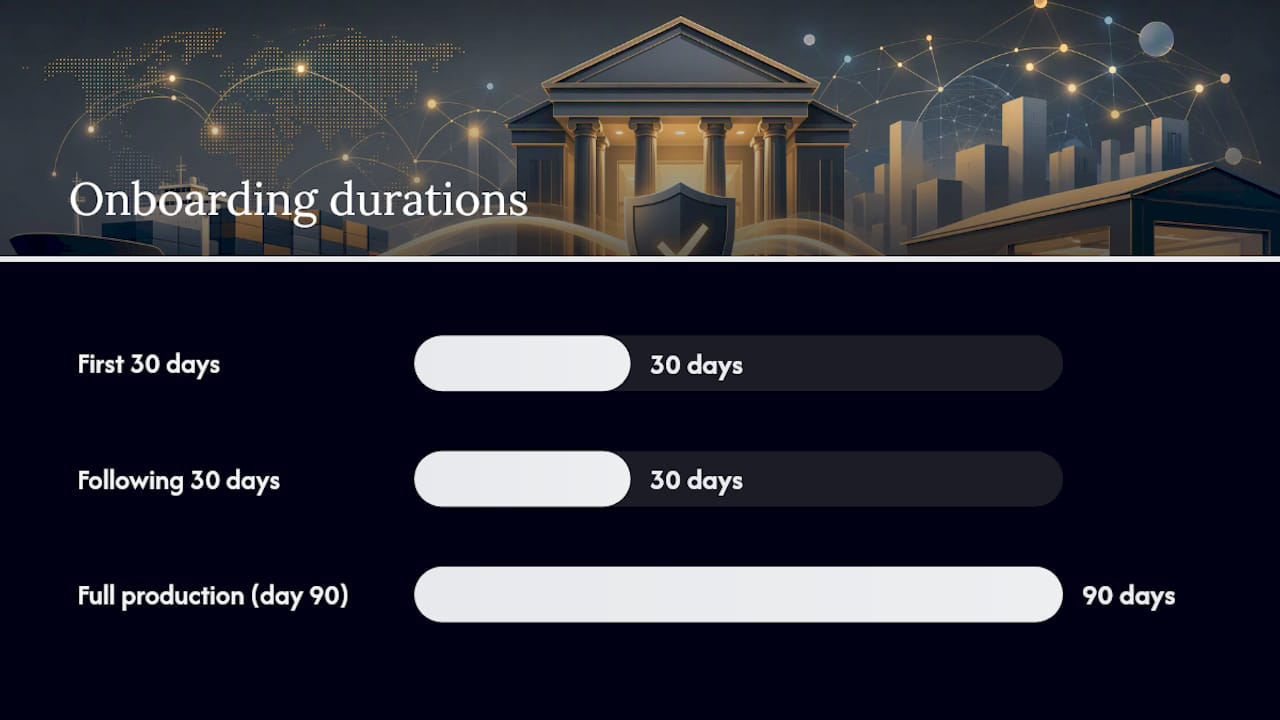
For a typical Demivolt client, the onboarding arc runs in three phases. In the first 30 days: application submission, KYC and beneficial ownership verification, and IBAN issuance. In the following 30 days: API sandbox testing, test payments, and integration work with existing TMS or ERP systems. By day 90, most clients have moved to full production with live SEPA and SWIFT payment flows and role-based access configured across their finance team.
What Should You Expect During Onboarding, and What Will It Cost?
Realistic timeline expectations prevent finance teams from either rushing a compliance review or stalling a launch waiting on steps that happen in parallel.
- Application and KYC submission — company documents, beneficial ownership disclosures, and business activity details.
- Documentation review — the provider verifies your registration, ownership structure, and expected transaction profile.
- IBAN issuance — your dedicated account number and routing details become active.
- Test payments — small transactions confirm the account works end-to-end before you route real volume through it.
- API sandbox integration — your development team connects the platform to your TMS or accounting software in a test environment.
- Production switch — full go-live with live payment volume and finalized role-based permissions.
Budget for these cost categories when comparing providers:
- Account fees, typically a flat monthly or annual charge for maintaining the IBAN and account infrastructure.
- Transaction fees for SEPA and SWIFT payments, which vary by volume and currency.
- Card issuance fees for virtual and physical business cards.
- Integration or project costs if your TMS or ERP requires custom API work.
- FX spreads and hedging costs on any cross-currency transaction, which can add up fast for a business invoicing in multiple currencies.
Practical note for procurement: ask every vendor for their specific SLA on SEPA versus SEPA Instant versus SWIFT, including settlement cutoff times. A provider that quotes “same-day” without specifying a cutoff hour is giving you a marketing answer, not an operational one, and that gap matters when you’re managing payroll or carrier payments against a cash flow calendar.
How Do You Integrate Banking With Your TMS and Reconcile Shipping Documents?
Tying payments to shipping records isn’t optional paperwork. It’s the documentary trail that protects you if a transaction ever gets questioned by a bank’s compliance team or a regulator.
- Map every payment flow to its corresponding shipment record, including invoice number, bill of lading or air waybill reference, and tariff codes.
- Capture packaging and routing metadata in payment fields, not in a separate spreadsheet your finance team has to cross-reference manually.
- Build automated invoice matching so payments only clear when the linked shipping documentation is present and consistent.
- Use webhooks for payment status updates, feeding directly into your TMS or accounting system instead of relying on daily statement pulls.
- Run scheduled batch settlement and reconciliation cycles, ideally daily, so mismatches surface within hours rather than at month-end close.
Cross-border payment platforms built for freight increasingly emphasize this kind of automated reconciliation and fraud detection precisely because manual matching doesn’t scale past a handful of shipments a week.
Pro Tip: Make shipping document references mandatory fields in your payment workflow, and configure automatic holds on any payment submitted without one. A missing bill-of-lading reference should stop a payment, not just flag it for review later.
For a broader operational framework, Demivolt’s guide on digital banking checklists for secure cross-border payments covers additional controls around AML and KYC workflows worth building into your standard operating procedures.
What Should You Do If a Payment or Shipment Raises a Red Flag?
When a transaction or routing pattern looks wrong, speed and documentation both matter. Delay lets a problem compound; poor documentation weakens your position if regulators or your bank ask questions later.
- Freeze the payment immediately rather than letting it process while you investigate.
- Escalate to compliance and legal counsel the same day the flag is identified.
- Gather every related document: invoices, bills of lading, correspondence with the counterparty, and prior screening records.
- Run enhanced due diligence on the counterparty, including beneficial ownership and any newly disclosed subsidiary relationships.
- Notify your banking provider if the transaction has already partially processed or if your account agreement requires disclosure.
Legal guidance on trade compliance consistently notes that voluntary self-disclosure to regulators, made early and with complete documentation, tends to result in more favorable outcomes than waiting for an investigation to find the issue independently.
As a rule of thumb, aim to have your core evidence file, shipping documents, payment records, and communications, assembled within 48 hours of identifying a red flag. Enforcement lookback periods can extend well beyond a single transaction, which is why intermediaries face liability even for legs of a route they didn’t fully control. Engage external counsel immediately if the flag involves a sanctioned jurisdiction, a beneficial ownership discrepancy, or any pattern that repeats across multiple shipments.
Why Compliance-First Banking Is a Growth Strategy, Not Just a Safeguard
Too many finance leaders in logistics still treat banking selection as a cost decision: whichever provider has the lowest fees wins. That framing misses what’s actually at stake. Your banking infrastructure is a compliance control, on par with your customs brokerage relationship or your carrier vetting process, and treating it as an afterthought creates exposure that shows up months later in the form of a frozen payment, a regulatory inquiry, or a lost banking relationship entirely.
The businesses that get this right treat account structure, role-based access, and API-driven reconciliation as core infrastructure decisions made at the CFO level, not delegated to whoever happened to open the first account when the company was three employees. That shift pays off in ways that go beyond avoiding enforcement risk: faster cash flow because payments clear without manual review bottlenecks, and stronger supplier relationships because carriers and vendors get paid on predictable timelines instead of waiting on a wire that got stuck in a compliance queue.
Readers evaluating this decision should look past marketing claims and verify the specifics directly, licensing status, fund segregation structure, and actual case studies or client references from a provider before committing.
How Demivolt Supports Compliance-First Banking for Logistics SMEs
If you’ve been running your logistics business on a mix of legacy business accounts and manual wire approvals, the gap isn’t convenience. It’s control. Demivolt gives finance teams at logistics and cross-border trading companies a regulated business banking setup built for exactly this: dedicated IBANs, SEPA and SWIFT payment rails, virtual and physical business cards, and role-based account access that keeps a dispatcher from approving a wire that should require sign-off from finance.
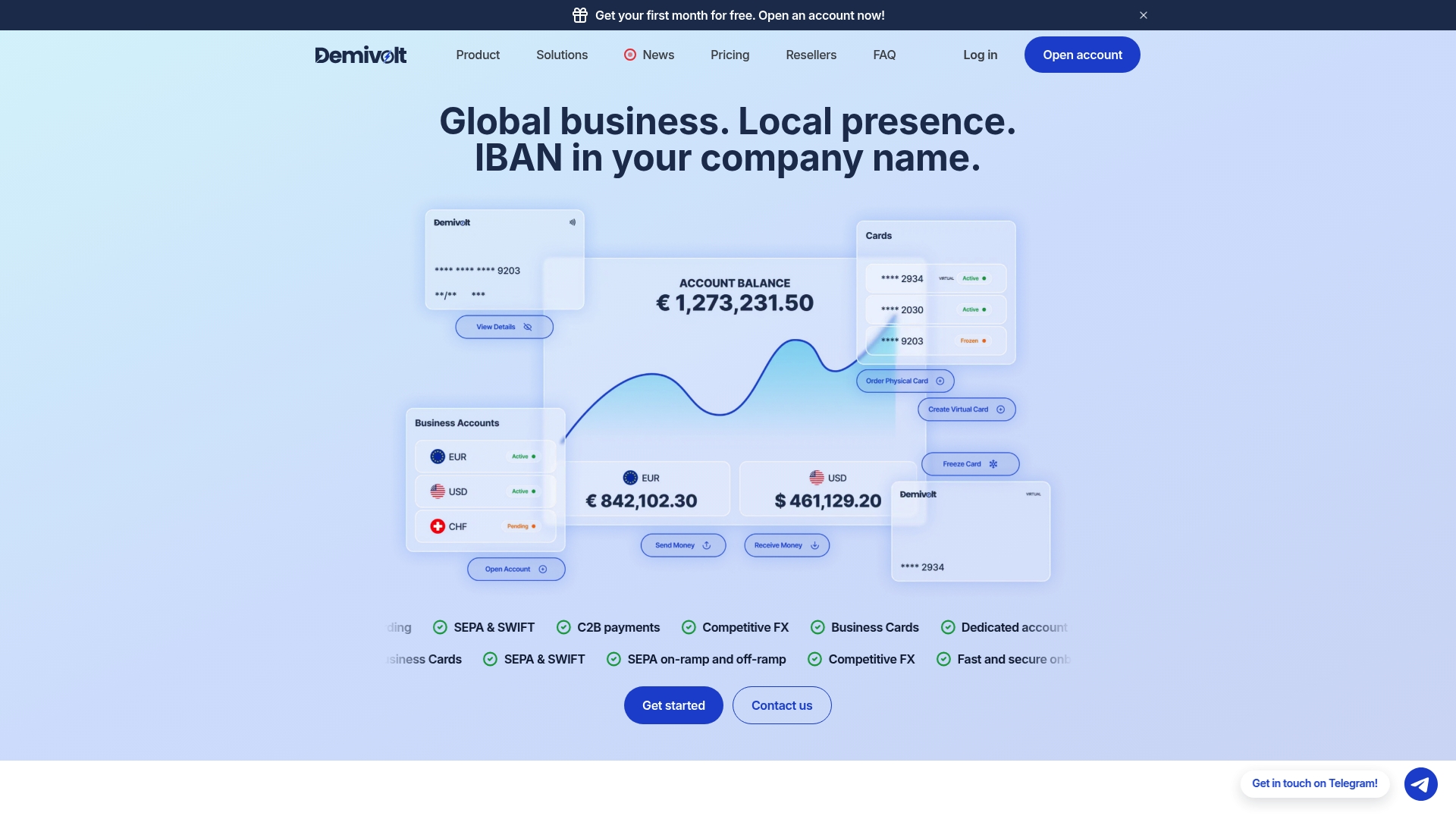
Client funds are held in segregated accounts under EU regulatory oversight, and every account comes with the audit trail and role-based permissions your compliance checklist requires. Before you commit to any provider, validate your current supplier and carrier IBANs using Demivolt’s free ISO 13616 checker, a quick way to catch account errors before they turn into a delayed payment or a fraud incident. If the account structure and API capabilities described here match what your operation actually needs, visit Demivolt to request a demo or start a sandbox integration test with your team.
Sources
- Freight Forwarding Under the Sanctions Spotlight: Key Developments and Enforcement Lessons
- Today’s Compliance Risks For Global Logistics Intermediaries
Use these resources directly in procurement and compliance reviews: cite the enforcement and legal analyses when building your risk assessment, and run the Demivolt tools during vendor evaluation to confirm account details before your first live payment goes out.
Recommended
- Demivolt | Blog – B2B banking checklist: Streamline cross-border compliance
- Demivolt | Blog – Modern business banking trends: boost efficiency & compliance
- Demivolt | Blog – Business banking for SMEs: services, compliance & cross-border
- Demivolt | Blog – How to streamline your digital business banking workflow