

For most U.S. SMEs, several account approaches cover the full range of cross-border payment needs: multi-currency business accounts for holding and converting multiple currencies in one place, dedicated foreign-currency sub-accounts for high-volume bilateral corridors, and virtual local collection accounts (IBANs or local account numbers) for receiving funds as if you were a local entity in a target market. Multi-currency accounts handle paying overseas suppliers and managing payroll for international contractors. Dedicated FX accounts suit manufacturers or importers with concentrated exposure to a single currency pair. Virtual IBANs and local collection accounts are the right tool for e-commerce sellers collecting EUR, GBP, or other currencies without triggering unnecessary conversion at the point of receipt.
Three areas that determine whether your account setup actually works in practice:
- Costs and timing — fee components, FX margins, and realistic settlement windows by rail (see the costs section below)
- Compliance and documentation — KYC/AML, OFAC screening, and the paperwork your bank or PSP will require before your first live payment
- Setup and integration — the operational sequence from account architecture to first transaction, including ERP reconciliation
Table of Contents
- How do cross-border payments actually move?
- What account types support cross-border business flows?
- What do real cross-border payment flows look like?
- What does a cross-border payment actually cost?
- What compliance and documentation should U.S. businesses expect?
- How do you set up business accounts for cross-border payments?
- When does a regulated specialist fintech make sense?
- Key Takeaways
- The mistakes that actually cost finance teams money
- Demivolt gives SMEs a regulated, multi-currency foundation for international payments
- Authoritative sources and further reading
How do cross-border payments actually move?
Every cross-border payment travels over a rail. The rail determines cost, speed, and how many intermediaries touch the funds before they reach the beneficiary. Understanding the flow helps finance teams map their account choices to the right infrastructure.
The basic sequence: your bank or payment platform originates the payment instruction, which passes through a messaging layer (SWIFT’s network, ISO 20022 formatted messages, or a direct API connection) to a correspondent or intermediary bank, which then credits the beneficiary’s bank or wallet. Each handoff is a potential fee and a potential delay. SWIFT data confirms that the beneficiary leg of the payment, specifically the final credit to the recipient’s account, is where most delays and transparency gaps occur, which is why GPI-enabled tracking and ISO 20022 messaging standards matter for reducing exceptions.
The four main rails U.S. businesses use:
- Wire/SWIFT — the standard for large B2B payments. Reaches virtually every country, but typically involves correspondent banks and their associated fees. Best for high-value supplier payments where certainty of delivery outweighs speed.
The Federal Reserve’s FedNow Service delivers real-time settlement domestically, but it operates entirely within the U.S. banking system. Finance teams sometimes assume domestic instant-payment speed will carry over to international transfers. It does not. Cross-border settlement remains a separate process governed by correspondent banking relationships and the rails above.
The World Bank’s remittance data illustrates the economic weight of cross-border flows and why cost transparency is not a secondary concern. For SMEs moving substantial volumes, even modest fee and FX inefficiencies can compound significantly across multiple transactions.
What account types support cross-border business flows?
Choosing the right account structure before your first international payment prevents costly restructuring later. Each account type solves a different operational problem.
Multi-currency business accounts
A multi-currency account holds balances in several currencies simultaneously under one account relationship. You receive multiple currencies into the same account without triggering an automatic conversion, and you convert only when the rate is favorable or when you need domestic currency for obligations. This is the most flexible structure for businesses with diversified international revenue or supplier bases. The trade-off is that FX conversion rates vary by provider, and some platforms charge a spread on every conversion even when the balance is already held in the target currency.
Dedicated foreign-currency sub-accounts
A dedicated FX account (sometimes called a nostro-style arrangement at the bank level) holds a single foreign currency. It suits importers paying a EUR-denominated supplier monthly or exporters invoicing in GBP. The advantage is clean reconciliation: one account, one currency, one ledger line. The limitation is that you need a separate account for each currency, which adds administrative overhead if your corridors are diverse. For international business bank accounts, the right choice between multi-currency and dedicated FX accounts usually comes down to how many currency pairs you actively use.
Virtual/local collection accounts (IBANs and local numbers)
A virtual IBAN or local collection account gives your business a local-format account number in a target market. A U.S. e-commerce seller, for example, can present a German IBAN to European customers, who pay via SEPA Credit Transfer as if paying a local vendor. Funds pool into your main account without the payer incurring international wire fees. This structure reduces friction for the payer, improves conversion rates on invoices, and avoids the FX hit at the point of receipt. The IBAN accounts guide for SMEs covers the technical setup and compliance requirements in detail.
Domestic USD accounts with FX conversion
The simplest structure: a standard U.S. business checking account, with FX conversion handled at the point of payment by your bank or PSP. This works for low-volume, occasional international payments. The cost is transparency: your bank’s FX margin is often embedded in the exchange rate rather than disclosed as a separate fee, making it difficult to benchmark.
| Dimension | Multi-currency account | Dedicated FX account | Virtual/local IBAN | Domestic USD + conversion |
|---|---|---|---|---|
| Best for | Diversified corridors, mixed receipts/payments | Single high-volume currency pair | Collecting local-currency sales | Occasional, low-volume payments |
| Settlement speed | Same-day to T+1 within network | T+1 to T+2 | Depends on local rail | T+2 to T+5 via SWIFT |
| Cost profile | Spread on conversion; low/no holding fees | Low holding cost; conversion on exit | Local rail fees; low FX friction | Embedded FX margin; wire fees |
| Integration complexity | Medium (API available on most platforms) | Low to medium | Medium (requires IBAN provisioning) | Low |
Use-case matrix:
| Business flow | Recommended account type |
|---|---|
| Paying overseas suppliers | Multi-currency or dedicated FX account |
| Collecting international sales | Virtual/local IBAN |
| Payroll and contractor payouts | Multi-currency account or PSP rail |
| Marketplace disbursements | Virtual IBAN or PSP/fintech rail |
What do real cross-border payment flows look like?
Abstract account types become clearer when mapped to specific business scenarios. Here are four that finance teams encounter regularly.
U.S. e-commerce seller collecting EUR sales. A U.S. retailer selling on European marketplaces receives EUR payments from customers. Without a local IBAN, each payment arrives as an international wire, triggering correspondent fees on both ends and an automatic USD conversion at the bank’s rate. With a virtual EUR IBAN, the customer pays via SEPA Credit Transfer at zero or near-zero cost, and the seller holds EUR until conversion makes sense. Reconciliation maps directly to order IDs.
Manufacturer paying overseas suppliers. A mid-size U.S. manufacturer pays a Taiwanese component supplier monthly in USD and a German parts vendor in EUR. The USD payment travels via SWIFT wire; the EUR payment is more cost-effective from a EUR-denominated sub-account, avoiding a USD-to-EUR conversion on every invoice. Recipient details to verify before each payment: SWIFT/BIC code, full legal beneficiary name (exact match), IBAN or local account number, and bank address.
SME paying international contractors. A software company with contractors in five countries needs to pay monthly in local currencies. A multi-currency account with PSP rail access handles this more efficiently than five separate wire instructions. Required fields: contractor’s local bank account number or IBAN, SWIFT/BIC, full legal name, and in some corridors a purpose code (e.g., “professional services”).
Marketplace disbursing to global sellers. A U.S. platform paying sellers in 20+ countries needs mass payout capability. Virtual local accounts or a PSP fintech rail reduce per-transaction costs and settlement time compared to individual SWIFT wires. Sellers receive funds in local currency, which improves seller satisfaction and reduces FX complaints.
For every scenario, the must-check recipient data fields are:
- Full legal name of the beneficiary (exact match to bank records)
- IBAN or local account number in the correct format
- SWIFT/BIC code of the beneficiary’s bank
- Bank name and address
- Purpose code or payment reference where required by the destination country
What does a cross-border payment actually cost?
The total cost of a cross-border payment has several components, including outbound fees charged by your institution, correspondent or intermediary bank fees deducted during transit, recipient bank fees which may be absorbed by the beneficiary, FX margin which is the spread between the interbank rate and your provider’s applied rate, and regulatory or network charges applicable in certain corridors or for specific payment types.
The World Bank Remittance Prices Worldwide database tracks corridor-level cost and timing data for cross-border transfers, providing a useful benchmark for what typical fees look like across major corridors. The full report and annex breaks these figures down by sending and receiving country, which finance teams can use to pressure-test their current provider’s pricing.
| Rail | Typical settlement time | Cost profile |
|---|---|---|
| SWIFT wire | T+1 to T+5 | Flat fee + correspondent deductions + FX margin |
| SEPA Credit Transfer (EUR corridors) | Same-day to T+1 | Low flat fee; minimal FX friction if held in EUR |
| Card/acquirer rails | T+1 to T+3 | Interchange + scheme fees; FX at point of settlement |
| PSP/fintech rail | Hours to T+1 | Percentage fee; often better FX rates than banks |
FX margin example: Your bank quotes EUR/USD at 1.0650 when the interbank rate is 1.0800. That 150-pip spread equals a 1.39% margin. On a $100,000 payment, you lose $1,390 to the FX margin before any wire fee is applied. Multiply that across recurring supplier payments and the annual cost becomes material.
What compliance and documentation should U.S. businesses expect?
Every account opening and every outbound payment triggers compliance checks. Expect KYC/AML verification, OFAC and sanctions screening, tax identifier confirmation, beneficial ownership disclosure, and transaction purpose documentation. These checks are not one-time events. Each intermediary in the payment chain re-screens the transaction independently, which means a payment that clears your bank’s compliance can still be delayed or returned by a correspondent bank further down the chain.
Account opening documentation checklist:
- Articles of incorporation or equivalent formation documents
- Employer Identification Number (EIN) confirmation
- Government-issued photo ID for all beneficial owners (typically those holding 25% or more)
- Proof of business address (utility bill, lease, or bank statement)
- Source of funds declaration
- Description of business activities and expected transaction volumes
- Sample contracts or invoices for anticipated payment types
Per-payment data requirements:
- Full legal name of the beneficiary (character-for-character match to bank records)
- Beneficiary account number (IBAN or local format) and SWIFT/BIC
- Purpose of payment (free text or structured purpose code)
- Invoice or contract reference where required
OFAC maintains the Specially Designated Nationals (SDN) list and other sanctions lists that U.S. businesses are legally required to screen against before sending any international payment. Your bank or PSP will screen automatically, but finance teams should understand that a name-match flag, even a false positive, can freeze a payment for days. Structuring your beneficiary data with exact legal names and verified account details reduces false positives significantly.
Pro Tip: Build a vendor onboarding template that captures the exact legal name, IBAN or account number, SWIFT/BIC, and purpose code before any payment is initiated. Payments that fail screening almost always fail because of a name mismatch or missing field, not because of a genuine sanctions hit. A standardized template, validated against your bank’s format requirements, eliminates most of these rejections before they happen.
This article provides general information on compliance requirements. Confirm current OFAC rules and AML obligations with a qualified compliance professional or directly via the U.S. Treasury’s OFAC resources.
How do you set up business accounts for cross-border payments?
Start by defining your account architecture before you open anything. The right structure depends on your active corridors, monthly payment volume, and whether you are primarily paying out, collecting in, or both. A business paying two suppliers in EUR and GBP needs a different setup than a marketplace disbursing to sellers in 30 countries.
Numbered setup sequence:
- Submit the account application — Most regulated platforms and banks complete initial KYC review within 3–10 business days for straightforward SME applications. Complex ownership structures or high-risk industries take longer.
- Complete API or ERP integration — Connect your accounting system (QuickBooks, NetSuite, Xero, or equivalent) via API or file-based reconciliation. Test the connection with a sandbox environment before going live.
Estimated timeline:
| Step | Typical duration |
|---|---|
| Document preparation | 1–3 business days |
| KYC review and account activation | 3–10 business days |
| API/ERP integration and testing | 3–7 business days |
| First live payment | Day 10–20 from application |
For a detailed checklist covering each step, the international payment checklist covers the full sequence with format-specific requirements.
When does a regulated specialist fintech make sense?
SMEs should consider a regulated specialist fintech when they need multiple local collection points, multi-currency liquidity management, better FX visibility, or API automation tied to their accounting systems. A traditional bank relationship works for simple, low-volume international payments. It becomes a constraint when your business needs to hold five currencies, collect via local IBANs in three markets, and reconcile automatically with your ERP.
Decision guidelines:
- Treasury complexity: — Businesses managing FX exposure, holding foreign balances, or running multi-entity structures benefit from the account architecture flexibility that specialist platforms provide.
The World Economic Forum’s interoperability analysis identifies rail interoperability as a structural solution to lower cross-border costs. For SMEs, the near-term benefit comes from choosing an account architecture that connects to the right rails, rather than waiting for systemic reform. The IMF’s work on retail CBDCs and the BIS/CPMI cross-border payments report both confirm that legacy SWIFT rails remain the backbone of international B2B settlement for the foreseeable future, even as new infrastructure develops.
| Provider type | Advantages | Trade-offs |
|---|---|---|
| Regulated specialist fintech | Multi-currency accounts, virtual IBANs, API access, faster onboarding, transparent FX pricing | Newer relationship; may have corridor limitations |
| Traditional bank | Established correspondent network, credit facilities, full banking relationship | Embedded FX margins, slower onboarding, limited API access |
| Full bank partnership (enterprise) | Maximum credit and liquidity support, dedicated relationship manager | Complex onboarding, high minimum volumes, less flexibility for SMEs |
For SMEs specifically, how fintech transforms cross-border payments covers the practical API and automation advantages in more detail.
Key Takeaways
Choosing the right account architecture, preparing complete compliance documentation, and applying disciplined FX and operational controls are the three factors that determine whether cross-border payments work efficiently for a U.S. SME.
| Point | Details |
|---|---|
| Account architecture first | Map corridors and volumes before opening accounts; match multi-currency, dedicated FX, or virtual IBAN to each flow. |
| Compliance documentation | Prepare EIN, incorporation docs, beneficial owner IDs, and source-of-funds before applying to avoid onboarding delays. |
| FX margin is the hidden cost | A 1.39% FX margin on $100,000 costs $1,390 per payment; holding foreign balances and converting strategically reduces this. |
| Beneficiary data accuracy | Exact legal name and account format match is the single most effective way to prevent payment rejections. |
| Demivolt for IBAN and SEPA/SWIFT | Demivolt provides regulated multi-currency accounts, virtual IBANs, and SEPA/SWIFT processing for SMEs ready to act. |
The mistakes that actually cost finance teams money
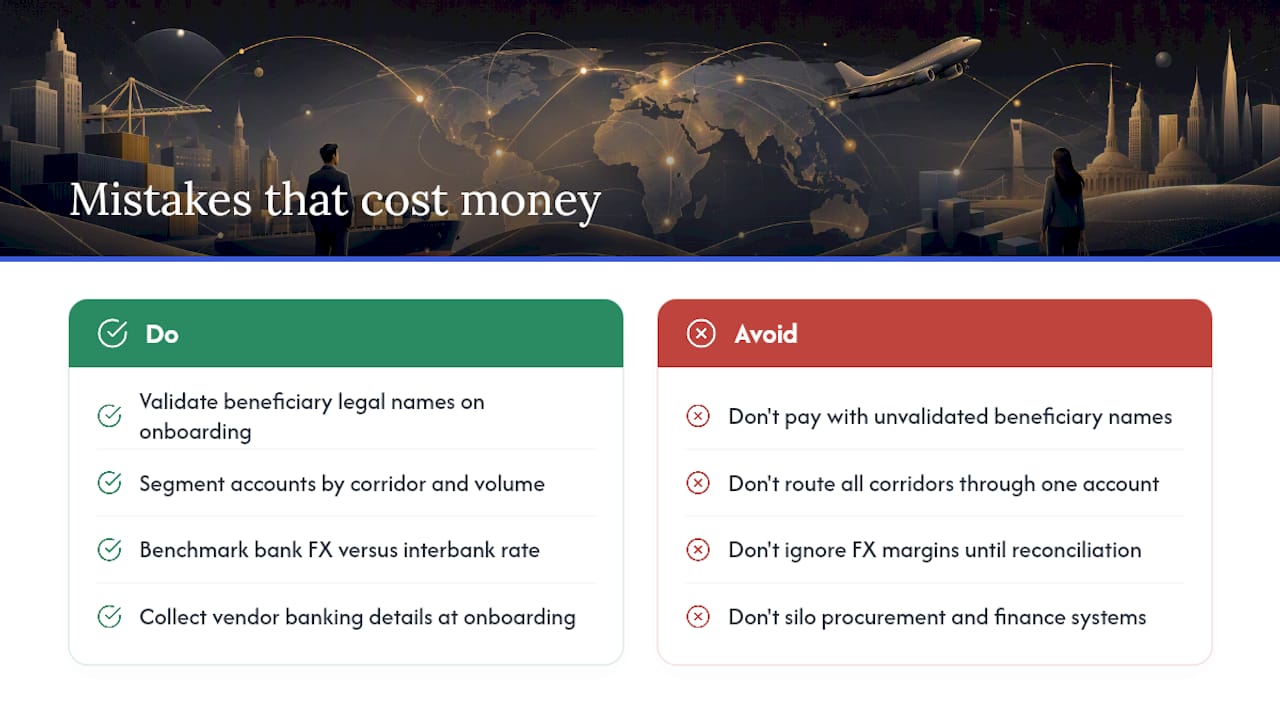
The most common cross-border payment mistakes are poor beneficiary data, assuming one account type handles all corridors, and ignoring FX margins until they show up in a reconciliation variance.
Poor beneficiary data is the most preventable. A payment rejected because the beneficiary name on the instruction does not match the bank’s records exactly costs time, generates a return fee, and delays a supplier who may put your orders on hold. The fix is a standardized onboarding form that captures the legal name exactly as it appears on the bank account, validated before the first payment runs.
The one-size-fits-all routing assumption is subtler. Finance teams often set up a single USD account with wire capability and route everything through it, regardless of corridor or volume. That works until the FX costs on recurring EUR payments become visible in a quarterly review. The right response is to segment: use a virtual IBAN for EUR collections, a dedicated FX account for high-volume bilateral payments, and the multi-currency account as the hub for everything else.
FX margins are the most consistently underestimated cost. Banks rarely present the margin as a line item. It is embedded in the exchange rate, which means it does not appear on a fee statement. Finance teams that benchmark their bank’s rate against the interbank rate at the time of conversion often find the gap is larger than expected.
Pro Tip: Align your procurement and finance processes so that vendor banking details are collected and validated at the point of vendor onboarding, not at the point of first payment. When procurement and finance operate in separate systems with no shared vendor data, the same compliance check runs twice, errors multiply, and payment rejections become routine. A shared, validated vendor master eliminates most of this friction.
Demivolt gives SMEs a regulated, multi-currency foundation for international payments
Managing cross-border payments through a traditional bank account means accepting embedded FX margins, limited currency options, and manual reconciliation. Demivolt is built specifically for SMEs that need something more structured: dedicated IBAN accounts, SEPA and SWIFT payment processing, multi-currency account structures, and role-based user management, all within a regulated, compliant framework with segregated client funds.
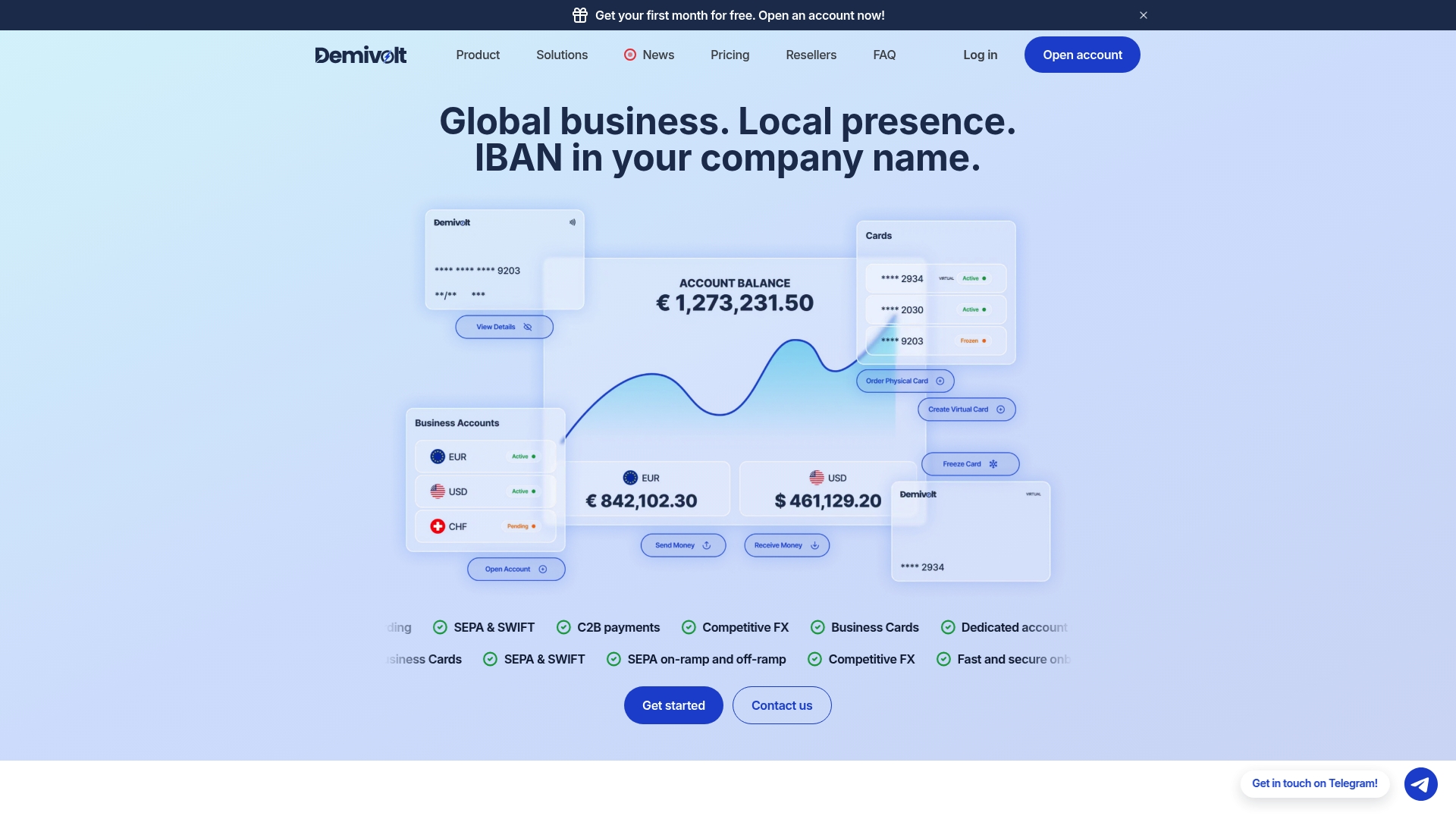
The practical advantages for finance teams are concrete. Virtual IBANs let your business collect EUR and other currencies as a local entity, without triggering international wire fees on the payer’s side. SEPA and SWIFT support covers both inbound and outbound flows. API integrations connect payment data directly to your accounting or ERP system, reducing manual reconciliation to near zero. Onboarding is designed to be fast and transparent, with clear documentation requirements and no hidden steps.
If you are ready to validate an IBAN before your next payment, use the free IBAN validator to check format and checksum in seconds. For the full suite of SEPA and payment tools, visit Demivolt’s tools page. To open a regulated business account and get your payment infrastructure in place, start at demivolt.com.
Authoritative sources and further reading
The sources below are the primary references used in this guide. Each covers a distinct aspect of cross-border payment infrastructure, costs, or compliance.
- Cross-Border Payments with Retail Central Bank Digital Currencies
- Remittance Prices Worldwide — Main report and annex
- Remittances (World Bank KNOMAD brief)
- SWIFT: Data shows focus needed on beneficiary leg for faster international payments
Recommended
- Demivolt | Blog – IBAN Accounts Explained: Guide for SMEs Managing Cross-Border Payments
- Demivolt | Blog – Master the international payments process: SME guide
- Demivolt | Blog – Business account benefits for European SMEs in 2026
- Demivolt | Blog – Business banking for SMEs: services, compliance & cross-border