

TL;DR:
- US companies can open a regulated EU business account remotely through a licensed EMI, obtaining a dedicated IBAN quickly with proper documentation. The quality of a company’s compliance file influences the onboarding speed more than its size, and EMIs offer faster, fully digital onboarding compared to traditional banks. Preparing a clear, concise business activity memo and verifying provider credentials helps streamline the process and avoid delays.
US companies can open a regulated EU business account and receive a dedicated IBAN remotely. The fastest route is through a licensed Electronic Money Institution (EMI) operating under EU payment regulations, with approvals possible quickly for straightforward cases. Traditional bank branches remain an option but require more time and, in some cases, local substance.
Before contacting any provider, prepare a compliance-grade onboarding file. That means:
- Certified company incorporation documents and a register extract
- Beneficial ownership disclosure and a clear ownership chart
- Passports and proof of address for all Ultimate Beneficial Owners (UBOs) and authorized signatories
- A one-page business activity memo covering expected monthly volumes, counterparty types, and source of funds
- A board resolution or signatory appointment letter
With that file ready, contact a regulated provider such as Demivolt to request an indicative onboarding timeline and cost estimate. The quality of your compliance file, not the size of your company, is what determines how fast the process moves.
Table of Contents
- Who this guide is for and what “EU business account” means here
- What documents does a US company need to open an EU business account?
- Which route is faster: EMI accounts or traditional bank branches?
- What does CRD VI mean for US companies using EU banking services?
- What features should you expect from an EU business account?
- How to open an EU business account from the US: step by step
- What costs should you budget for an EU business account?
- What questions should you ask any EU provider before signing?
- How Demivolt helps US companies get EU IBANs and payment infrastructure
- Key Takeaways
- The compliance file is the real product you’re selling to a provider
- Get started with Demivolt: EU IBANs for US companies
- Useful primary sources and references
Who this guide is for and what “EU business account” means here
This guide is written for US-incorporated companies: founders, CFOs, finance teams, fintechs, and digital businesses that need EU IBANs for corporate operations, not personal banking.
Throughout this article, “EU business account” means:
- A regulated account that issues a dedicated IBAN tied to your company
- Access to SEPA credit transfers, SEPA Instant, and SWIFT inbound/outbound payments
- Business payment features including virtual and physical cards, multi-account structures, and API access
This guide does not cover personal or consumer EU accounts, expat retail banking, or comparisons between named competing vendors.
What documents does a US company need to open an EU business account?
Providers perform risk-based enhanced due diligence under Article 13 of Directive (EU) 2015/849, which requires them to identify customers and beneficial owners, understand the purpose of the relationship, and monitor it on an ongoing basis. Company incorporation alone does not guarantee approval. The quality of your commercial evidence file often determines acceptance.
Core company documents:
- Certificate of incorporation and articles of association or bylaws
- Official register extract (dated within 3–6 months)
- Board resolution authorizing account opening and naming signatories
Ownership and people:
- Full beneficial ownership disclosure and ownership chart showing all UBOs above the provider’s threshold (typically 25%)
- Valid passports for all UBOs and authorized signatories
- Proof of address for relevant persons (utility bill or bank statement, typically within 3 months)
Commercial evidence:
- Business activity description: what the company does, who its customers are, and where they are located
- Sample contracts or invoices demonstrating real economic activity
- Projected monthly volumes, expected transaction sizes, and source-of-funds statement
Pro Tip: Write a single, well-structured one-page business activity memo covering your product or service, expected counterparties, and projected flows. Submitting this consistently across providers is more effective than multiple ad-hoc applications, and it gives underwriters a clear risk picture from the start.
Which route is faster: EMI accounts or traditional bank branches?
Two practical routes exist for opening bank accounts in Europe as a US company. The right choice depends on your product needs, timeline, and how much local substance your business has.

| Factor | EMI / Payment Institution | Full Bank (Branch or Subsidiary) |
|---|---|---|
| Onboarding speed | 24–48 hours (clean cases) | Weeks to months |
| Remote onboarding | Yes, fully digital | Often requires in-person or local presence |
| Dedicated IBAN | Yes | Yes |
| SEPA and SWIFT | Yes | Yes |
| Lending / credit lines | No | Yes |
| Deposit insurance | Not standard | Yes (deposit guarantee scheme applies) |
| Local substance required | Generally no | Often yes for branch licensing |
| Best for | Fast EU payment rails, API-first ops | Full banking relationship, credit products |
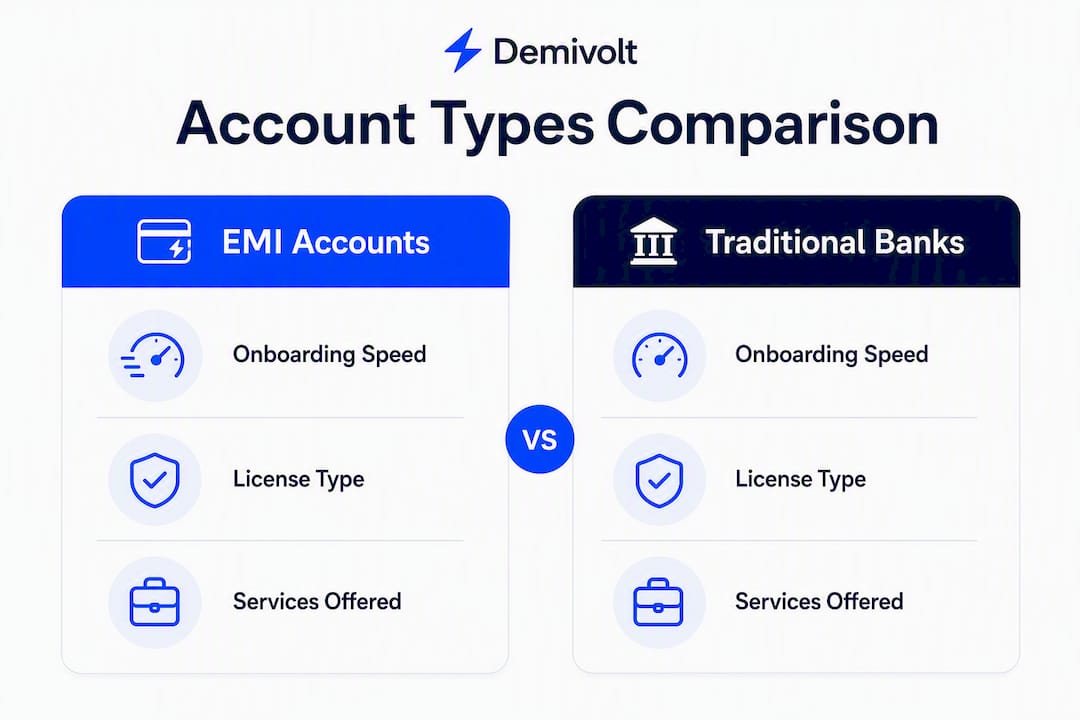
Lithuanian EMIs are a common choice for international companies because Lithuania’s regulatory environment combines pragmatic EMI licensing with competitive onboarding policies for non-EEA applicants. For US companies that need EU IBANs quickly and do not require lending, an EMI route through a Lithuanian-licensed institution is often the most practical starting point.
EMIs are authorized to issue IBANs and process payments but do not offer loans or the same deposit-taking protections as credit institutions. Verify client fund segregation with any EMI before committing.
What does CRD VI mean for US companies using EU banking services?
CRD VI introduces cross-border supervisory rules that can require non-EEA firms to establish a formal EU branch or subsidiary depending on the business lines they operate. For US companies that are simply opening an account to receive payments, this is unlikely to trigger a branch requirement. For US fintechs or platforms actively providing financial services into the EU, the picture is more complex.
Practical implications:
- Map your product lines against CRD VI requirements before selecting a provider. Cross-border payments and card programs can change the supervisory outcome.
- Ask prospective providers whether they have reviewed their own CRD VI exposure and whether they publish compliance statements.
- Expect enhanced due diligence from EU providers on US-headquartered applicants, particularly if your business touches higher-risk sectors or geographies.
Timing benchmark: EMIs typically issue an IBAN within 24–48 hours after KYC verification for straightforward cases. Traditional banks usually take several weeks. Factor that gap into your implementation plan.
For a deeper read on how EU regulatory tightening affects cross-border access, Demivolt’s analysis of EU banking regulatory changes is a useful reference.
What features should you expect from an EU business account?
A well-specified EU business account for a US company should cover the following:
Payment rails:
- Dedicated IBAN (named to your company, not a pooled or shared IBAN)
- SEPA Credit Transfer and SEPA Instant Credit Transfer; the SEPA Credit Transfer rulebook mandates IBAN as a required attribute for all transfers
- SWIFT inbound and outbound for non-SEPA currencies
Account structure:
- Multi-currency wallets and sub-accounts
- Virtual and physical Visa business cards with card program management
- Role-based user access and multi-account structures for finance team controls
Platform and integration:
- API access for payment initiation and reconciliation
- Web dashboard with reporting exports and transaction monitoring
- Card program management and spend controls
EMIs do not provide core lending or traditional deposit insurance. Confirm your provider’s licensing type and verify that client funds are held in segregated accounts before activating.
How to open an EU business account from the US: step by step
- Prepare your compliance file. Collect certified company documents, UBO passports, proof of address, and write a one-page business activity memo covering your product, counterparties, and expected monthly flows.
- Select your route and provider. Decide between an EMI and a full bank based on your product needs. Confirm the provider’s regulatory status, supervising authority, and remote onboarding capability. Review EU banking compliance requirements before shortlisting.
- Submit your application and KYC materials. Upload documents through the provider’s onboarding portal. For straightforward EMI cases, expect a decision within 24–48 hours. Complex ownership structures or high-risk sectors will extend this timeline.
- Complete underwriting clarifications. Respond promptly to any requests for additional commercial evidence. Sign the account agreement, complete account provisioning, and receive your IBAN. Card issuance and API credentials follow activation.
Common delays and how to avoid them:
- Incomplete commercial evidence (missing invoices, vague activity description)
- Unclear ownership chains (missing intermediate holding company documents)
- Unexpected high-risk geographies or counterparty types not disclosed upfront
- Mismatched information between documents and the activity memo
A compliance-first onboarding approach that anticipates these gaps before submission consistently shortens underwriting time.
What costs should you budget for an EU business account?
Fee structures vary by provider and account type. The categories below represent the standard line items to request and model:
- Monthly account fee: fixed recurring charge for account maintenance and platform access
- SEPA transaction fees: per-transfer charges for outbound SEPA Credit Transfers; inbound fees vary
- SWIFT fees: typically higher per-transaction than SEPA; charged on both inbound and outbound
- FX conversion: spread applied to currency conversions plus, in some cases, a flat conversion fee
- Card issuance and transaction fees: one-off issuance fee per card plus per-transaction or monthly charges
- Onboarding or KYC review fee: some providers charge a one-off fee for complex cases or higher-risk sectors
To compare providers accurately, normalize pricing against your expected monthly volume and FX exposure. A provider with a lower monthly fee but higher per-transaction SWIFT costs may be more expensive at scale.
Pro Tip: Request a 12-month forecasted fee schedule from each shortlisted provider, built on your actual expected volumes. That single document makes true cost-to-serve comparisons straightforward and removes pricing surprises after onboarding.
What questions should you ask any EU provider before signing?
Regulatory status:
- What is your licence type: EMI, payment institution, or credit institution?
- Which authority supervises you, and where can we find your public register entry?
Client fund safety:
- Are client funds held in segregated accounts, separate from the provider’s own capital?
- What insolvency protections apply to our funds?
Operational readiness:
- What is your standard onboarding timeline for a US-incorporated company?
- What are your API uptime SLAs, and how are disputes and refunds handled?
Commercial terms:
- Is pricing fully transparent with no hidden minimums?
- Do you offer a reseller or partner program for B2B referrals?
- What are the exit and account closure terms?
For fintech companies or businesses in higher-risk sectors, a directory of EMIs suited to crypto and Web3 businesses can supplement your due diligence shortlist.
How Demivolt helps US companies get EU IBANs and payment infrastructure
Demivolt is a regulated European fintech platform built for companies that need compliant EU payment infrastructure without the delays of traditional banking. For US-incorporated businesses, Demivolt offers:
- Dedicated IBANs issued to your company, not pooled accounts
- SEPA and SWIFT payments for euro and multi-currency operations
- Virtual and physical Visa business cards with card program management
- Multi-account structures and role-based user management for finance team controls
- API access for payment initiation, reconciliation, and platform integrations
- White-label BaaS solutions for fintechs and platforms building payment products
Onboarding is designed for remote applicants. Demivolt’s compliance-first process sets clear documentation requirements upfront, so US companies know exactly what to prepare. Client funds are held in segregated accounts, and Demivolt publishes compliance statements covering its regulatory obligations, including CRD VI awareness.
Demivolt also operates a reseller and partner program. If you work with a business advisor, accountant, or technology partner, ask about partner onboarding terms and recurring commission structures during your vendor due diligence conversation.
Key Takeaways
US companies can open a regulated EU business account remotely through a licensed EMI, with dedicated IBANs and SEPA/SWIFT payment rails available within 24–48 hours for well-prepared applicants.
| Point | Details |
|---|---|
| Compliance file is decisive | Strong commercial evidence and a clear activity memo determine approval speed more than company size. |
| EMI route is fastest | EMIs issue IBANs within 24–48 hours for clean cases; traditional banks take weeks and may require local substance. |
| CRD VI requires early mapping | US fintechs providing services into the EU should map product lines against CRD VI before selecting a provider. |
| Fee comparison needs volume modeling | Normalize all provider fees against your expected monthly volume and FX exposure to find true cost-to-serve. |
| Demivolt for US applicants | Demivolt offers dedicated IBANs, SEPA/SWIFT, cards, and API access with a compliance-first remote onboarding process. |
The compliance file is the real product you’re selling to a provider
Most US founders and CFOs approach EU account opening as a paperwork exercise. It is not. It is a risk assessment, and you are the subject. Every provider reviewing your application is asking one question: does this business make sense, and can we verify it?
The companies that get approved quickly are not the ones with the cleanest corporate structure or the most prestigious investors. They are the ones that explain their business clearly. A one-page memo that states what you sell, who buys it, where those buyers are, and what a typical transaction looks like will outperform a 40-page investor deck every time. Underwriters are not evaluating your market opportunity. They are checking whether your stated activity matches your expected flows.
The EMI route earns its reputation for speed precisely because EMIs are built to process this kind of risk assessment digitally. A Lithuanian-licensed EMI with a well-designed KYC workflow can move from submission to IBAN issuance in under two business days when the file is clean. That is not marketing. That is the operational reality for prepared applicants.
The providers worth working with are the ones that tell you upfront what they need, publish their compliance position, and hold client funds in segregated accounts. Opacity at the due diligence stage is a reliable signal of friction later.
Get started with Demivolt: EU IBANs for US companies
US companies that need a dedicated EU IBAN, SEPA and SWIFT payment rails, and business card infrastructure can start the process with Demivolt today. The fastest path is straightforward: prepare your one-page business activity memo and core KYC documents, then submit an onboarding request to receive an indicative timeline and cost estimate specific to your company’s profile.
Before integration, use Demivolt’s free IBAN validator to verify account details against ISO 13616 standards, and access the full suite of free SEPA tools to prepare payment data before going live. If you work with a business advisor or technology partner, ask about Demivolt’s reseller program and the recurring commission structure available for B2B referrals.
Contact Demivolt directly to begin your onboarding conversation.
Useful primary sources and references
- Single Euro Payments Area (SEPA) — European Central Bank: The ECB’s authoritative overview of SEPA, euro payment standards, and the role of IBAN/BIC in cross-border transfers. Essential reading before any EU account integration.
- SEPA Credit Transfer Rulebook — European Payments Council: The technical rulebook governing SEPA Credit Transfers, including mandatory IBAN attributes and message standards. Reference this when specifying payment integration requirements.
- SEPA Direct Debit B2B Rulebook — European Payments Council: Covers mandate verification and electronic processing rules for business-to-business direct debits across SEPA. Relevant if your business model includes recurring B2B collections.
- CRD VI cross-border banking rules — Norton Rose Fulbright: Legal analysis of CRD VI’s supervisory implications for non-EEA firms. Use this during internal compliance review and when briefing legal counsel on branch or subsidiary requirements.
- Doing business in the EU — European Union: The EU’s official entry point for business registration, legal requirements, and financial support programs. Useful for context when establishing a legal presence alongside your banking setup.
- Demivolt onboarding guide — Open a business bank account online in Europe: Step-by-step procedures and document requirements for non-EU companies opening EU business accounts, with practical onboarding guidance.
- EU banking regulations guide for compliance officers — Demivolt: Regulatory primer covering EU directives and reporting obligations for in-house compliance teams preparing to open and maintain EU accounts.