

PEP screening is the mandatory, risk-based check of a customer and their beneficial owners against politically exposed person lists, triggered at onboarding and repeated on a schedule. If a name matches, your business must apply enhanced due diligence and document every step. Start now: screen account holders and UBOs before onboarding, and log the outcome even when there’s no match.
TL;DR:
- Screening should extend beyond account signatories to include all individuals with control or influence over the account, such as UBOs, signatories, and key management personnel.
- Implement a comprehensive process combining multiple data sources, documented matching thresholds, and trigger-based re-screenings, not just periodic reviews.
- Confirmed PEP matches require detailed ongoing due diligence, including source of wealth and funds documentation, senior management approval, and multi-year record retention.
- Combining AI-powered name matching and adverse media screening enhances detection accuracy, but human judgment remains essential for final risk assessment.
- A strong, documented compliance process significantly lowers the risk of regulatory penalties, reputational damage, and account restrictions during audits.
Table of Contents
- What Is a PEP, and What Do Regulators Actually Require?
- Who Do You Actually Need to Screen?
- How Do You Run a Practical Screening Process?
- What Happens After a Confirmed PEP Match?
- Should You Hire, Outsource, or Build a Hybrid Compliance Model?
- Your Quarter-One PEP Screening Checklist
- What Real PEP Screening Failures Teach You
- Where PEP Screening Still Falls Short
- How Does PEP Screening Affect Customer Experience?
- What Technology Is Changing PEP Screening?
- What Are the Penalties for Inadequate PEP Screening?
- How Does PEP Screening Fit Into Your Broader AML/KYC Program?
- How Documented Controls Protect Your Banking Relationships
- A Banking Partner Built for Businesses That Take Compliance Seriously
- Sources
What Is a PEP, and What Do Regulators Actually Require?
A politically exposed person is someone entrusted with a prominent public function, a head of state, senior politician, judge, military official, or state-owned enterprise executive, whose position creates elevated corruption or bribery risk. The label extends to their family members and close associates, a category most supervisory frameworks read broadly to include spouses, children, business partners, and anyone with a documented financial relationship to the PEP.
FATF Recommendation 12 requires enhanced due diligence for foreign PEPs automatically, and a risk-based approach for domestic PEPs and those tied to international organizations. EU anti-money laundering directives absorbed that standard into binding law across member states, which is why your compliance obligations aren’t optional guidance, they’re statutory.
The domestic versus foreign distinction matters operationally. A foreign PEP triggers EDD by default, no risk assessment needed first. A domestic PEP only escalates to EDD once your risk assessment flags elevated exposure, meaning the paperwork trail justifying that decision matters just as much as the decision itself.
Who Do You Actually Need to Screen?
Screening only the name on the account application is the single most common gap regulators flag. PEP screening has to extend to everyone with meaningful control or influence over the account, not just the signatory.
Your screening scope should cover:
- Account holders — the named individual or entity opening the relationship.
- Ultimate beneficial owners (UBOs) — typically anyone holding 25% or more ownership or control, though thresholds vary by jurisdiction and risk category.
- Authorized signatories — anyone with transaction authority, even without ownership stake.
- Key management personnel (KMP) — directors, executives, and decision-makers at corporate clients.
Nominee director structures and layered subsidiary ownership are where businesses get caught out. A holding company with a nominee director obscures the real controller, and if you stop at the visible signatory, you’ve missed the person the rule was written to catch.
How Do You Run a Practical Screening Process?
A workable screening process rests on three pillars: broad data coverage, a documented matching standard, and a re-screening cadence tied to real triggers, not just a calendar reminder.
Start with data sources. Relying on one commercial PEP list is a gap waiting to surface in an audit. Best practice, per FluxForce’s compliance guidance, combines commercial PEP databases, sanctions registries, government beneficial ownership registers, and adverse media monitoring.
Matching is where most screening programs stumble. Names transliterated from non-Latin scripts, common surnames, and slight spelling variants generate false positives constantly. Set a documented matching threshold and route anything above it to manual review rather than letting automated systems auto-clear or auto-reject.
For cadence, build around this sequence:
- Onboarding screening — before the account activates, no exceptions.
- Periodic re-screening — annually for standard risk, more frequently for higher-risk categories.
- Trigger-based rechecks — run immediately after an ownership change, a new public appointment, or adverse media coverage naming the client.
Pro Tip: Set a fixed service-level target, say 48 to 72 hours, for resolving manual review matches. A queue that sits untouched for weeks doesn’t just create compliance exposure, it slows down legitimate customer onboarding and damages the relationship before it starts.
What Happens After a Confirmed PEP Match?
A confirmed match doesn’t mean automatic rejection. It means enhanced due diligence, a deeper, documented investigation proportional to the risk the relationship presents.
Your EDD file should assemble:
- Source of wealth documentation, showing how the individual accumulated their overall net worth.
- Source of funds evidence, tracing the specific money moving through this account.
- Supporting records — contracts, invoices, tax filings, or property records that corroborate the stated income.
- Ongoing monitoring adjustments — lower transaction thresholds and more frequent transaction review for the account going forward.
FATF guidance is explicit that senior management approval is expected before establishing or continuing a high-risk PEP relationship. That sign-off can’t be a junior analyst’s checkbox, it needs a named senior officer’s decision on record.
Recordkeeping is where good screening programs separate from audit-ready ones. Regulators expect you to retain PEP screening records and EDD evidence for multiple years, and to retrieve them promptly on request, according to FluxForce’s compliance research. If your EDD documentation lives across five people’s inboxes instead of one retrievable file, you don’t have a compliance program, you have a liability waiting for an inspection.

Should You Hire, Outsource, or Build a Hybrid Compliance Model?
The right resourcing model depends less on company size than on transaction volume and customer risk profile, though the two usually correlate.
An in-house compliance officer gives you direct control and institutional knowledge, but salary costs and the need for backup coverage make it expensive for smaller operations. Outsourcing to a specialist firm scales more predictably and spreads expertise across cases, but you lose some day-to-day control and speed. A hybrid model splits the difference: a named internal operator handles routine screening and escalates complex cases to an external consultant.
For most SMEs, hybrid wins on cost and coverage:
- Subscription screening software for automated PEP and sanctions checks on every new client.
- A junior in-house operator who manages the queue, resolves simple matches, and escalates uncertain ones.
- Periodic external review from a consultant who audits the program and handles complex EDD cases.
Cost inputs vary by scope, but external compliance officer services in Lithuania typically run from a few hundred to several thousand euros monthly depending on transaction volume and risk complexity, according to Neteisk. That range reflects the difference between a light-touch quarterly review and a full outsourced compliance function. Read more on resourcing compliance functions as your transaction volume grows.
Your Quarter-One PEP Screening Checklist
Turning regulatory principle into an operational habit is the whole game. Here’s the minimum viable control set to have running within the next three months.
- Screen at onboarding — name, UBOs, signatories, and KMP, before account activation.
- Collect ownership documents — beneficial ownership declarations, corporate registry extracts, ID verification.
- Set your matching threshold — document it in writing and route borderline hits to manual review.
- Build your re-screening calendar — annual baseline, immediate trigger-based rechecks.
- Draft your EDD template — source of wealth, source of funds, supporting evidence, senior sign-off field.
- Log everything — every screening run, every match, every resolution, timestamped and retrievable.
| Control area | Minimum action | Owner |
|---|---|---|
| Onboarding screening | Screen all parties before activation | Compliance operator |
| Matching standard | Documented threshold, manual review for hits | Compliance operator |
| Re-screening | Annual plus trigger-based | Compliance operator |
| EDD documentation | Source of wealth/funds, senior sign-off | Senior management |
| Recordkeeping | Multi-year retention, retrievable on request | Compliance officer |
What Real PEP Screening Failures Teach You
The pattern in most publicized PEP screening failures isn’t a missing tool, it’s a missing process. Financial institutions across Europe have faced regulatory penalties for onboarding politically connected clients without adequate ownership checks, then failing to escalate when adverse media coverage later surfaced.
A recurring theme: the screening happened once, at onboarding, and never again. A client who wasn’t politically exposed at signup became a government minister eighteen months later, and nobody’s system flagged the appointment because re-screening wasn’t trigger-based, it was calendar-based and hadn’t come due yet.
Another common thread is beneficial ownership blindness. A corporate account gets screened at the entity level, the named directors clear, but a holding structure three layers up conceals the actual controlling person, who happens to be a sanctioned official’s relative. The screening technically happened. It just screened the wrong entity.
The lesson isn’t complicated: screening depth matters more than screening frequency, and trigger-based rechecks catch what calendar-based schedules miss. A business that screens once thoroughly, understanding true beneficial ownership through every corporate layer, outperforms one that screens monthly but only at the surface level.
Where PEP Screening Still Falls Short
No screening program is airtight, and pretending otherwise sets your business up for a false sense of security. Data gaps are the most persistent problem. PEP lists rely on public disclosures, court records, and government registers that update inconsistently across countries, some jurisdictions publish comprehensive PEP registers, others rely almost entirely on media reporting.
List currency is a related headache. Someone leaves public office and should roll off “PEP” status after a defined period, typically 12 to 18 months under most frameworks, but list providers don’t always update promptly. You can end up applying EDD to a former official years after their actual risk profile normalized, wasting compliance resources on low-risk relationships while genuinely risky new PEPs go unflagged elsewhere.
False positives compound the problem in the opposite direction. Common names, especially in regions with limited surname diversity, generate matches against unrelated individuals constantly. Without a documented matching threshold and a competent manual review process, teams either drown in false alerts or start rubber-stamping clearances to keep pace, which defeats the purpose entirely.
Adverse media screening carries its own limitation: it depends on media coverage existing and being indexed in a language and format your screening tool can parse. A regional official implicated in a local corruption scandal covered only in a minor outlet may never surface in an automated adverse media feed. None of this means screening isn’t worth doing. It means treating any PEP list as a starting point for judgment, not a final verdict.
How Does PEP Screening Affect Customer Experience?
Every EDD request adds friction, and legitimate customers notice. Asking a client for source-of-wealth documentation feels invasive if it isn’t explained, and businesses that handle this poorly lose customers who assume they’ve been wrongly suspected of wrongdoing.
The operational fix is transparency built into onboarding from the start. Tell customers upfront that enhanced checks apply to certain risk categories as standard practice, not as a red flag specific to them. Businesses that frame EDD as a routine regulatory step, rather than an accusation, retain far more clients through the process.
There’s a real operational cost too. Manual review queues that sit unaddressed for weeks delay account activation, and in competitive markets, a slow onboarding process pushes customers toward competitors with faster (if less rigorous) checks. This is exactly why a documented service-level target for match resolution matters as much for business continuity as for compliance. A smooth onboarding workflow that still performs full screening isn’t a contradiction, it’s the standard your business should be building toward.
The trade-off compounds at scale, and leveraging AI for financial services can enhance compliance automation and risk detection. A business processing ten onboarding applications a month can afford manual review of every match. One processing a thousand needs automated triage that still preserves a compliant paper trail, which is exactly where the next section’s technology shift matters most.
What Technology Is Changing PEP Screening?
Machine learning models have started tackling the two hardest problems in screening: name matching across scripts and languages, and adverse media triage across enormous volumes of text. Fuzzy matching algorithms that account for transliteration variants, cultural naming conventions, and common misspellings catch matches that simple string comparison misses entirely.
Merchant monitoring platforms increasingly combine automated screening with structured case management, so a flagged match doesn’t just sit in an inbox, it routes through a defined review workflow with an audit trail attached automatically. That matters because the automation isn’t replacing judgment, it’s supposed to be reducing the volume of noise a human reviewer has to sort through.
AI-driven adverse media screening is the newer frontier, using natural language processing to scan far more news sources and flag risk-relevant coverage than a manual search could realistically cover. The technology still requires human sign-off on anything that could result in declining or offboarding a client, no automated system should make that call independently.
The realistic take: automation raises your ceiling on volume and consistency, but it doesn’t eliminate the need for a documented threshold and a human reviewer for genuine hits. Businesses that buy screening software and assume the compliance problem is solved are the ones showing up in enforcement actions two years later.
What Are the Penalties for Inadequate PEP Screening?
Regulatory penalties for AML failures, including inadequate PEP screening, have run into the tens of millions of euros for larger financial institutions across the EU, and smaller businesses face proportionally scaled but still serious consequences. Beyond fines, supervisors can restrict a business’s ability to onboard new clients, suspend licenses, or require costly remediation programs monitored by external auditors.
The reputational cost often outlasts the financial penalty. A business named in an enforcement action for onboarding a sanctioned individual carries that association in banking relationships and partner negotiations for years afterward, regardless of how quickly the underlying issue gets fixed.
Lithuanian supervisory guidance is explicit that a risk-based approach doesn’t mean a lighter-touch approach, it means a defensible one. Institutions must be able to justify their internal risk-based decisions during inspections, according to the Lietuvos bankų asociacija’s clarifications. A screening program that “usually catches most things” doesn’t satisfy that standard. A regulator reviewing your file wants to see the decision logic, the evidence considered, and the sign-off trail for every case, not just the outcome.
The gap between adequate and inadequate screening usually isn’t sophistication, it’s documentation. A business that runs solid checks but can’t produce the paper trail proving it looks the same to an auditor as a business that never checked at all.
How Does PEP Screening Fit Into Your Broader AML/KYC Program?
PEP screening isn’t a standalone task, it’s one module inside a larger customer due diligence framework that includes identity verification, sanctions screening, transaction monitoring, and suspicious activity reporting. Treating it as an isolated checkbox at onboarding, disconnected from ongoing transaction monitoring, is how risk slips through later.
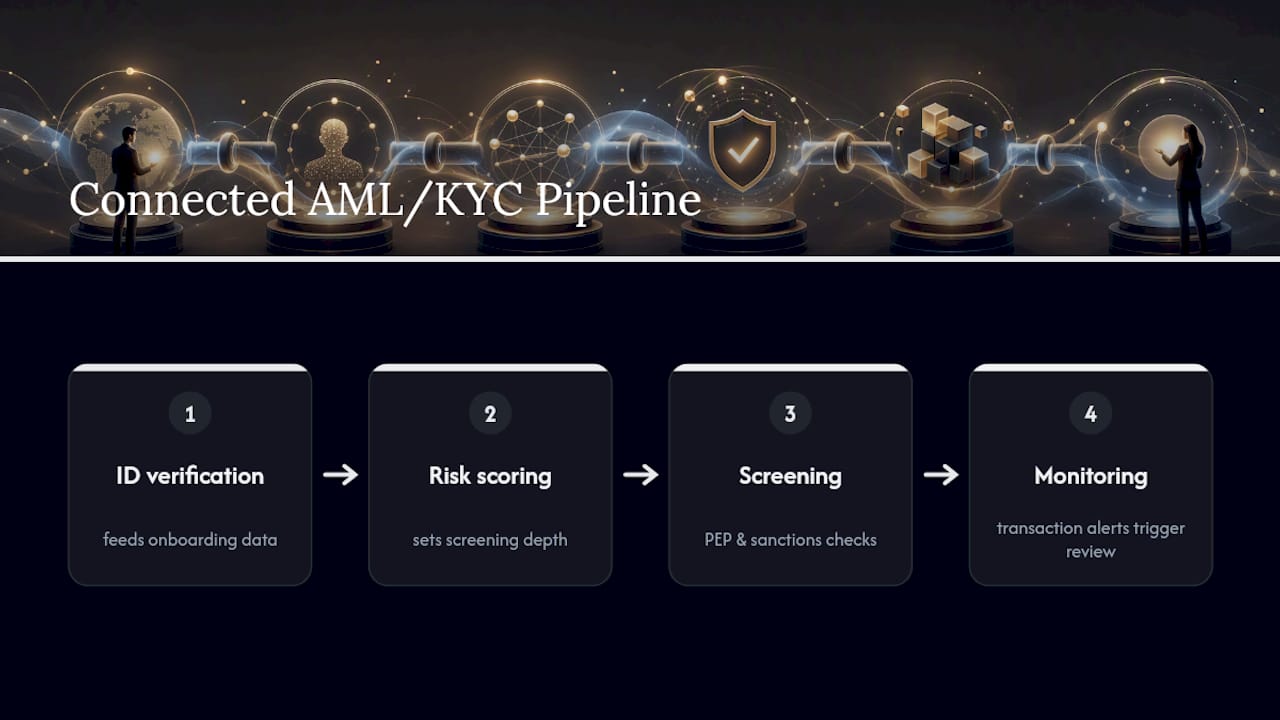
The integration point that matters most is data continuity. Your onboarding KYC data, the identity documents, ownership structure, and risk rating, should feed directly into your ongoing transaction monitoring rules. A client who cleared as low-risk at onboarding but later triggers a PEP match through a career change should automatically escalate to tighter transaction thresholds, not sit at the original risk rating until the next scheduled review.
Customer due diligence, PEP screening, and sanctions screening typically run through the same underlying identity data, which means your onboarding system architecture matters as much as your screening vendor choice. A fragmented setup where PEP checks live in one tool, sanctions screening in another, and transaction monitoring in a third creates exactly the kind of gap where a risk signal in one system never reaches the team managing another.
The businesses that handle this well treat AML/KYC as a single connected pipeline, identity verification feeds risk scoring, risk scoring sets screening depth and re-screening frequency, and any change in status anywhere in that chain triggers a review everywhere else. That’s a harder system to build than three separate point solutions, but it’s the only one that catches a PEP status change before it becomes an enforcement finding.
How Documented Controls Protect Your Banking Relationships
Banks and payment providers watch their business clients’ compliance posture closely, and a documented PEP screening program is one of the clearest signals you can send that your account won’t become a liability for theirs. Businesses with visible gaps in customer due diligence run a real risk of account restrictions or relationship termination, sometimes with little warning, because the banking partner’s own regulatory exposure depends on your controls.
Practically, this means the businesses with the smoothest banking relationships are the ones that can produce an EDD file on request in hours, not weeks. Using a banking partner that supports multi-account structures and role-based access can make evidence collection and transaction monitoring considerably easier to manage day to day, since ownership and authorization data lives in one auditable place rather than scattered across spreadsheets.
If your screening program surfaces a genuinely complex case, a politically sensitive UBO structure, a cross-border ownership chain, escalate to an external AML specialist rather than guessing. Ask what documentation they’d need, how they’d score the risk, and whether they’d recommend continuing or exiting the relationship. That’s a decision worth getting outside judgment on before it becomes a regulator’s question.
— dd
A Banking Partner Built for Businesses That Take Compliance Seriously
Demivolt gives compliance-conscious businesses a foundation that makes PEP screening and EDD documentation easier to operate day to day, not harder. Dedicated IBAN accounts with segregated client funds, transparent onboarding, and multi-account structures with role-based access mean your ownership and authorization data lives in one place instead of scattered across systems.
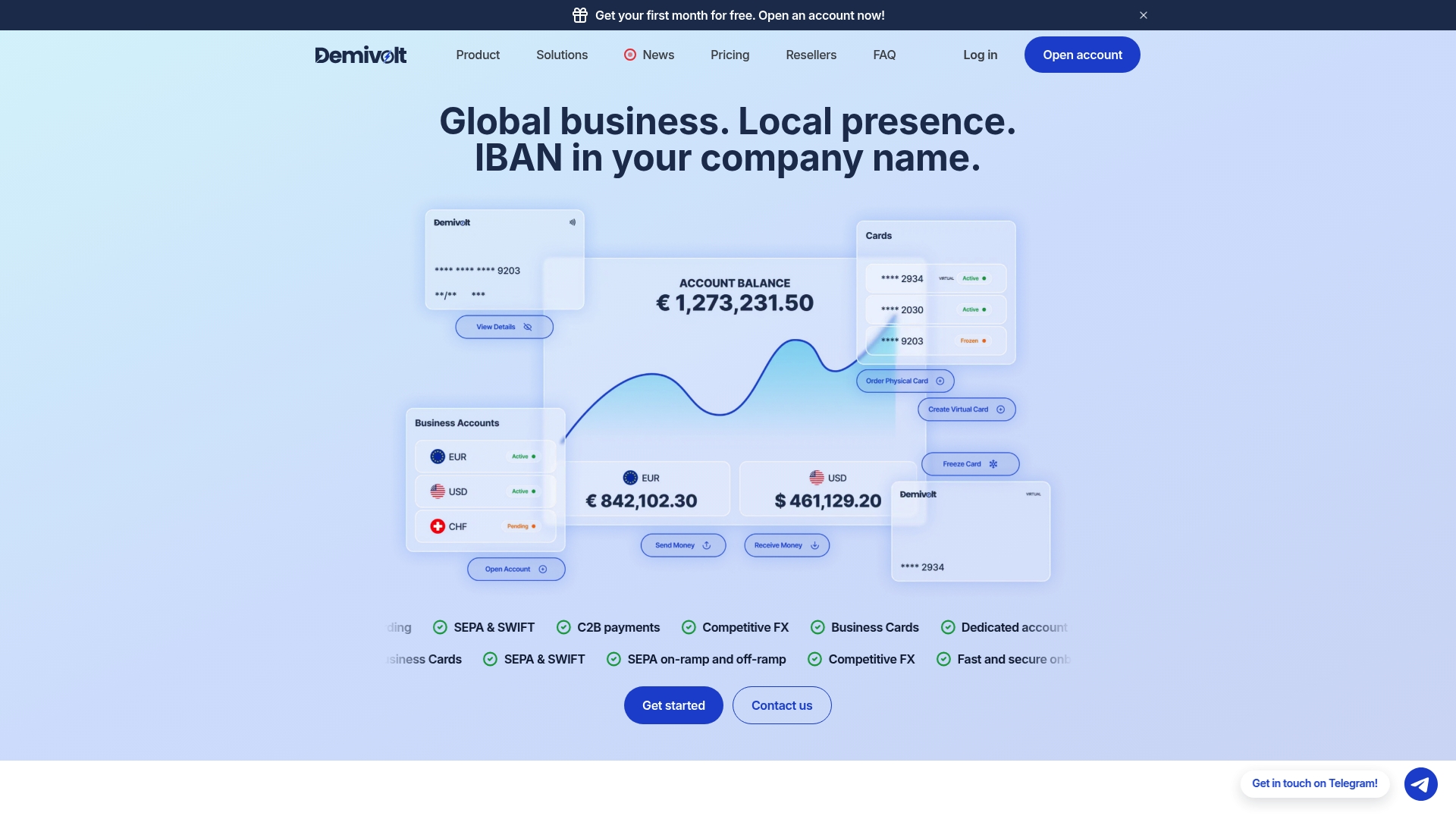
That matters when a regulator asks for evidence fast. Reconciling who controls an account, who’s authorized to move funds, and when that access last changed is far simpler when your banking infrastructure already tracks it, rather than reconstructing the picture from disconnected tools during an audit. Businesses managing cross-border payments through SEPA and SWIFT also reduce the manual work of tracing source of funds, since transaction records sit in one auditable account structure.
If you’re setting up new banking relationships as part of tightening your compliance program, start by verifying account details accurately with Demivolt’s IBAN validator, then explore how a dedicated IBAN account supports cleaner onboarding and evidence collection for your next EDD review.
This article is general information, not a substitute for advice from a qualified lawyer. Consult a qualified legal professional about your own circumstances before acting on anything here.
Sources
- FATF - Specific risk factors in the laundering of proceeds of corruption (FATF guidance)
- FluxForce — PEP screening requirements and best practices
- Lietuvos bankų asociacija — Clarifications on AML prevention rules (LBA)
- Neteisk