

A business account in Lithuania is most at risk of closure when the bank cannot verify who owns the company, where its money comes from or what the business actually does. The risk is manageable. Complete and current KYC records, a transaction pattern that matches your declared activity, and a second account at a separate provider remove most of the exposure. This guide explains why closures and freezes happen, what notice you are owed, what to do on the day it happens and how to structure your banking so one decision cannot stop your company.
DemivoltKeep Business Payments MovingDemivolt offers regulated business accounts with dedicated IBANs and SEPA and SWIFT payments, giving your company another banking line.Explore business bankingTL;DR
- Closures and freezes in Lithuania mostly come from anti-money-laundering (AML) and counter-terrorist-financing (CTF) duties, not from commercial disagreements. Missing or outdated KYC is the most common trigger you control.
- A freeze or suspended transaction is temporary. A closure ends the relationship. A provider that ends an indefinite-term contract generally has to give at least 60 days’ written notice where the contract allows termination.
- If a closure or freeze is announced: answer information requests the same day, keep written proof, secure your payment calendar and open a second account before you need it.
- Complaints start in writing with the bank. As a business, you may need contractual negotiation or a civil claim rather than the consumer route.
- The simplest protection is redundancy: two regulated accounts, documented ownership and role-based access.
Table of Contents
- Why Lithuanian banks close or restrict business accounts
- Closure, freeze and blocked transaction: three different events
- Notice, explanation and your rights
- What to do the day a closure or freeze is announced
- How to challenge a closure decision
- How to reduce your closure risk
- Risk profile by business type
- Our perspective
- Build a second banking line with Demivolt
- FAQ
- Sources
Why Lithuanian banks close or restrict business accounts
The driver is regulatory duty. The Bank of Lithuania states that a payment-service provider may refuse to open an account where legal restrictions apply, including when it cannot meet Lithuanian AML and CTF requirements. The same logic applies to existing customers: if a provider cannot manage the risk a client represents, it may restrict or end the service.
The Bank of Lithuania’s AML FAQ identifies failure to provide or update KYC information as a possible basis for restricting or terminating financial services. Providers may request information about the customer, its beneficial owners, the business purpose and the source of funds.
In practice, the risk factors usually fall into five groups:
- Incomplete or stale KYC. An unanswered request for a updated ownership chart or director passport is the cheapest way to lose an account.
- Complex ownership. Layered holding structures, nominee arrangements or owners in several jurisdictions make verification slower. A Lithuanian law firm has reported increased scrutiny of fintech businesses and companies with international structures, cross-border transfers or complex ownership.
- Activity that does not match the profile. A company declared as consulting that suddenly receives large marketplace payouts will be asked why.
- Sanctions exposure. The Financial Crime Investigation Service (FCIS) defines financial sanctions as restrictions on a sanctioned party’s right to hold, use or dispose of money and other assets, and on payments to them. A counterparty match can freeze a payment or an account.
- Suspicious-transaction reporting. In 2024, Lithuanian financial institutions reported 530 customer-account suspensions under Article 16 of the AML law, involving suspended operations of more than EUR 79 million. Suspension is an active, routine compliance tool.
Supervisors also hold providers accountable for weak controls. When the Bank of Lithuania revoked one payment institution’s licence, it cited inadequate customer identification and risk assessment, insufficient enhanced due diligence and failure to monitor transactions. That pressure explains why institutions prefer to over-ask for documents.
Closure, freeze and blocked transaction: three different events
The three are often confused, and the difference determines your response.
| Event | What happens | Typical duration | Your first move |
|---|---|---|---|
| Blocked or held transaction | One payment is stopped for review or screening | Hours to days | Supply the invoice, contract or explanation requested |
| Temporary freeze or suspension | Operations on the account are restricted while the account stays open | Until the bank or authority clears the case | Answer information requests fully, in writing |
| Closure | The contract is terminated and the relationship ends | Permanent | Check notice terms, move funds and payment flows |
A suspension is the narrower measure. In the Bank of Lithuania’s guidance for electronic money and payment institutions, refusal or termination of a banking relationship should be applied only in extreme cases when other risk mitigation measures are not available. That position was written for payment and e-money institutions, but it reflects the supervisory direction: closure follows when monitoring and controls cannot manage the risk.
The practical conclusion: a freeze is not yet a closure. How quickly and completely you respond often decides which one you get.
Notice, explanation and your rights
Two rules matter most.
Notice. The Bank of Lithuania’s dispute-resolution practice records that a provider may terminate an indefinite-term contract with at least 60 days’ written notice, provided the contract provides for termination. That decision concerned a consumer dispute, so read your own business contract: its termination clause, notice period and any exceptions for compliance reasons are what bind you.
Explanation. When a provider refuses to open an account, it must tell the applicant and state the reasons, unless disclosure is prohibited by law. Anti-money-laundering rules can prevent a bank from telling you everything, for example when a suspicious-transaction report has been made. A vague reply is therefore not always a sign of bad faith, and it is not a reason to stop asking for the contractual basis of the decision.
For anything touching on damages, held funds or the validity of termination, speak to a Lithuanian commercial lawyer. The rights of a company differ from those of a consumer, and the right route depends on your contract.

What to do the day a closure or freeze is announced
Published guidance on this is thin, so this is a practical sequence built on the rules above rather than an official procedure.
- Read the notice and the contract. Note the effective date, the stated ground and the termination clause. Ask in writing whether it is a closure, a freeze or a transaction hold.
- Answer every information request immediately. Send ownership documents, director IDs, contracts, invoices and proof of the source of funds in one complete package. Keep proof of submission.
- Map what runs through the account. List direct debits, payroll, card subscriptions, tax payments, payment-processor settlement accounts and customer invoices that show this IBAN.
- Open or activate a second account. Do it before the closure date. Onboarding at a new provider includes verification, and it takes longer when you are in a hurry.
- Redirect incoming payments first. Send updated bank details to customers and marketplaces, then move outgoing payments.
- Ask how the balance will be returned. Request in writing the destination account, the date and any fees. Confirm what happens to payments in transit and to cards linked to the account.
- Document everything. A dated log of requests and replies is your evidence in any later dispute.
Pending payments, linked cards and recurring debits are where companies are hurt most. Treat them as a project with a deadline, not an afterthought. Our guide on payment risk management for businesses in Lithuania covers how to build that payment map.
How to challenge a closure decision
Start with a written complaint to the bank or payment provider, with proof of submission and all supporting evidence. Ask for the contractual ground, the facts relied on (as far as the law allows) and what would be needed to reverse the decision.
If the matter qualifies under the Bank of Lithuania’s procedure, you can escalate there for out-of-court resolution. The Bank’s AML FAQ explains the process, but because the customer is a company, eligibility and available remedies differ from the consumer route. Where the dispute concerns termination, funds or damages, contractual negotiation and a civil claim may be necessary. Do not wait for the complaint outcome before arranging a replacement account: the closure date keeps running.
How to reduce your closure risk
Most protective steps are administrative. They cost little and make a compliance team’s job easier.
Keep KYC current before anyone asks
The FCIS national risk assessment lists client and beneficiary identification, suspicious-transaction reporting and monitoring of complex or unusually large transactions among the core AML prevention measures. Your counterpart at the bank is applying those measures to you. Give them what they need before they ask:
- an up-to-date ownership chart down to the natural persons who ultimately own or control the company;
- current director and beneficial-owner IDs;
- a clear description of the business, its main customers, suppliers and countries;
- the expected monthly volumes, so that normal activity is not read as unusual.
Our explainer on the KYB check for companies shows what business verification typically involves and which documents slow it down.
Keep activity consistent with your declared profile
If your business model changes, tell your provider before the new flows arrive. New countries, new customer types or a jump in volume are each reasons for questions. Keep contracts and invoices ready for any large or unusual payment.
Simplify ownership where you can
Complex structures are legitimate, but each layer adds documents. Where a holding layer has no real function, simplifying it reduces both verification time and scrutiny. Where the layers are needed, prepare a one-page structure summary with supporting registry extracts.
Control who can do what
An account used by many people with unlimited rights makes monitoring harder. Role-based access, approval limits and a regular review of who holds which permissions show a provider that the company is controlled. See our overview of user access auditing in banks for what regulators expect.
Do not depend on a single account
This is the most effective step. A second account at a different regulated provider turns a closure from a crisis into an inconvenience. Split functions logically: operating payments on one, card spending or foreign settlements on the other. If you hold several accounts, a clear structure makes reconciliation easier, as described in our practical guide to linking business bank accounts in Lithuania.
Risk profile by business type
Not every company faces the same questions. These are the patterns that tend to prompt requests for additional information.
| Business type | What draws questions | What to prepare |
|---|---|---|
| E-commerce | High transaction counts, refunds, payouts from several processors | Payout reports, refund policy, supplier contracts |
| SaaS and digital services | Customers in many countries, subscription billing | Customer geography summary, pricing and billing terms |
| Import and export | Large cross-border transfers, new counterparties | Trade contracts, customs documents, counterparty details |
| Fintech and platforms | Client funds, licences, flow-of-funds design | Licence or registration evidence, AML policy, fund-flow diagram |
| Professional services | Payments from or on behalf of clients | Engagement letters, proof of the client relationship |
Cross-border activity multiplies the screening points. Payments that move through the SWIFT network also take longer; our article on how long a SWIFT transfer takes explains the timing, which matters when you are redirecting flows under a deadline.
Our perspective
Account closure rarely arrives without warning signs. In most cases the first sign is a request for documents, and the difference between a resolved review and a terminated relationship is how fast and how completely the client replies.
We built Demivolt around that reality. We are a regulated European fintech platform, and we open dedicated IBAN accounts through a risk-based onboarding process that is designed to be fast, secure and transparent. Client funds are held in segregated accounts, and every business can run multiple accounts with role-based user management, so access and responsibilities are documented from day one.
For companies with international operations, we recommend treating banking as infrastructure with redundancy: one account for core operations, another for card programmes or cross-border settlement. Our published fee structure removes uncertainty about cost, and our dedicated client manager is available at no charge to keep the compliance dialogue practical rather than adversarial.
Strong compliance is not an obstacle to doing business internationally. It is the condition for keeping accounts open.
dd
Build a second banking line with Demivolt
If you want a back-up account, or a compliant primary account for cross-border operations, Demivolt offers business accounts with dedicated IBANs, SEPA and SWIFT payments, multi-account structures and virtual and physical Visa business cards. The published fees are straightforward:
| Item | Fee |
|---|---|
| Account opening | 0 |
| Account verification | 0 |
| Dedicated Client Manager | 0 |
| Monthly maintenance | 0 per month |
| Internal transfers between Demivolt accounts | 0 |
| SEPA In | €0 |
| SEPA Out | €0.40 |
| SWIFT In | €25.00 |
| SWIFT Out | €30.00 |
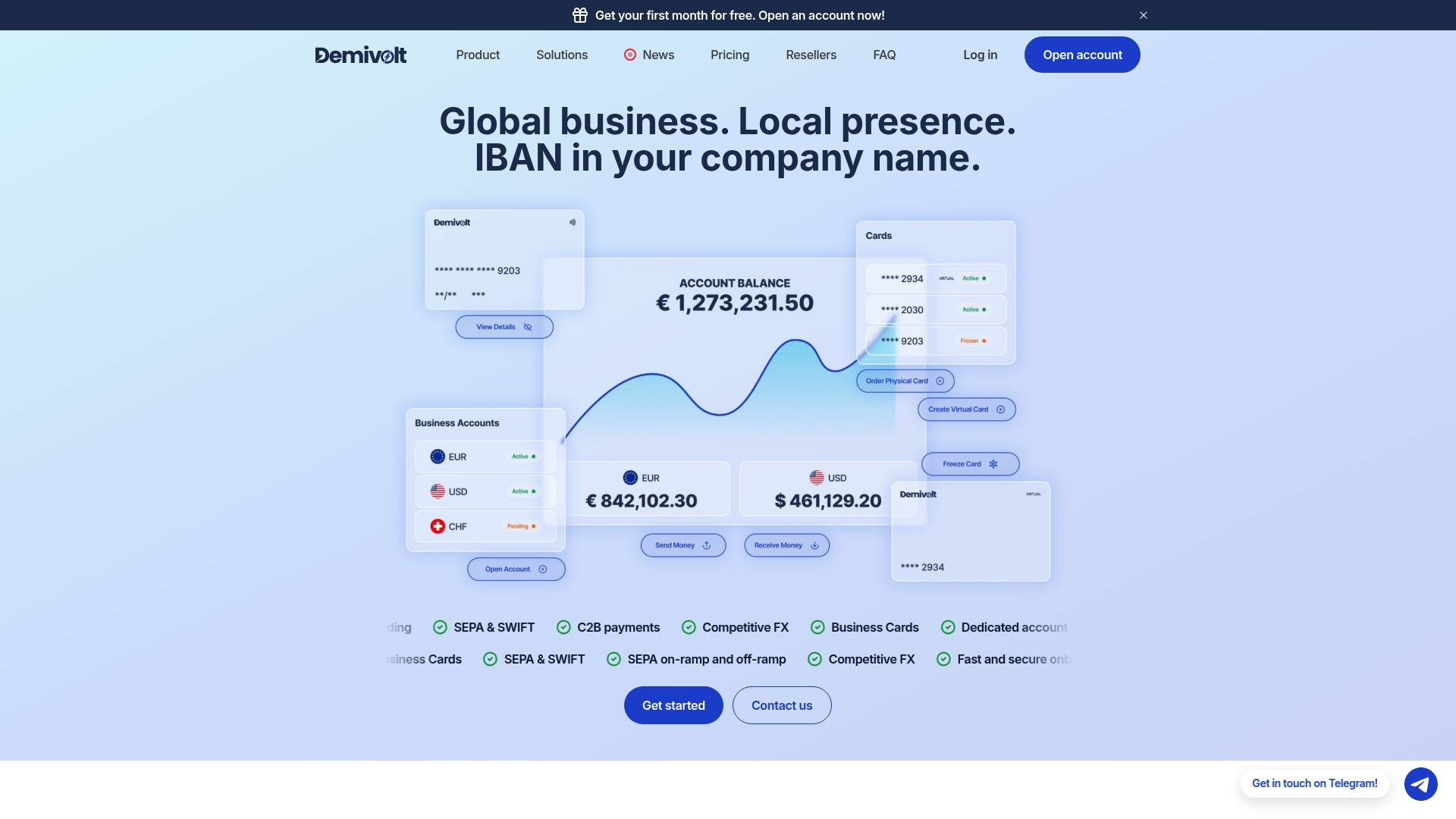
You can estimate outgoing transfer costs with our SEPA fee calculator, review the payments and card programmes pages, or contact us to start onboarding while your current account is still in good standing.
FAQ
Can a Lithuanian bank close my business account without giving a reason?
It can end the relationship if your contract allows termination and the notice rules are met, but you can ask for the reason in writing. Where the law prohibits disclosure, for example because of AML reporting, the bank may not be able to explain fully. Ask for the contractual ground at least.
How much notice should I expect?
For an indefinite-term contract, the Bank of Lithuania’s dispute practice records a minimum of 60 days’ written notice when the contract provides for termination. Your own contract governs a business account, so check its termination clause and any compliance exceptions.
Is a freeze the same as a closure?
No. A freeze or suspension restricts operations while the account remains open and can be lifted once the questions are resolved. A closure ends the contract. Respond to a freeze fully and quickly, and prepare a back-up account in parallel.
What should I do first if my account is frozen?
Send the requested documents in one complete package and keep proof of submission. Then list the payments that depend on the account and arrange an alternative route for the most urgent ones, such as payroll and taxes.
Can I complain to the Bank of Lithuania?
You should first complain in writing to your provider. The Bank of Lithuania has an out-of-court procedure, but a company’s eligibility and remedies differ from a consumer’s. For termination, held funds or damages, seek advice from a Lithuanian commercial lawyer.
Sources
- Can a payment service provider refuse to open a payment account? Bank of Lithuania
- FAQ on prevention of money laundering and terrorist financing, Bank of Lithuania
- International financial sanctions: implementation, FCIS
- FCIS annual report 2024
- Licence of UAB epayblock revoked, Bank of Lithuania
- Bank of Lithuania guidelines on bank accounts for electronic money and payment institutions
- Bank of Lithuania dispute decision on contract termination notice
- Lithuanian national risk assessment of money laundering and terrorist financing
- Fintech account restrictions, frozen funds and digital assets, Šulija & Partners