

Transparent onboarding is the practice of making every verification step, data use, timeline, and fee trigger visible to the client in real time, supported by KYC/CIP collection, AML/CTF screening, OFAC checks, and immutable audit logs. For regulated business banking and payments in the U.S., this approach delivers three measurable outcomes:
- Faster time-to-activation, because clients know exactly what to submit and when
- Fewer disputes, because fee triggers and scope limits are documented at intake
- Lower drop-off rates, because status visibility removes the uncertainty that causes clients to abandon the process
Regulators increasingly expect firms to demonstrate not just that documents were collected, but that clients understood why. Transparency is both a client-experience standard and a compliance control.
Table of Contents
- Why transparent onboarding matters for regulated U.S. banking and payments
- Core principles that make onboarding genuinely transparent
- A practical step-by-step onboarding flow for business banking clients
- U.S.-specific compliance considerations that shape your onboarding design
- Technology and integrations that enable transparent onboarding
- KPIs and benchmarks to measure onboarding performance
- Common pitfalls and how to fix them
- Launch-ready checklist for implementing transparent onboarding
- Key Takeaways
- What practitioners get wrong about transparent onboarding
- Demivolt makes compliant, transparent onboarding operational
- Useful sources and further reading
Why transparent onboarding matters for regulated U.S. banking and payments
Disputes in regulated financial services rarely start with bad intent. They start with misaligned expectations: a client who didn’t know a re-verification would be required, or a fee that triggered without warning. Transparent onboarding prevents this by documenting fee triggers, scope limits, and responsibilities at the start of the relationship, shifting the conversation from “you didn’t tell me” to “we planned for this.”
From a regulatory standpoint, the Bank Secrecy Act, FinCEN’s Customer Identification Program rules, and OFAC screening requirements all generate documentation obligations. Transparent onboarding turns those obligations into client-facing communication: explaining why a beneficial ownership form is required, what happens if a sanctions hit is flagged, and how long each step takes. That explanation becomes part of the audit trail.
“Organizations with strong onboarding programs see measurably higher retention and faster time-to-productivity — a pattern that holds in client onboarding just as clearly as in employee onboarding.”
The business case is direct: fewer manual escalations, shorter time-to-revenue, and a compliance record that holds up under examination.
Core principles that make onboarding genuinely transparent
Transparency works best as infrastructure, not a communication style. That means building it into systems so information is visible by default, not delivered on request.
The foundational design decisions are:
- Published SLAs per milestone: Define and display expected completion times for each step (e.g., “identity verification: 1 business day”). Clients who know the timeline tolerate delays far better than clients who don’t.
- Self-service status portal: Clients should see their current step, outstanding items, and next action without contacting support.
- Automated status updates: Trigger notifications at each milestone transition, not just at the start and end.
- Role-based access controls (RBAC): Limit who on your team can view, edit, or approve each step. This protects sensitive data and creates a clear ownership chain.
- Immutable audit logs: Every status change, document upload, and decision must be timestamped and non-editable. These logs serve both compliance and dispute resolution.
- Data-use explanations: At each document request, explain what the data is used for, who sees it, and how long it is retained.
Pro Tip: The most common under-investment is in SLA exception handling. Define what happens when a milestone misses its SLA: who is notified, what the escalation path is, and what the client is told. Teams that skip this step create the exact opacity they were trying to avoid.

A practical step-by-step onboarding flow for business banking clients
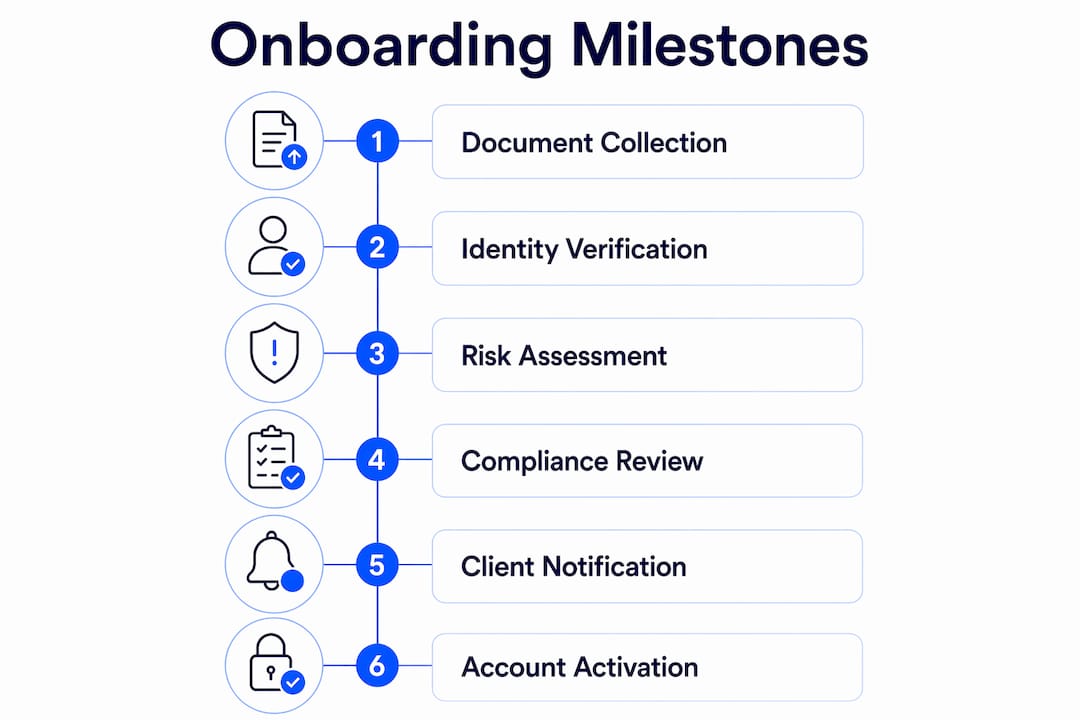
A well-structured transparent onboarding process runs through six sequential milestones. Parallelizing steps 2 and 3 (running identity verification and business document review simultaneously) typically cuts total time-to-activation by 30–40%.
| Milestone | Client-Visible Status | Expected SLA | Required Artifacts |
|---|---|---|---|
| 1. Intake & application | “Application received” | Same day | Business details, contact info |
| 2. Identity & ownership verification | “Identity check in progress” | 1 business day | Government ID, beneficial ownership form |
| 3. Business document review | “Documents under review” | 1–2 business days | Articles of incorporation, EIN confirmation |
| 4. AML/OFAC screening | “Compliance review” | 1 business day | No client action; status visible |
| 5. Account provisioning | “Account being set up” | Same day post-approval | None |
| 6. Funding & payment activation | “Ready to transact” | Same day | Initial deposit or payment test |
Key delay drivers: document quality (blurry IDs, missing pages), third-party verification response times, and sanctions hits that require manual review. Clients should be told at intake that these factors can extend timelines, and given a named contact for questions.
- Each milestone should have a defined owner (client, compliance team, or platform)
- Rejection reasons must be specific: “ID image too low resolution” beats “document not accepted”
- Escalation paths (who to contact, expected response time) should be visible at every step
U.S.-specific compliance considerations that shape your onboarding design
The compliance-first approach to digital banking onboarding requires understanding what U.S. regulators actually expect at each step.
KYC/CIP: Under FinCEN’s Customer Identification Program, covered financial institutions must collect name, date of birth, address, and identification number for each account holder. For business accounts, beneficial ownership rules require identifying individuals who own 25% or more of the entity and one controlling person.
AML/CTF: Firms must maintain a written AML program, conduct ongoing monitoring, and file Suspicious Activity Reports (SARs) when required. Transparent onboarding means explaining to clients that transaction monitoring is ongoing, without disclosing the specific controls that could be exploited.
OFAC screening: Every applicant must be screened against OFAC’s Specially Designated Nationals list. If a potential match is flagged, the investigation must proceed before the account is activated. Clients can be told their application is under additional review without disclosing the specific reason.
Minimum disclosure and documentation checklist:
- Written explanation of what data is collected and why (delivered at intake)
- Documented consent for data use and retention
- Timestamped record of each client communication and status update
- Audit log of every document submission and review decision
- Retention schedule aligned with BSA requirements (minimum five years for most records)
- Clear statement of what triggers re-verification or enhanced due diligence
Technology and integrations that enable transparent onboarding
The minimal technical stack for a transparent, secure onboarding workflow covers four layers:
| Layer | Function | Integration Pattern |
|---|---|---|
| Identity & document verification | Real-time ID checks, liveness detection, document OCR | API-first; webhook on decision |
| Case management / workflow engine | Task tracking, ownership assignment, client-visible status | Webhook triggers on milestone change |
| Audit logging & RBAC | Immutable event log, role-scoped access | Write-only log API; RBAC at platform level |
| Payment rail connectivity | IBAN provisioning, SEPA/SWIFT routing, account activation | API; event-driven status updates |
A few integration decisions matter more than others:
- Webhooks over polling: Use webhooks for verification decisions and milestone transitions. Polling creates lag and increases the chance of a client seeing a stale status.
- API-first identity providers: Choose providers that return structured, machine-readable decisions (not just PDF reports) so your workflow engine can trigger the next step automatically.
- Centralized audit log: All four layers should write to a single, append-only log. Fragmented logs across systems are a compliance liability and a support burden.
KPIs and benchmarks to measure onboarding performance
Tracking the right metrics turns onboarding from a process into a managed system. Core KPIs for regulated business banking onboarding:
- Median time-to-activation: Total elapsed time from application submission to account ready-to-transact. Target: under 3 business days for standard applications.
- Step-level drop-off rate: Percentage of applicants who abandon at each milestone. High drop-off at document upload typically signals unclear requirements.
- Verification pass rate: Percentage of identity and document submissions that pass on the first attempt. Low pass rates indicate poor upfront guidance.
- Manual review share: Percentage of applications requiring human intervention beyond automated checks. High rates signal automation gaps.
- Dispute rate post-activation: Percentage of activated accounts that generate a fee or scope dispute within 90 days. This is the clearest measure of whether onboarding set expectations correctly.
Track SLA miss rate as a governance metric: every milestone that exceeds its published SLA should generate an internal alert and a client notification. Financial clarity at every step directly reduces post-activation disputes and churn.
Common pitfalls and how to fix them
Most transparent onboarding failures come from the same short list of avoidable mistakes.
- Vague timelines: Publishing “2–5 business days” without milestone-level SLAs leaves clients with no way to track progress. Fix: define and publish an SLA for each step individually.
- Manual handoffs with no visibility: When a file moves from one team to another with no automated status update, clients assume nothing is happening. Fix: automate a status notification on every ownership transfer.
- Buried rejection reasons: Generic rejection messages (“document not accepted”) force clients to guess and resubmit incorrectly. Fix: implement standard rejection codes with plain-language explanations and a specific resubmission instruction.
- Over-sharing process controls: Explaining that OFAC screening is required is appropriate. Describing the specific match thresholds or watchlist logic is not. Fix: explain the why (regulatory requirement) without exposing the how (control parameters).
Pro Tip: Run a first-touch response time experiment: halve the time between a client’s document submission and the first status update (even if it’s just “received and queued for review”). Track whether drop-off at that step decreases. Most teams find it does, within two weeks.
Launch-ready checklist for implementing transparent onboarding
Use this as a build or audit checklist for your onboarding flow.
- Define an SLA for every milestone and publish it in the client-facing portal
- Implement automated status notifications triggered by each milestone transition
- Build a self-service document portal where clients can upload, track, and resubmit
- Add plain-language explanations to every data and document request (what, why, how long retained)
- Integrate identity verification, AML screening, and OFAC checks with your workflow engine via API
- Configure RBAC so each team role accesses only the data it needs
- Set up an immutable, centralized audit log across all workflow layers
- Define escalation paths: who the client contacts, expected response time, and what triggers an internal alert
- Build a rejection-code library with specific resubmission instructions for each failure type
- Run a 30-day pilot on one customer segment, measure the five KPIs above, and fix the worst drop-off step before scaling
For a ready-made reference, the business onboarding checklist for SMEs covers additional templates and documentation requirements.
Key Takeaways
Transparent onboarding requires building status visibility, published SLAs, and immutable audit logs into your regulated onboarding infrastructure from day one.
| Point | Details |
|---|---|
| Transparency is infrastructure | Make status, timelines, and data-use explanations visible by default, not on request. |
| Compliance and UX align | Published SLAs, client-visible status, and audit logs serve both regulatory and client-experience requirements. |
| Measure five core KPIs | Track time-to-activation, drop-off rate, verification pass rate, manual review share, and post-activation dispute rate. |
| Fix rejection clarity first | Specific rejection codes with resubmission instructions reduce drop-off faster than any other single change. |
| Demivolt enables the approach | Demivolt’s platform provides RBAC, audit logging, IBAN provisioning, and compliance-focused onboarding infrastructure for regulated business banking and payments. |
What practitioners get wrong about transparent onboarding
The conventional wisdom treats transparency as a communication problem: send more emails, write clearer copy, add a FAQ. That framing misses the point. Transparency in regulated onboarding is a systems problem. If your workflow engine doesn’t trigger a status update when a milestone changes, no amount of well-written copy fixes the gap. The client still sees silence.
The tradeoff that actually matters is not speed versus verification strictness. It’s automation depth versus exception handling. Teams that automate the standard path but leave exceptions in manual queues with no client visibility create a two-tier experience: fast for simple applications, opaque for anything complex. Complex applications are often your highest-value clients.
Working with Demivolt’s platform, the clearest lesson is that audit logs and client-visible status are not separate concerns. When both are built on the same event stream, a compliance reviewer and a client portal can read the same source of truth. That architecture eliminates a whole category of disputes.
The pilot worth running in two weeks: pick one document-rejection step, add a specific rejection code and a one-sentence resubmission instruction, and measure whether first-attempt pass rate improves. It will.
Demivolt makes compliant, transparent onboarding operational
Regulated onboarding done right requires more than good intentions. It requires infrastructure: RBAC, audit logs, real-time status, and payment rails that activate the moment compliance clears.
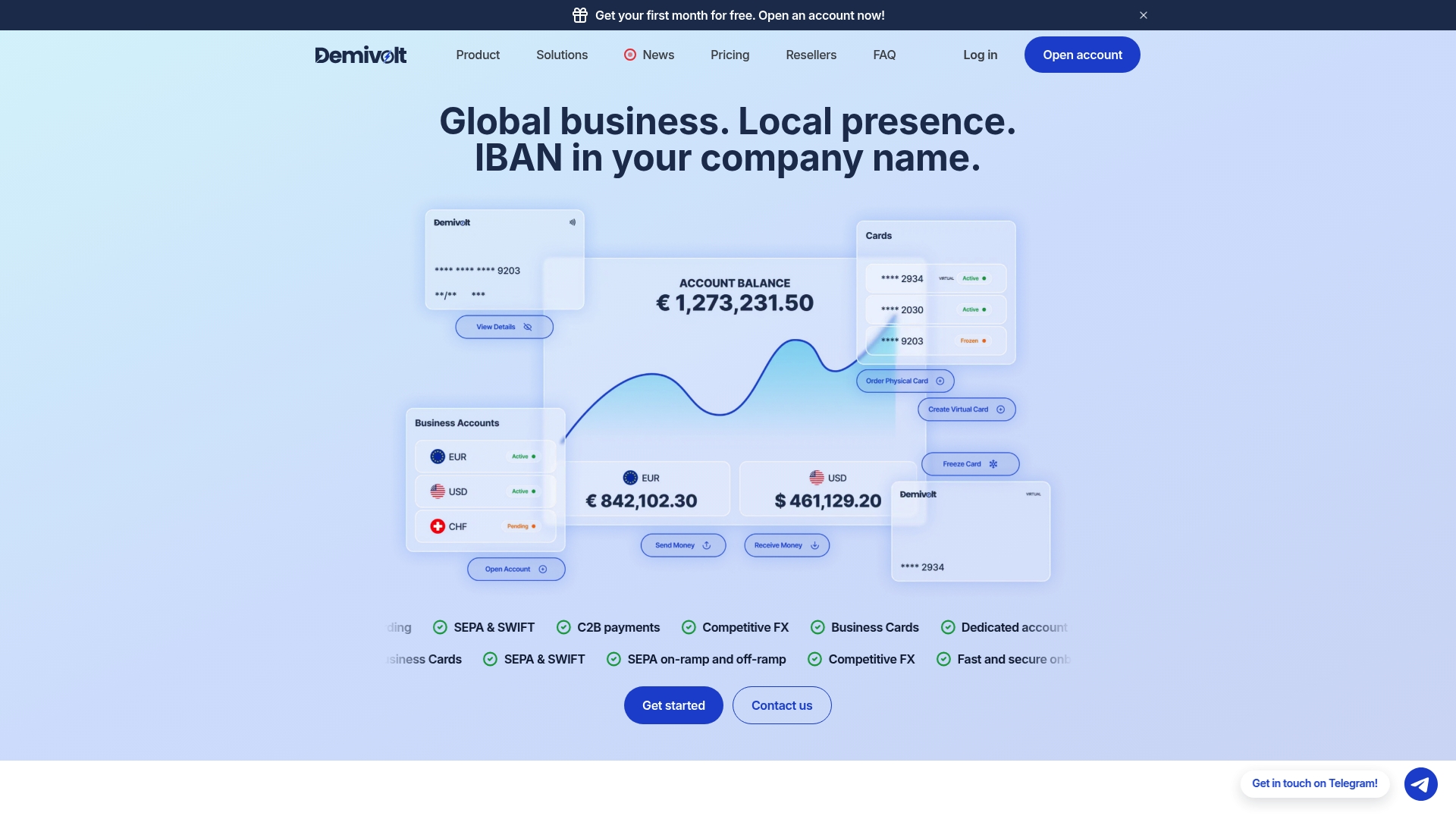
Demivolt’s regulated business banking platform provides exactly that stack: dedicated IBAN accounts, SEPA and SWIFT payment processing, role-based user management, and compliance-focused onboarding flows built for SMEs and fintechs operating in cross-border environments. Every account provisioning step is logged, every role is scoped, and every client sees their status in real time. Use the free IBAN validator to eliminate one of the most common document back-and-forth delays before your next onboarding cycle. To see how the full platform maps to the compliance and transparency requirements in this guide, get started at Demivolt.
Useful sources and further reading
These sources informed the compliance and operational guidance in this article.
- FinCEN Customer Identification Program rules: The primary regulatory source for KYC/CIP requirements under the Bank Secrecy Act. Read this before designing your data collection flow.
- OFAC SDN List and screening guidance: The authoritative source for sanctions screening obligations. Essential for understanding what triggers a hold and what you can communicate to clients.
- SHRM: structured onboarding and retention research: Evidence base for the business ROI of structured onboarding programs, applicable to client as well as employee onboarding.
- Why transparent notifications matter in digital identity: Operational commentary on how clear verification notifications reduce friction and support audit trails.
- Why strong onboarding foundations build trust and cut disputes: Practical framing for using onboarding documentation as a dispute-prevention tool.
- Demivolt blog: compliance-first onboarding guides: Operational guides covering SME and fintech onboarding patterns, checklists, and compliance workflows.
Recommended
- Demivolt | Blog – Onboarding in fintech: Efficient, compliant solutions for SMEs
- Demivolt | Blog – Financial Onboarding Best Practices for SMEs in 2026
- Demivolt | Blog – Digital banking client onboarding: a compliance-first guide
- Welcome to Fintech Explained by Demivolt — Fintech Explained | Demivolt