

For most early-stage U.S. startups, the right digital banking tool comes down to three non-negotiable factors: regulated deposit custody, API access for automation, and multi-user controls that scale with your team. Demivolt stands out as a leading regulated option for startups that need compliant, API-first business banking with dedicated IBAN accounts, SEPA/SWIFT payment rails, and role-based access built in from day one. If your startup operates across borders, processes payments programmatically, or needs a clean audit trail before your first fundraise, that combination is hard to replicate elsewhere.
Three platform categories cover the majority of startup needs:
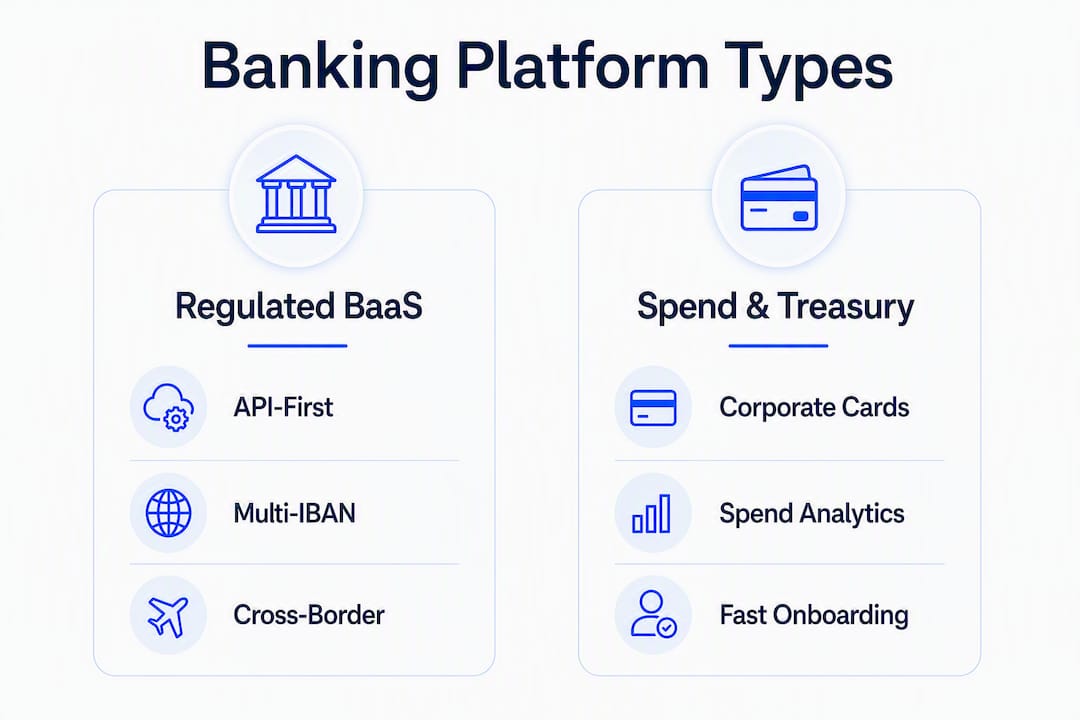
- Regulated BaaS / IBAN provider (Demivolt): Best for seed-stage and growth-stage startups that need compliant multi-account structures, cross-border payments, and API-driven finance ops. The deciding factor is deposit segregation and payment-rail access.
- Startup spend-and-treasury platforms (e.g., Rho, Brex, Mercury, Ramp): Best for venture-backed startups prioritizing corporate card programs, spend controls, and treasury yield on idle cash. Ideal when domestic USD operations dominate.
- Traditional commercial banks with startup programs (e.g., Chase Business, J.P. Morgan Innovation Economy): Best for brick-and-mortar businesses, startups needing SBA lending, or founders who want branch access and a long-term banking relationship. Onboarding is slower, but the charter and FDIC coverage are direct.
The single most important deciding factor when choosing between these categories is deposit custody combined with API or automation capability. A platform with a polished UI but opaque custodial arrangements is a liability, not an asset, when your investors start asking questions.
Table of Contents
- Which digital banking tools for startups compare best at a glance?
- What each platform category actually offers and when to pick it
- How do you choose the right banking tool for your startup?
- Which features matter at each startup stage?
- How do you verify deposit safety and compliance claims?
- Two finance-ops practices that pay off fast for startups
- Platform pros, cons, and pricing highlights by use case
- What should you expect from mobile and online banking features?
- How do multi-user and team account management features work?
- What are the international transaction capabilities and fees to know?
- Key Takeaways
- What most founders get wrong about startup banking
- Demivolt gives startups a regulated foundation for cross-border finance ops
- Useful resources for further research
Which digital banking tools for startups compare best at a glance?
Market roundups consistently group startup banking options by “best for” use-cases rather than by brand, and that framing is correct. The table below maps the three platform categories across the dimensions that matter most during vendor selection.

| Dimension | Regulated BaaS / IBAN provider (Demivolt) | Startup spend-and-treasury platforms | Traditional commercial banks |
|---|---|---|---|
| Best for / ideal stage | Seed → Series A; cross-border, API-driven ops | Venture-backed; domestic spend-heavy teams | Bootstrapped or brick-and-mortar; SBA lending needs |
| Monthly fees | Account and transaction fees; transparent pricing | Free tiers with premium subscription tiers | Often free for startups (introductory periods); fee schedules vary |
| Deposit custody / FDIC | Segregated client accounts; regulated custody | Custodial bank partners; FDIC via sweep | Direct FDIC insured (chartered bank) |
| Corporate cards & spend controls | Virtual and physical Visa business cards; role-based limits | Strong card programs; real-time spend controls | Physical cards; basic spend controls |
| Accounting & payments integrations | API-first; connects to QuickBooks, Xero, and custom stacks | Native QuickBooks, Xero, NetSuite integrations | ACH, wire, accounting sync varies |
| International payments & FX | SEPA and SWIFT; multi-currency IBAN accounts | Limited FX; primarily USD-focused | Wires in up to 70 currencies (J.P. Morgan); fees apply |
| Treasury / yield | Sweep features available | High-yield accounts; treasury portfolios | Money market options; varies by program |
| Onboarding speed | Fast digital KYC; days not weeks | Typically days; automated KYC | Weeks; branch visits may be required |
| Customer support | Dedicated compliance and ops support | Chat and email; tiered by plan | Relationship manager for larger accounts |
Pricing shapes to know: Regulated BaaS providers typically charge per account and per transaction. Startup spend platforms often offer a free tier with premium features behind a subscription. Traditional banks may waive fees for two to three years under startup programs, then revert to standard commercial schedules.
Onboarding speed matters more than most founders expect. A platform that takes three to four weeks to activate accounts can delay payroll, vendor payments, and investor wire receipts at exactly the wrong moment. Prioritize providers with documented digital KYC timelines.
What each platform category actually offers and when to pick it
Regulated BaaS and IBAN providers
This category covers platforms like Demivolt that operate as regulated financial infrastructure rather than consumer-facing apps. The core offering is a dedicated IBAN account (or multiple), SEPA and SWIFT payment processing, virtual and physical card issuance, and an API layer that connects to your accounting and payments stack. Multi-account structures let finance teams separate operating funds, tax reserves, and payroll without opening accounts at multiple institutions.
When to pick this category: Your startup processes cross-border payments, needs a clean IBAN for European counterparties, or is building a product that requires embedded payment rails. Also the right fit when your finance team needs role-based controls from day one, not bolted on later.
Operational limitations: Cash deposits are not a feature of most BaaS providers. If your business handles physical cash regularly, you will need a supplementary account at a chartered bank. Wire limits and daily ACH caps vary by provider and KYC tier, so confirm these in writing before signing.
Integration stack example: Demivolt + QuickBooks or Xero for bookkeeping + Economico for GAAP-shaped books from day one + an AI CFO tool like Fintoit for board-ready reporting.
Pros: Regulated custody, multi-IBAN capability, API-first architecture, fast digital onboarding, cross-border payment rails. Cons: No physical branch, no cash deposit, card programs may be less feature-rich than dedicated spend platforms.
Startup spend-and-treasury platforms
Platforms in this category (Rho, Brex, Mercury, Ramp) are built around corporate card programs and spend management, with banking features added on top. They typically offer free checking accounts, high-yield savings or treasury products, and deep integrations with accounting software. Brex and Ramp are particularly strong on spend controls and receipt capture. Mercury is popular with early-stage founders for its clean UI and API access. Rho targets slightly larger teams with treasury management and AP automation.

When to pick this category: You are venture-backed, your team is spending heavily on SaaS, travel, and cloud infrastructure, and you want real-time spend visibility with automated receipt matching. Treasury yield on idle cash is a meaningful consideration when you are sitting on a large seed or Series A round.
Operational limitations: Most platforms in this category are not chartered banks. Deposits are held at custodial bank partners, which means FDIC coverage is indirect. Confirm the sweep arrangement and the custodial bank’s name in writing. FX capabilities are limited compared to a SWIFT-enabled provider.
Pros: Strong card programs, spend analytics, treasury yield, native accounting integrations, fast onboarding. Cons: Custodial (not direct) FDIC coverage, limited international payment rails, vendor lock-in risk if you build deeply into their API.
Traditional commercial banks with startup programs
J.P. Morgan’s Innovation Economy Banking and Chase Business Complete Banking represent this category. The appeal is direct FDIC insurance, access to SBA lending, and a relationship manager who can connect you to the bank’s venture network. J.P. Morgan works with companies across the full lifecycle, from early stage through pre-IPO, and offers wires in nearly 70 currencies.
When to pick this category: You need SBA financing, your investors expect a named chartered bank on your cap table, or your business model involves physical locations and cash handling. Also a strong choice when you anticipate needing credit facilities within 12–18 months.
Operational limitations: Onboarding can take weeks. Branch visits are sometimes required. The digital experience lags behind fintech-native platforms, and API access is limited compared to BaaS providers.
Pros: Direct FDIC insurance, SBA lending access, venture network, multi-currency wires, long-term relationship value. Cons: Slower onboarding, less developer-friendly, fee schedules can be complex after introductory periods.
How do you choose the right banking tool for your startup?
Start with deposit custody and integrations. Everything else is secondary. Here is a practical checklist to run through before committing to any provider.
Vendor evaluation checklist
- Confirm the custodial model. Ask directly: “Is this a chartered bank, or do you hold deposits at a partner institution?” Get the partner bank’s name in writing. Neobanks and fintech platforms commonly partner with chartered banks to hold deposits, and that separation matters for counterparty risk.
- Request a written custody disclosure. Any reputable provider will supply this. If they hesitate, that is a red flag.
- Verify FDIC or equivalent coverage. For U.S. startups, confirm whether coverage is direct (chartered bank) or via sweep arrangement, and what the per-depositor limit is.
- Check KYC timelines. Ask: “How long does account activation take after document submission?” Document what is required: certificate of incorporation, EIN, beneficial ownership details, and ID verification for all directors.
- Test API rate limits and sandbox access. Request sandbox credentials before signing. Parse a sample ledger export against your accounting stack to surface mapping and timing issues before live migration.
- Confirm wire and ACH caps. Daily and monthly limits vary significantly. A $50,000 daily wire cap can become a problem fast when you are paying vendors or receiving investor funds.
- Ask about dispute resolution timelines. Payment disputes and fraud claims should have a documented SLA. Vague answers here are a warning sign.
- Review the integration list. Confirm native connections to QuickBooks, Xero, or your ERP. Ask whether the integration is read-only or bidirectional.
Red flags during demos or contract review
- No written custody disclosure available on request
- Vague answers about which chartered bank holds your deposits
- No sandbox environment for API testing
- Wire or ACH caps not disclosed upfront
- Customer support accessible only via chatbot with no escalation path
Realistic timeline and costs
Fintech-native platforms typically activate accounts within one to five business days after KYC completion. Traditional banks may take two to four weeks. Budget for one to two days of internal engineering time to test API connections and map ledger exports. Initial card program setup typically adds another two to three business days.
Pro Tip: Request a written SRE/uptime SLA and a sample custody disclosure during your first sales call. A provider that cannot produce both within 24 hours is telling you something important about their operational maturity.
You can also use Demivolt’s free IBAN validator to verify account identifiers and reduce friction during integration testing before you go live.
Which features matter at each startup stage?
Not every feature on a platform’s pricing page is worth paying for at your current stage. The table below maps startup stage to the features that actually move the needle.
| Startup stage | Must-have features | Nice-to-have | Skip for now |
|---|---|---|---|
| Solo / bootstrapped | Free or low-cost checking, bookkeeping integration, invoicing | Sub-accounts for tax savings | Corporate cards, treasury yield, multi-user controls |
| Seed (2–9 people) | Multi-user access, role-based permissions, corporate cards, GAAP bookkeeping | ACH automation, basic spend controls | Treasury portfolios, dedicated banker |
| Seed+ to Series A | Corporate card program, spend analytics, treasury sweep, API access | Multi-currency accounts, AP automation | Full ERP integration (unless finance team is in place) |
| Venture-backed growth | Treasury yield, multi-account structures, FX rails, dedicated support | White-label card programs, BaaS infrastructure | Basic free-tier checking |
At the solo and bootstrapped stage, the priority is clean books and low fees. Setting up GAAP-shaped bookkeeping from day one avoids painful retroactive migrations when investors ask for audited financials. Once you hit seed stage, role-based permissions and corporate cards become the operational priority. A finance contractor or part-time CFO joining at this stage will immediately ask for those controls.
At Series A and beyond, treasury yield on idle cash and multi-account structures for budget separation are worth the additional cost. A startup sitting on a $5M Series A round can generate meaningful yield on undeployed capital, and the operational discipline of separate accounts for payroll, taxes, and operating expenses reduces reconciliation errors significantly.
Pro Tip: Introduce a dedicated treasury product only when your idle cash balance justifies the management overhead. For most startups below $2M in the bank, a single regulated provider with a sweep feature is sufficient. Above that threshold, a dedicated treasury portfolio starts to earn its keep.
For cross-border operations, multi-currency IBAN accounts and SWIFT rails become relevant at the seed+ stage, particularly for startups with European customers or suppliers. Demivolt’s cross-border finance guide covers how multi-account structures support this transition without requiring a full banking overhaul.
How do you verify deposit safety and compliance claims?
The most important trust check is not the platform’s marketing copy. It is the written custody disclosure. Here is what to request and how to interpret what you receive.
Trust signals to request during vendor evaluation
- Written custody statement: Names the chartered bank holding your deposits and specifies the account structure (omnibus vs. segregated).
- Regulator registration or certificate: For U.S. platforms, check FinCEN registration and state money transmitter licenses. For regulated European fintechs like Demivolt, look for the relevant national competent authority registration.
- Audit reports or SOC 2 certification: Confirms that security and operational controls have been independently verified.
- Uptime SLA: A documented service-level agreement for payment processing availability. Anything below 99.9% warrants a follow-up question.
- Incident history: Ask for a summary of payment processing incidents in the past 12 months. A provider with nothing to share is either very new or not being transparent.
How to interpret common vendor claims
“Bank partner” does not mean the platform is a bank. It means deposits are held at a chartered institution, but the fintech’s UX and the bank’s charter are separate entities. This matters for counterparty risk: if the fintech platform fails, the path to your deposits runs through the partner bank, not the platform. Understanding this distinction is covered in detail in Demivolt’s fintech vs. bank explainer.
KYC timelines also signal operational maturity. A provider that takes three weeks to complete KYC is either under-resourced or dealing with compliance backlogs. Both scenarios affect your ability to receive funds and pay vendors on time.
For compliance-first onboarding expectations and required documentation, Demivolt’s onboarding guide provides a practical reference for what a well-run KYC process looks like and what documents to prepare in advance.
Two finance-ops practices that pay off fast for startups
Two operational practices consistently reduce audit risk and accelerate fundraising readiness, regardless of which banking platform you choose.
First: set up GAAP-shaped, accrual double-entry books from day one. Retroactive bookkeeping migrations are expensive, time-consuming, and often incomplete. Platforms like Economico create accountant-grade books at signup, so founders have clean financials before they hire a finance team. When your Series A investors ask for 18 months of audited financials, having clean books already in place is the difference between a two-week process and a two-month scramble.
Second: use an AI CFO tool for repeatable board reporting. Tools like Fintoit can generate board-ready PDF reports with narrative and KPI tables from live data in under 30 seconds. That capability removes low-value reporting work from your plate and lets small teams focus on product and growth. The AI-driven finance automation trend is accelerating, and startups that build these workflows early have a measurable advantage during due diligence.
Practical implementation checklist
- Connect your banking platform to QuickBooks or Xero on day one
- Set up Economico or an equivalent GAAP bookkeeping tool before your first revenue transaction
- Configure automated monthly close reminders in your calendar
- Integrate an AI CFO tool for burn rate, runway, and board deck generation
- Reconcile bank statements weekly, not monthly, to catch errors before they compound
For a practical guide to integrating these workflows with your banking platform, Demivolt’s banking workflow guide covers the connection points between accounts, bookkeeping, and payment automation.
Platform pros, cons, and pricing highlights by use case
The platforms named in SERP consensus for startup banking in 2026 fall cleanly into the three categories above. Here is how the specific names map to practical use cases.
Demivolt is the regulated BaaS option for startups that need multi-IBAN accounts, SEPA/SWIFT payment rails, and role-based user management. Pricing is account and transaction-based. Onboarding is digital and KYC-driven. Best for cross-border operations, API-first finance teams, and startups that need compliant infrastructure from day one.
Rho targets growth-stage startups with AP automation, corporate cards, and treasury management. It is a strong fit for teams that have moved past basic checking and need a more complete finance operations platform. Pricing includes a free tier with premium features available at higher plan levels.
Brex is well-suited to venture-backed startups with high SaaS and travel spend. Its card program and spend controls are among the strongest in the category. Brex has moved upmarket and now focuses primarily on larger startups and growth-stage companies.
Mercury remains a popular choice for early-stage founders who want a clean, developer-friendly interface and basic treasury features. It offers a free checking account with API access and integrations with QuickBooks and Xero.
Bluevine is a strong option for startups that need a business checking account with a competitive interest rate and access to a line of credit. It suits bootstrapped founders who want yield on operating cash without a complex treasury setup.
Chase Business and J.P. Morgan Innovation Economy Banking serve startups that need direct FDIC coverage, SBA lending, or a relationship with a global bank. Fee waivers for up to three years are available under startup programs. Wire capabilities extend to nearly 70 currencies.
Ramp focuses on spend management and expense automation. It is less a banking platform and more a corporate card and finance operations tool. Best used alongside a primary banking account rather than as a standalone solution.
Relay is a multi-account business banking platform built for small teams that want to separate funds across multiple accounts without the complexity of a full BaaS setup. It offers up to 20 individual checking accounts, which makes it useful for budget-envelope-style cash management.
What should you expect from mobile and online banking features?
The gap between fintech-native platforms and traditional banks is widest in mobile and online usability. Startup spend platforms and BaaS providers typically offer real-time transaction notifications, instant balance visibility, and mobile check deposit. Traditional banks have improved their digital interfaces but still lag on features like instant virtual card issuance and API-accessible transaction data.
For finance teams, the most operationally valuable online features are not cosmetic. Real-time transaction feeds that sync to your accounting software reduce reconciliation time. Approval workflows for outgoing payments prevent unauthorized transfers. Role-based dashboard access means your bookkeeper sees what they need without touching payment initiation controls.
Mobile banking matters most for founders who are frequently away from the office. The ability to approve a wire, issue a virtual card, or check burn rate from a phone is a practical requirement, not a luxury. Most fintech-native platforms deliver this well. Traditional banks vary significantly by product tier.
How do multi-user and team account management features work?
Multi-user controls are where many early-stage startups underinvest. A single-user account is a liability the moment you bring on a finance contractor, an office manager, or a co-founder who needs payment access.
The features that matter most for team account management are:
- Role-based permissions: Separate view-only, payment-initiation, and admin roles. Your bookkeeper should not have the same access as your CFO.
- Approval workflows: Require a second approval for payments above a defined threshold. This is a basic fraud control that most platforms support but few startups configure.
- Card program controls: Set per-card spending limits, merchant category restrictions, and single-use virtual cards for vendor payments.
- Audit logs: Every action on the account should be logged with a timestamp and user ID. This is non-negotiable for investor-ready finance ops.
- Sub-accounts or virtual accounts: Separate operating funds, payroll, tax reserves, and project budgets without opening multiple bank accounts at different institutions.
Demivolt’s multi-account structures and role-based user management are designed specifically for this use case, allowing finance teams to assign granular permissions without compromising the integrity of the primary account. For a practical overview of how these controls fit into a broader banking workflow, the SME finance guide covers the operational setup in detail.
What are the international transaction capabilities and fees to know?
International payment capability varies more across platform categories than any other feature. Here is what each category delivers.
Regulated BaaS / IBAN providers like Demivolt offer SEPA and SWIFT payment rails natively. SEPA covers euro-denominated transfers across 36 European countries with low fees and same-day or next-day settlement. SWIFT covers international wires in multiple currencies. Multi-currency IBAN accounts allow startups to hold and receive funds in different currencies without conversion at every transaction. For startups with European customers, suppliers, or employees, this is a material operational advantage.
Startup spend platforms are primarily USD-focused. International wire capabilities exist but are often limited to a subset of currencies, and FX conversion fees can be significant. If your startup’s international payment volume is low, this may be acceptable. If you are regularly paying European vendors or receiving euro-denominated revenue, a SWIFT-enabled provider is worth the additional setup.
Traditional commercial banks offer the broadest currency coverage. J.P. Morgan, for example, supports wires in nearly 70 currencies. The trade-off is fee complexity: international wire fees, correspondent bank charges, and FX spreads can add up quickly for high-volume cross-border operations.
For startups evaluating cross-border payment options, Demivolt’s cross-border payments checklist provides a practical framework for assessing FX risk and payment controls before committing to a provider.
Key Takeaways
Choosing the right digital banking tool for your startup in 2026 comes down to deposit custody, API access, and stage-appropriate features — not brand names or fee structures alone.
| Point | Details |
|---|---|
| Deposit custody is the first check | Always confirm in writing which chartered bank holds your funds and whether accounts are segregated. |
| Match features to your stage | Solo founders need bookkeeping integrations and low fees; Series A teams need card programs, treasury sweep, and multi-user controls. |
| GAAP books from day one | Setting up accrual bookkeeping at incorporation prevents costly retroactive migrations before fundraising. |
| API and sandbox access | Request sandbox credentials before signing any provider agreement to surface integration issues early. |
| Demivolt for cross-border ops | Demivolt’s regulated IBAN accounts, SEPA/SWIFT rails, and role-based controls make it a strong fit for startups with international payment needs. |
What most founders get wrong about startup banking
The conventional wisdom says to pick the platform with the best free tier and switch later when you outgrow it. That advice is wrong, and it costs founders real time and money.
The switching cost in banking is not the account closure fee. It is the re-KYC process, the API remapping, the accounting system reconnection, and the two to four weeks of parallel running while you verify that nothing broke. Founders who pick a platform based on UI aesthetics or a referral bonus often find themselves doing this migration at the worst possible moment: right before a fundraise, right after a new hire, or right when a key vendor integration finally works.
The smarter approach is to pick a platform that fits your next 18 months, not just today. That means asking about wire limits, multi-user controls, and API rate limits on your first call, not after you have already moved your operating account. It also means treating deposit custody as a non-negotiable disclosure, not a footnote.
One more thing: vendor lock-in in banking is real, and it is most acute at the integration layer. If your accounting system, payroll provider, and expense tool all connect through a single banking platform’s proprietary API, switching becomes a full engineering project. The mitigation is to use open standards where possible (ACH, SWIFT, ISO 20022) and to keep your accounting system as the source of truth, not the banking platform’s dashboard.
Demivolt gives startups a regulated foundation for cross-border finance ops
Most startup banking guides focus on domestic USD operations. But a growing share of early-stage companies need compliant payment infrastructure from day one: European customers, SEPA-denominated invoices, SWIFT wires to suppliers, and multi-currency accounts that do not convert every transaction at a spread.
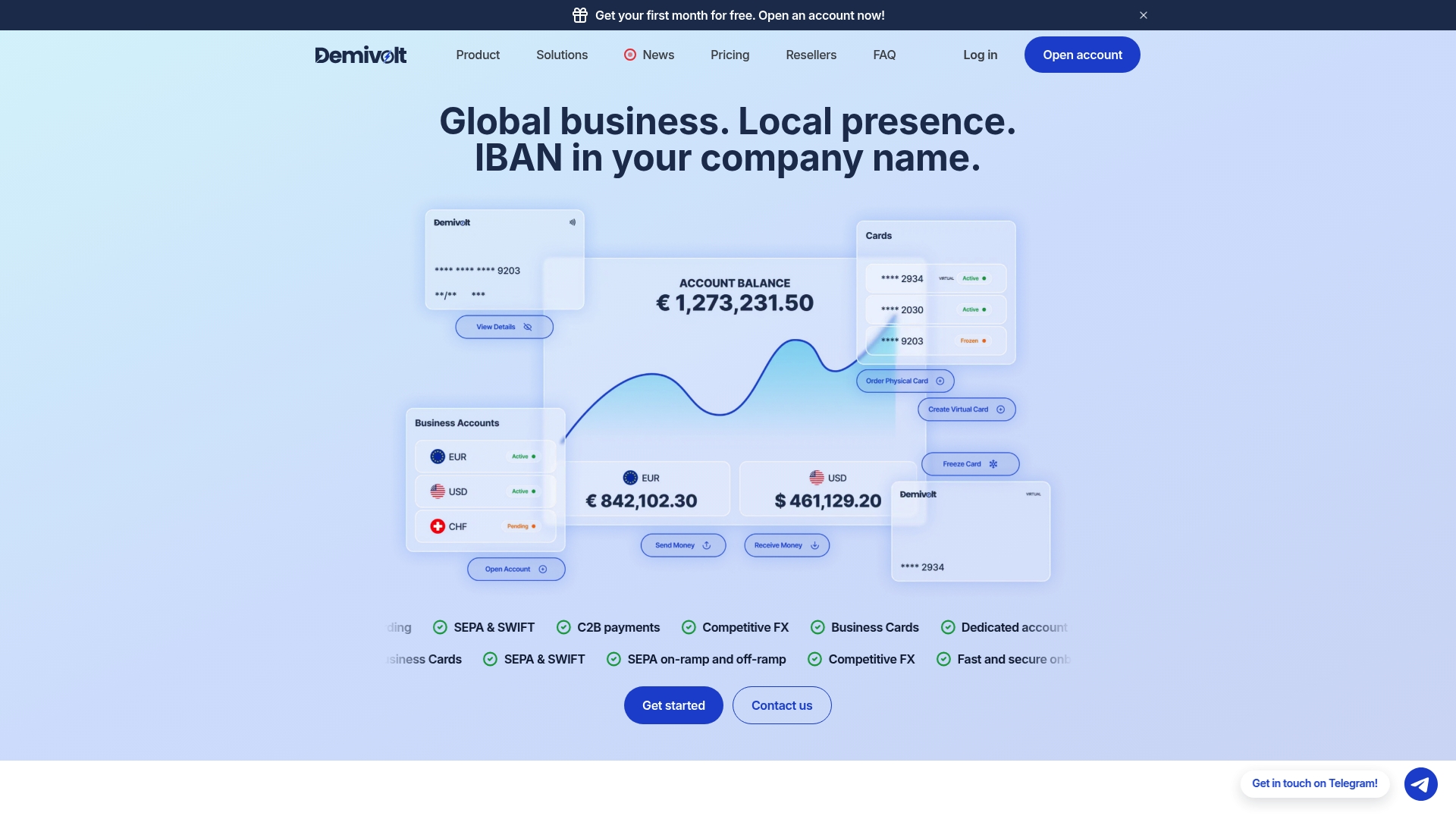
Demivolt is built for exactly that use case. Dedicated IBAN accounts, SEPA and SWIFT payment processing, virtual and physical Visa business cards, and role-based user management come standard. Multi-account structures let your finance team separate operating funds, tax reserves, and payroll without juggling accounts at multiple institutions. Onboarding is digital, compliance-first, and designed to move fast.
If your startup is evaluating cross-border payment infrastructure or needs a regulated account with clean API access, start with Demivolt’s free SEPA tools to validate payment identifiers and test your integration before going live. When you are ready to open an account, the onboarding process requires standard KYC documentation: certificate of incorporation, EIN or equivalent, beneficial ownership details, and director ID verification. Most accounts activate within a few business days of document submission. Visit Demivolt to get started.
Useful resources for further research
- Demivolt free SEPA tools: Validate IBANs, explore SEPA explainers, and test payment identifiers before going live with any integration.
- Demivolt IBAN validator: Free ISO 13616-compliant IBAN checker; use it during vendor integration testing to reduce onboarding errors.
- NerdWallet — Best Banks for Startups 2026: Market-level overview of startup banking categories and “best for” use-case groupings.
- Economico: GAAP-shaped bookkeeping from day one; useful for founders who want investor-ready financials before hiring a finance team.
- Fintoit — The AI CFO platform: AI-driven board reporting and KPI automation; reduces fractional CFO hours for early-stage teams.
This article is general information, not professional financial or legal advice. Confirm current regulatory requirements, fee structures, and deposit insurance arrangements directly with your chosen provider or a qualified financial professional before making decisions for your specific situation.
Recommended
- Demivolt | Blog – How to streamline your digital business banking workflow
- Demivolt | Blog – Online Business Banking Benefits 2026: SME Guide
- Demivolt | Blog – Digital banking checklist: secure cross-border payments
- Demivolt | Blog – Why digital banking empowers SMEs for smarter cross-border finance