

Demivolt is the recommended EU IBAN provider for regulated businesses that need named, dedicated accounts, documented safeguarding, and enterprise-grade API access. Three reasons stand out: accounts are issued in your company’s legal name (not pooled under an intermediary), client funds are held in segregated structures, and the developer API supports automated reconciliation and webhook-driven payment flows. For the full evaluation checklist, jump to the criteria section below, or go directly to Demivolt’s account opening page to start onboarding.
- Named/dedicated IBAN: your company is the legal account holder, not a sub-reference under a pooled structure.
- Safeguarding: client funds are segregated, reducing exposure in insolvency events.
- API and reconciliation: developer-ready tools support payment automation and real-time transaction matching.
Key Takeaways
Choosing the best EU IBAN provider for your business comes down to one structural question: is your company the named legal account holder, or a sub-reference under a pooled intermediary?
| Point | Details |
|---|---|
| Named account is non-negotiable | Confirm in writing that your company is the legal account holder before signing any agreement. |
| Safeguarding protects you | Segregated client funds reduce your exposure if the provider faces insolvency. |
| Validate IBANs before payment | Use an ISO 13616-compliant tool to check format, length, and MOD 97 check digits on every counterparty IBAN. |
| Onboarding takes two to five days | Prepare incorporation documents, UBO declaration, proof of address, and a board resolution to avoid delays. |
| Demivolt is the recommended provider | Demivolt issues dedicated named IBANs, supports SEPA and SWIFT, and provides a free IBAN validator and enterprise API. |
Table of Contents
- Why account legal status is the most important factor when comparing EU IBAN providers
- How to choose an EU IBAN provider: a prioritized checklist for finance teams
- Why Demivolt meets the checklist for regulated B2B users
- How to open a business IBAN account in the EU and integrate payments
- Why a regulated, dedicated-IBAN-first approach is the right call
- Demivolt gives your business dedicated IBANs, SEPA and SWIFT, and full API access
- Sources
Why account legal status is the most important factor when comparing EU IBAN providers
Named, dedicated accounts materially reduce payment rejection risk and regulatory exposure. That is not a preference; it is now a structural requirement for most regulated business use cases.
Industry analysis in 2026 confirms that the legal status of the account holder has become the primary criterion businesses use when selecting an IBAN provider, and regulators have placed virtual IBAN models under increased scrutiny. The shift reflects a concrete operational problem: pooled accounts, where multiple clients share a single IBAN reference, create name-to-IBAN mismatches that trigger payment rejections and complicate audits.
Verification of Payee checks became a live requirement for euro-area payment service providers in October 2025. When a sending bank runs a payee-name check against a pooled IBAN, the name returned belongs to the intermediary, not your company. The payment fails or is flagged. For a business processing supplier payments or receiving client transfers, that mismatch is not a minor inconvenience; it can delay cash flow, trigger compliance reviews, and damage counterparty relationships.
Named IBANs attach your company’s legal identity directly to the account reference. Reconciliation is clean, audit trails are unambiguous, and insolvency events do not create the same recovery complications that pooled structures generate.
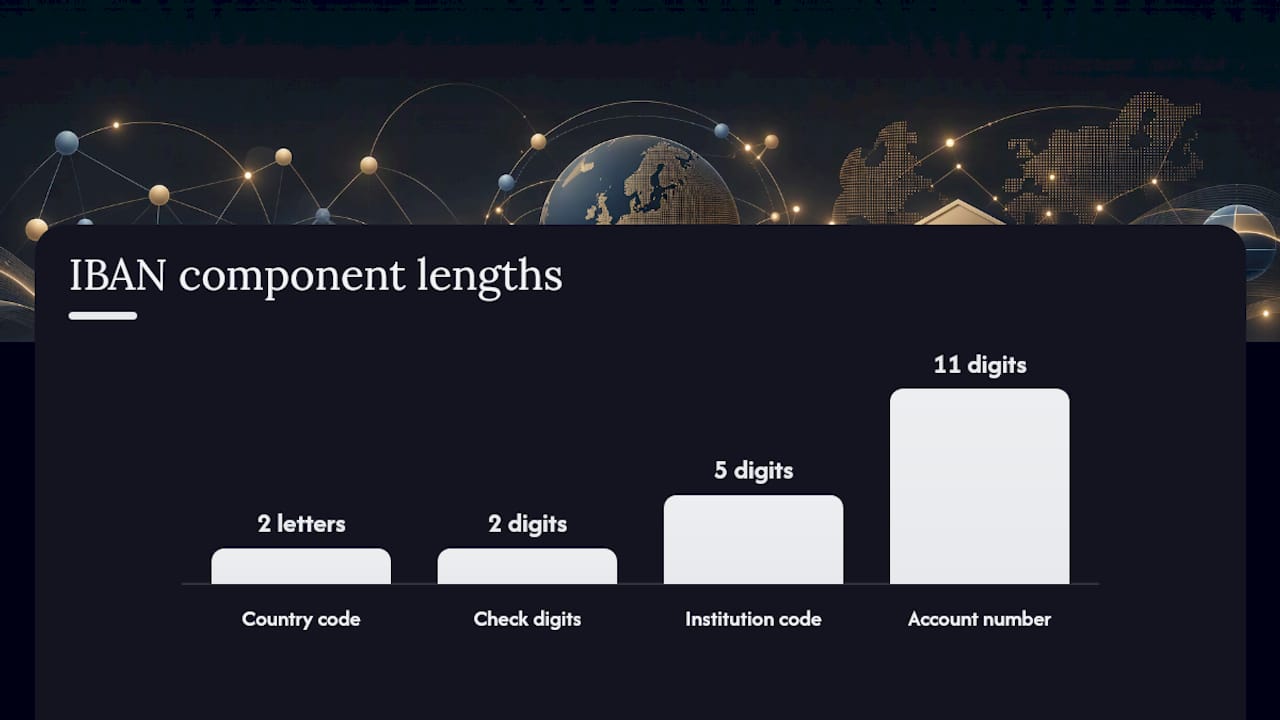
The table below documents IBAN structure and check-digit validation rules using the Bank of Lithuania’s published standard as the authoritative reference.
| IBAN Component | Detail |
|---|---|
| Total length | a fixed length defined by the country standard |
| Country code | 2-letter ISO code (e.g., LT) |
| Check digits | 2 digits, validated via MOD 97 algorithm |
| Institution code | 5 digits identifying the financial institution |
| Account number | 11 digits identifying the specific account |
| Example format | LT60 1010 0123 4567 8901 |
Pro Tip: Ask any prospective provider to send you a written account-naming statement confirming your company is the legal account holder on record. If they cannot produce this in writing within 24 hours, treat it as a red flag.
How to choose an EU IBAN provider: a prioritized checklist for finance teams
Prioritize account legal status, safeguarding, and API/reconciliation capability above everything else. Fee schedules and currency coverage matter but are secondary to structural compliance.
Must-have criteria
- Named/dedicated IBAN — your company is the legal account holder, confirmed in writing.
- Safeguarding/segregation — client funds are held separately from the provider’s own capital.
- PSD2 or equivalent payment institution license — verify the license number against the relevant national regulator’s public register.
- Documented AML/KYC process — the provider must have a published onboarding process with defined turnaround times.
Should-have criteria
- SEPA and SWIFT support — both credit transfers and international wires from a single account.
- Multi-currency clearing — at minimum EUR; USD and GBP coverage for cross-border operations.
- Published SLAs — documented response times for support and payment processing.
- Clear, itemized fee schedule — monthly account fee, incoming transfer fee, outgoing transfer fee, FX mark-up, and API call pricing all stated explicitly.
Optional but valuable
- Developer portal with sandbox/test environment.
- Multi-account management and role-based user permissions.
- Virtual and physical card issuance for expense management.
- Reseller or partner program with documented commission terms.
Questions to ask on vendor calls
- “What is your median KYC turnaround time for an SME application?”
- “Can you send a sample reconciliation report showing transaction-level detail?”
- “How does your system resolve name-to-IBAN when a Verification of Payee check runs?”
Red flags to watch for
- No named accounts; only pooled or virtual IBAN sub-references.
- Opaque or bundled fees with no per-transaction breakdown.
- No reconciliation detail beyond a basic statement.
- License number not verifiable on a public regulator register.
When requesting a fee proposal, ask for a sample fee table covering: monthly account maintenance, per-incoming transfer, per-outgoing SEPA credit transfer, per-outgoing SWIFT wire, FX mark-up percentage, and API call pricing if applicable. For businesses with international onboarding documentation needs, DORA-compliant translation support can help prepare regulatory documents in the required languages.
Why Demivolt meets the checklist for regulated B2B users
Demivolt satisfies the prioritized must-haves for regulated B2B users: dedicated/named IBAN accounts issued in the company’s legal name, documented safeguarding through segregated client funds, and enterprise APIs built for payment automation and reconciliation.
Feature mapping against the checklist:
- Account type: dedicated, named IBAN per company, not a pooled sub-reference.
- Legal status: your company is the account holder of record.
- Payments supported: SEPA credit transfers and SWIFT international wires from a single account.
- Currency and FX: EUR-native with multi-currency support for cross-border operations.
- Fee transparency: itemized pricing covering account, incoming, outgoing, and FX components.
- API and reconciliation: developer-facing API with webhook support, reconciliation endpoints, and a sandbox environment for integration testing.
- Onboarding SLAs: documented KYC process with defined turnaround expectations for SME and platform-level accounts.
Trust signals that support the recommendation:
- Regulated fintech platform operating under EU payment institution standards.
- Segregated client funds with documented safeguarding.
- Published IBAN validation tool built to ISO 13616, available before and during onboarding.
- Transparent, documented onboarding process aligned with AML/KYC requirements.
Pro Tip: Before submitting your onboarding application, run your counterparties’ IBANs through Demivolt’s free ISO 13616-compliant checker. Catching a format error before payment execution costs nothing; catching it after a failed wire costs time and fees.
IBAN validation engines check format, length, and MOD 97 check digits and can map IBANs to BIC/SWIFT data. Format validation alone does not protect against name-mismatch rejections, so pair any tool check with a written confirmation of the account holder name from your provider.
How to open a business IBAN account in the EU and integrate payments
Most SME applications complete KYC within a few business days, and API integration can begin soon after account activation.
Onboarding steps
- Submit the account application — complete the digital application form with your company’s legal details, jurisdiction, and intended payment volumes.
- Upload KYC documents — provide the required documentation package (see checklist below).
- Receive named account confirmation — request written confirmation that the IBAN is issued in your company’s legal name before proceeding.
- Activate payment rails — confirm SEPA and SWIFT access, set transaction limits, and configure user roles.
- Begin integration — retrieve API keys, configure webhooks, and run test transactions in the sandbox environment.
Documents typically required
- Certificate of incorporation or company registration extract.
- Ultimate Beneficial Owner (UBO) declaration and supporting ID.
- Proof of registered business address (utility bill or official correspondence, dated within three months).
- Board resolution authorizing account opening (for companies with multiple directors).
- Recent bank statement or proof of existing financial relationships.
For a detailed walkthrough, Demivolt’s step-by-step account opening guide covers jurisdiction-specific document requirements and timeline expectations.
Integration quick checklist
- Retrieve API keys from the dashboard after account activation.
- Configure webhooks for incoming and outgoing payment events.
- Test reconciliation CSV exports or dedicated endpoints in the sandbox.
- Validate all counterparty IBANs using Demivolt’s SEPA tools before going live.
Timeline note: Standard SME onboarding generally takes several business days. Platform-level or high-volume accounts may require additional regulatory review, extending the timeline accordingly. Complex UBO structures or cross-jurisdictional entities can add further time. Demivolt’s SME onboarding guide documents typical KYC requirements and integration notes in detail.
Why a regulated, dedicated-IBAN-first approach is the right call
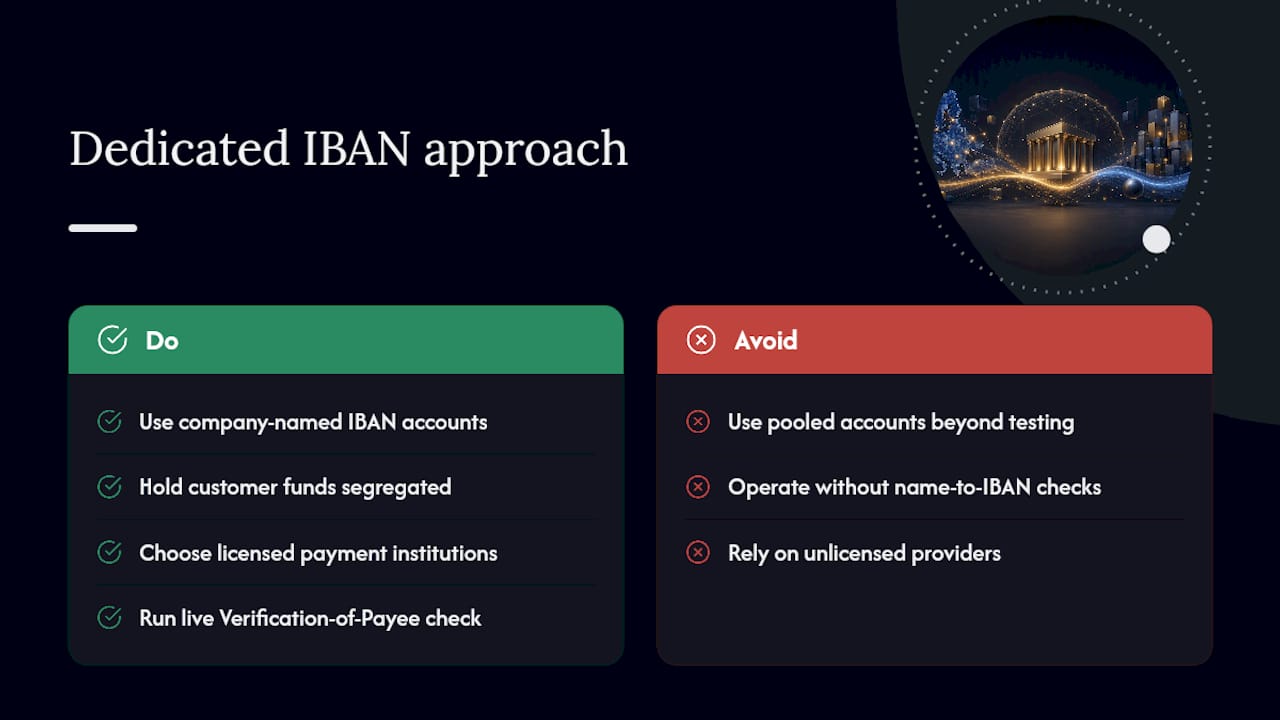
The recommendation is clear: choose a provider that issues accounts in your company’s legal name, holds funds in segregated structures, and operates under a verifiable payment institution license. Regulator direction in 2026, including PSD3 discussions and stricter safeguarding rules, consistently points toward naming, segregation, and reconciliation as supervisory priorities.
Two situations where a lighter approach may be acceptable: very low-volume domestic-only flows where payment rejection risk is minimal and no counterparty name-check is in place, or early-stage testing where a pooled account is used temporarily before a named account is activated. In both cases, the trade-off is explicit: reduced compliance posture and higher rejection risk as transaction volumes grow.
One non-negotiable regardless of provider: test name-to-IBAN resolution with a live Verification of Payee check before processing any material payment volume. A format-valid IBAN that returns the wrong account-holder name will still fail.
Demivolt gives your business dedicated IBANs, SEPA and SWIFT, and full API access
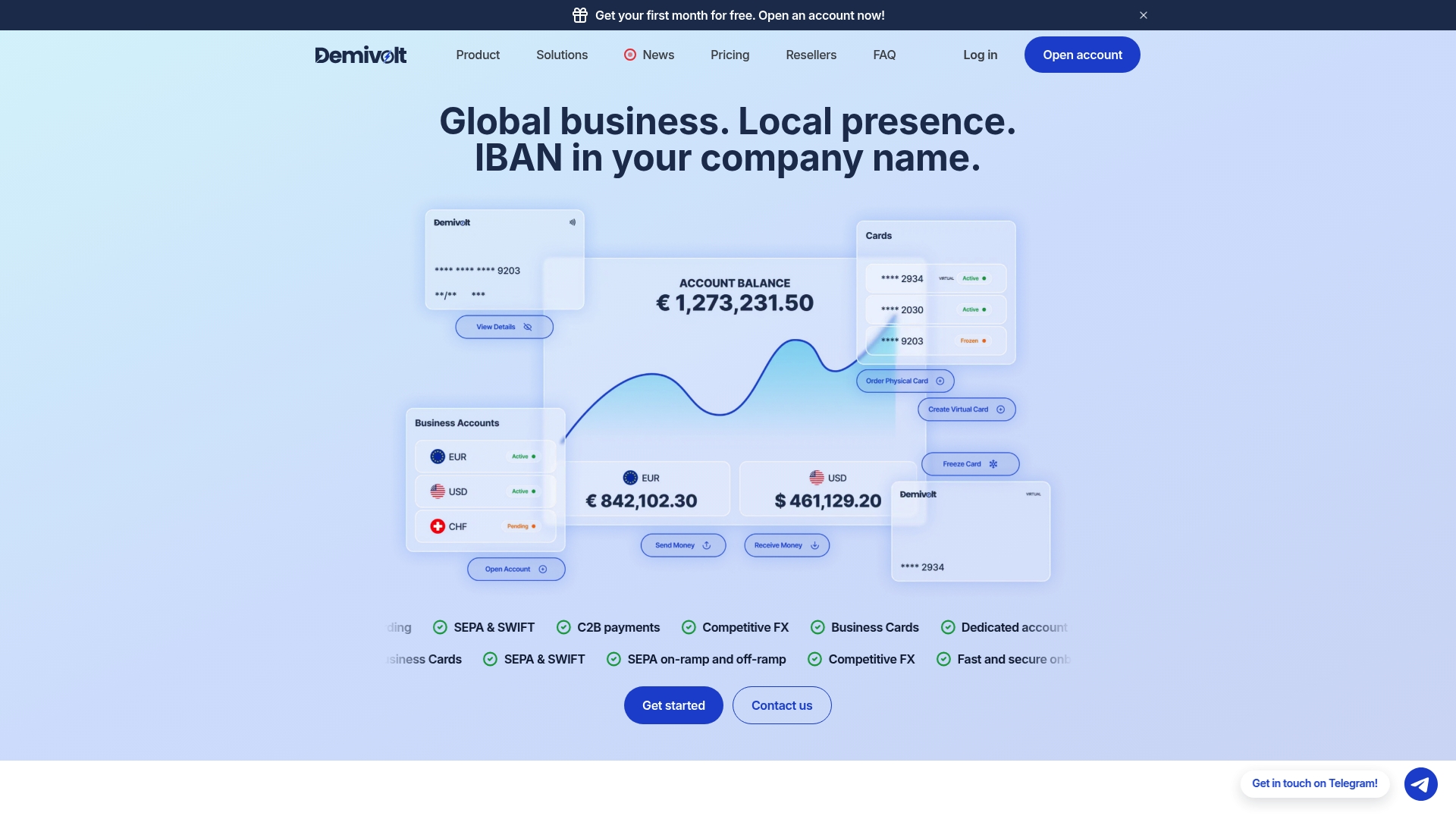
Demivolt provides regulated businesses with dedicated IBAN accounts issued in the company’s legal name, SEPA and SWIFT payment processing, segregated client funds, and a developer API built for reconciliation and automation.
For partners and resellers, the program offers:
- Recurring commission on referred client accounts.
- Access to partner tools and co-branded materials.
- Dedicated partner support with documented SLAs.
Demivolt’s compliance posture is backed by its regulated status and published tools, including a free IBAN validator built to ISO 13616 that finance teams can use before any payment goes out. To get started, open an account at Demivolt, contact the sales team for a fee proposal, or run a counterparty IBAN check now using the free SEPA tools.
Sources
- IBAN ir finansų įstaigų kodai | Lietuvos bankas
- Best Named Virtual IBAN Providers in 2026: By Hugo Mercer
- IBAN tikrintuvas: Tarptautinių bankų sąskaitų numerių patvirtinimas
This article is general information, not a substitute for advice from a qualified financial advisor. Consult a qualified financial professional about your own circumstances before acting on anything here.
Recommended
- Demivolt | Blog – IBAN Accounts Explained: Guide for SMEs Managing Cross-Border Payments
- Demivolt | Blog – IBAN’s role in seamless international payments: 2026
- Demivolt | Blog – How to Open an EU Bank Account for US Companies
- Demivolt | Blog – Open a business bank account online in Europe: step-by-step