

The best banking with roles combines three non-negotiables: templated role-based access control (RBAC), digital dual-authorization on payments, and audit logs that hold up under scrutiny. Look for a regulated, EU-compliant provider that segregates client funds and builds these controls natively into the platform, not as an afterthought. This guide walks through the features to demand, the role templates to start with, and the evaluation checklist to run before you sign anything.
TL;DR:
- Effective role-based banking requires native templated RBAC, digital dual-authorization, and audit logs that auditors can export easily without friction.
- Properly designed roles should follow the principle of least privilege, with layering attributes for multi-division businesses and automatic updates on role changes or departures.
- Regular permission audits, immediate revocation on staff changes, and automated alerts help prevent privilege creep from undermining internal controls.
- Before choosing a provider, test live scenarios for onboarding, role changes, and payment approvals, and verify clear SLA, data retention, and transparent pricing.
- Regulated platforms with native segregation, automation, and API integration significantly reduce operational risks compared to manual controls or bespoke systems.
DemivoltStrengthen Your Banking ControlsDemivolt gives businesses role-based user management, payment controls, and dedicated IBAN accounts through regulated digital banking infrastructure.Explore Demivolt
Table of Contents
- What Is Role-Based Business Banking, and Why Does It Matter?
- What Features Should You Require From a Business Banking Platform With Roles?
- How Do You Design Roles and Permission Policies for Your Team?
- How Often Should You Audit Roles and Monitor Activity?
- What Should You Check Before You Sign With a Banking Provider?
- Why a Regulated Platform Beats a Patchwork of Manual Controls
- How Demivolt Supports Secure Multi-User Business Banking
- Sources
- FAQ
What Is Role-Based Business Banking, and Why Does It Matter?
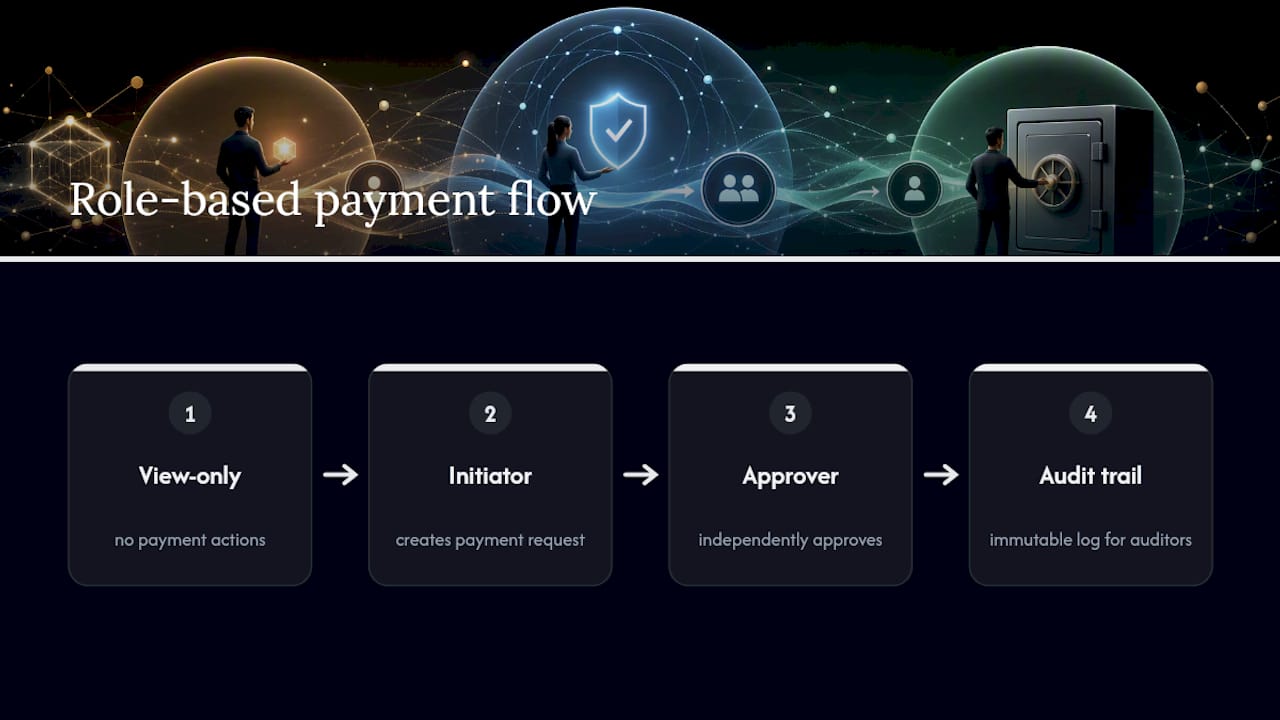
Role-based access control means every user on your business account gets permissions tied to their job function, not a shared login and blind trust. A finance platform with proper RBAC lets you assign templated roles, such as view-only, initiator, approver, and admin, then layer approval workflows on top so no single person can move money alone.
That layering enforces segregation of duties, which is the foundation of internal fraud prevention. When one employee creates a payment and a different employee must approve it, you close the gap where most internal fraud actually happens: a single person with too much unchecked control. This structure pays off operationally, too. Teams with defined roles spend less time on emergency approvals, onboard new hires faster, and hand auditors a clean trail instead of a shared password and a shrug. Vaidmenų valdymas bankininkystėje is not just a compliance checkbox. It is what lets a five-person finance team run controls that used to require a much larger back office.
What Features Should You Require From a Business Banking Platform With Roles?
Not every provider markets “role-based banking,” but the strongest ones build these seven capabilities into the core product rather than bolting them on later.
- Templated RBAC with attribute extensions. Roles like initiator, approver, and admin should be ready out of the box, with the option to layer attributes such as cost center, legal entity, or budget ceiling for multi-division operations.
- Digital dual-authorization on payments. High-value transfers should require a second approver inside the platform itself, not a phone call or an email confirmation after the fact.
- MFA and SSO across every account tier. Every user and every admin, no exceptions, and ideally with device and session controls that flag logins from unrecognized hardware.
- Per-transaction and daily limits, plus card-level controls. Virtual and physical business cards should support spend caps and merchant category blocking at the card level, not just the account level.
- Exportable audit logs with timestamps and device IDs. Auditors need activity reports they can pull on demand, not a support ticket and a week’s wait.
- Multiple IBANs with SEPA and SWIFT support, plus real APIs. Integration with your ERP or accounting stack matters more than most founders realize until the manual reconciliation starts eating a full day a month.
- Automated onboarding and offboarding. Role changes and departures should trigger access updates automatically, not sit in someone’s inbox.
Pro Tip: Ask a prospective provider to show you the audit log export before you ask about pricing. If it takes more than a few clicks to produce, your auditors will feel that friction every quarter.
How Do You Design Roles and Permission Policies for Your Team?
Building a role structure is not a one-time setup task. It is a framework you revisit as your team grows.
- Map your finance processes first. List accounts payable, receivable, payroll, and reconciliation, and identify exactly which actions each process requires: viewing, initiating, approving, or administering.
- Apply the principle of least privilege. Give every user the minimum access their role needs, and keep permanent admin rights limited to a small, named group. Guidance on adding authorized users to business accounts consistently points to documented roles and periodic review as the baseline for containing risk.
- Build starter role templates. A view-only role for bookkeepers, an initiator role for AP staff, an approver role for department heads, and an admin role for the CFO or founder, each with clear transaction thresholds attached.
- Layer attributes for complexity. Multi-entity or multi-division businesses should add cost center, legal entity, or budget tags on top of the base role, which lets RBAC scale without creating a new role for every combination.
- Time-bound contractor access. Set expiration dates on temporary users and revoke access immediately on exit, not at the next quarterly review.
Done properly, this process turns role-based access control from a technical exercise into a working policy document your whole finance team can follow.
How Often Should You Audit Roles and Monitor Activity?
Role structures decay over time. Employees change jobs, projects wind down, and permissions that made sense in January quietly become a liability by summer. That drift, often called privilege creep, is the reason a defined audit cadence matters as much as the roles themselves.
- Run a full permission audit regularly, and immediately after staff departures, promotions, or reorganizations.
- Set automated alerts for role changes, unusual transaction patterns, and any payment above your defined high-value threshold.
- Retain logs long enough to satisfy your auditors, and make sure they export cleanly against your ERP records.
- When something looks wrong, follow a fixed sequence: revoke access first, investigate second, document everything, then restore only the minimum access needed to keep operations running.
- Restrict who can add or remove users to a named short list, and require a documented approval for every change.
Quarterly reviews paired with immediate revocation on staff changes are the recommended cadence for containing the kind of privilege creep that quietly undermines otherwise solid controls. Platforms with built-in RBAC and activity logging also improve accountability by giving auditors a continuous record instead of a periodic snapshot.
What Should You Check Before You Sign With a Banking Provider?
Before committing, put the provider through the same test you’d run on any critical piece of finance infrastructure.
- Ask direct questions. Does the platform support native digital dual-authorization, exportable audit logs, MFA and SSO, prebuilt role templates, open APIs, and a defined onboarding SLA?
- Run live test scenarios. Simulate a new-user onboarding, a mid-cycle role change, a high-value payment requiring two approvers, and a full log export, and time each one.
- Read the contract for these specifics. Segregated client funds, clear data retention and export terms, and stated SLAs for onboarding and incident response.
- Confirm the full pricing picture. Ask what additional IBANs, card issuance, per-user access, and international transfers actually cost before you assume the headline price is the whole story.
Why a Regulated Platform Beats a Patchwork of Manual Controls
Most SMEs do not lack the discipline to enforce segregation of duties. They lack a platform that makes it automatic. Manual dual-signature processes and spreadsheet-tracked permissions work until the day someone is on vacation and a payment needs to go out anyway, and that is exactly when controls quietly get skipped.
A regulated banking platform with segregated accounts and native role templates removes that pressure point. It also does the unglamorous work of onboarding automation and API integration that saves finance teams real hours every month. The trade-off is real: bespoke on-premises systems can be tuned more precisely to a single company’s workflow. For most growing businesses, though, a platform built for integration and automated onboarding outweighs that flexibility with speed and lower operational risk.
— dd
How Demivolt Supports Secure Multi-User Business Banking
Demivolt is the practical alternative to stitching together manual approval chains and spreadsheet permission trackers. Instead of relying on email confirmations for a second signature, you get role-based user management built into the account from day one.
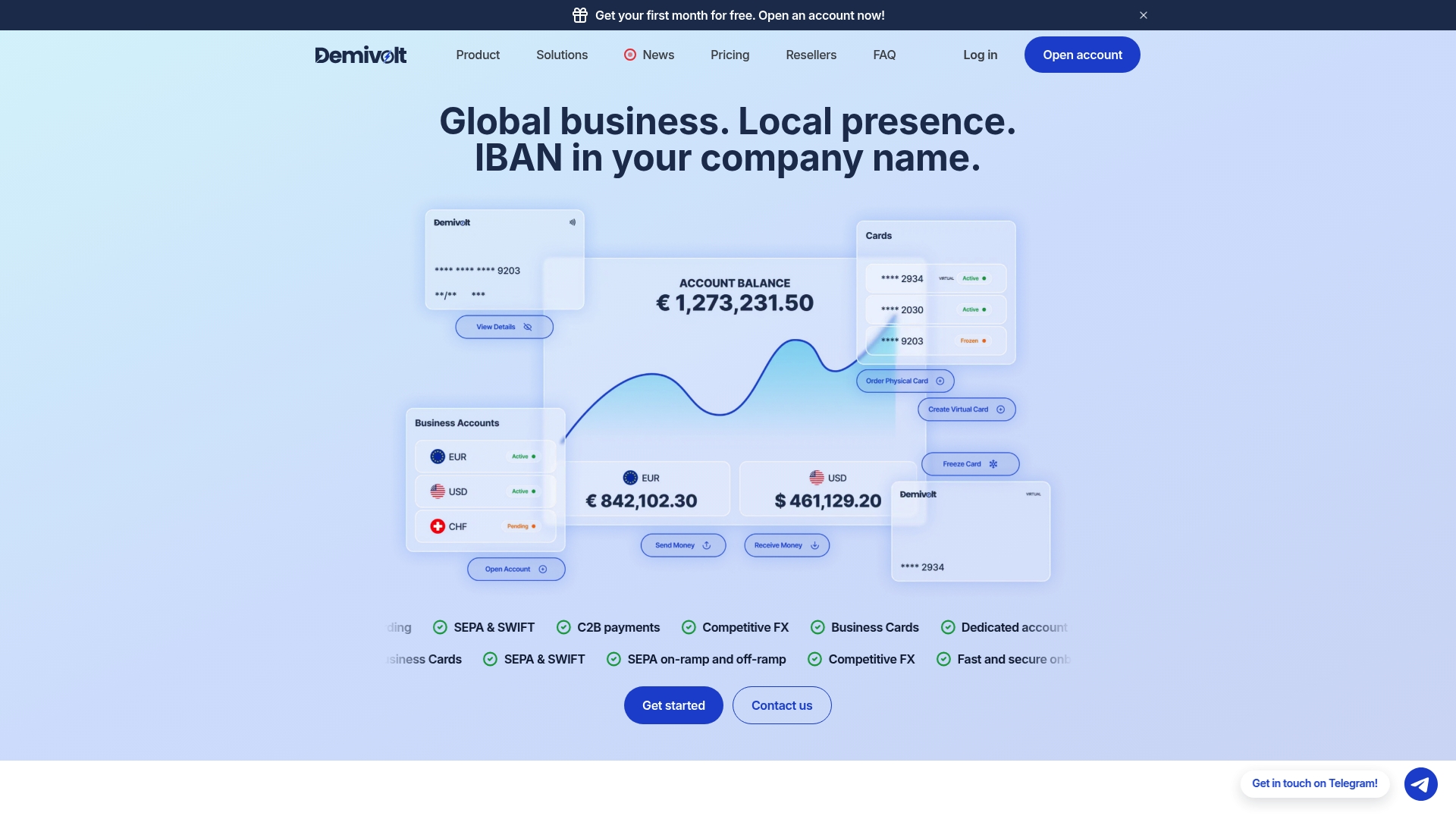
The platform matches the checklist this guide just walked through:
- Templated roles across your finance team, with permissions tied to job function rather than shared logins.
- Multiple dedicated IBANs alongside SEPA and SWIFT support, so cross-border payments do not require a separate provider.
- Virtual and physical business cards with spend controls at the card level.
- Automated onboarding, so new users get access in hours, not days of manual setup.
- Segregated client funds, held under EU regulatory standards, so your operating cash stays protected regardless of platform risk.
If your finance team is still relying on shared credentials and manual sign-off chains, start by opening a business account with role-based controls built in, or review the payments infrastructure to see how SEPA and SWIFT transfers fit into your existing approval workflow.
This article is general information, not a substitute for advice from a qualified financial advisor. Consult a qualified financial professional about your own circumstances before acting on anything here.
Sources
- Lithuania regulation: cybersecurity requirements — Advisera
- Intelligent ERP integration with RBAC — International Review (2026)
- Safely adding authorized users to business bank accounts — Catalyst Legal
FAQ
What Does “Banking With Roles” Actually Mean?
It means a business account where each user’s permissions match their job function, controlled through RBAC rather than a single shared login. Demivolt builds this in through templated role-based user management rather than requiring manual workarounds.
How Often Should We Review User Permissions?
Run a full permission audit every quarter, plus an immediate review whenever someone changes roles or leaves the company. This cadence is the standard recommended containing privilege creep before it becomes a real exposure.
Is Dual-Authorization Required by Law?
Dual-authorization is not universally mandated by law, but it is widely treated as a core control against internal fraud because it stops one person from both creating and approving the same payment. Regulators and security practitioners consistently recommend it as best practice for any account with multiple authorized users.
What Should Be in a Vendor RFP for Role-Based Banking?
Ask about native dual-authorization, exportable audit logs, MFA and SSO support, prebuilt role templates, API access, and documented onboarding SLAs. Follow up by running a live test, such as a simulated high-value payment requiring two approvers, before you sign anything.
Does Demivolt Charge Extra for Multi-User Access?
Demivolt does not publish a separate fee for role-based user management, and no fees for account opening, verification, or monthly maintenance are listed. Payment fees such as outgoing SEPA transfers are billed per transaction, and current pricing details are available directly on the Demivolt site.