

Most small businesses should run several business bank accounts depending on payroll, revenue complexity, and balance size. A solo freelancer can operate cleanly with two accounts. A small business with employees typically needs three. A growing SME with multiple revenue streams or a large cash reserve often has multiple accounts, according to LegalClarity.
There’s no law capping how many accounts a business can hold. The real limit is administrative: every account you add needs a purpose, a transfer rule, and someone responsible for reconciling it. Here’s the quick shortlist before we unpack the reasoning:
- Minimum (2 accounts): Operating account plus a tax reserve account. Works for solo operators and pre-revenue startups.
- Recommended (3 accounts): Add a dedicated payroll account once you hire your first employee.
- Growth tier (4–5 accounts): Add a profit or reserve account and a separate account for a second revenue stream, product line, or currency.
Exceptions exist. Regulated businesses (law firms, real estate brokers, fintechs) often must hold segregated client funds by professional or legal requirement, according to TET’s guidance on regulated-sector accounting. And any business carrying more than $250,000 in reserves should think about splitting balances across separate banking institutions, since FDIC insurance protects deposits per depositor, per bank, not per account.
Key Takeaways
Most small businesses operate best with two to five business bank accounts, scaling account count to payroll obligations, revenue complexity, and reserve balance size.
| Point | Details |
|---|---|
| Start with two accounts | Operating and tax reserve cover solo operators and pre-revenue businesses. |
| Add payroll at three | Once you hire your first employee, separate payroll from operating cash immediately. |
| Watch the $250,000 threshold | FDIC insurance applies per depositor per bank, so diversify institutions as reserves grow. |
| Automate before adding accounts | Scheduled transfers and sweep rules keep multi-account setups manageable without extra admin. |
| Use the trigger checklist | Add or close accounts based on hiring, revenue streams, or balance size, not guesswork. |
| Demivolt supports multi-IBAN setups | Demivolt offers dedicated IBANs, role-based access, and automated transfers for structured multi-account banking. |
Table of Contents
- How Many Business Bank Accounts Should You Actually Have?
- Why Separating Your Money Actually Helps
- Practical Account Setups by Business Type
- The Account Types Every Business Should Know
- Managing Multiple Accounts Without the Extra Admin
- What Multiple Accounts Actually Cost You
- How to Open Additional Business Accounts
- When to Add or Close an Account
- Your Quick Decision Checklist
- How Digital-First Banking Platforms Simplify Multiple Accounts
- What Most Owners Get Wrong About Account Count
- Get Your Multi-Account Structure Running in Days, Not Weeks
- Frequently Asked Questions
- Sources
How Many Business Bank Accounts Should You Actually Have?
The number that matters isn’t a round figure. It’s whatever count lets you answer three questions without opening a spreadsheet: How much cash do I actually have to spend? Is payroll covered next Friday? How much do I owe in taxes right now? For most small businesses, that takes between two and five accounts.
Two accounts is the floor. One handles all incoming and outgoing operating cash, and one sits untouched as a tax reserve. Below that floor, you’re mixing tax money with rent money, and that’s how owners end up scrambling in April.
Five accounts is a practical ceiling for most SMEs before returns start to shrink. Beyond that point, reconciliation time grows faster than the clarity you gain. A business bookkeeper managing eight or nine accounts for a company doing modest revenue is usually solving a problem that better transfer automation could fix instead.
Can a business have two bank accounts and stop there? Yes, and for many solo consultants and freelancers, two is exactly right. Can a business have two bank accounts at two different banks instead of one? Also yes; there’s no rule requiring accounts to sit at the same institution, and spreading balances across banks is often the smarter move once your reserve balance climbs.
Why Separating Your Money Actually Helps
The benefit of multiple accounts isn’t organization for its own sake. It’s that separated money forces separated decisions, and separated decisions are harder to get wrong.
- Cash-flow visibility. When revenue, operating expenses, payroll, and tax money sit in one account, your balance tells you nothing useful. Split them, and your operating account balance becomes an honest number: money you can actually spend.
- Deposit protection. Spreading reserves across institutions keeps you under FDIC insurance thresholds at each bank rather than concentrating risk in one place.
- Cleaner bookkeeping. Reconciliation gets dramatically easier when each account has one job. Your accountant can trace a transaction to its category just by knowing which account it hit, which cuts down on common bookkeeping errors like miscategorized tax withholdings.
- Fraud detection. A payroll-only account that suddenly shows an unfamiliar outbound wire is a five-second red flag. The same wire buried in a general operating account with hundreds of monthly transactions might not surface for weeks.
Pro Tip: Keep your payroll account funded a few days ahead of each pay run, separate from operating cash. If a client payment is late or a vendor invoice hits harder than expected, your team still gets paid on time. That single account can be the difference between a bad week and a payroll crisis.
Silicon Valley Bank’s 2023 collapse turned an abstract risk into a concrete lesson for thousands of businesses overnight: companies holding all their operating cash and payroll reserves at one bank found themselves unable to run payroll within days, regardless of how healthy their balance sheet looked on paper.
That single event did more to popularize cross-bank diversification advice than a decade of banking blog posts combined. Compare that scenario to a business that already split payroll into its own account at a second bank. Same crisis, same headline, but payroll clears on schedule.
Practical Account Setups by Business Type
Your business’s complexity, not its age or size in employees alone, determines how many accounts make sense. Here’s how that breaks down in practice.
- Solo freelancer or single-owner LLC. Two accounts: one operating account for all income and expenses, one tax reserve account funded automatically at 25 to 30% of every deposit.
- Small business with employees. Three accounts: operating, tax reserve, and a dedicated payroll account funded a few days before each pay date.
- Growing SME with multiple revenue streams. Four accounts: operating, tax reserve, payroll, and a profit or reserve account that captures a fixed percentage of monthly revenue for reinvestment or a rainy-day cushion.
- Payroll-heavy or high-balance business. Five accounts, often across two banks: operating, tax reserve, payroll, profit/reserve, and a second operating account at a separate institution once balances approach the $250,000 FDIC threshold.
Some owners map this structure to the Profit First method, developed by Mike Michalowicz, which allocates every dollar of revenue into separate accounts (income, profit, owner’s pay, tax, operating expenses) the moment it arrives rather than waiting until month-end to divide it up. It’s not mandatory, but it gives the tier system above a concrete allocation rule instead of a vague “move money when you remember to” habit.
A quick monthly snapshot for the SME tier might look like this:
- Operating account receives $40,000 in customer payments.
- 30% ($12,000) sweeps automatically to the tax reserve account.
- 10% ($4,000) sweeps to the profit/reserve account.
- Payroll account is topped up separately based on your actual payroll run, not a percentage.
The Account Types Every Business Should Know
Each account type solves a specific problem. Confusing their purposes is the fastest way to end up back at one account doing five jobs poorly.

Operating account handles day-to-day income and expenses. This is where customer payments land and where you pay vendors, software subscriptions, and rent.
Tax reserve account holds money set aside for income tax, sales tax, and payroll tax obligations.
Payroll account exists solely to fund employee wages and withholdings. Keeping it separate from operating cash means a slow month doesn’t put payroll at risk.
Naming conventions matter more than people expect. Label accounts by function, not by number: “Tax Reserve,” “Payroll,” “Operating” rather than “Business Checking 2.” When your accountant or bookkeeper opens the online banking dashboard, the names alone should tell the story of your business’s cash flow. Explore common account types built for different SME needs if you want deeper templates.
| Account Type | Primary Use | Sample Rule of Thumb |
|---|---|---|
| Operating | Daily income and expenses | Keep 1–2 months of operating costs as a buffer |
| Tax Reserve | Income, sales, and payroll tax | 25–30% of net monthly sales |
| Payroll | Employee wages and withholdings | Funded 2–3 days ahead of each pay date |
| Profit/Reserve | Reinvestment and cash cushion | 5% to 10% of monthly revenue |
Merchant or payment-processor balances (from card processors or e-commerce platforms) should route directly into your operating account on a fixed schedule rather than sitting in a processor’s holding balance, which isn’t FDIC-insured the way a bank deposit is.
Managing Multiple Accounts Without the Extra Admin
The administrative fear that stops owners from adding accounts is usually overblown once automation is in place. Manual tracking is the actual burden, not the number of accounts.
- Set up scheduled transfers that move fixed percentages from your operating account to tax reserve and profit accounts every time revenue arrives.
- Use sweep rules so end-of-day balances above a threshold automatically shift into a reserve or interest-bearing account.
- Connect accounts to your accounting software so transactions categorize themselves by account rather than requiring manual tagging.
- Standardize naming and tagging across every account and every connected card so reconciliation takes minutes, not hours.
- Confirm which team member owns each account (owner, bookkeeper, controller).
- Set approval thresholds for transfers above a set dollar amount.
- Review access permissions quarterly, especially after any staffing change.
- Reconcile every account monthly against your accounting software, not just the primary operating account.
Pro Tip: Build a one-page governance sheet listing who has login access to each account, who can approve transfers above a set dollar threshold, and who reconciles which account. It takes twenty minutes to create and saves hours of confusion the first time someone leaves the company. Role-based access controls make this dramatically easier to enforce than shared logins ever will.
What Multiple Accounts Actually Cost You
Every account carries a real cost, even the “free” ones. Monthly maintenance fees, per-transaction charges, and incoming or outgoing wire fees add up faster across five accounts than across one. The math that matters: does the account save you more in clarity, tax accuracy, or fraud prevention than it costs in fees each month? For a tax reserve account, the answer is almost always yes. For a fifth account tracking a minor side project, it might not be.
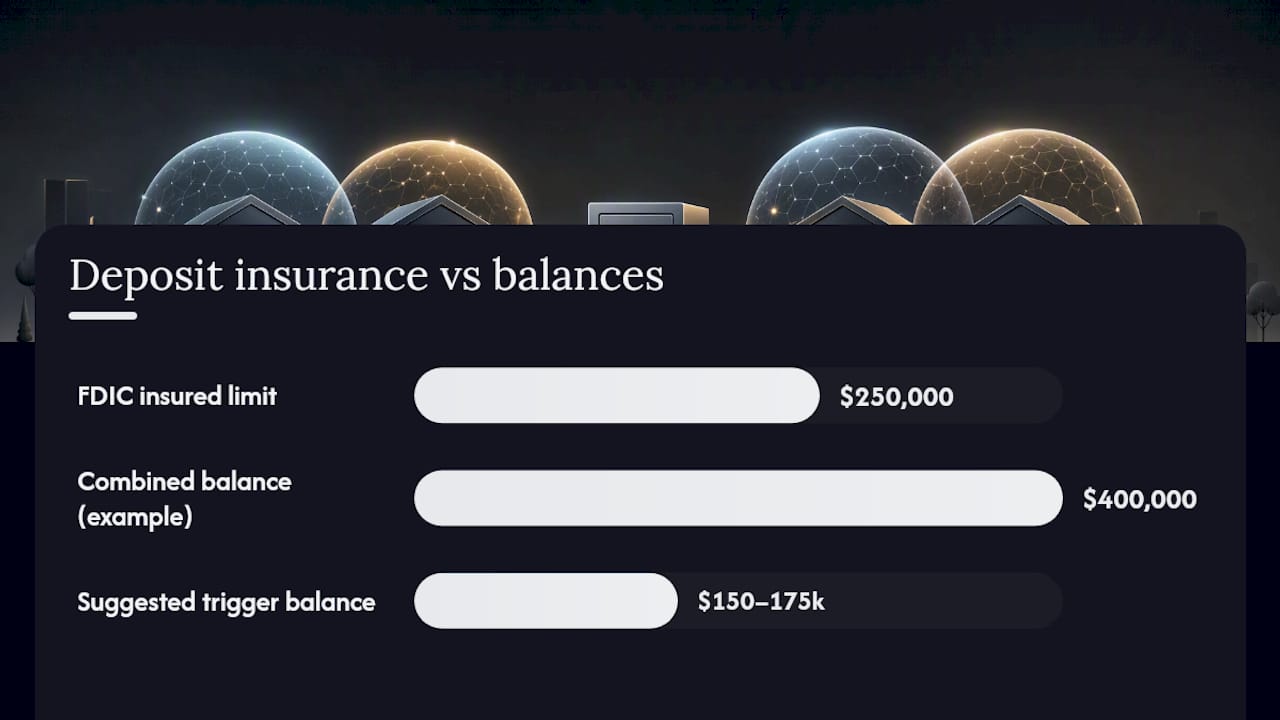
Deposit insurance is where owners most often get confused. The FDIC insures deposits up to $250,000 per depositor, per insured bank, per ownership category. That protection applies to you as a depositor at that bank, not to each individual account you hold there.
Opening a second checking account at the same bank does not double your coverage. Insurance is calculated per depositor, per institution, according to the Lithuanian deposit guarantee scheme, which applies the same aggregation logic used across most European deposit protection frameworks. If you’re holding $400,000 in reserves at one bank across three accounts, only $250,000 of it carries deposit insurance. You can check any U.S. institution’s insurance status directly through the FDIC’s EDIE data tool.
The practical fix is diversification across institutions, not more accounts at the same bank. Once your combined balance at a single bank approaches the insured threshold, opening a second operating or reserve account at a different institution is the move that actually reduces risk.
Pro Tip: If your reserves are climbing toward six figures, don’t wait until you cross $250,000 to act. Open the second bank relationship at $150,000 to $175,000, so the account is already active, funded, and tested before you need it.
How to Open Additional Business Accounts
Opening your second, third, or fifth account is more paperwork than your first, but it follows a predictable path. Banks want to see a clear business purpose for each account, not just a request to “open another one.”
- Gather documentation. Most banks require your EIN, formation documents (articles of incorporation or organization), ownership identification, and a list of authorized signers.
- State the account’s purpose. Banks and compliance teams respond better to “this account will hold payroll reserves for eight employees” than to a vague request for an additional account.
- Complete identification and AML checks. Every new account triggers fresh Know Your Customer verification under laws like the Bank Secrecy Act, even if you’re an existing customer at that bank.
- Wait for verification and funding. Expect anywhere from same-day approval for digital-first platforms to one to two weeks for traditional banks running manual compliance reviews.
- Activate cards and credentials. Virtual cards often activate immediately; physical cards typically arrive within five to ten business days.
Bring a simple checklist to your bank or your online application: EIN confirmation letter, formation documents, government ID for each signer, and a one-paragraph explanation of the account’s purpose. This preparation alone speeds up account verification more than any other single step.
Pro Tip: If a bank denies or delays a new account request, ask specifically what documentation triggered the hold. Compliance teams often just need one missing piece, like an updated operating agreement, rather than a fundamental problem with your application.
When to Add or Close an Account
Account decisions should follow operational triggers, not gut feeling. Here are the signals worth acting on.
Add an account when:
- You hire your first W-2 employee (add payroll).
- You launch a second product line or revenue stream with different margins or tax treatment.
- Your reserve balance at one bank approaches $250,000.
- A regulator or professional body requires segregated client funds.
Close or consolidate an account when:
- It’s had zero or near-zero activity for three or more consecutive months.
- Its original purpose now overlaps with another account you already maintain.
- Monthly fees exceed the practical value it provides.
- Notify your bookkeeper or accountant before making any change.
- Move recurring payments (vendor auto-pay, payroll deposits) to the replacement account first.
- Leave the old account open with a small buffer for 60 to 90 days to catch any missed transactions.
- Close the account only after two full statement cycles show zero unexpected activity.
Pro Tip: Never close an account the same week you’re running payroll or paying quarterly taxes. Time account changes for slower weeks, and always keep the closing account open with a buffer until you’ve confirmed every automated payment has migrated.
Your Quick Decision Checklist
Answer these questions in order, and you’ll land on a sensible starting account count in under five minutes.
- Do you have employees on payroll? If yes, you need a dedicated payroll account. If no, skip to question 2.
- Do you collect sales tax or owe regular payroll tax withholdings? If yes, add a tax reserve account.
- Does your reserve balance exceed $250,000 at one bank? If yes, open a second banking relationship at a different institution.
- Do you run more than one distinct revenue stream or product line? If yes, consider a separate account per stream for cleaner reporting.
- Answered “no” to all four: Two accounts (operating and tax reserve) is your setup.
- Answered “yes” to payroll only: Three accounts.
- Answered “yes” to payroll and multiple revenue streams: Four to five accounts.
- Answered “yes” to the balance question: Add a second bank regardless of your other answers.
Next steps: open the account that matches your trigger this week, set up one automated transfer rule, update your accounting software’s chart of accounts, and confirm payroll deposits route through the correct account before your next pay run.
How Digital-First Banking Platforms Simplify Multiple Accounts
The administrative burden that used to make owners avoid opening a third or fourth account has largely disappeared with digital-first banking infrastructure. Platforms built for SMEs now offer multi-IBAN account structures under one login, role-based access so your bookkeeper sees only what they need, and automated sweep rules that move money between accounts without a manual transfer every time revenue lands.
- Multi-account support under a single dashboard, so you’re not logging into four separate bank portals to check balances.
- Segregated account structures that keep client or reserve funds legally and operationally separate.
- Role-based user management so an employee, bookkeeper, or accountant gets exactly the access level their job requires.
- API integrations that connect directly to accounting software, eliminating manual transaction entry.
- Automated transfer and sweep rules that execute your tax reserve or profit allocation percentages the moment a payment clears.
Pro Tip: Before adding a fourth or fifth account through a traditional bank, check whether a digital-first platform can give you the same account separation under one login with automated transfers already built in. It often cuts your monthly reconciliation time by more than half.
A business running five separate accounts across two traditional banks used to mean five logins, five statements, and a bookkeeper manually copying balances into a spreadsheet every week. The operational cost of that setup, not the number of accounts itself, is what digital-first platforms are built to eliminate.
Demivolt provides exactly this kind of infrastructure, with dedicated IBANs, role-based access, and automated transfer capabilities designed for exactly this multi-account use case, alongside free tools like the Demivolt SEPA tools suite for validating transfers before they go out.
What Most Owners Get Wrong About Account Count
The mistake I see repeated most often isn’t having too few accounts. It’s overcomplicating the structure before the business has earned the complexity. A solo consultant billing $80,000 a year doesn’t need five accounts; they need two accounts and a disciplined transfer rule that actually gets followed every month. Complexity added ahead of need just becomes another spreadsheet nobody updates.
The opposite mistake, though, is more dangerous: under-protecting payroll. Owners will happily split out a “marketing account” or a “software subscriptions account” while leaving employee wages sitting in the same pool as everything else. If cash gets tight, payroll should be the last thing touched, and the only way to guarantee that is to make it structurally separate from day one.
Start with the floor, two accounts, and add complexity only when a real trigger shows up: your first hire, a second revenue stream, a balance that’s crossing insurance thresholds. Automate the transfers so the structure runs itself instead of demanding your attention every week. That’s the difference between account structure as a tool and account structure as a chore.
Get Your Multi-Account Structure Running in Days, Not Weeks
Demivolt is built for exactly the account structure this article walks through: dedicated IBANs for operating, payroll, tax reserve, and profit accounts, all under one login with role-based access for your bookkeeper or accountant.
Instead of juggling logins across multiple traditional banks to hit the deposit-insurance diversification this article recommends, Demivolt lets you open additional dedicated IBAN accounts within a single regulated platform and set automated sweep rules between them the same day you open them. Before your first transfer between accounts, run the receiving IBAN through the free IBAN Validator to catch formatting errors before money moves. If you’re ready to set up your operating, payroll, and reserve accounts properly, start your application with Demivolt today.
Frequently Asked Questions
How many bank accounts should a business have? Most small businesses do well with two to five accounts: an operating account and a tax reserve at minimum, with payroll and profit/reserve accounts added as the business grows.
Can a business have two bank accounts? Yes. Two accounts, one operating and one tax reserve, is a common and sufficient setup for solo operators and freelancers with no employees.
Can a business have 2 bank accounts at different banks? Yes, there’s no requirement that business accounts sit at the same institution. Splitting accounts across banks is standard practice once reserve balances approach FDIC insurance thresholds.
Is there a limit on how many business bank accounts I can open? There’s no legal cap. Practical limits come from bank policies, compliance requirements, and how much administrative work you’re willing to manage.
Does opening a second account at the same bank increase my deposit insurance coverage? No. FDIC insurance and similar European deposit guarantee schemes apply per depositor, per bank, not per account, so a second account at the same institution doesn’t add coverage.
Sources
- FDIC — Deposit Insurance FAQ
- Deposit guarantee scheme of Lithuania
- How many business checking accounts should I have? - LegalClarity
- How many business bank accounts can you have? - KTVZ/Stacker
Deposit insurance rules and account regulations vary by country and change over time. Confirm current limits with your bank or the deposit guarantee authority in your jurisdiction, and consult an accountant for guidance specific to your tax situation.
Recommended
- Demivolt | Blog – Types of Business Bank Accounts: Find the Right Fit for Your SME
- Demivolt | Blog – Online Business Multi-Account Use Cases: 2026 Guide
- Demivolt | Blog – How to manage multiple accounts: A step-by-step guide for SMEs
- Demivolt | Blog – Multi-Account Structure Examples for SMEs and E-Commerce