

TL;DR:
- U.S. companies should prioritize international accounts with clear regulatory licensing, named IBANs, and transparent FX costs. Demivolt, Wise Business, Airwallex, Revolut, Payoneer, and Chase Bank each serve different business needs, from high-volume payouts to full-service banking. Proper evaluation of provider regulations, fee structures, and compliance requirements can reduce operational risks and tax reporting burdens.
For U.S. companies operating across borders, the strongest shortlist for international business bank accounts in 2026 is: Demivolt (regulated European fintech, dedicated IBANs, SEPA & SWIFT, segregated funds), Wise Business (transparent mid-market FX, local receiving details), Airwallex (high-volume cross-border payouts), Revolut (card programs and expense management), Payoneer (marketplace and payout networks), and Chase Bank (full-service incumbent with correspondent banking). The single most important selection criterion is the combination of FX cost, named local receiving accounts, and confirmed U.S. availability with clear regulatory licensing.
- Multi-currency invoicing and European payments: Demivolt and Wise Business both provide named IBANs and SEPA access. Named IBANs are increasingly required by European counterparties, and pooled IBANs are sometimes rejected outright.
- High-volume cross-border payouts or marketplace operations: Airwallex and Payoneer offer the deepest payout rails and platform integrations.
- Card programs and expense management: Revolut leads on integrated card workflows; Demivolt also issues virtual and physical Visa cards with role-based controls.
- Relationship banking with a major U.S. institution: Chase Bank remains the default for businesses that need in-branch services and a global correspondent network.
The comparison table is in the next section. U.S. companies should also be aware that holding or transacting through foreign accounts triggers IRS, FBAR (FinCEN Form 114), and FATCA reporting obligations — covered in detail in the tax and compliance section below.
Table of Contents
- Which international business bank accounts compare best side by side?
- Provider profiles: what each platform actually offers U.S. businesses
- How should you evaluate FX pricing, rails, and receiving accounts?
- How do you choose the right international business account for your U.S. company?
- What does cross-border banking actually cost?
- What does it take to open an international business account from the U.S.?
- U.S. tax and reporting obligations for foreign and multi-currency accounts
- How we evaluated these providers
- Key Takeaways
- What U.S. businesses get wrong when choosing international accounts
- Demivolt: regulated IBAN accounts and payment infrastructure for U.S. businesses
- Useful sources and further reading
Which international business bank accounts compare best side by side?
A multicurrency account holds balances in multiple currencies under one relationship, letting businesses invoice, receive, convert, and pay without opening separate foreign accounts. The table below maps each provider against the dimensions that matter most to finance leaders at U.S. companies.

| Provider | Best for | Currencies / multi-currency | Local receiving accounts | FX pricing model | Transfer rails & speed | Monthly / transaction fees | Card issuance | Integrations / API | Onboarding & U.S. availability | Regulatory status |
|---|---|---|---|---|---|---|---|---|---|---|
| Demivolt | SMEs and fintechs needing regulated IBANs, card programs, and BaaS infrastructure | Multi-currency balances; EUR-primary | Dedicated named IBANs (EUR); SWIFT inbound | Transparent fee-based; no hidden spread disclosed publicly | SEPA, SWIFT; standard SEPA 1 business day | Account and transaction fees (contact for schedule) | Virtual & physical Visa cards; role-based controls | API-ready; multi-account structures; BaaS | Remote onboarding; EU-regulated; U.S. companies accepted | EU-regulated EMI; segregated client funds |
| Airwallex | High cross-border transaction volumes; platform payouts | 60+ currencies | USD, EUR, GBP, AUD, HKD, SGD, CAD, and more | 0.5%–1% above mid-market (varies by currency) | SWIFT, SEPA, local rails; same-day to 2 days | No monthly fee on base plan; per-transfer fees apply | Virtual cards; expense management | Xero, QuickBooks, Shopify; open API | Fast remote onboarding; U.S. available | Australian ASIC-regulated; U.S. money transmitter licenses |
| Wise Business | SMEs needing low-cost FX and multiple local receiving details | 60+ currencies | USD, EUR, GBP, AUD, CAD, SGD, and more | Mid-market rate + small transparent fee (0.33%–3.56% by currency) | SWIFT, SEPA, local rails; 1–2 days typical | No monthly fee; per-transfer fees | Visa debit card (select markets) | Xero, QuickBooks, Stripe; API | Fast remote; U.S. available | FCA-regulated (UK); FinCEN-registered (U.S.) |
| Payoneer | Marketplace sellers, freelancers, global payout networks | 70+ currencies | USD, EUR, GBP, JPY, CAD, AUD, and more | 2% above mid-market for currency conversion | SWIFT, ACH, local rails; 2–5 days | No monthly fee; transaction fees apply | Prepaid Mastercard | Amazon, Upwork, Fiverr, and others; API | Fast remote; U.S. available | U.S. FinCEN-registered; state money transmitter licenses |
| Revolut | Card programs, expense management, multi-currency holding | 25+ currencies | GBP, EUR, USD (plan-dependent) | Interbank rate (weekdays); 0.5%–1% markup on weekends | SWIFT, SEPA, local rails; 1–3 days | Free plan available; paid plans from $0–$79/month | Virtual & physical cards; expense management | Xero, Slack, QuickBooks; API | Remote; U.S. available (limited features vs. EU) | U.S. state money transmitter licenses; EU banking license (Revolut Bank UAB) |
| Chase Bank | Established U.S. businesses needing full-service banking and correspondent relationships | USD primary; foreign currency wires available | USD domestic; foreign currency via wire | Proprietary FX rate (spread not disclosed); typically higher than fintechs | SWIFT, CHIPS, ACH; 1–3 days international | Monthly fees $15–$95 (waivable); wire fees $25–$50 per transfer | Business debit and credit cards | QuickBooks; limited open API | In-branch or online; U.S.-based | FDIC-insured national bank; OCC-regulated |
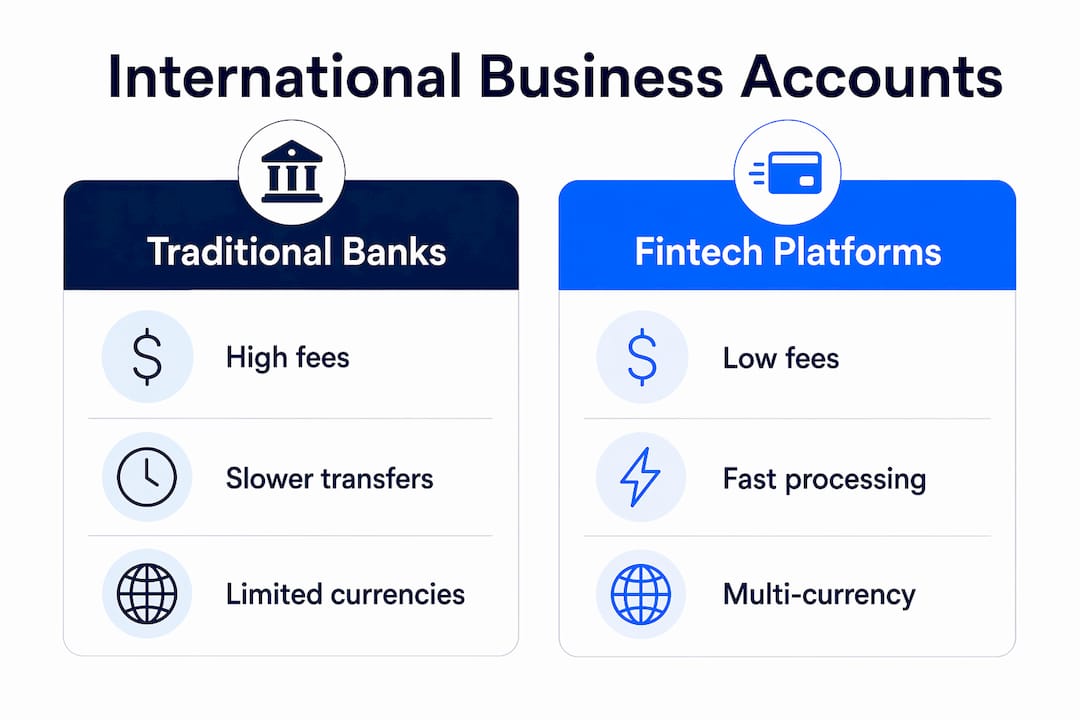
Quick pros and cons
Demivolt
- Pros: Dedicated named IBANs, segregated client funds, SEPA and SWIFT, virtual and physical Visa cards, BaaS and white-label capabilities, API-ready multi-account structures
- Cons: EUR-centric receiving accounts; pricing schedule requires direct contact; newer brand recognition outside Europe
Airwallex
- Pros: 60+ currencies, strong local receiving details, competitive FX on high volumes, solid API and e-commerce integrations
- Cons: FX spread varies; customer support response times reported as inconsistent at scale
Wise Business
- Pros: Fully transparent mid-market FX pricing, broad local receiving details, easy API, trusted brand
- Cons: No physical branch; card availability varies by country; not a licensed bank (EMI/money transmitter)
Payoneer
- Pros: Deep marketplace integrations, 70+ currencies, strong payout network for exporters and platforms
- Cons: 2% FX conversion fee is higher than some peers; interface less suited to complex treasury needs
Revolut
- Pros: Integrated card and expense workflow, multi-currency balances, competitive plans for SMEs
- Cons: U.S. product is more limited than the EU version; weekend FX markup applies; customer support quality varies
Chase Bank
- Pros: FDIC-insured, full-service banking, global correspondent network, in-branch relationship management
- Cons: Higher FX spreads and wire fees than fintechs; slower onboarding for international features; less API flexibility
Pro Tip: Before requesting a fee schedule, ask each provider specifically whether their IBAN is named in your company’s entity name or pooled. Pooled IBANs can cause payment rejections from European banks and payment platforms, which creates operational delays that are difficult to resolve after the fact.
Provider profiles: what each platform actually offers U.S. businesses
Demivolt
Demivolt is a regulated European fintech platform built specifically for businesses that need compliant, digital-first banking infrastructure. Its core product is a dedicated IBAN account in the company’s own name, supported by both SEPA and SWIFT payment processing. That combination makes it directly relevant for U.S. companies with European customers, suppliers, or subsidiaries. Client funds are held in segregated accounts, which is a material protection compared to platforms that commingle funds.
Beyond the IBAN, Demivolt supports multi-account structures with role-based user permissions, virtual and physical Visa business cards, and a card program infrastructure that suits fintechs and platforms building their own payment products. Its Banking-as-a-Service (BaaS) capabilities and white-label options mean it serves both direct business clients and partners who want to embed payment infrastructure. The cross-border payment mechanics are documented in detail for finance teams evaluating SEPA and SWIFT workflows.
- Regulation: EU-regulated electronic money institution (EMI); segregated client funds
- U.S. availability: U.S. companies accepted; remote onboarding
- Receiving accounts: Named IBANs (EUR); SWIFT inbound
- Cards: Virtual and physical Visa; role-based expense controls
- Best for: SMEs, e-commerce businesses, and fintechs needing regulated IBAN accounts, card programs, and integration-ready infrastructure
Airwallex
Airwallex operates as a global payments platform with multi-currency business accounts available to U.S. companies. It supports 60+ currencies and provides local receiving details in markets including the U.S., EU, UK, Australia, Hong Kong, Singapore, and Canada. Its FX pricing sits 0.5%–1% above mid-market depending on the currency pair, which is competitive for businesses moving large volumes. The platform’s API is well-documented and integrates with Xero, QuickBooks, and Shopify, making it a practical fit for e-commerce operators and SaaS businesses with recurring cross-border billing.
Airwallex is regulated by ASIC in Australia and holds money transmitter licenses in U.S. states. It is not a licensed bank, so client funds are not FDIC-insured. For high-volume cross-border payouts and marketplace-style payment flows, it is one of the more capable platforms available to U.S. businesses today.
- Regulation: ASIC (Australia); U.S. state money transmitter licenses
- U.S. availability: Full product available
- Best for: Businesses with high cross-border transaction volumes and platform/marketplace payment needs
Wise Business
Wise Business is built around one principle: charge the mid-market exchange rate and show the fee separately. That transparency is its clearest differentiator. The fee ranges from approximately 0.33% to 3.56% depending on the currency pair, and the rate itself is never marked up. Fintech multicurrency providers like Wise give businesses country-specific bank details — U.S. routing numbers, UK sort codes, EU IBANs — under a single account relationship, which simplifies receiving payments from international customers.
Wise Business is FCA-regulated in the UK and registered with FinCEN in the U.S. It is not a bank, and balances are not FDIC-insured, but funds are safeguarded in line with FCA requirements. For SMEs that want predictable, low-cost FX without the overhead of a traditional bank relationship, it is a strong option.
- Regulation: FCA (UK); FinCEN-registered (U.S.)
- U.S. availability: Full product available
- Best for: SMEs prioritizing transparent, low-cost FX and multiple local receiving details
Payoneer
Payoneer’s strength is its payout network. It connects to 70+ currencies and integrates directly with major marketplaces including Amazon, Upwork, and Fiverr, making it the default choice for businesses that receive payments from platforms rather than directly from clients. Its currency conversion fee of 2% above mid-market is higher than Wise or Airwallex, but for businesses whose primary need is receiving marketplace payouts and disbursing to global contractors, the network access often outweighs the FX cost.
Payoneer is registered with FinCEN and holds state money transmitter licenses across the U.S. Like other fintech platforms in this list, it is not a bank and balances are not FDIC-insured.
- Regulation: FinCEN-registered; U.S. state money transmitter licenses
- U.S. availability: Full product available
- Best for: Marketplace sellers, exporters, and platforms requiring global payout networks
Revolut
Revolut’s business product combines multi-currency balances, integrated card issuance, and expense management in a single interface. For U.S. companies, the product is available but more limited than the EU version — some features, including the full banking license capabilities, are not yet active in the U.S. market. Revolut holds an EU banking license through Revolut Bank UAB and U.S. state money transmitter licenses. Its free plan covers basic multi-currency needs; paid plans range from $0 to $79 per month and unlock higher limits and additional features.
One practical note: Revolut applies a 0.5%–1% FX markup on weekend conversions when interbank markets are closed. For businesses running automated payment flows over weekends, that cost adds up.
- Regulation: EU banking license (Revolut Bank UAB); U.S. state money transmitter licenses
- U.S. availability: Available; some features limited vs. EU product
- Best for: SMEs needing integrated card programs, expense management, and multi-currency balances
Chase Bank
Chase Bank is the incumbent option for U.S. businesses that want a single, full-service banking relationship. It is FDIC-insured, OCC-regulated, and backed by one of the largest correspondent banking networks in the world. For international wire transfers, Chase uses a proprietary FX rate that is not disclosed in advance, and wire fees run $25–$50 per outbound transfer. Monthly account fees range from $15 to $95 depending on the account tier, though most are waivable with minimum balance requirements.
“Most offshore institutions prefer entity accounts over individual U.S. clients due to FATCA compliance requirements — a pattern that applies equally to traditional international banks and newer fintech platforms.” — Offshore Broker
Chase’s value is in its depth: in-branch relationship management, credit facilities, treasury services, and the credibility of a major regulated bank. For businesses that need those features, the higher FX cost is a known trade-off. For businesses whose primary need is low-cost international payments, the fintech options above will almost always be cheaper.
- Regulation: FDIC-insured; OCC-regulated national bank
- U.S. availability: Full product; in-branch and online
- Best for: Established U.S. businesses needing full-service banking, credit, and correspondent relationships
Pro Tip: EMIs and fintech platforms typically onboard in days rather than weeks, but they operate under different protections than licensed banks. Client funds at an EMI are safeguarded separately from the institution’s own capital — not insured by the FDIC — so understanding how each provider holds your funds is a non-negotiable step before onboarding.

How should you evaluate FX pricing, rails, and receiving accounts?
The difference between a good and a poor international banking setup often comes down to three things: how FX is priced, whether receiving accounts are named or pooled, and which payment rails the provider actually supports. Getting these right before signing up saves significant cost and operational friction later.
FX pricing: spread vs. mid-market
Traditional banks apply a proprietary spread to the exchange rate without disclosing it. A business sending $10,000 to a EUR supplier might receive a rate 2%–3% worse than the mid-market rate, costing $200–$300 on a single transfer. Fintech platforms like Wise Business charge the mid-market rate plus a transparent fee, while Airwallex charges 0.5%–1% above mid-market. Over a year of regular transfers, that difference is material.
Illustrative example (not a live quote):
| Transfer scenario | FX method | Approximate FX cost on $10,000 USD → EUR |
|---|---|---|
| Traditional bank (proprietary spread) | 2.5% spread, no disclosure | — |
| Airwallex | 0.5%–1% above mid-market | — |
| Wise Business | Mid-market + 0.33%–1% fee (major pairs) | — |
| Demivolt | Fee-based; contact for schedule | Confirm directly |
All figures are illustrative. Actual rates vary by currency pair, volume, and market conditions. Request a live quote before committing.
Named IBANs vs. pooled IBANs
A named IBAN is issued in your company’s legal entity name. A pooled IBAN is shared infrastructure where your funds sit in an account owned by the provider, with a reference number to identify your sub-balance. European counterparties and payment platforms increasingly require named IBANs — some will reject payments to pooled accounts outright. Demivolt and Wise Business both provide named IBANs; confirm this explicitly with any provider before onboarding.
Transfer rails and speed
- SEPA: Euro-denominated transfers within the EU/EEA; typically settles in 1 business day (SEPA Credit Transfer) or near-instant (SEPA Instant where supported)
- SWIFT: Global correspondent banking network; typically 1–5 business days depending on correspondent chain
- Local rails (ACH, Faster Payments, etc.): Domestic-equivalent speed in each market; usually same-day to next-day
Evaluation priority by business type
- SaaS with EU subscribers: Named IBAN + SEPA + transparent FX (Demivolt, Wise Business)
- E-commerce with global suppliers: Multi-currency local receiving + competitive FX + API (Airwallex, Wise Business)
- Marketplace or platform: Payout network depth + API + marketplace integrations (Payoneer, Airwallex)
- Payroll across borders: Multi-currency balances + local rails + compliance support (Airwallex, Wise Business, Demivolt)
- Relationship banking + credit: Full-service bank with FDIC insurance (Chase Bank)
How do you choose the right international business account for your U.S. company?
The right account depends on your payment flows, not on which platform has the most features. A business sending one wire per month to a European supplier has different needs than a SaaS company billing 500 EU customers monthly. Start with the flows, then match the provider.
Decision checklist
- Identify your primary payment flows: inbound from EU/UK customers, outbound to suppliers, payroll, marketplace payouts, or a mix.
- Confirm U.S. availability: not every international platform offers its full product to U.S.-registered entities. Verify before investing time in onboarding.
- Check IBAN type: ask explicitly whether the IBAN is named in your company’s legal entity name or pooled. Get the answer in writing.
- Evaluate FX pricing model: request a sample rate for your most common currency pair and compare it to the mid-market rate on the same day.
- Review transfer rails: confirm whether the provider supports SEPA, SWIFT, and any local rails relevant to your markets.
- Assess card and expense needs: if your team needs business cards with multi-currency spend, confirm card issuance, limits, and expense management features.
- Check API and accounting integrations: if you use Xero, QuickBooks, or a custom ERP, verify the integration is live and supported.
- Understand the regulatory structure: EMI, money transmitter, or licensed bank — each has different fund protection implications.
- Request a sample fee schedule: inbound wire fees, outbound wire fees, monthly account fees, card fees, and API usage fees should all be disclosed before you sign.
- Confirm FBAR/FATCA compatibility: the provider should be able to confirm it will provide the documentation your U.S. tax advisor needs for annual reporting.
Questions to ask providers directly
- What license do you hold, and in which jurisdictions?
- Are client funds held in segregated accounts, and can you provide documentation?
- Is the IBAN issued in my company’s legal entity name?
- What is your SWIFT BIC, and do you use intermediary correspondents?
- What is the typical onboarding timeline for a U.S.-registered company?
- What AML triggers might delay or pause my account during onboarding?
- What is your SLA for customer support, and do I get a named relationship manager?
- Can you provide a full fee schedule in writing before I sign?
Red flags to watch for
- FX rates quoted without disclosing the spread or markup
- IBAN described as “virtual” without clarifying whether it is named or pooled
- No clear regulatory license or registration number provided on request
- KYC process that cannot tell you what documents are needed upfront
- No written fee schedule available before account opening
- Inability to confirm how the provider handles FATCA-related documentation requests
Pro Tip: Ask for the provider’s regulatory license number and verify it on the relevant register (FCA, FinCEN, ASIC, or the EU national competent authority). A legitimate regulated provider will give you this information immediately. Hesitation or redirection is a signal worth taking seriously.
What does cross-border banking actually cost?
The headline account fee is rarely where the real cost lives. For most businesses, FX spreads and per-transfer fees are the dominant cost drivers, and they compound quickly at volume.
Typical fee categories
- Outbound wire fee: charged per transfer sent via SWIFT or local rails; ranges from $0 (some fintechs) to $50 (traditional banks)
- Inbound wire fee: charged when you receive a SWIFT transfer; ranges from $0 to $15 at most providers
- FX conversion fee: the spread or markup applied when converting between currencies; the largest cost driver for most businesses
- Receiving account / IBAN fee: some providers charge a monthly fee for each named IBAN or local receiving account
- Card issuing fee: monthly or per-card fee for virtual or physical business cards
- Monthly account maintenance fee: flat fee for account access; ranges from $0 to $95 depending on provider and tier
- API / usage fee: charged by some providers for high-volume API calls or batch payment processing
Sample landed-cost comparison (illustrative)
A U.S. company sends $5,000 USD to a EUR supplier every month. Over 12 months, the difference between a 2.5% bank spread and a 0.5% fintech fee is approximately $1,200 per year on that single payment flow alone. Add a $35 outbound wire fee per transfer at a traditional bank versus $0–$5 at a fintech, and the annual difference grows to roughly $1,620.
| Cost component | Traditional bank (illustrative) | Fintech platform (illustrative) |
|---|---|---|
| FX spread on $5,000/month | 2% FX conversion fee | 0.5% = $25/transfer |
| Outbound wire fee | $35/transfer | $0–$5/transfer |
| Monthly account fee | $25/month | $0–$15/month |
Illustrative only. Request live quotes from each provider for your specific currency pairs and volumes.
Practical steps to reduce FX cost
- Invoice in your customer’s currency where possible to shift the conversion responsibility and reduce your own FX exposure.
- Batch transfers rather than sending small amounts frequently; per-transfer fees add up faster than spreads at low volumes.
- Hold multi-currency balances when you have both inflows and outflows in the same currency, avoiding unnecessary conversions.
- Use forward contracts for large, predictable payments if your provider supports them; this locks in a rate and removes timing risk.
Pro Tip: For businesses managing multiple accounts across currencies, a structured multi-account setup with clear currency segregation reduces both FX conversion costs and the risk of accidental cross-currency payments.
What does it take to open an international business account from the U.S.?
The document requirements and timelines vary significantly between fintech platforms and traditional or offshore banks. Knowing what to prepare before you start saves weeks.
Standard document checklist for U.S. companies
- Certificate of incorporation or formation documents (LLC operating agreement or corporate charter)
- EIN confirmation letter (IRS Form CP-575 or 147C)
- Beneficial ownership information: passport or government-issued ID for all owners with 25%+ equity, plus any authorized signatories
- Proof of business address (utility bill, lease agreement, or bank statement dated within 90 days)
- Business activity description: what the company does, who its customers are, and where revenue comes from
- Source-of-funds documentation: recent bank statements, audited financials, or investor agreements
- Sample contracts or invoices demonstrating the nature of transactions
- For offshore or traditional international banks: notarized and apostilled copies of formation documents may be required
Typical onboarding timelines
- Fintech / EMI platforms (Demivolt, Wise Business, Airwallex, Revolut, Payoneer): remote digital onboarding; typically 1–2 weeks from document submission to account activation. Delays most often occur at source-of-funds review or beneficial ownership verification.
- Traditional bank with international services (Chase Bank): in-branch or relationship-managed onboarding; typically 2–4 weeks for domestic accounts with international wire access; longer for dedicated foreign currency accounts.
- Offshore or private international banks: 4–12+ weeks; often require an existing relationship, minimum deposit, or an offshore entity structure. Some offshore business products are available only to existing customers.
The onboarding process typically moves through four stages: structure review, institution matching, KYC and compliance vetting, and account activation. The KYC stage is where most delays occur, particularly when source-of-funds documentation is incomplete or when beneficial ownership structures involve trusts or holding companies.
Pro Tip: Prepare a one-page KYC summary before you start: company name, registration number, EIN, beneficial owners with percentage holdings, business activity in two sentences, and primary transaction types. Attach it to every document package. Providers that receive a clean, organized submission move faster through compliance review, and it signals that your business operates with financial discipline.
U.S. tax and reporting obligations for foreign and multi-currency accounts
Holding or transacting through international business accounts creates specific reporting obligations for U.S. companies. These are not optional, and the penalties for non-compliance are significant.
FBAR (FinCEN Form 114)
U.S. persons and entities — including U.S.-registered corporations and LLCs — must file an FBAR if the aggregate value of all foreign financial accounts exceeds $10,000 at any point during the calendar year. This applies to accounts held at foreign banks, fintech platforms, and EMIs outside the U.S. The filing deadline is April 15, with an automatic extension to October 15. FBAR is filed electronically with FinCEN, not the IRS.
FATCA (Foreign Account Tax Compliance Act)
FATCA requires foreign financial institutions to report accounts held by U.S. persons to the IRS. For U.S. businesses, this means that regulated international providers — including EU-regulated EMIs like Demivolt — will request a W-9 or W-8 form during onboarding and may report account information to the IRS. This is standard compliance practice, not a red flag. Businesses should expect it and have their EIN and entity documentation ready.
Practical compliance steps
- Maintain a complete record of all foreign account numbers, institution names, and maximum balances for each calendar year.
- Retain onboarding documentation, KYC submissions, and account statements for at least 6 years.
- File FBAR annually via the BSA E-Filing System at FinCEN.
- Consult a U.S. tax advisor or international compliance counsel before opening accounts in jurisdictions with complex treaty or reporting implications.
- Confirm with each provider that they can supply the documentation your tax advisor needs (account statements, transaction records, year-end balance confirmations).
Working with a regulated provider like Demivolt, which maintains segregated client funds and operates under EU regulatory standards, means the compliance documentation trail is built into the account structure from day one. For dedicated business accounts with clear audit trails, the annual reporting process is significantly more straightforward.
Pro Tip: FBAR and FATCA obligations apply even if the account is held at a fintech platform rather than a traditional bank. The determining factor is whether the account is held at a financial institution outside the U.S., not whether the institution calls itself a bank.
This article provides general information, not legal or tax advice. Confirm your specific reporting obligations with a qualified U.S. tax advisor or international compliance counsel.
How we evaluated these providers
This evaluation was conducted in 2026 using publicly available provider documentation, official regulatory registers, and published fee schedules. No provider paid for inclusion or placement.
Evaluation criteria
- FX pricing transparency: whether the spread or markup is disclosed and how it compares to the mid-market rate
- Named IBAN availability: whether the account issues an IBAN in the company’s legal entity name, not a pooled account
- Local receiving accounts: number of currencies and markets where the provider offers local receiving details (routing number, sort code, IBAN)
- Transfer rails supported: SEPA, SWIFT, ACH, Faster Payments, and other local rails
- Onboarding from the U.S.: whether U.S.-registered companies can open accounts remotely and what the typical timeline is
- Regulatory status: license type (bank, EMI, money transmitter), jurisdiction, and fund protection model
- API and integration quality: availability of a documented API, accounting software integrations, and developer support
- Customer support SLA: availability of named support, response time commitments, and escalation paths
- Card issuance: virtual and physical card availability, spend controls, and expense management features
Data sources
Provider information was drawn from official product pages, published fee schedules, and regulatory registers including the FCA register, FinCEN’s MSB registrant search, and ASIC’s professional registers. Pricing figures in this article reflect publicly available rates at the time of evaluation and may change. Always request a current fee schedule directly from the provider before making a decision.
Limitations
Pricing at several providers varies by volume, entity type, and geography. Some features listed as available in the U.S. may be subject to state-level restrictions. Offshore and private banking products were not included in the primary comparison because their availability to U.S. companies is highly conditional on entity structure and relationship history. Confirm all details during vendor conversations before committing.
Key Takeaways
For U.S. companies, the best international business bank account combines named IBANs, transparent FX pricing, confirmed U.S. availability, and a clear regulatory structure — no single provider leads on every dimension, so matching your primary payment flows to provider strengths is the most reliable selection method.
| Point | Details |
|---|---|
| Named IBANs matter | Always confirm whether your IBAN is issued in your company’s legal entity name; pooled IBANs are rejected by some European counterparties. |
| FX cost is the largest variable | A 2% spread vs. 0.5% on regular transfers can cost thousands annually; request a sample rate before committing to any provider. |
| FBAR and FATCA apply to fintech accounts | Foreign accounts at EMIs and fintech platforms trigger U.S. reporting obligations just as traditional bank accounts do. |
| Match provider to payment flow | SaaS and EU-facing businesses benefit most from SEPA-capable named IBANs; marketplace operators need payout network depth. |
| Demivolt for regulated IBAN infrastructure | Demivolt provides dedicated named IBANs, SEPA and SWIFT, segregated client funds, and card programs for SMEs and fintechs operating internationally. |
What U.S. businesses get wrong when choosing international accounts
The most common mistake is treating an international business account as a commodity purchase. Finance leaders compare headline monthly fees, pick the lowest number, and discover six months later that the FX spread on every transfer was costing them more than the account fee they saved. The real cost of cross-border banking is almost never the account fee.
The second mistake is underestimating the named IBAN question. Businesses open accounts, start invoicing European customers, and then find that payments are being rejected or returned because the receiving IBAN is pooled rather than named. Fixing that after the fact means re-issuing invoices, updating payment details with customers, and absorbing the operational cost of the delay.
The third mistake is choosing a provider without confirming U.S. regulatory compatibility. Not every international platform is equipped to handle FATCA documentation requests or provide the account records a U.S. tax advisor needs for FBAR filing. A provider that cannot produce a year-end balance statement or a transaction history in a format your accountant can use is a liability at tax time.
Regulated fintech platforms with segregated funds and documented compliance processes are not just a safer choice operationally. They are a more defensible choice from a U.S. reporting perspective, because the compliance infrastructure is already part of how they operate. The businesses that get this right early spend far less time on remediation later.
Demivolt: regulated IBAN accounts and payment infrastructure for U.S. businesses
U.S. companies that need a regulated European banking partner with dedicated named IBANs, SEPA and SWIFT processing, and card program infrastructure have a direct option in Demivolt. Where most fintech platforms offer multi-currency accounts as a feature set, Demivolt is built around regulated payment infrastructure as its core product.
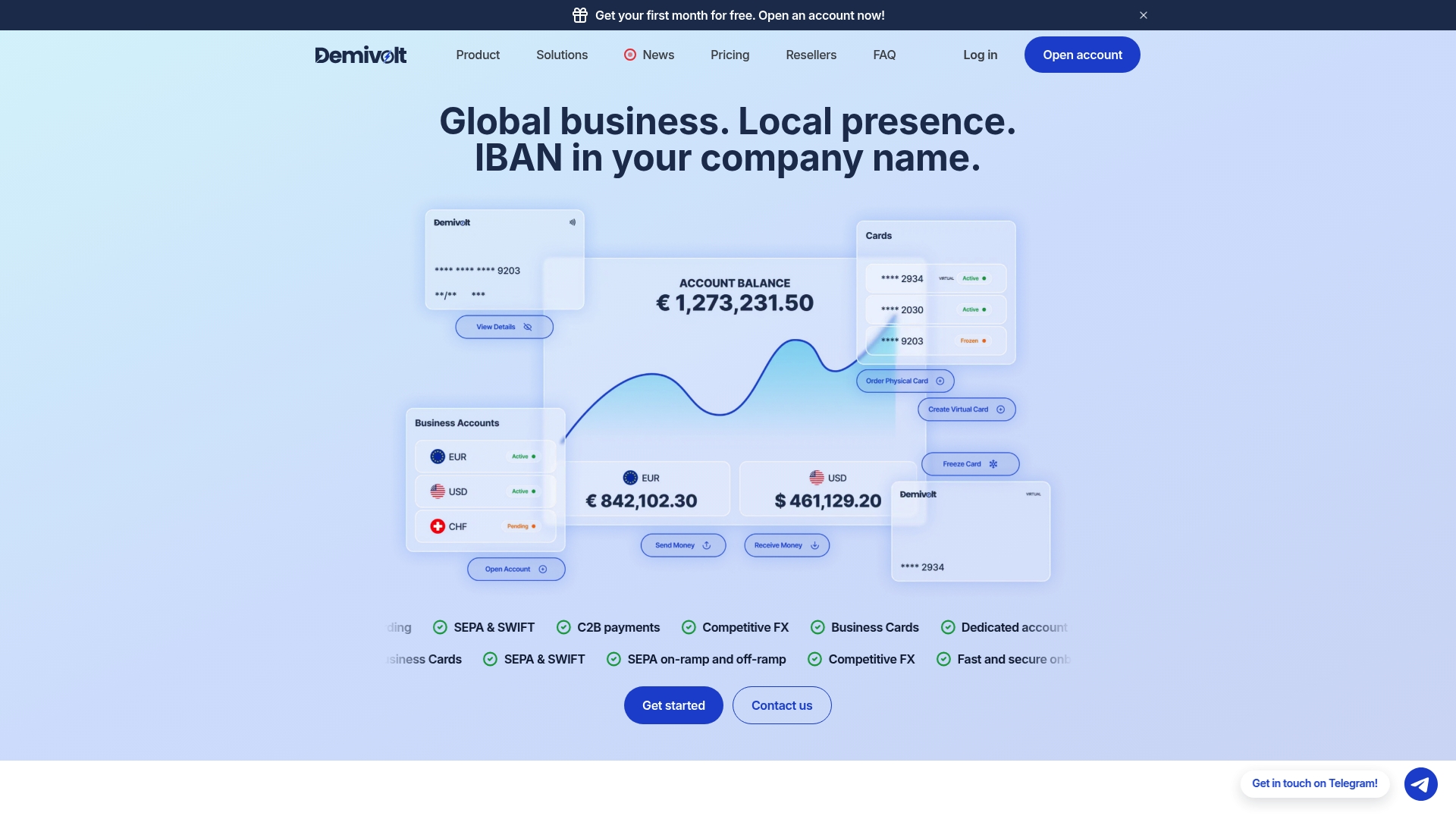
The practical advantages for U.S. businesses are specific: dedicated IBANs issued in your company’s legal entity name, inbound and outbound SEPA and SWIFT payments, multi-account structures with role-based user controls, and virtual and physical Visa business cards for team expenses. Client funds are held in segregated accounts under EU regulatory standards, which supports the documentation trail U.S. companies need for FBAR and FATCA compliance. For fintechs and platforms that need to embed payment infrastructure, Demivolt’s BaaS and white-label capabilities extend the product further.
[Insert internal data or performance metrics about Demivolt’s platform success or user satisfaction.]
To verify a beneficiary IBAN before your first transfer, use Demivolt’s free IBAN validator — a practical first step before onboarding any new European counterparty. To explore the full account and payment infrastructure, visit Demivolt’s platform and contact the team directly for a fee schedule and onboarding timeline specific to your entity type.
Demivolt is the publisher of this article. This section describes Demivolt’s own products and services.
Useful sources and further reading
The sources below were used in preparing this article and are recommended for finance teams conducting their own due diligence. Pricing and product availability change frequently; always confirm live terms directly with each provider.
| Source | Relevance | Notes |
|---|---|---|
| NerdWallet: Multi-Currency Account Guide | Explains how multicurrency accounts work and who they suit | Useful for teams new to multi-currency account structures |
| Offshore Broker: Offshore Banking Overview | Covers offshore account types, named IBANs, EMI vs. bank trade-offs, and onboarding stages | Background on account structures and regulatory trade-offs |
| Skipton International: Corporate Offshore Accounts | Shows availability constraints and relationship minimums for traditional offshore banks | Relevant for businesses considering private or offshore banking relationships |
| Demivolt: IBAN Accounts Guide for SMEs | Detailed IBAN mechanics and cross-border payment workflows | Practical reference for SEPA and SWIFT payment setup |
| Demivolt: Business Banking for SMEs | Services, compliance, and cross-border operations for SMEs | Useful primer on compliance considerations for international accounts |
| Demivolt: Free SEPA Tools | SEPA payment validation and preparation tools | Practical toolkit for teams managing European payments |
| FinCEN BSA E-Filing System | FBAR filing portal for U.S. entities with foreign accounts | Required for annual FBAR compliance; access at bsaefiling.fincen.treas.gov |
| IRS FATCA Resource Center | Official IRS guidance on FATCA obligations for U.S. entities | Consult before opening accounts at foreign financial institutions |
All sources accessed in 2026. Regulatory guidance and provider terms change; verify current requirements with a qualified U.S. tax advisor and directly with each provider before making decisions.
Recommended
- Demivolt | Blog – Types of Business Bank Accounts: Find the Right Fit for Your SME
- Demivolt | Blog – Business account benefits for European SMEs in 2026
- Demivolt | Blog – IBAN Accounts Explained: Guide for SMEs Managing Cross-Border Payments
- Demivolt | Blog – Why Dedicated Business Accounts Matter for European SMEs