

Treasury management in a company (in Lithuanian, iždo valdymas įmonėje) is the discipline of knowing how much cash you hold, where it sits, what is coming in and going out, and who is allowed to move it. For a small or mid-sized Lithuanian business it comes down to four habits: one clear view of every account, a rolling cash forecast, strict payment approvals, and a payment setup that handles SEPA and SWIFT without surprises. This guide explains each habit, shows where the Lithuanian and European rules touch it, and gives a worked fee example.
Demivoltdemivolt.comBring More Structure to TreasuryDemivolt offers business accounts with dedicated IBANs, SEPA and SWIFT payments, and role-based access for companies managing cash across borders.Explore DemivoltTL;DR
- Treasury management covers planning, organizing, forecasting and controlling your money flows, not only holding a balance.
- Start with visibility and control over every account, then add sophistication as the business grows.
- Separate who prepares, who approves and who releases a payment, and keep an audit trail.
- Cross-border work needs a clear view of SEPA and SWIFT costs, cut-off times and currency exposure.
- A regulated business account with dedicated IBANs, role-based access and segregated client funds gives a small finance team the structure that treasury needs.
Table of Contents
- What treasury management means for a business
- Build visibility first, sophistication later
- Forecast cash flow in a way you can act on
- Control payments, approvals and access
- Cross-border treasury: SEPA, SWIFT and settlement
- Treasury priorities for e-commerce and digital-first businesses
- Our perspective: treasury starts with the account structure
- Start with a regulated business account
- A simple treasury routine for the first 90 days
- FAQ
- Sources
What treasury management means for a business
The word “treasury” is often associated with the state treasury, and that is what most search results about this topic describe. In a company the meaning is narrower and more practical. Lithuanian academic work on corporate cash flows, citing earlier authors, describes the functions of money-flow management as planning, organization, forecasting and control. That is a useful working definition: treasury is the set of routines that make those four functions happen for your cash.
In practice, treasury covers:
- Cash position: the balance across all accounts and currencies, reconciled and current.
- Liquidity: whether you can meet payroll, suppliers, taxes and other obligations on the dates they fall due.
- Forecasting: a view of expected inflows and committed outflows over the coming weeks and months.
- Payment control: who can initiate, approve and release payments, and through which channels.
- Risk: currency, interest rate, liquidity, credit and operational exposure.
A European banking industry paper on corporate liquidity puts the stakes simply: cash held at banks funds working capital and the company’s current and future obligations. If that cash is scattered, mislabeled or locked behind slow processes, the business pays for it in missed opportunities or late payments.
Build visibility first, sophistication later
Many SMEs assume treasury is something for large corporations with dedicated software. It is not. A practical guide on scaling treasury in growth companies sums up the common thread as starting with visibility and control, then layering in sophistication as you mature. That order matters for a company with five or fifty employees.
The European banking paper notes that cash-management processes can be supported by bank technologies such as balance reporting and cash pools, by treasury management system vendors, and even by Excel as an operational and reporting tool. So the tool is secondary. What counts is that the data feeding it is complete and trustworthy.
Step 1: Map every account
List each bank account, payment account and card balance the company uses, with its currency, owner and purpose. Many Lithuanian companies end up with a separate account for each project, entity or currency, opened ad hoc. Write down which ones are operating accounts, which hold tax reserves, which receive customer payments and which are used only for card spending.
Step 2: Give each flow its own account
A multi-account structure makes classification automatic. If customer receipts land in one dedicated IBAN, supplier payments leave from another and card expenses run from a third, the balance on each account already tells you something. Our business accounts are built for exactly this: multiple accounts under one company profile, each with a dedicated IBAN.
Step 3: Reconcile daily
At the end of each day, the effect of interbank payments and collections is consolidated as net cash positions on the company’s bank accounts. Your own records should be matched to that figure. A cash-visibility guide for SMEs advises to start from a reconciled cash position, identify amounts already reserved or unavailable for normal operating decisions, and not assume every line in a bank feed is already classified correctly.
In plain terms: the number on the screen is not your spendable cash until you have subtracted VAT you owe, payroll already scheduled, and money that belongs to customers or partners.
Forecast cash flow in a way you can act on
A forecast is useful only if it triggers decisions. The same SME guide says cash-flow visibility should connect verified cash, expected inflows, committed or planned outflows, time periods, assumption quality, and the action needed when the forecast changes. That list translates into a simple weekly routine.
- Start with verified cash. Use the reconciled position from the previous step.
- Add expected inflows. Group them by confidence: invoices due from reliable customers, invoices overdue, and pipeline you only hope for.
- Subtract committed outflows. Payroll, rent, taxes, supplier invoices with fixed due dates and card spending.
- Mark the assumptions. Note which customer payment you assume will arrive on which day, and what happens to the plan if it slips.
- Decide the action. Define in advance what you do when the forecast shows a gap: delay a discretionary payment, move funds between accounts, or call a customer.
Horizons that work for SMEs
| Horizon | Question it answers | Typical update rhythm |
|---|---|---|
| 1 to 2 weeks | Can we pay everything that is due? | Daily or weekly |
| 1 to 3 months | Do we need to move funds or change payment timing? | Weekly or monthly |
| 6 to 12 months | Is the business funded for its plans? | Monthly or quarterly |
The rhythm column is our suggested working pattern for SMEs, not a regulatory requirement.
Multi-currency liquidity
If you invoice in euros but pay some suppliers in other currencies, forecast each currency separately and decide where the conversion happens. Treasury risk literature classifies this as market risk: a Lithuanian master thesis on treasury risk lists currency exchange, interest rate and commodity price fluctuations as market risks, alongside liquidity, credit and operational risks. For an SME the practical response is modest: know your open currency positions and keep them visible next to your euro balances.
Control payments, approvals and access
Visibility tells you where the money is. Control decides who can move it. The scaling-treasury guide adds that control should wrap around everything, including segregation of duties, approval workflows and audit trails, particularly as threats such as cyber attacks increase.
For a small team, a workable control model has five parts:
- Separate roles. The person who prepares a payment is not the person who approves it.
- Role-based access. An accountant can see balances and prepare payments, a manager approves, an owner or CFO manages users and limits.
- Approval thresholds. Small recurring payments follow a lighter route, large or new-beneficiary payments need a second approver.
- Card limits. Virtual and physical business cards are issued per person or per purpose, with spending limits, instead of sharing one card.
- Audit trail. Every payment shows who created, approved and released it, and when.
The same guide notes that for a 300 to 500 person company expanding internationally, three people is typically the minimum for providing segregation of duties and backup coverage. Very few SMEs have that headcount in finance, so the account platform itself has to enforce the separation through roles and approvals. Our card programmes and role-based user management are designed for this: each user gets only the rights the job requires.
Payment authentication is part of control too. The EU’s PSD2 framework sets the rules for how payments are initiated and authenticated, and a short explainer on the PSD2 payment services directive is a good starting point for finance staff who want to understand why strong authentication prompts appear when they approve a payment.
For a deeper look at fraud, rejections and operational exposure in payments, see our guide to payment risk management for businesses in Lithuania.
Cross-border treasury: SEPA, SWIFT and settlement
Most Lithuanian companies handle euro payments daily and non-euro or non-SEPA payments occasionally. Both need a clear picture of speed, cost and cut-off times.
How SEPA payments are processed
The Bank of Lithuania’s SEPA-MMS rules describe the processing and execution of credit transfers and direct debits, and link the system to TARGET2 for final settlement and STEP2 for exchanging payment orders with other SEPA providers. The same rules state that accepted credit transfer payment orders are executed in real time, while direct debit orders are executed at the time set in the operating schedule.

For treasury, the lesson is that timing depends on the channel and the cut-off, not only on the date you press “send”. We explain how to avoid next-day delays in our article on SEPA cut-off times in Lithuania. If your team uploads payment files, rejected files also delay cash. Our PAIN.001 guide walks through the formatting steps that prevent rejections.
Why liquidity must be in place before the payment
The Bank of Lithuania describes the logic of the large-value system: in RTGS settlement a payment is executed only if sufficient liquidity is available, settlement is in central bank money, and an executed payment is final and irrevocable. The operating rules of the CENTROlink payment system apply the same principle to instant credit transfers: orders are executed only when sufficient funds are on the participant’s designated account.
These rules govern payment providers and banks rather than your company directly, but they have a direct consequence for you: a payment you have approved can only leave if funds are available at the right moment, and once final it cannot be recalled. Keep a buffer on the account you pay from, and approve with that in mind.
Fee example: what cross-border payments cost
Predictable fees make forecasting easier. These are Demivolt’s published fees for payments:
| Payment type | Fee |
|---|---|
| SEPA In | €0 |
| SEPA Out | €0.40 per transfer |
| SWIFT In | €25.00 |
| SWIFT Out | €30.00 |
| Account opening, verification, monthly maintenance, account closure | €0 |
| Internal transfers between Demivolt accounts | €0 |
A worked example: a company that sends 120 SEPA payments and 4 outgoing SWIFT payments in a month pays 120 × €0.40 = €48.00 plus 4 × €30.00 = €120.00, a total of €168.00 in payment fees, and nothing in monthly maintenance. If it also receives 2 SWIFT payments, add 2 × €25.00 = €50.00. You can model your own volumes with our SEPA fee calculator.
The example shows a treasury habit worth adopting: since SWIFT payments cost far more than SEPA ones, batch them, plan them and, where the counterparty can receive euros in the SEPA area, route them by SEPA.

Treasury priorities for e-commerce and digital-first businesses
Online businesses have a treasury profile of their own: many small incoming payments, regular supplier and advertising payments, often in several currencies, and cash that moves quickly. The principles above apply with a few emphases.
- Separate customer receipts from operating cash. A dedicated IBAN for incoming sales makes reconciliation faster and keeps the forecast clean.
- Pay recurring costs by card. Virtual cards for advertising, software and marketplace fees, each with its own limit, make spending visible by purpose.
- Watch timing gaps. Money from sales does not always arrive on the day of the sale, so the forecast should reflect when funds actually reach your account.
- Keep a reserve for refunds and taxes. Treat money already owed as unavailable, as the reconciled-position approach suggests.
See our page on e-commerce business accounts and payments for how these flows are set up. Fintechs and platforms that hold money on behalf of others have additional needs, covered on our fintech business accounts page. For the direction treasury tools are heading, our news piece on treasury software moving cash in real time is a good follow-up.
Our perspective: treasury starts with the account structure
We see the same pattern in many growing companies. Treasury is treated as a spreadsheet problem, when it is mostly a structure problem. If every flow runs through one account, no forecast can be clean. If every employee can release payments, no policy can be enforced.
That is why we build around structure first. A dedicated IBAN for each purpose, multiple accounts under one company profile, role-based users and cards issued per person or purpose give a finance team visibility and control from day one. Our approach is designed so that a small team can apply segregation of duties without adding headcount.
We are a regulated European platform, and client funds are held in segregated accounts. Onboarding is risk-based, fast and transparent, and our fees are published openly, so your finance lead can model costs before a single payment is made.
The result we aim for is simple: you open the dashboard and know what you hold, what is reserved, what is coming and who can move it. Everything else in treasury, from forecasting to currency decisions, builds on that.
dd
Start with a regulated business account
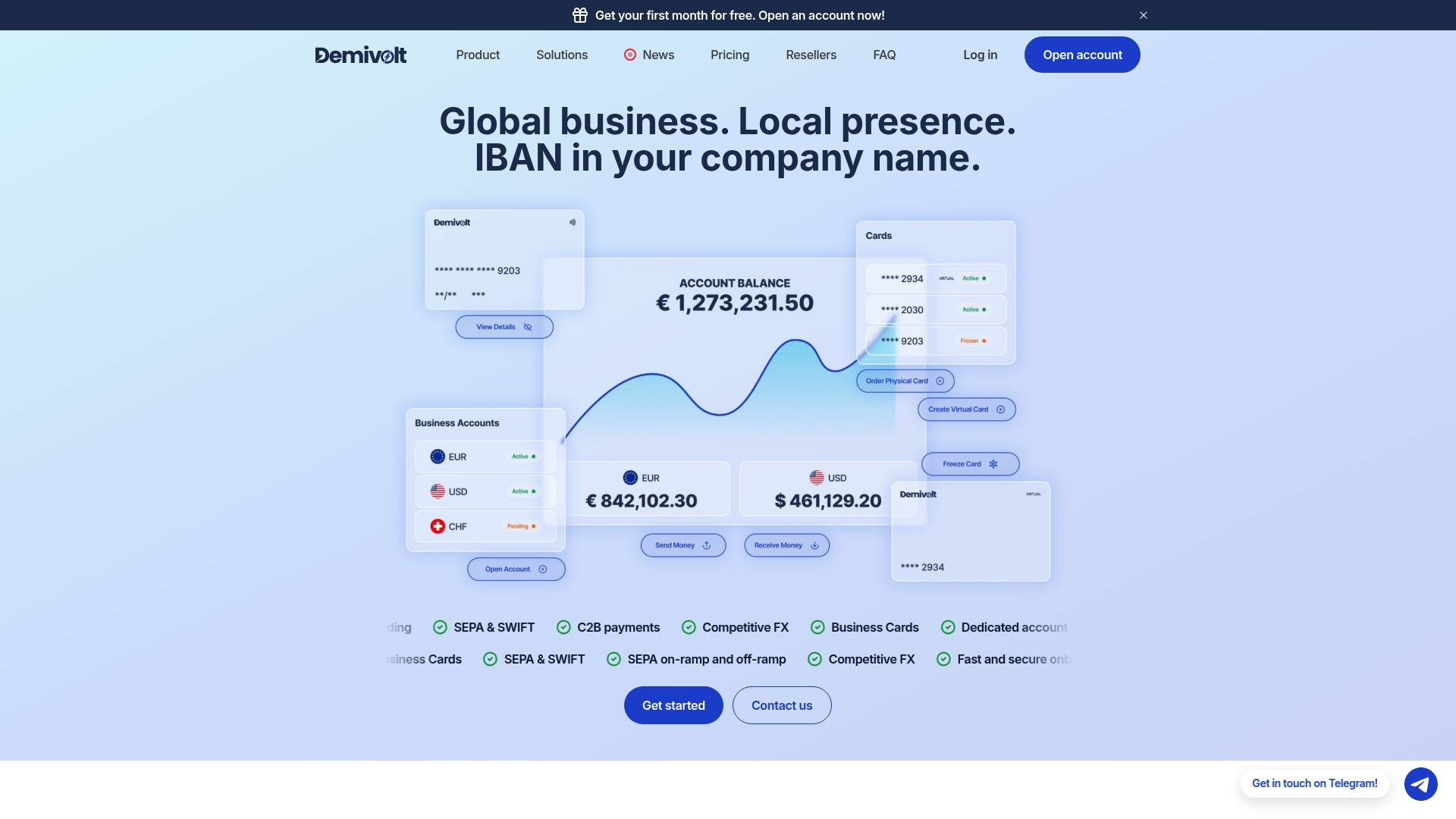
If you are setting up or reorganizing treasury, the account layer is the right first step. Demivolt offers regulated business accounts with dedicated IBANs, SEPA and SWIFT payments, virtual and physical Visa business cards, multi-account structures and role-based user management. Account opening, verification, monthly maintenance and closure carry no fees, and a dedicated client manager is included at no charge.
To see how it fits your company, review our business accounts and payments pages, or get started at demivolt.com. Advisors who guide clients through this setup can also look at our reseller program.
A simple treasury routine for the first 90 days
- Week 1: list all accounts and cards, owners and currencies. Close or consolidate those without a purpose.
- Week 2: define roles and approval thresholds. Decide who prepares, approves and administers.
- Weeks 3 to 4: set up purpose-based accounts and cards. Move recurring payments to the right ones.
- Month 2: start a weekly 13-week cash forecast, with inflows grouped by confidence and assumptions written down.
- Month 3: review SEPA and SWIFT usage against the fee table, batch payments and check cut-off times for your busiest days.
The 13-week horizon is our suggested working practice, not a legal requirement. Adjust it to your sales cycle.
FAQ
What is treasury management in a company?
It is the management of a company’s cash, liquidity, payments and financial risks. Academic work on money-flow management describes its core functions as planning, organization, forecasting and control. In an SME it usually means one view of all accounts, a regular forecast and clear payment approvals.
Does a small company need treasury software?
Not at the start. Cash-management processes can be supported by bank reporting, specialist systems or even Excel, according to a European banking industry paper. What matters first is reconciled data and clear roles. A business account with multiple accounts and role-based access provides much of that structure.
What are the main treasury risks for a business?
The commonly named categories are market risk (currency, interest rate, commodity prices), liquidity risk, credit risk and operational risk, as listed in a Lithuanian academic study of treasury risk. For most SMEs, liquidity and operational risk, meaning failed or unauthorized payments, are the most immediate.
How much do SEPA and SWIFT payments cost with Demivolt?
SEPA In is €0 and SEPA Out is €0.40 per transfer. SWIFT In costs €25.00 and SWIFT Out costs €30.00. Account opening, verification and monthly maintenance are €0. You can estimate your own costs with the SEPA fee calculator.
Sources
- Academic study on money-flow management functions (Vilnius University)
- Managing Corporate Liquidity and Bank Liabilities (European Banking Federation)
- Scaling treasury in growth companies
- Cashflow Visibility for SMEs: Practical Guide
- Treasury risk study (Vilnius University, 2007)
- SEPA-MMS rules (Bank of Lithuania)
- TARGET2-Lietuvos bankas (Bank of Lithuania)
- CENTROlink operating rules (Bank of Lithuania)
- PSD2 payment services directive