

Every card payment involves up to three currencies: the one the merchant prices in, the one the payment is processed in, and the one your card account is held in. When they differ, a conversion happens, and the rate and mark-up applied to it decide what the payment really costs your company. This guide explains which currency counts, who sets the rate, what EU rules require providers to disclose, and how a Lithuanian business can keep conversion costs predictable.
DemivoltManage Cross-Border Business PaymentsDemivolt supports SEPA and SWIFT payments, dedicated IBAN accounts, and business cards for companies operating across borders.Visit DemivoltTL;DR
- The amount you pay is set in the merchant’s transaction currency. It is converted into your card account’s billing currency only when the two differ.
- The conversion normally happens when the payment is cleared and settled, not at the moment of purchase, so the final amount can differ slightly from what you saw at the till.
- In the EU, card conversion charges must be shown as a percentage mark-up over the latest available ECB reference rate, which makes offers comparable.
- When a terminal or ATM offers to charge you in your own currency (dynamic currency conversion), you can choose to pay in the local currency and let your card issuer convert.
- Holding an account in the currency you spend most often removes conversion from many payments altogether.
Table of Contents
- What “payment card currency” means
- Which currency determines the amount charged
- Who sets the exchange rate, and when it applies
- What EU rules require providers to show you
- Dynamic currency conversion: pay in local currency or in yours?
- How card currency affects Lithuanian businesses
- Eight ways to keep conversion costs under control
- Card or bank transfer: choosing for each payment
- Our perspective
- Open a business account with Demivolt
- Which businesses benefit most
- FAQ
- Sources
What “payment card currency” means
The phrase covers two separate things, and mixing them up is the source of most surprises on card statements.
Transaction currency is the currency in which the merchant priced the goods and in which the payment is authorized. A Lithuanian company paying a US software vendor will usually see USD at checkout. A purchase in Vilnius is almost always in euros.
Billing (account) currency is the currency in which the card issuer records your transactions and debits your account. According to Visa’s guidance on cross-border e-commerce, the billing currency is typically the cardholder’s home-country currency, although it can differ, for example on a card issued in a foreign currency. For a company registered in Lithuania, the billing currency is usually the euro.
When both currencies are the same, nothing is converted and the amount on the receipt equals the amount debited. When they differ, a conversion is applied, and that is where rates, mark-ups and fees enter the picture.
Which currency determines the amount charged
The merchant’s transaction currency fixes the price. Your card account currency fixes what you see debited. The link between them is the exchange rate.
A simple example: your company card is billed in euros and you pay a supplier an invoice of 1,000 USD. The merchant’s amount stays 1,000 USD. The card network and your issuer convert it, and your statement shows the euro amount at the applied rate, plus any mark-up the issuer adds. If the supplier is in the euro area, the payment is in euros and no conversion is needed.
Three practical consequences follow:
- The euro figure is not final at checkout. Unless you pay in your billing currency, the final debit is known only after clearing.
- The same purchase can cost different amounts on different cards. The network rate is shared, but each issuer’s mark-up and fees are its own.
- Accounting should record both amounts. Booking the transaction currency amount and the euro debit separately keeps your records consistent with the bank statement.
Who sets the exchange rate, and when it applies
Three parties touch the rate on a typical card payment.
The card network. On multi-currency card products, a transaction in a currency with no linked account is converted to the billing currency using the scheme conversion rate. Networks source their rates from wholesale currency markets and apply the same rate to all issuers for a given currency pair and processing date.
The card issuer. The issuer may add a mark-up or a foreign transaction fee on top of the network rate. Because this part is set by each issuer, it is the one worth comparing. Issuers’ card terms in Lithuania typically state that funds are debited either in the transaction currency or, where the account is in another currency, converted using the issuer’s own rate.
The ECB, as the transparency benchmark. The European Central Bank publishes euro reference rates for major currencies every day, and the Bank of Lithuania republishes them. These are reference values, not rates at which you can trade, but EU law uses them as the yardstick for disclosing mark-ups.

When the conversion actually happens
A card payment is first authorized and later cleared. The conversion is generally based on the rate in effect on the processing date, not on the purchase date. A payment made on a Friday may clear on Monday, and weekend purchases, delayed merchant submissions and offline terminals can all add a gap. For small amounts the difference is minor. For large supplier payments or advertising spend in a volatile currency, it is worth knowing that the final euro amount can move.
What EU rules require providers to show you
The EU has tightened transparency for card conversions inside the Union. Regulation (EU) 2019/518 requires currency conversion charges to be expressed as a percentage mark-up over the latest available ECB euro reference exchange rate. That gives you one common measure: a provider quoting a 1.5% mark-up and one quoting 3% can be compared directly, without reverse-engineering rates.
The same regulation sets a notification duty. When a card payment is made in a Union currency different from the account currency, the payer’s provider must send an electronic message with the conversion charge information without undue delay. For recurring payments in the same currency, the message is sent once each month, and the payer may opt out of receiving it. If your finance team handles many small foreign-currency payments, this message is a useful input for monthly reconciliation.
Clear disclosure of conversion costs is also part of how financial providers earn credibility with business customers, a theme covered in this guide to trust signals in financial content.

No surcharges for paying by card
A separate rule protects the payer: in the EU, retailers are prohibited from charging extra for paying with a credit or debit card under the surcharging ban. If a merchant inside the EU adds a card surcharge for a consumer-type card payment, that is a point to raise with the merchant or your card provider.
Where EU rules stop
Protections for euro payments do not extend everywhere. The ECB notes that rules on equal charges for euro transactions do not apply outside the EU/EEA. A payment to a merchant in the United States, the United Kingdom or Asia follows the network’s rules and the issuer’s terms, so check the conversion costs more carefully for these destinations.
Dynamic currency conversion: pay in local currency or in yours?
Dynamic currency conversion (DCC) is the offer, at a terminal, ATM or online checkout, to pay in your card’s home currency instead of the local currency. It looks convenient, because you see a familiar euro amount. The conversion, however, is then done by the merchant’s or ATM operator’s provider at its own rate, not by your card issuer.
EU rules address this directly. Before a payment is initiated, whoever offers DCC at an ATM or point of sale must inform the payer of the possibility of paying in the local merchant’s currency, allowing the payer’s own card issuer to handle the conversion. The regulation was adopted because a lack of transparency at ATMs and points of sale left customers exposed to expensive, hidden conversion options.
A practical rule for company cards
When a terminal asks whether to pay in euros or in the local currency, the question to ask is which conversion is cheaper and clearer. If your card issuer discloses its mark-up over the ECB rate, you can compare that figure with the rate shown on the terminal slip. Where the terminal’s offer shows no clear mark-up, choosing the local currency and letting your issuer convert keeps the cost tied to a disclosed number. Finance teams often set this as a simple travel policy: pay in the local currency unless the mark-up is shown and lower.
How card currency affects Lithuanian businesses
Lithuanian companies meet foreign-currency card payments daily: SaaS subscriptions in USD, ad platforms billing in other currencies, marketplace fees, supplier purchases at trade fairs. Each conversion adds a small cost, and across a year those costs become a measurable budget line.
A few features of the wider market are worth knowing. The ECB has pointed out that two-thirds of euro area card transactions are governed by the business rules of non-European companies. It also notes that the 2015 Interchange Fee Regulation capped consumer interchange fees at 0.2% for debit cards and 0.3% for credit cards. Interchange is paid between banks, so it is not a charge you see directly, but it shapes the economics of the card products offered to your company and why issuers compete mainly on other fees, including conversion.
Industry news also shows how quickly this area moves. Several providers are building shared cross-border infrastructure, as in the report on five European payment providers launching a shared entity, and card programmes with several currencies are becoming more common, as seen in the launch of a multi-currency Mastercard programme.
Where costs hide
| Cost element | Who sets it | Where you see it |
|---|---|---|
| Network exchange rate | Card network | Implicit in the debited amount |
| Issuer mark-up over ECB rate | Card issuer | Fee schedule, conversion notification |
| Foreign transaction fee | Card issuer | Statement line or fee schedule |
| DCC rate | Merchant or ATM operator’s provider | Terminal slip, checkout page |
| Timing gap between purchase and clearing | Market movement | Difference between receipt and statement |
Eight ways to keep conversion costs under control
- Match card currency to spend. If most of your spending is in euros, a euro-billed card avoids conversion on domestic and euro-area payments.
- Ask for the mark-up as a percentage over the ECB rate. That is the format EU rules require for card conversions, and it makes offers comparable.
- Decline DCC unless the figure is clearly better. Pay in the local currency when in doubt.
- Pay large foreign invoices by transfer rather than card. For high-value supplier payments, a SEPA or SWIFT transfer with a known fee can be more predictable than a card payment converted at clearing.
- Use virtual cards for recurring foreign subscriptions. Dedicated cards make it easier to see which vendor generates conversion costs.
- Set spending limits and merchant controls. Limits per card and per user keep unexpected foreign-currency charges visible. See our guide to merchant blocking on business cards.
- Reconcile monthly. Compare the transaction currency amount, the euro debit and the conversion message your provider sends.
- Protect cards used abroad. Cross-border payments attract more fraud attempts, so review our card fraud prevention guidance for Lithuanian businesses.
Card or bank transfer: choosing for each payment
Cards are convenient for subscriptions, online purchases and travel. Transfers are often better for large, planned payments. Below are the published Demivolt transfer fees, useful as a benchmark when you decide which route fits a payment.
| Payment type | Demivolt fee |
|---|---|
| SEPA In | €0 |
| SEPA Out | €0.40 per transfer |
| SWIFT In | €25.00 |
| SWIFT Out | €30.00 |
| Internal transfers between Demivolt accounts | €0 |
| Account opening, verification, monthly maintenance | €0 |
A euro supplier in the SEPA area costs €0.40 per outgoing transfer, with no conversion at all. You can estimate this with our SEPA fee calculator. For a non-euro supplier, compare the SWIFT fee plus the conversion applied with the card route for the same invoice. For a small recurring charge, a card is normally simpler. For a single large invoice, the fixed fee of a transfer can be easier to budget.
Our perspective
Most cost surprises on business cards come from not knowing which currency is in play at each step. We think a finance lead should be able to answer three questions about any card: what currency it is billed in, how conversion is disclosed, and who can see and control spending.
That is why we build our infrastructure around transparency and control. Our business accounts come with dedicated IBANs, multi-account structures and role-based user management, so a company can separate budgets by purpose and give each team member only the access they need. Our card programmes cover virtual and physical Visa business cards, designed for teams that pay vendors across borders every month.
Our fees are published: account opening, verification and monthly maintenance are free, SEPA Out costs €0.40, and SWIFT fees are listed in full. We believe predictable pricing and a regulated, compliance-first setup, with client funds held in segregated accounts, are what let a business plan its cross-border payments with confidence.
dd
Open a business account with Demivolt
If your company pays and gets paid across borders, a dedicated IBAN account with clear fees is a sound base. With Demivolt you can open a business account with no opening fee, no verification fee and no monthly maintenance fee, manage SEPA and SWIFT payments in one place, and issue cards through our card programmes. Onboarding is risk-based and designed to be fast and transparent.
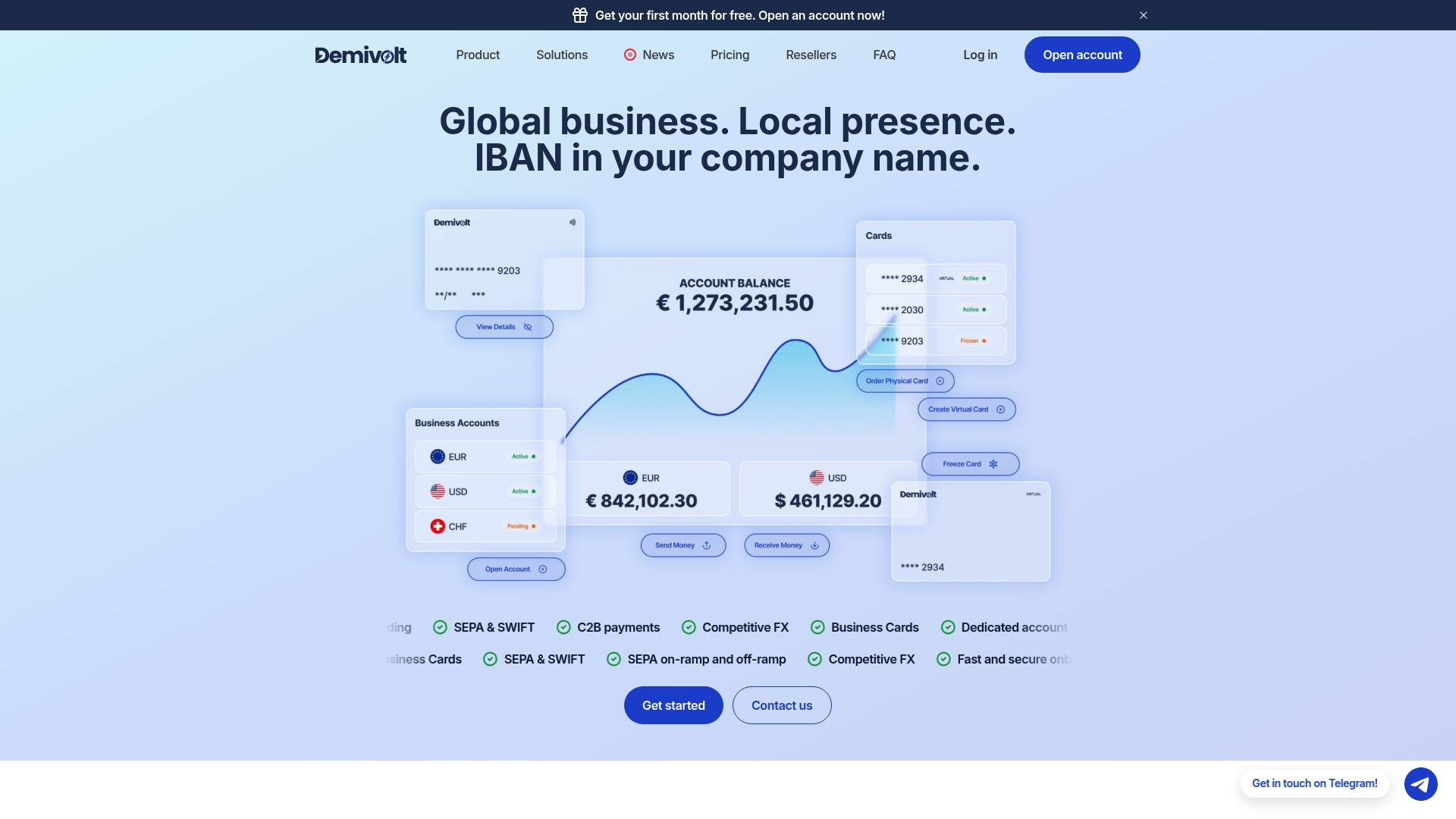
Ready to start? Visit demivolt.com to get started, or contact us to discuss your payment flows. If you are an advisor, our reseller programme lets you refer clients and earn recurring commissions.
Which businesses benefit most
The currency question matters differently by sector. E-commerce companies that pay platform and advertising fees abroad will find our e-commerce payments page relevant. Software companies with USD subscriptions and customers worldwide can look at SaaS business accounts, and traders that settle supplier invoices in several currencies at import, export and wholesale payments. Travel and hospitality teams, who face DCC offers most often, can see travel and hospitality business payments.
FAQ
Which currency will my business card be charged in?
Your card is debited in its billing currency, which for a Lithuanian company is usually the euro. If the merchant prices in another currency, the amount is converted at clearing. If the merchant also prices in euros, no conversion is applied.
Is the exchange rate fixed when I tap my card?
Not usually. The payment is authorized at purchase but converted when it clears, using the rate in effect on the processing date. The final amount can therefore differ slightly from the one you saw at the time of purchase, especially over weekends.
Should I pay in euros or in the local currency at a foreign terminal?
In most cases choose the local currency, so that your card issuer performs the conversion. EU rules require anyone offering dynamic currency conversion to tell you that this option exists. Choose euros only if the terminal’s rate is clearly shown and better than your issuer’s disclosed mark-up.
How can I compare conversion costs between providers?
Ask for the mark-up as a percentage over the latest ECB reference rate. EU Regulation 2019/518 requires card conversion charges to be expressed this way, so a single percentage lets you compare providers directly.
Can a merchant charge me extra for paying by card?
Within the EU, retailers may not add a surcharge for paying with a credit or debit card. If you see one, raise it with the merchant and your card provider.
Sources
- Visa: Optimize Your Cross-Border Ecommerce Payment Acceptance
- Multi-currency card documentation
- Bank of Lithuania: ECB currency reference rates
- Regulation (EU) 2019/518, EUR-Lex
- Your Europe: Electronic and cash payments and rules on surcharges
- ECB: Single Euro Payments Area (SEPA)
- ECB: The digital euro in a fragmenting world
- Trust signals in financial content