

For a sole trader business bank account in Lithuania, open with a regulated EMI holding an unrestricted licence — and evaluate Demivolt as your first-choice platform for dedicated IBAN accounts, SEPA/SWIFT access, and compliant cross-border payment infrastructure.
Three reasons this route works for CFOs:
- SEPA and SWIFT rails. An unrestricted EMI licensed by the Bank of Lithuania can operate EU-wide, giving your business full SEPA credit transfer and SWIFT correspondent access — not just domestic Lithuanian payments.
- Client-funds safeguards. Regulated institutions must segregate client funds or place them in safe, liquid investments per Bank of Lithuania compliance requirements, protecting your operating balances from institutional insolvency.
- API and operational controls. Native API support for payment initiation and transaction webhooks cuts reconciliation overhead and reduces freeze risk during high-volume periods; for practical onboarding and documentation guidance on such compliance processes, see our U.S. Business Bank Account Guide for Non-Residents.
Your immediate next steps:
- Contact your shortlisted provider for a pre-application call to confirm licence scope.
- Verify the provider holds an unrestricted EMI licence (not restricted-activity licences which limit monthly outstanding balances and restrict geographic reach to Lithuania only…
- Prepare your KYC pack: corporate documents, UBO declarations, and a written disclosure of expected cross-border payment flows and volumes.
Key Takeaways
Choosing a regulated, unrestricted EMI in Lithuania is the fastest compliant route to a business IBAN account with full EU SEPA/SWIFT access, client-funds safeguards, and the API infrastructure that modern finance teams require.
| Point | Details |
|---|---|
| Licence scope first | Unrestricted EMI licences enable EU-wide operations; restricted licences cap balances and limit geography. |
| Capital threshold | Unrestricted EMIs must hold a minimum initial capital as specified by regulatory requirements, indicating provider stability. |
| Onboarding timeline | The Bank of Lithuania assesses complete dossiers in approximately three months; pre-application contact shortens the process. |
| Disclose flows upfront | Specific cross-border flow disclosures reduce manual review cycles and lower the risk of account holds. |
| Demivolt | Offers dedicated IBAN accounts, SEPA/SWIFT, multi-currency structures, and API integration for compliant EU operations. |
Table of Contents
- How do providers compare on support and service quality?
- What features matter most for sole trader business banking?
- What finance leaders consistently underestimate about onboarding
- Demivolt: regulated IBAN accounts built for EU operations
- Sources
How do providers compare on support and service quality?
Support quality separates regulated EMIs from each other more than pricing does. The critical variables are response SLAs for payment queries, dedicated account management for business clients, and transparent escalation paths when a transaction is flagged for compliance review.
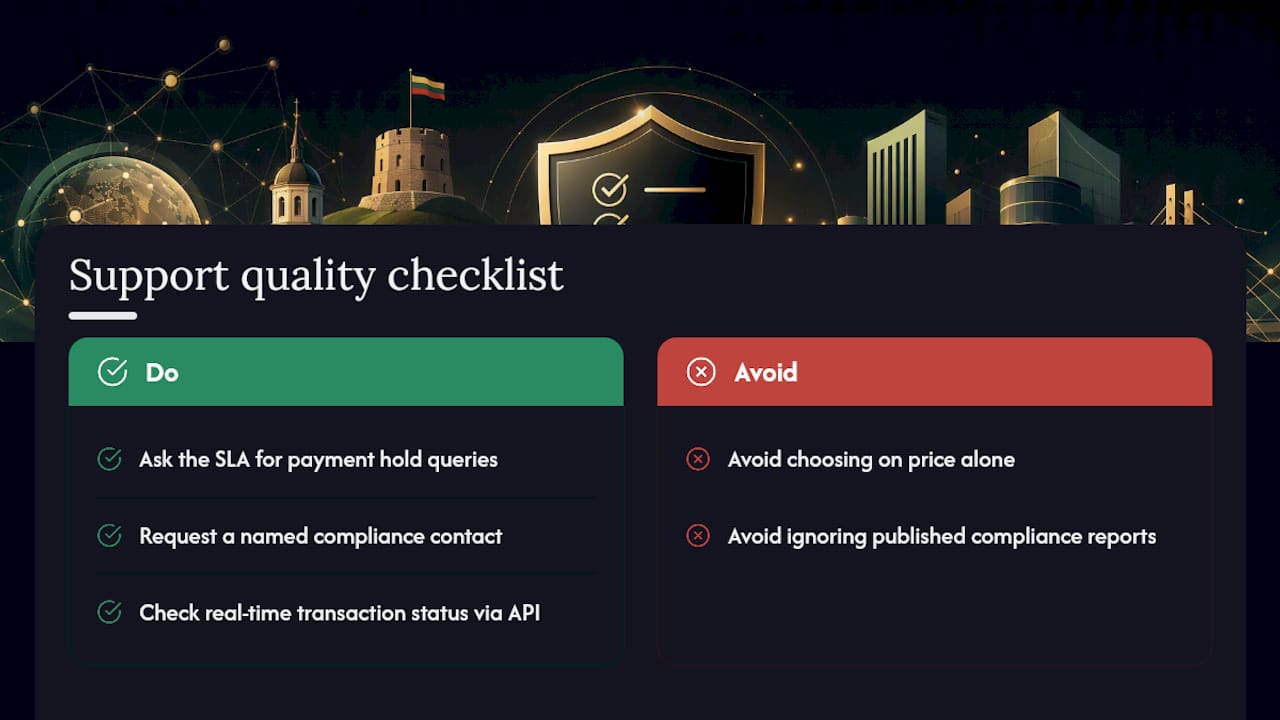
Providers with direct Bank of Lithuania supervision publish Compliance Reports and maintain internal control documentation — both signals of operational maturity. When evaluating options, ask specifically: What is the SLA for a payment hold query? Is there a named compliance contact? Can you access transaction status via API in real time rather than waiting for a support ticket?
Demivolt provides dedicated support for business clients alongside transparent onboarding, which reduces the back-and-forth that typically delays account activation at less structured providers.
What features matter most for sole trader business banking?
The types of business bank accounts that genuinely serve SMEs and digital-first businesses share a consistent feature set. For a sole trader operating cross-border, the non-negotiables are:
- Multi-currency IBAN structures to hold and settle in EUR and other currencies without forced conversion.
- SEPA and SWIFT in a single account — understanding which payment rails fit your flows determines whether you need both or can optimize for one.
- Role-based user access so finance team members can initiate payments without sharing root credentials.
- Virtual and physical Visa business cards for expense control without a separate card program.
- Native API and webhook support for automated reconciliation — far more reliable than CSV exports for high-frequency transaction environments.
SEPA-MMS operating rules require providers to meet ISO BIC (ISO 9362) and IBAN (ISO 13616) standards, hardware/software testing, and capacity opinions before admission. Confirm your provider has passed these prerequisites, not just claimed SEPA participation.
Pro Tip: Ask your provider for sandbox API access before signing. If they cannot provide it within two weeks, that timeline signals how their operational support will perform post-onboarding.
What finance leaders consistently underestimate about onboarding
The licence scope question is where most CFOs lose time. Choosing a restricted-activity EMI because onboarding looks faster is a short-term decision with medium-term consequences: restricted licences carry transaction caps and geographic limits that will force a provider switch once your volumes scale. Confirm unrestricted EMI status in writing before submitting documents.
Cross-border flow disclosure is the other underestimated lever. Proactive, specific disclosure of expected payment corridors, counterparty jurisdictions, and monthly volumes materially reduces manual review cycles with Lithuanian regulators. Vague descriptions (“international payments”) generate follow-up requests; specific ones (“EUR-denominated B2B invoices to EU counterparties, average EUR 150,000/month”) move files forward.
For your onboarding packet, structure the business model description around three elements: what you sell, who you sell it to (jurisdiction and entity type), and how funds flow in and out. That framing matches what compliance teams at regulated Lithuanian EMIs are trained to assess.
The Bank of Lithuania reviews complete application dossiers within approximately three months and encourages pre-application engagement — a timeline that rewards preparation, not speed.
Demivolt: regulated IBAN accounts built for EU operations
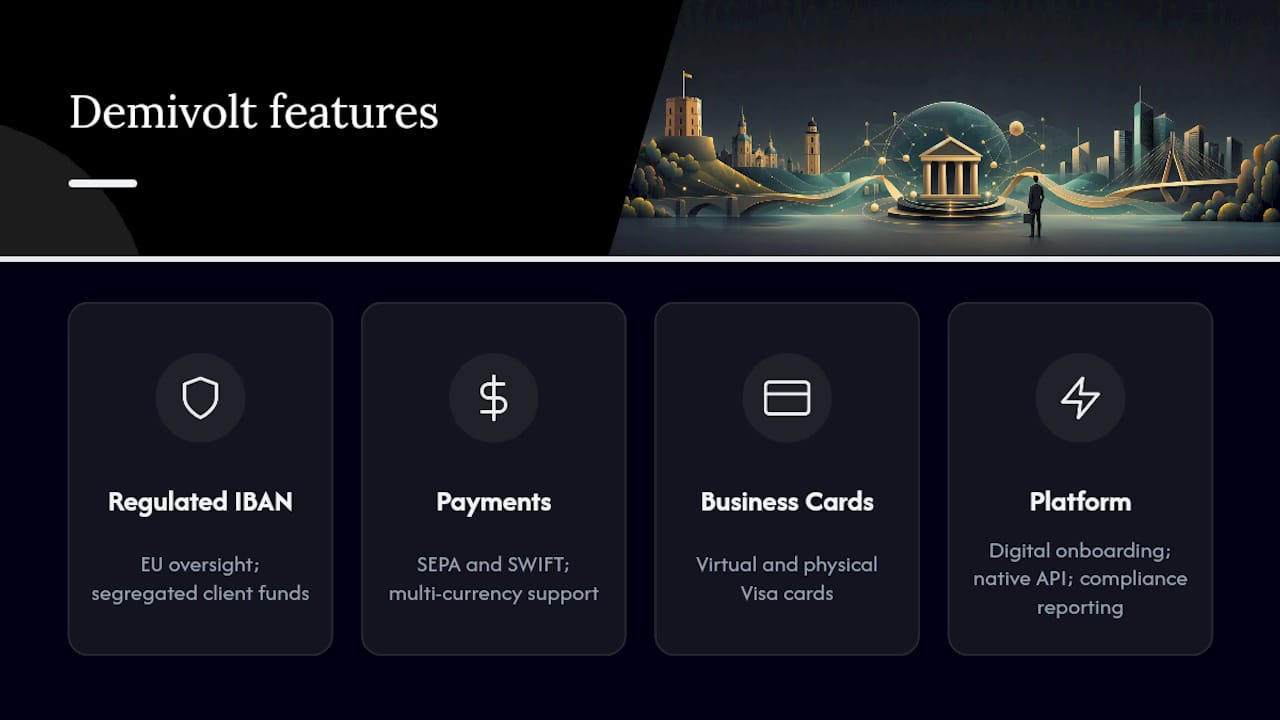
Demivolt gives founders and CFOs a direct path to a compliant, dedicated IBAN account with SEPA and SWIFT payment processing, multi-currency structures, and virtual and physical Visa business cards — all under EU regulatory oversight with segregated client funds.
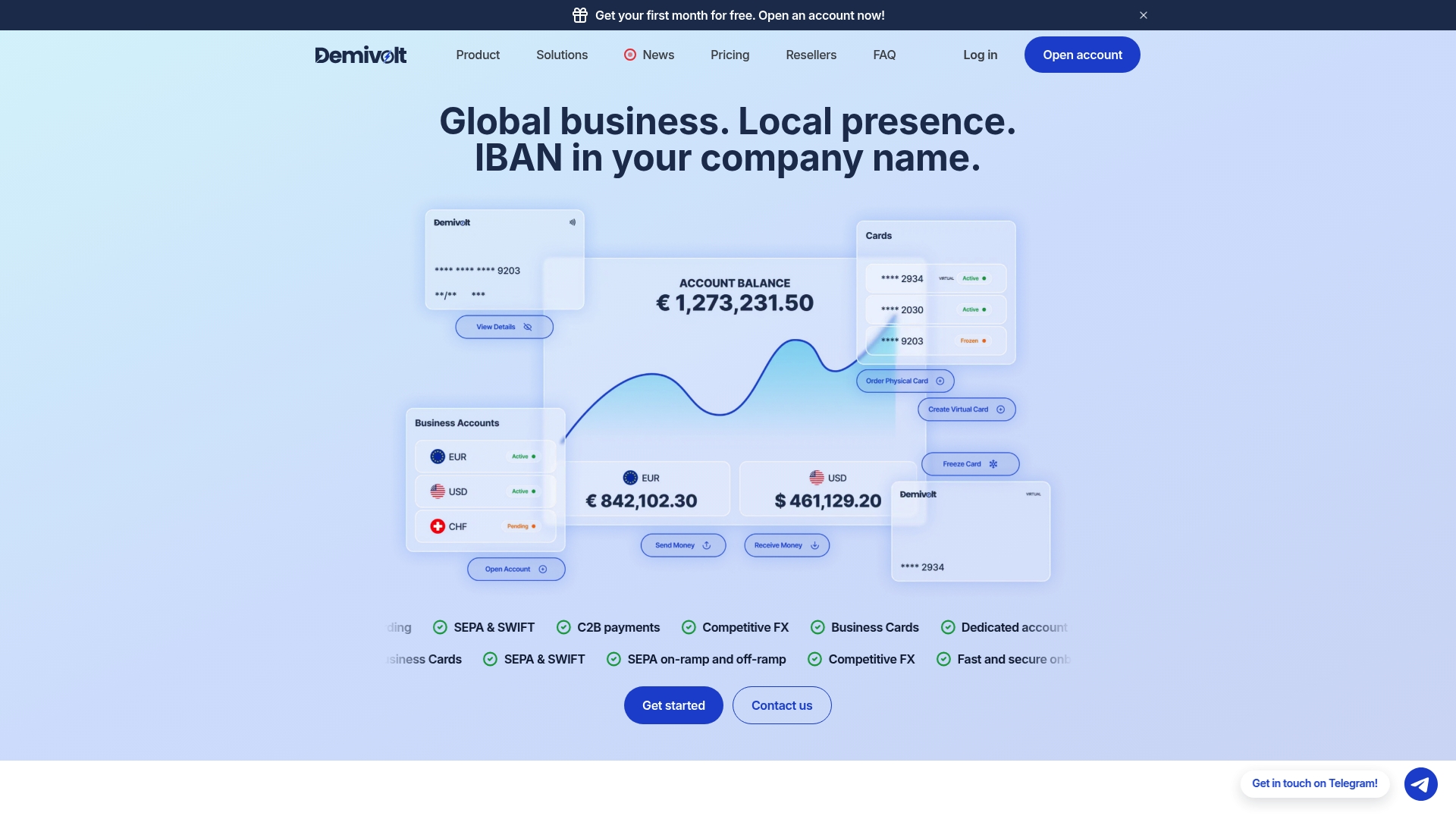
For businesses that need cross-border payment infrastructure without the delays of traditional banking, Demivolt’s digital-first onboarding is built to match the compliance expectations of the Bank of Lithuania. Role-based access, native API support, and transparent compliance reporting are included, not add-ons.
Review Demivolt’s full regulated banking infrastructure at Demivolt and start your pre-application conversation today.
Sources
Finance teams preparing an account-opening or compliance packet should reference these Bank of Lithuania documents directly. Citing the primary source in your cover letter signals regulatory literacy and reduces back-and-forth.
Use the Demivolt IBAN validator to verify ISO 13616 compliance on any IBAN before including it in application documentation or integration test data.