

Why EU banking compliance matters for financial stability
EU banking compliance is not a bureaucratic checkbox. It is the mechanism that keeps European financial systems solvent, trustworthy, and capable of absorbing economic shocks without collapsing onto the public. The global financial crisis of 2008 demonstrated precisely what happens when banks operate without adequate oversight: losses cascade across borders, governments absorb the damage, and households pay the price for years afterward.
The core case for compliance rests on three pillars. First, it protects financial stability by requiring banks to hold sufficient capital and liquidity buffers, so they act as shock absorbers rather than shock amplifiers during downturns. Second, it enforces legal standards uniformly across 27 member states, reducing the regulatory arbitrage that once allowed risk to accumulate in lightly supervised corners of the system. Third, it protects consumers by mandating transparency, anti-fraud controls, and deposit insurance frameworks that give depositors confidence in cross-border institutions.
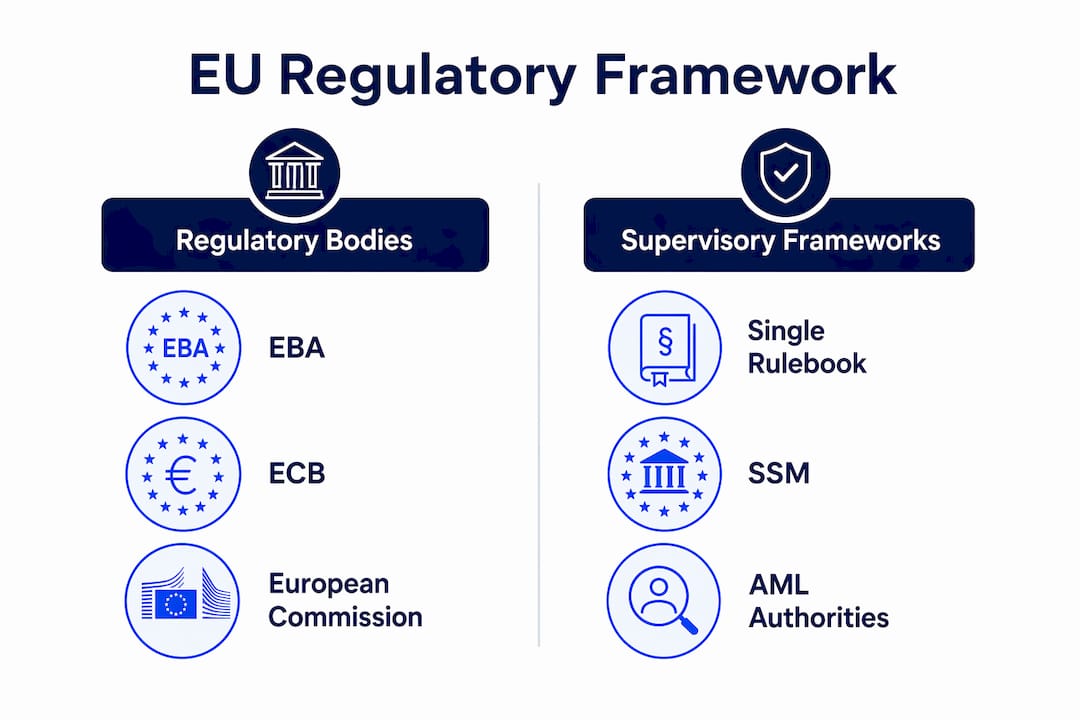
Key institutions driving this framework include:
- European Banking Authority (EBA): Sets binding technical standards and guidelines that apply across all EU member states.
- European Central Bank (ECB): Conducts monetary policy and directly supervises the eurozone’s most significant banks.
- Single Supervisory Mechanism (SSM): Coordinates the ECB and national competent authorities to apply consistent supervisory standards.
- Anti-Money Laundering Authority (AMLA): Centralizes direct AML supervision for high-risk cross-border entities, enforcing technical standards and managing a central AML database.
Non-compliance carries concrete consequences. Banks face fines, operational restrictions, and reputational damage that can cascade globally given AMLA’s centralized supervision and FIU cooperative mechanisms. A compliance failure in one jurisdiction no longer stays contained there.
Table of Contents
- How the EU’s regulatory bodies and supervisory frameworks work together
- Key EU banking regulations every financial institution should know
- How compliance supports risk management and governance in banks
- How digital transformation turns compliance into a competitive advantage
- What compliance failures in EU banking have taught the industry
- How EU banking compliance protects consumers and the broader economy
- How EU banking compliance interacts with international regulations
- Demivolt supports your EU compliance requirements from day one
- Key Takeaways
How the EU’s regulatory bodies and supervisory frameworks work together
The EU’s supervisory architecture is layered by design. No single institution handles everything, and the relationships between bodies matter as much as their individual mandates.
The European Banking Authority
The EBA develops the Single Rulebook, a unified set of prudential rules that applies to all credit institutions across the EU. Its technical standards cover capital adequacy, liquidity requirements, reporting formats, and governance expectations. When member states transpose EU directives into national law differently, the EBA’s binding standards serve as the floor that prevents a race to the bottom.
The European Central Bank and the SSM
The ECB’s supervisory role operates through the SSM, which was established after the financial crisis to ensure that banks across Europe face the same high-quality supervisory standards. The SSM directly supervises significant institutions, while national competent authorities handle less significant ones under ECB oversight. The ECB’s mission is clear: ensuring the safety and soundness of banks so they remain at the service of people and businesses by funding innovation, productivity, and sustainable growth.

Institutional responsibilities at a glance
| Institution | Primary Role | Scope |
|---|---|---|
| EBA | Regulatory standard-setting, Single Rulebook | All EU credit institutions |
| ECB | Monetary policy, direct supervision of significant banks | Eurozone |
| SSM | Coordinated supervision with national authorities | Eurozone significant institutions |
| AMLA | Centralized AML supervision and enforcement | High-risk cross-border entities |
| National competent authorities | Day-to-day supervision of less significant institutions | Individual member states |
Harmonization remains an active challenge. The European Commission’s 2026 reform proposals aim to reduce fragmentation by converting prudential directives into regulations, which would substantially reduce the differences that currently exist when directives are transposed into national legislation. As it stands, there are effectively 27 different national legal environments even in areas intended to be governed by common rules.
Key EU banking regulations every financial institution should know
The regulatory framework governing EU banks spans capital adequacy, anti-money laundering, consumer protection, and sanctions. Understanding the specific rules, not just the general principle of compliance, is what separates institutions that manage regulatory risk from those that get caught off guard.
Capital Requirements Directive and Regulation (CRD IV/V and CRR)
The CRD/CRR framework sets minimum capital buffers, liquidity coverage ratios, and leverage requirements. EU banks hold 3.1 percentage points more CET1 capital than their US peers on average, a direct result of these requirements. That gap increases costs but also explains why European banks weathered recent stress events without systemic failures.
The EU AML package
The EU’s AML package introduces harmonized rules and centralized oversight through four instruments: the AML Regulation (AMLR), the 6th Anti-Money Laundering Directive (AMLD6), the AMLA authority, and updated transfer funds transparency rules. Together, they create a consistent system for combating money laundering and terrorist financing across all member states, replacing the patchwork of national implementations that previously allowed gaps to persist.
The Single Rulebook
The EBA’s Single Rulebook reduces fragmentation by establishing a common prudential framework. Without it, banks operating across borders would face materially different capital, reporting, and governance requirements in each jurisdiction, multiplying compliance costs and creating uneven competitive conditions.
Key compliance obligations for financial institutions include:
- Maintaining capital buffers aligned with CRR requirements and SREP outcomes.
- Implementing customer due diligence and enhanced due diligence under AMLD6.
- Reporting under the EBA’s standardized formats, including COREP and FINREP.
- Integrating sanctions screening into AML workflows, particularly for cross-border payments.
- Meeting consumer protection and transparency requirements under EU directives.
- Preparing for AMLA’s direct supervision if classified as a high-risk cross-border entity.
For institutions managing cross-border compliance, understanding which rules apply at the EU level versus the national level is a practical daily challenge, not a theoretical one.
How compliance supports risk management and governance in banks
Compliance and risk management are not parallel functions. Compliance is the foundation on which sound risk governance is built. A bank that treats them as separate departments typically discovers the hard way that gaps between the two are where material failures originate.

Regulators mandate specific governance structures. Boards and senior management carry direct accountability for risk oversight, capital adequacy, and the adequacy of internal controls. The Capital Requirements Directive requires banks to put processes in place to identify all material risks, and the ECB’s SREP assessments evaluate whether those processes are genuinely effective. Risk data aggregation and reporting was the lowest-scoring sub-category of internal governance in the 2023 SREP, which tells you where many institutions still have structural weaknesses.
Enhanced due diligence, transaction monitoring, and sanctions screening are not optional add-ons. They are the operational expression of a bank’s risk appetite, and regulators treat gaps in these areas as evidence of broader governance failures. When the ECB identifies a deficiency, it sets a time-bound remediation path and escalates supervisory action if the bank does not meet it.
Compliance culture matters as much as compliance processes. An institution where front-line staff understand why controls exist, not just how to follow them, tends to catch emerging risks before they become regulatory findings. Training programs, clear escalation paths, and board-level engagement with compliance outcomes are the practical markers of a culture that takes governance seriously.
Poor compliance creates compounding exposure. Regulatory scrutiny increases, capital requirements may rise through SREP add-ons, and reputational damage affects customer retention and counterparty relationships simultaneously.
How digital transformation turns compliance into a competitive advantage
Leading banks no longer treat compliance as a cost center. They treat it as a process design problem, and the institutions solving it well are pulling ahead on both cost efficiency and regulatory standing.
The shift is toward compliance-by-design: embedding regulatory requirements directly into business workflows rather than layering controls on top of existing processes after the fact. AI-driven transaction monitoring, automated sanctions screening, and real-time regulatory reporting reduce the manual burden while improving detection accuracy. Between 2016 and 2023, employee hours spent on compliance grew by 61% and compliance-related IT budgets grew by 40%. Institutions that automate effectively are containing that trajectory while those that do not are watching it accelerate.
Pro Tip: When evaluating compliance technology, prioritize tools that integrate directly with your core banking system and produce audit-ready outputs. A monitoring tool that requires manual data extraction before reporting adds headcount, not efficiency.
Digital compliance tools also create strategic advantages beyond cost:
- Faster onboarding through automated KYC and identity verification.
- Reduced false-positive rates in AML screening, freeing analyst capacity for genuine risk cases.
- Real-time regulatory reporting that reduces the risk of late submissions and associated penalties.
- Data-driven audit trails that satisfy supervisory requests quickly and completely.
Demivolt’s digital-first infrastructure is built around these principles. Its compliance-first onboarding processes and segregated account structures are designed to meet EU regulatory standards from day one, reducing the compliance burden for businesses operating across borders.
What compliance failures in EU banking have taught the industry
The EU’s post-2008 regulatory architecture was built in direct response to failures, not theoretical risks. Those failures carry specific lessons that remain relevant in 2026.
The global financial crisis exposed what happens when supervision is fragmented and capital requirements are inadequate. Banks in different jurisdictions operated under materially different standards, supervisory cultures diverged, and the risks that mattered most, particularly concentrations and interconnections, fell between supervisory gaps. The ECB has stated directly that light supervision does not work and has repeatedly and expensively failed in the past.
More recent AML failures across European institutions demonstrated a different vulnerability: compliance programs that existed on paper but lacked operational depth. Correspondent banking relationships, cross-border payment flows, and shell company structures were not adequately monitored. The result was not just regulatory fines but fundamental damage to institutional credibility and, in some cases, loss of banking licenses in key markets.
The sovereign debt crisis added another dimension. Feedback loops between banks and their home sovereigns amplified stress in both directions, a dynamic the banking union’s common supervision and resolution frameworks were specifically designed to break. The ECB notes that these feedback loops proved “so harmful during the sovereign debt crisis” that completing the European Deposit Insurance Scheme (EDIS) remains a priority.
Three consistent lessons emerge from these episodes:
- Supervisory gaps across borders create systemic risk that individual institutions cannot manage on their own.
- Compliance programs without genuine operational depth fail under stress, regardless of how well they look on paper.
- Reputational damage from compliance failures compounds quickly, particularly when AMLA’s centralized oversight and FIU cooperation mechanisms bring cross-border scrutiny to bear.
How EU banking compliance protects consumers and the broader economy
The consumer protection case for compliance is direct. Deposit guarantee schemes, transparency requirements, and AML controls collectively ensure that individuals and businesses can trust the institutions holding their money. Without common supervisory standards, depositors in cross-border institutions would have no reliable basis for that trust.
The banking union’s three-pillar architecture makes this explicit: common supervision ensures consistent standards, common resolution provides a framework for managing failing banks, and common deposit insurance would ensure that all depositors enjoy the same protection regardless of where in the euro area they are based. The third pillar, EDIS, remains incomplete, which is why national authorities still retain incentives to ringfence resources within their borders.
At the macroeconomic level, a well-regulated banking sector acts as a buffer during downturns rather than a source of additional stress. Strong and resilient banks are better equipped to lend to the real economy, funding innovation, investment, and growth even during difficult periods. Banking deregulation or more lenient supervision would weaken those foundations directly.
Fragmentation imposes real costs on the broader economy. The European Commission estimates that reforms reducing barriers to cross-border banking could raise EU GDP by about 2% in the long term. That figure reflects how much economic value is currently locked up in a fragmented system where capital cannot flow freely to its most productive uses.
How EU banking compliance interacts with international regulations
EU banking regulation does not operate in isolation. It sits within a global framework anchored by the Basel Committee on Banking Supervision (BCBS), and the interaction between EU rules and international standards shapes how European banks compete globally.
Basel III, developed after the 2008 crisis, sets the international baseline for capital adequacy, leverage, and liquidity. The EU’s CRR/CRD framework implements Basel III with EU-specific adjustments, which is one reason EU banks carry more CET1 capital than their US counterparts on average. The ECB has been clear that this additional capital is a feature, not a bug: it reflects the EU’s decision to implement international standards rigorously rather than selectively.
The European Central Bank’s monetary policy decisions also interact with prudential requirements, since interest rate changes affect banks’ net interest margins, asset valuations, and capital positions simultaneously.
AMLA’s centralized supervision creates a new interface with international AML standards. By managing a central database that includes Financial Intelligence Unit (FIU) collaboration, AMLA connects EU enforcement directly to international financial intelligence networks. For banks with global correspondent relationships, this means that a compliance failure flagged by AMLA can trigger scrutiny from regulators in multiple jurisdictions simultaneously.
The tension between EU-specific rules and international standards also appears in reporting. The ECB’s Integrated Reporting Framework (IReF) initiative aims to harmonize reporting requirements across Europe, reducing the duplication that currently forces banks to submit similar data in different formats to different authorities. Until that harmonization is complete, banks operating across borders carry a reporting overhead that purely domestic institutions do not face.
For institutions managing cross-border payment compliance, the interaction between SEPA rules, SWIFT standards, and national AML requirements creates a compliance matrix that requires both technical infrastructure and clear governance to navigate effectively.
Demivolt supports your EU compliance requirements from day one
EU banking compliance demands infrastructure that is built for it, not retrofitted to meet it. For businesses operating across European borders, the gap between a compliant payment setup and a non-compliant one shows up in onboarding delays, rejected transactions, and regulatory exposure that compounds over time.

Demivolt is a regulated European fintech platform built specifically for businesses that need compliant, digital-first financial infrastructure without the overhead of a traditional banking relationship. Dedicated IBAN accounts, SEPA and SWIFT payment management, segregated client funds, and role-based user controls are all structured to meet EU regulatory standards from the first transaction. Onboarding is fast, transparent, and designed to satisfy KYC requirements without unnecessary friction. For companies involved in cross-border trade, digital services, or SME operations, Demivolt provides the regulated account infrastructure that compliance-conscious businesses need. Validate your payment setup with Demivolt’s free IBAN validator or explore the full suite of SEPA compliance tools to get started.
Key Takeaways
EU banking compliance is the structural foundation that keeps European financial systems stable, legally sound, and capable of protecting both consumers and the broader economy.
| Point | Details |
|---|---|
| Compliance prevents systemic failure | Post-2008 reforms turned EU banks into shock absorbers; light supervision has repeatedly and expensively failed. |
| Three institutions anchor the framework | The EBA sets standards, the ECB supervises significant banks through the SSM, and AMLA centralizes AML enforcement. |
| Capital requirements carry real cost | EU banks hold 3.1 percentage points more CET1 capital than US peers on average, reflecting rigorous Basel III implementation. |
| Digital tools contain compliance costs | Employee hours spent on compliance grew 61% and IT budgets 40% between 2016 and 2023; automation is the primary lever for controlling that trajectory. |
| Demivolt delivers compliant infrastructure | Demivolt provides regulated IBAN accounts, SEPA/SWIFT payments, and segregated funds built to EU regulatory standards for cross-border businesses. |