

TL;DR:
- Business bank statements summarize all account transactions and are essential for reconciliation, tax filing, and fraud detection. They can be accessed in various formats like paper, PDF, or export files, each suited to specific needs such as sharing with lenders or importing into accounting software. Regularly reviewing, securely storing, and understanding each statement detail helps prevent errors, detect fraud, and support financial decision-making.
A business bank account statement is a periodic summary, typically monthly, of every transaction that moved through your business bank account during a defined period, including deposits, withdrawals, fees, and the resulting balances. For small business owners and finance managers, it is the single most referenced financial document across daily operations. Here is why it matters immediately:
- Reconciliation: Match your internal books against the bank’s records to catch posting errors before they compound.
- Tax preparation: Provide auditable evidence of income and deductible expenses without reconstructing records from memory.
- Loan applications: Lenders require several months of statements to verify cash flow and average balances.
- Fraud detection: Unauthorized charges and unfamiliar payees surface here first, often before any other system flags them.
- Cash-flow monitoring: Track seasonal patterns, recurring obligations, and deposit timing across a rolling period.
Statements arrive by mail as paper documents, as electronic PDFs through your bank’s online portal, or as exportable data files you pull on demand. The section on how to access and download your statements covers each method in detail.
Table of Contents
- What counts as a business bank statement: paper, e-statement, or export file?
- Every field on a business bank statement, explained
- How to read an example business bank statement
- How to get your business bank statements
- Six practical uses for business bank statements
- What lenders and auditors actually check on your statements
- How to resolve errors, disputes, and fraud on your statements
- Key Takeaways
- The case for treating your bank statement as a management tool, not a filing obligation
- Demivolt gives you statements built for lenders, auditors, and your accounting team
What counts as a business bank statement: paper, e-statement, or export file?
Not every format serves the same purpose, and knowing which to request before you need it saves time when a lender or auditor asks for documentation on short notice.
| Delivery Method | Typical Content | Security | Best Used When |
|---|---|---|---|
| Paper statement (mailed) | Full transaction list, account summary, check images | Physical; no password required | Lenders requiring certified originals; legal proceedings |
| E-statement (PDF via portal) | Identical to paper; bank-branded, date-stamped | Password-protected portal access | Routine recordkeeping, sharing with accountants |
| CSV export | Raw transaction rows: date, description, amount | Portal access; file is unencrypted | Importing into QuickBooks, Xero, or other accounting software |
| QBO / OFX export | Structured transaction data with category codes | Portal access; proprietary format | Direct bank feed imports into QuickBooks Online or Quicken |
PDF is the right format for human review, lender packets, and audit files. CSV, QBO, and OFX are the right formats for accounting software imports, where manual re-entry would introduce errors. When a lender or court requires an “official” statement, a paper copy or a bank-certified PDF with the institution’s letterhead carries more weight than a self-exported file.
Every field on a business bank statement, explained
A standard U.S. business bank statement follows a predictable structure. Understanding each section lets you spot problems faster and package documents more accurately for lenders or auditors.
Account header
- Bank name, logo, and branch contact details (phone, address)
- Account holder’s legal business name and, if applicable, the DBA (doing business as) name registered with the bank
- Business mailing address on file
- Account number (often partially masked, e.g., ****4821)
- Account type (business checking, business savings, merchant account)
Statement period and balances
- Statement start and end dates (e.g., March 1–March 31)
- Beginning balance: the closing balance from the prior statement
- Ending balance: the balance after all transactions in the period
- These two figures are your reconciliation anchors
Account summary block
- Total deposits and credits for the period
- Total withdrawals and debits
- Total service charges and fees
- Number of transactions (some banks include this)
Transaction detail section
Each row typically shows: posting date, transaction description or payee name, debit or credit amount, and running balance after each transaction. Many statements also include a transaction code or type indicator.
Common transaction codes to recognize:
- ACH: Automated Clearing House transfer (payroll, vendor payments, direct deposits)
- POS: Point-of-sale card purchase
- ATM: Cash withdrawal or deposit at an ATM
- WIRE: Domestic or international wire transfer
- NSF: Non-sufficient funds (a returned payment indicator)
- OD: Overdraft fee or overdraft protection transfer
- SVC CHG: Monthly service charge
Additional elements
Some statements include check images or truncated check numbers, pending transaction notices, promotional messages, and footnotes about fee schedules or rate changes. Pending items are not yet final; they should not be included in a reconciliation until they post.
What to watch for immediately
- Payee names you do not recognize
- Recurring charges you did not authorize
- NSF or OD indicators, which signal timing problems in your cash flow
- Holds that reduce your available balance without a corresponding posted transaction
Pro Tip: Before filing a statement, highlight any transaction you cannot match to an invoice, receipt, or payroll record. Unmatched items are the starting point for both reconciliation and fraud review.
How to read an example business bank statement
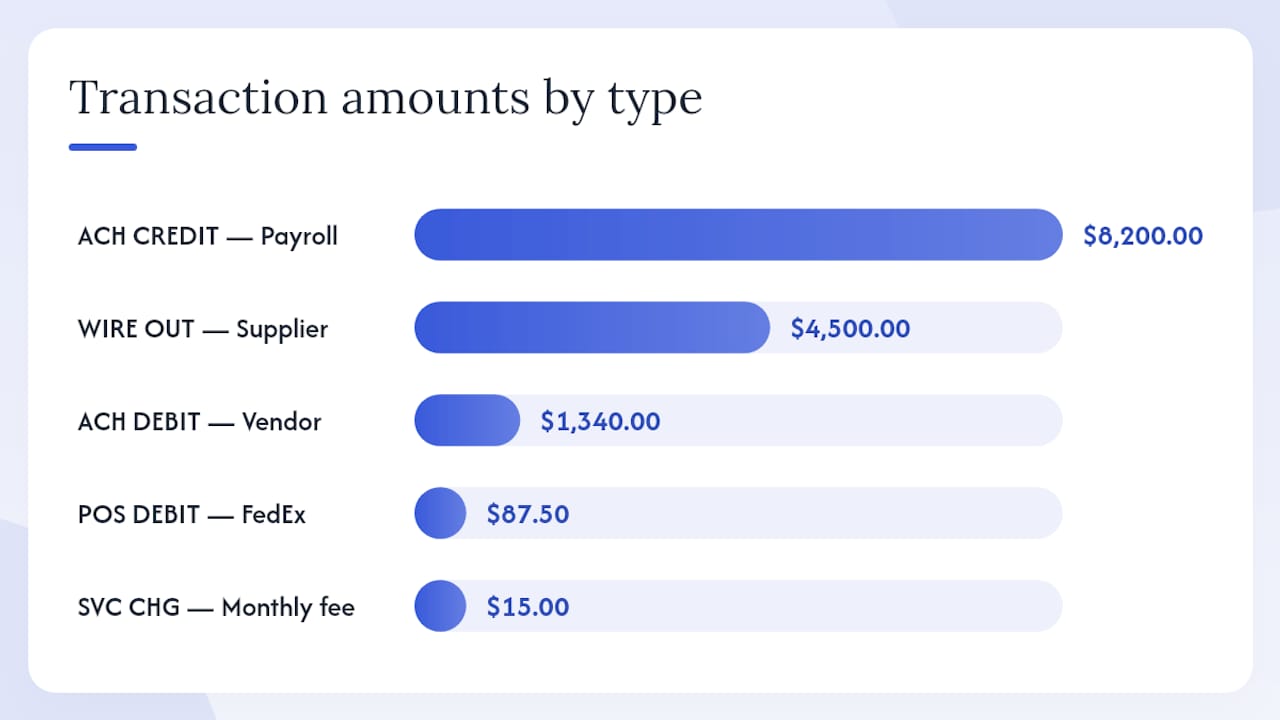
A short annotated excerpt makes the abstract concrete. The following sample represents a single week from a fictional business account and illustrates the most common transaction types you will encounter.
**Sample Statement Excerpt — Acme Supply Co. | Account **4821 | March 1–7
Date Description Debit Credit Balance Mar 1 Beginning balance $12,450.00 Mar 2 ACH CREDIT — Payroll deposit, ADP $8,200.00 $20,650.00 Mar 3 ACH DEBIT — Vendor payment, Office Depot $1,340.00 $19,310.00 Mar 5 POS DEBIT — FedEx Shipping #7743 $87.50 $19,222.50 Mar 6 WIRE OUT — Supplier invoice #INV-2241 $4,500.00 $14,722.50 Mar 7 SVC CHG — Monthly maintenance fee $15.00 $14,707.50 Reading these lines: The ACH credit on March 2 is an inbound payroll funding deposit from ADP. The ACH debit on March 3 is an outbound vendor payment. The POS debit on March 5 is a card charge at a shipping carrier. The wire on March 6 is an outbound international or domestic wire to a supplier. The SVC CHG on March 7 is the bank’s monthly account fee. Each transaction reduces or increases the running balance in the rightmost column.
For SEPA and SWIFT transactions that appear on statements for businesses with cross-border operations, the SEPA vs. SWIFT distinction affects both the transaction code and the processing timeline shown on the statement.
When sharing a statement with a lender or auditor, save a redacted copy with the full account number masked. Keep the unredacted original in a secure, access-controlled folder. Most banks allow you to download statements as PDFs directly from the online portal; store them in a named folder structure by year and month (e.g., /Statements/2025/March/).
How to get your business bank statements
Most U.S. banks make statements available through their online banking portal within one to two business days after the statement period closes.
Downloading from an online portal
- Log in to your business online banking account.
- Navigate to “Statements,” “Documents,” or “Account Activity” (the label varies by bank).
- Select the account and the statement period you need.
- Choose your format: PDF for review or sharing, CSV/QBO/OFX for accounting imports.
- Download and save immediately to a named, dated folder.
Banks typically send e-statements automatically at the end of each statement cycle. If your bank still defaults to paper, switching to e-statements in your account settings gives you faster access and reduces the risk of mail interception.
Requesting certified or historical statements
When a lender, court, or auditor requires an official certified statement, a self-downloaded PDF may not suffice. Use this template as a starting point for a written request:
“I am requesting certified copies of business account statements for account number [XXXX], covering [start date] through [end date]. Please provide them on bank letterhead with an authorized signature or seal. I understand there may be a fee for this service.”
Most U.S. banks charge a per-statement fee for certified copies, typically ranging from $5 to $10 per statement, though fees vary by institution. Turnaround is usually 3–7 business days for branch requests and can be faster for online requests at larger banks.
How far back can you go?
U.S. banks are generally required to retain account records for a minimum of five years under federal regulations, and many retain them for seven years or longer. For accounts closed within that window, you can typically still request historical statements by contacting the bank directly. Always verify the retention policy with your specific institution before assuming access to older records.
Pro Tip: Download the full prior 12 months of statements as PDFs at the start of each new year. Store them in a dedicated folder alongside your tax documents so they are ready when your accountant or a lender asks.
Six practical uses for business bank statements
Business account statements are working documents, not just archive files. Each use case below maps to specific fields or patterns on the statement itself.
-
Reconciliation. Compare every transaction on the statement against your accounting records in QuickBooks, Xero, or your ledger. The beginning and ending balances are your checkpoints. Any gap between the bank’s ending balance and your book balance signals a posting error, a timing difference, or an unauthorized transaction.
-
Tax preparation. Your statement provides a complete, bank-verified record of income and expenses. Accountants and the IRS treat bank records as primary evidence. Highlight deductible expenses (vendor payments, subscription fees, business travel charges) and match them to receipts before filing.
-
Loan applications. Lenders typically request three to twelve months of statements to assess cash flow, average balances, and revenue consistency. Packaging clean, complete statements with explanatory notes for large or unusual transfers speeds up underwriting. The role of financial statements in due diligence extends beyond the bank statement itself, but the bank statement is usually the first document requested.
-
Cash-flow forecasting. A rolling 12-month view of deposits and withdrawals reveals seasonal patterns, payment timing gaps, and recurring obligations. Use the monthly totals from the account summary block to build a simple cash-flow model.
-
Vendor payment verification. Confirm that ACH debits and wire transfers to suppliers posted correctly and on time. Discrepancies between your payment records and the statement can indicate processing errors or, in some cases, payment fraud.
-
Fraud detection. Unauthorized transactions, duplicate charges, and unfamiliar payees appear on statements before most internal systems flag them. U.S. businesses lose an average of $300,000 per year due to invoice fraud, making monthly statement review a first-line control, not an optional one. Cross-reference every ACH debit and wire against approved vendor lists.
For businesses with cross-border transactions, identifying recurring revenue patterns on statements is also critical for lender submissions and partner due diligence.
What lenders and auditors actually check on your statements
Submitting statements to a lender is not simply a document handoff. Underwriters read statements with specific questions in mind, and knowing what they look for lets you prepare a stronger package.
Key lender metrics
- Average daily balance: Lenders calculate this across the statement period to assess liquidity. A balance that swings dramatically from week to week raises questions about cash management.
- Total monthly deposits: The sum of all credits shows gross revenue flowing through the account. Lenders compare this figure across multiple months to assess consistency.
- Deposit volatility: Highly irregular deposit amounts or timing can indicate project-based or seasonal revenue, which affects loan structuring.
- Recurring revenue evidence: Regular, predictable deposits from the same sources signal stable income. Spotting these patterns is one of the most valuable exercises before submitting a loan packet.
- NSF and overdraft frequency: Even one or two NSF events in a 12-month window can raise a flag. Multiple occurrences suggest cash-flow management problems.
- Large unexplained transfers: Lenders will ask about any large inbound or outbound transfer that lacks an obvious business explanation.
Sample lender checklist
- 3–12 months of complete business bank statements (no pages missing)
- Written explanation for any transfer exceeding a threshold the lender specifies (often $10,000 or more)
- Supporting invoices for large deposits, especially if they are irregular
- Evidence of payroll processing (ACH credits from a payroll provider)
- Confirmation that the account is in the business’s legal name
Statistic callout: U.S. businesses lose an average of $300,000 per year to invoice fraud, according to Medius. Auditors reviewing statements for fraud look for the same patterns lenders flag: irregular deposit sources, duplicate payment amounts, and payees that do not match approved vendor records.
Pro Tip: Before submitting statements to a lender, add a brief cover note that explains any large or unusual transactions. Underwriters appreciate context; unexplained anomalies slow approvals.
For compliance-related submissions, business account verification workflows often require statements alongside KYC documentation, particularly for cross-border or regulated transactions.
How to resolve errors, disputes, and fraud on your statements
Finding a problem on a statement requires a clear, documented response. Speed matters: federal Regulation E and similar protections have reporting deadlines, and delays can limit your recovery options.
-
Identify the transaction. Note the posting date, description, amount, and transaction code. Gather any supporting documentation: invoices, receipts, or payment confirmations that contradict the charge.
-
Freeze the affected card or payment method immediately. If the unauthorized transaction involved a business debit card, freeze or cancel it through your online banking portal or by calling the bank’s fraud line. Do not wait to confirm the charge is fraudulent before taking this step.
-
Contact your bank in writing. Submit a formal dispute through the bank’s dispute portal or send a written notice to the address listed on your statement. Include: your business name, account number, the transaction date and amount, a description of why the transaction is disputed, and copies of supporting documents.
-
Document everything. Keep a log of every call, email, and submission, including the name of the representative you spoke with and the date. This record is critical if the dispute escalates.
-
Understand the timeline. For electronic fund transfers, U.S. banks are generally required to investigate disputes within 10 business days and resolve them within 45 days (or up to 90 days for certain point-of-sale transactions). For wire transfers, timelines and recovery options differ and are often more limited.
-
Escalate if necessary. If the bank does not resolve the dispute to your satisfaction, file a complaint with the Consumer Financial Protection Bureau (CFPB) at consumerfinance.gov or with your state’s banking regulator. For suspected criminal fraud, file a report with the FBI’s Internet Crime Complaint Center (IC3) at ic3.gov and preserve all statement records as evidence.
Documentation checklist for disputes:
- Government-issued ID for the account holder
- Full transaction details (date, amount, payee, transaction code)
- Copies of invoices, contracts, or receipts that contradict the charge
- Any prior correspondence with the vendor or payee
- Bank dispute confirmation number
Key Takeaways
Business bank account statements are the foundation of accurate books, credible loan applications, and effective fraud detection — reviewing them monthly is the single most protective financial habit a small business can build.
| Point | Details |
|---|---|
| Reconcile every month | Match your books to the bank’s records monthly to catch errors before they compound across quarters. |
| Package statements for lenders | Provide 3–12 months of complete statements with written explanations for any large or unusual transfers. |
| Run fraud checks on every statement | Cross-reference all ACH debits and wire transfers against your approved vendor list each cycle. |
| Retain records for at least seven years | U.S. banks retain records for a minimum of five years; keeping your own copies for seven years covers most tax and audit windows. |
| Demivolt for exportable, audit-ready statements | Demivolt’s dedicated IBAN accounts and role-based access make downloading clean, lender-ready statements straightforward for SMEs. |
The case for treating your bank statement as a management tool, not a filing obligation
Most small business owners treat their bank statement as something to file after the accountant asks for it. That framing is the source of most avoidable financial problems.
A statement reviewed monthly, against your books, is a live control. It catches the $87 recurring SaaS charge nobody canceled after the employee left. It surfaces the vendor who double-billed in March. It shows the lender, before you apply, that your average balance has been climbing for six consecutive months. None of that happens if the statement sits unopened in a downloads folder.
The seven-year retention recommendation is not arbitrary caution. The IRS has three years to audit a return in most cases, six years if it suspects a substantial understatement of income, and no limit if fraud is alleged. State tax authorities often have their own windows. Keeping seven years of statements costs nothing in digital storage and eliminates the scramble when an inquiry arrives.
Assign reconciliation ownership explicitly. In a solo operation, that is the owner. In a team, it belongs to the person who does not also have payment authorization, which is a basic segregation-of-duties control. Whoever owns it should complete it within five business days of the statement closing date, not at quarter-end.
For businesses operating across borders or managing multiple accounts, dedicated business accounts produce cleaner statements with clearer transaction trails, which directly reduces reconciliation time and strengthens audit packages. The financial control practices that separate high-performing SMEs from reactive ones almost always start here.
Demivolt gives you statements built for lenders, auditors, and your accounting team
The friction most finance managers describe when preparing statement packages for lenders or auditors comes down to one thing: the statements were never designed with that use case in mind. Demivolt solves that at the account level.
With a dedicated IBAN account through Demivolt, your business gets exportable statements in PDF and CSV formats, consolidated multi-account reporting, and role-based access controls that let your accountant or CFO pull documents without touching payment functions. Segregated accounts keep business funds clearly separated, which produces cleaner transaction trails and reduces the annotation work before a lender submission. For businesses managing cross-border payments, SEPA and SWIFT transactions appear with consistent, structured descriptions that map directly to your accounting categories.
If you are preparing a loan packet, running a compliance review, or simply building a monthly reconciliation habit, open a Demivolt business account and have audit-ready statements available from day one. You can also validate IBANs before sharing payment details with partners or lenders, eliminating a common source of documentation errors.
This article provides general information about business bank account statements and is not legal, tax, or financial advice. Confirm current regulations, retention requirements, and dispute timelines with your bank, accountant, or a qualified professional.
Recommended
- Demivolt | Blog – Types of Business Bank Accounts: Find the Right Fit for Your SME
- Demivolt | Blog – Common Online Business Banking Account Errors: SMB Guide
- Demivolt | Blog – Business banking for SMEs: services, compliance & cross-border
- Demivolt | Blog – Managing SME Finances: A Practical 2026 Guide