

An e-commerce payout in Lithuania usually reaches your bank account in two stages. First the platform or payment provider releases the money on its own schedule, which can be every few days, twice a month or monthly. Then the bank transfer itself takes anywhere from about 10 seconds (instant euro transfer) to the next business day (standard SEPA) or longer (SWIFT). This guide separates the two stages, shows real schedules, and explains how weekends, cut-offs and contract terms move the date.
DemivoltManage E-Commerce PayoutsDemivolt provides business accounts with dedicated IBANs and SEPA and SWIFT payments for businesses managing payouts across borders.Visit DemivoltTL;DR
- The total wait is the provider’s release schedule plus the bank transfer time. Marketplaces and platforms control the first part, your bank controls the second.
- Pigu.lt’s marketplace terms pay orders completed on the 1st to 15th on the 12th of the next month, and orders completed on the 16th to month-end on the 27th. Wolt describes payout cycles of every 5 days, twice monthly or monthly, depending on the agreement.
- Standard euro transfers within the EU are credited no later than the next business day. Instant euro transfers must be made available within 10 seconds.
- A payment ordered after the cut-off or on a non-business day counts as received on the next business day, so a Friday evening sale can become a Tuesday deposit.
- If a payout is late, ask the provider to trace it, then complain in writing. A payment service provider must answer a written complaint within 15 business days.
Table of Contents
- Two clocks: provider release and bank transfer
- Release schedules you will meet in Lithuania
- How long the transfer itself takes
- Weekends, holidays and cut-off times
- Contract terms and fees that change the payout date
- Perspective: what we see from the banking side
- Plan your cash flow around the real payout date
- A business account built for receiving payouts
- What to do when a payout is late
- FAQ
- Sources
Two clocks: provider release and bank transfer
Most payout confusion comes from treating “when do I get paid” as one question. It is two.
- The release clock. This starts when the customer pays or when the order is completed, and ends when the platform or payment provider sends the money to you. The rules are set by your contract with that provider.
- The transfer clock. This starts when the provider sends the payout and ends when the funds are credited to your business account. The rules here come from the payment scheme and your bank.
A provider that advertises “payouts in 2 days” may be describing only one of these. Settlement guidance from the payments industry makes the same point: a promise should define the event that starts the clock (authorization, capture or batch submission) and the endpoint (balance availability, payout dispatch or bank receipt), because these are different milestones. Before you sign, ask which two events the provider means.
Release schedules you will meet in Lithuania
Payout cycles differ by channel. Three patterns cover most Lithuanian online sellers.
Marketplaces with fixed monthly dates
Pigu.lt is the best-known local example. Its Lithuanian marketplace terms state that orders completed from the 1st through the 15th are paid on the 12th of the following month, and orders completed from the 16th through month-end on the 27th. In practice, an order completed on the 2nd of a month waits roughly 10 days for the first window, while an order completed on the 15th waits almost four weeks. An order completed on the 16th waits about 11 days for the second window, while one completed on the 31st waits nearly four weeks.

This matters for cash flow planning. Sales completed just after a cut-off date wait the longest, and a seller who restocks weekly will feel it.
Delivery and service platforms with negotiated cycles
Platforms such as Wolt do not apply one rule to everyone. Wolt’s merchant guidance for Lithuania says that payout cycles depend on the agreement and country, with common arrangements of every 5 days, twice monthly or monthly. Your own contract is the only reliable source for your cycle.
Your own web shop with a payment gateway
If you run your own e-shop, the gateway or acquirer sets the rhythm. Common arrangements are a fixed number of business days after the transaction, or daily or weekly batches. Card payments, bank-link payments and wallet payments can follow different schedules inside the same gateway, so read the settlement section for each method separately. Do not assume that a bank-link payment, which the customer sees as instant, reaches you faster than a card payment.
A worked example shows how this stacks up. Suppose your gateway settles card sales in weekly batches every Monday and sends the money by standard SEPA transfer. A customer pays on Tuesday. The batch closes the following Monday, the transfer is ordered that day, and under standard SEPA rules the credit arrives no later than Tuesday. That is a wait of about a week from sale to bank account, and almost none of it is the bank’s doing.

How long the transfer itself takes
Once a provider sends your money, the second clock runs. The relevant rules are well defined for euro payments.
Standard SEPA credit transfers
The Association of Lithuanian Banks’ recommended payment service rules say that covered euro domestic and intra-EU payments are credited no later than the following business day. Many transfers arrive the same day, but the guaranteed outer limit is the next business day.
Instant euro transfers
Regulation (EU) 2024/886 defines an instant euro credit transfer as one executed immediately, 24 hours a day and on any calendar day. For covered transfers, the payee’s provider must make the funds available within 10 seconds of receiving the order and apply the same value date as the credit date. If confirmation does not arrive within 10 seconds, the payer’s provider must immediately restore the payer’s account, so a failed instant transfer does not leave money in limbo. For a seller, this means that if your provider pays out by instant transfer, the transfer clock is effectively zero, including on weekends. The provider’s release schedule is then the only wait. Whether your provider uses instant transfers for payouts is a question for its terms, not an assumption.
SWIFT payments
Payouts from outside the euro area, for example from a marketplace paying in US dollars, normally travel by SWIFT through correspondent banks. There is no single statutory deadline comparable to the SEPA rules, so the timing depends on the sending bank, intermediaries and currency cut-offs. SWIFT also costs more at both ends. At Demivolt, an incoming SWIFT payment costs €25.00 and an outgoing one €30.00, compared with €0 for an incoming SEPA payment and €0.40 for an outgoing one. If a marketplace offers you a choice between a euro SEPA payout and a SWIFT payout, SEPA is nearly always cheaper and more predictable.
| Payment route | Typical timing rule | Demivolt fee to receive | Demivolt fee to send |
|---|---|---|---|
| Instant euro transfer | Funds available within 10 seconds, any day | Not listed separately | Not listed separately |
| Standard SEPA | Credited no later than the next business day | €0 | €0.40 |
| SWIFT | Depends on banks and intermediaries | €25.00 | €30.00 |
Weekends, holidays and cut-off times
The same Lithuanian banks’ rules state that an order received after the cut-off time, or on a non-business day, is deemed received on the next business day. The next-business-day limit then starts from that later day.
Here is what that does to a real week:
- Friday after the cut-off. The provider sends a standard SEPA payout at 18:00. It counts as received on Monday, and the credit is due by Tuesday.
- Before a Lithuanian public holiday. A payout sent the afternoon before, for example before 16 February or 11 March, may count as received on the next working day after the holiday.
- A provider that pays only on business days. Its release date may itself shift, even if the schedule says “the 12th” or “the 27th”.
Cut-off times are set by each bank or provider, so check yours. For a detailed look at how cut-offs produce one-day delays and how instant payments change the picture, see our guide on SEPA cut-off times and the instant payments rollout.
Two more factors that sellers often miss:
- Payment method mix. A customer who pays by bank transfer can add a day before your provider even sees the money, while a card payment is authorized immediately but settled later.
- Refunds and disputes. Providers often net refunds and chargebacks against the next payout, which makes the amount smaller or the release later. Our article on chargeback management for businesses in Lithuania explains how to keep these deductions predictable.
Contract terms and fees that change the payout date
A provider’s headline schedule is not the whole story. These terms commonly change when money is actually released:
- Rolling reserves or holdback. Part of your sales is kept for a period as security against refunds and chargebacks.
- Minimum payout thresholds. Balances below a set amount wait for the next cycle.
- Verification holds. A new seller, a changed bank account or an unusually large sale can pause release while the provider checks the account.
- Enhanced monitoring. The Bank of Lithuania reported that some financial institutions charged €50 to €150 for enhanced monitoring of transfers involving higher sanctions risk, while saying that separately passing on mandatory statutory compliance work is generally inconsistent with the definition of a payment service commission.
There is also a legal floor. The Bank of Lithuania states that payment service terms and framework contracts must disclose required information, including the maximum execution time, and cannot override statutory rules on execution times or liability. The distinction is worth remembering: a platform can legitimately choose when it sends your sales proceeds under your commercial agreement, but once a payment order has been placed, the bank-side execution rules apply and cannot be contracted away.
The wider legal framework is listed by the Bank of Lithuania, which names Regulation (EU) 260/2012, the card interchange fee regulation and the Payment Services Directive framework among the legislation governing the Lithuanian payments market.
Perspective: what we see from the banking side
We run business accounts and payment infrastructure for companies operating in and out of Lithuania, so we see the transfer clock from the receiving end. Our view is simple: the part of the wait that sellers can control most easily is the part they check least.
Most businesses compare commission rates and ignore the settlement terms. Yet a seller with thin margins feels a 27-day release window more than a half-point difference in fees. We recommend asking every provider three questions in writing: which event starts the clock, which event ends it, and which payment rail is used for the payout.
The second lever is the account that receives the money. A dedicated IBAN in your company’s name, held with a regulated institution that keeps client funds in segregated accounts, means payouts land in an account built for business flows rather than a personal-style account that triggers extra questions. Incoming SEPA payments to a Demivolt account are free, and internal transfers between Demivolt accounts cost nothing, which keeps the cost of moving your own money between entities or currencies low.
The third lever is planning. Treat the release date plus one business day as your working date, and never schedule a supplier payment on the exact day a payout is promised. Regular cut-off and weekend effects explain most of the “late” payouts we are asked about, and the rest usually come from verification holds that a complete onboarding file would have avoided. If you also pay out to others, for example sub-sellers or partners, splitting flows correctly matters as much as speed, and our piece on escrow and split payments in Lithuania covers it.
— dd
Plan your cash flow around the real payout date
A practical routine takes about an hour to set up and saves repeated surprises.
- List every sales channel. Marketplace, own web shop, delivery platform, invoice sales.
- Write down the release rule for each. Fixed dates, rolling days or negotiated cycles, from the contract and not from the marketing page.
- Add the transfer time. Same day to next business day for SEPA, longer for SWIFT, near zero for instant.
- Add a weekend and holiday buffer. One extra business day is a reasonable planning default.
- Build a calendar. Mark the expected credit date per channel and compare it with your payment dates to suppliers, payroll and taxes.
- Reconcile every payout. Match each credit to the orders it covers, so deductions for refunds, fees and reserves are visible.
For reconciliation it helps to have separate accounts per channel or currency. Linking them is covered in our practical guide to linking business bank accounts in Lithuania. The principle behind faster cash conversion applies beyond e-commerce: tighter terms and clear invoices that get paid faster shorten the gap between work done and money received, whatever the sales channel.
If your developers handle payment notifications, reliable event handling also prevents false “missing payment” alerts. See our guide to payment webhooks for Lithuanian developers.
A business account built for receiving payouts
Demivolt is a regulated European fintech platform that gives companies a dedicated IBAN, SEPA and SWIFT payments, virtual and physical Visa business cards, multi-account structures and role-based user management. Client funds are held in segregated accounts. Account opening, verification, a dedicated client manager and monthly maintenance all cost €0, so receiving marketplace and gateway payouts does not add a standing cost.
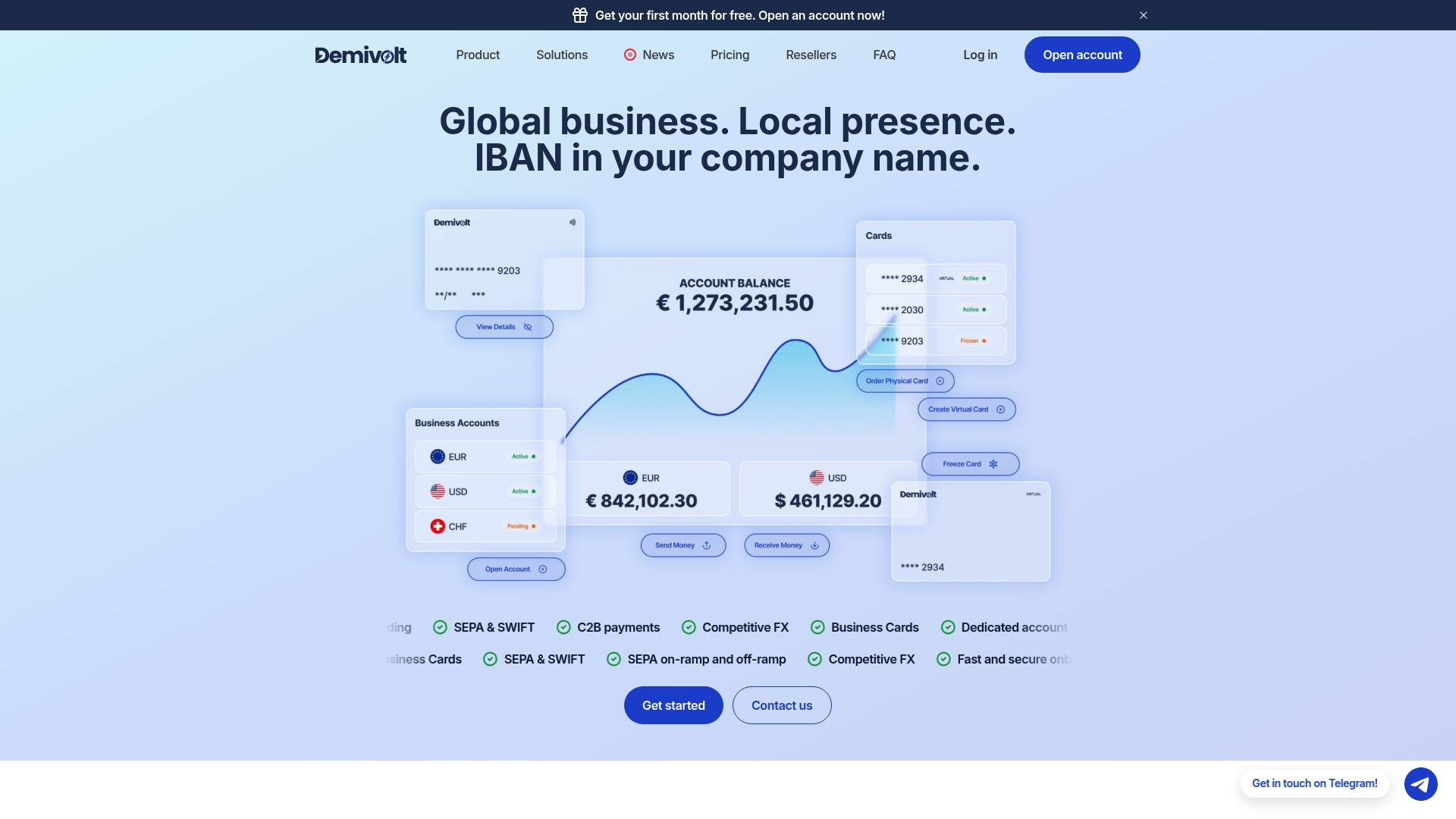
If you collect e-commerce proceeds in euros, a Demivolt business account gives you a dedicated IBAN to name as the payout destination. For outgoing flows, see our payments solution, and use the SEPA fee calculator to estimate the €0.40 cost per outgoing transfer. Ready to start? Get started or contact us through demivolt.com.
What to do when a payout is late
Work through these steps in order. Keep every message in writing.
- Check the schedule first. Confirm the release date for that order, including cut-off dates and any holiday or weekend shift.
- Check for holds. Look in your provider dashboard for verification requests, reserves, refunds or chargebacks netted against the payout.
- Get the transfer reference. Ask the provider for the payout’s reference number and the date it was sent.
- Ask your bank to trace it. If the provider says the money has been sent but you cannot see it, the Bank of Lithuania’s guidance is that you can ask the financial institution to trace a stuck payment and provide evidence and instructions.
- File a written complaint. A payment service provider must generally reply in detail, with reasons and documentation, within 15 business days.
- Escalate if needed. If the answer is unsatisfactory, contact the Bank of Lithuania, which supervises payment service providers in Lithuania. For disputes about card payments, see also why the same card payment may appear twice.
For larger payout volumes, consider the risk side as well. Our overview of payment risk management for businesses in Lithuania explains how reserves and holds are typically justified.
FAQ
How long does an e-commerce payout take in Lithuania?
There is no single answer. The provider’s release schedule can range from a few days to about four weeks, as Pigu.lt’s twice-monthly dates show. After release, a standard SEPA transfer is credited no later than the next business day, and an instant euro transfer within 10 seconds.
Why did my payout arrive on a Tuesday instead of Friday?
Most likely it was sent after the cut-off on Friday or on a non-business day. Such orders count as received on the next business day, and the next-business-day credit limit starts from there.
Are instant payouts available on weekends?
Instant euro transfers are defined as executing 24 hours a day on any calendar day. Whether your platform sends payouts that way depends on its terms, so ask it directly which payment rail it uses.
Can a platform hold my money longer than its published schedule?
Yes, if your agreement allows reserves, verification holds or minimum thresholds. These terms should be disclosed in your contract. Statutory execution times for payment orders cannot be overridden by contract, but the commercial release date under your sales agreement is a matter of that agreement.
Do SWIFT payouts cost more than SEPA payouts?
Usually yes. On a Demivolt account, receiving a SWIFT payment costs €25.00 against €0 for SEPA, and sending one costs €30.00 against €0.40. Choose a euro SEPA payout when the platform offers it.
Sources
- Prekiaukite per Pigu.lt, marketplace terms
- Wolt merchant fees and commissions explained
- Regulation (EU) 2024/886, Official Journal of the European Union
- Recommended payment service rules, Association of Lithuanian Banks
- Bank of Lithuania, financial services and markets review 2023
- Bank of Lithuania, legislation regulating the payments market
- Payment settlement SLAs: what to agree before choosing a provider
- Invoices that get paid faster