

Electronic Money Institution Licence: What It Is and How to Prepare

An electronic money institution (EMI) licence is a regulatory authorisation to issue electronic money and provide payment services. It is granted by a national regulator, such as the FCA in the UK or the Bank of Lithuania in the EU. Getting one means building a regulated business: capital, governance, safeguarding and anti-money-laundering controls that a supervisor will examine in detail. Most of the work is preparation, and our compliance team supports it. We are an EMI ourselves, authorised by the Bank of Lithuania under licence No. 77, so we know what the process asks of a company.
DemivoltPrepare for EMI Licence ReadinessDemivolt supports businesses preparing for licensing with assessments, AML/CTF frameworks, onboarding procedures and regulatory policies.- ✓Business model and regulatory readiness assessments
- ✓AML/CTF frameworks
- ✓KYC/KYB onboarding procedures
- ✓Policies and procedures
TL;DR
- An EMI licence lets a firm issue e-money, hold customer funds in e-money accounts and provide payment services under one authorisation.
- In the UK there are two routes: an authorised EMI (AEMI) and a small EMI (SEMI), split by the volume of e-money outstanding and payment transactions.
- A full EMI licence in the EU and Ireland requires initial capital of €350,000, plus governance, safeguarding and AML controls that scale with the business.
- Timelines are set by the regulator: in Lithuania the statutory assessment period is up to three months once the file is complete.
- Readiness work done before submission, on the business model, policies and AML framework, decides how smoothly the application runs.
Table of Contents
- What an electronic money institution licence is
- EMI or payment institution licence: which does a business need?
- UK routes: authorised and small EMI
- Capital, governance and safeguarding
- What the application contains
- How long it takes and what it costs
- How to prepare before you apply
- Where Demivolt helps
- Our perspective
- FAQ
- Sources
What an electronic money institution licence is
Electronic money is a claim on the issuer, stored electronically, issued when a customer hands over funds and accepted as a means of payment by someone other than the issuer. That is how the Central Bank of Ireland defines it, following the EU’s Electronic Money Directive (2009/110/EC). An EMI is a company authorised to issue it.
In practice, the licence sits behind the business accounts, prepaid products and card programmes that many companies use daily. The customer’s balance is e-money, and the institution must safeguard the funds behind it.
Under the UK’s Electronic Money Regulations 2011, regulation 32, an EMI may do more than issue e-money. It can also:
- provide payment services;
- offer closely related services such as foreign exchange, safe-keeping and data processing;
- operate payment systems;
- carry on other business activities.
This breadth is why the EMI licence is often described as an upgrade on a payment institution licence.
EMI or payment institution licence: which does a business need?
The test is whether you will issue e-money. A payment institution (PI) executes payments but does not issue e-money. If your product holds balances for customers that they can spend, redeem or send on, you are normally in EMI territory.
The FCA’s guidance in PERG 3A says a payment institution that also wants to issue e-money should cancel its PI authorisation and apply as an EMI. An EMI does not need a separate authorisation to provide payment services.
A simple way to decide:
| Question | Points towards |
|---|---|
| Will customers hold a balance with you that they can spend or redeem? | EMI |
| Will you only move money on instruction and never hold a stored balance? | Payment institution |
| Do you plan to issue your own branded cards backed by customer balances? | EMI, or a partnership with an existing issuer |
| Are you a licensed firm planning to widen into e-money? | EMI application, replacing the PI authorisation in the UK |
If you are unsure, a readiness assessment of the business model settles the question before any application is drafted. That is the first item in our compliance services.
UK routes: authorised and small EMI
The FCA’s application page sets out the decision. A firm projecting average outstanding e-money above €5 million must apply to become an authorised EMI. At or below €5 million it may register as a small EMI. A small EMI must keep its monthly average payment transactions under €3 million and cannot provide account information or payment initiation services.
Banks, credit unions and municipal banks use a different route, a Part 4A permission under the Financial Services and Markets Act 2000.
The small route is lighter. The authorised route carries the full set of requirements and suits a business with growth plans. A firm with ambitions beyond the small limits often designs its model for the authorised route from the start, so it does not have to re-plan later.
Capital, governance and safeguarding
Regulators in different countries ask for the same core things. The FCA lists them for authorised EMIs:
- adequate initial capital;
- robust governance, internal controls and risk management;
- qualifying holders (significant owners) who are fit and proper, and directors of good repute with suitable knowledge and experience;
- safeguarding of e-money holders’ funds;
- compliance with the Money Laundering Regulations;
- a structure that does not impede effective supervision.
Capital figures by jurisdiction
Capital differs by country, so always check the regulator that will license you.
| Regulator | Full EMI initial capital | Notes |
|---|---|---|
| Bank of Lithuania | €350,000 | A restricted-activities licence is exempt from the minimum capital but is valid only in Lithuania, with average outstanding e-money capped at €900,000 per month |
| Central Bank of Ireland | €350,000 | €125,000 for a small EMI (May 2025 guidance) |
| Gibraltar FSC | Greater of €350,000 or 2% of projected e-money outstanding plus a 20% risk adjustment | Plus any additional buffer, or wind-down costs if higher |
The capital is a floor. Regulators also expect a calculation of ongoing capital tied to your projected e-money volumes, and a wind-down plan showing how customers would be repaid if the business failed.
Safeguarding
Safeguarding means customer funds are held separately from the firm’s own money, so they are protected if the firm gets into difficulty. It is the part of the regime customers and partners ask about first. For a Lithuanian example of how this works in practice, see our guide to safeguarded funds at an EMI in Lithuania.
What the application contains
The application is a large body of documents, not a form. The FCA’s supporting material list includes:
- a programme of operations and business plan with financial information;
- details of each responsible individual and qualifying holder;
- anti-money-laundering control mechanisms;
- evidence of initial capital and the ongoing capital calculation;
- safeguarding measures;
- governance arrangements and a wind-down plan;
- incident reporting and sensitive payment data procedures;
- business continuity, security and complaints policies;
- outsourcing arrangements.
The Gibraltar FSC splits its process into three stages: business model, capital and key individuals first, then risk management, IT systems, governance and financial crime, then conduct of business, policies and regulated individual forms. The Belgian regulator requires an informal intake meeting before any draft application. The sequence varies, but the content is consistent: a regulator wants to see that the model works, the people are suitable and the controls are real.
How long it takes and what it costs
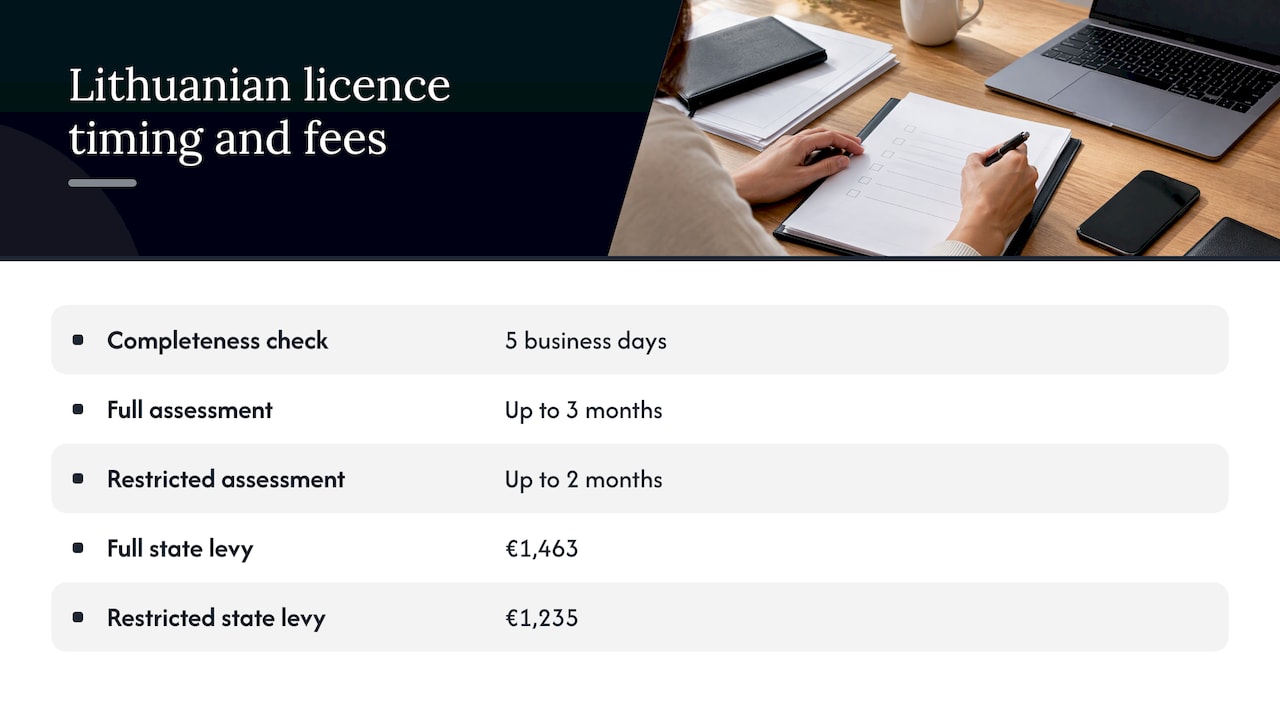
Timelines and fees are set by each regulator. In Lithuania, the Bank of Lithuania checks completeness within five business days. If the documents are complete, assessment takes up to three months, or two months for a restricted-activities licence. If the Bank asks for more information, the period runs from receipt of it. The state levy is €1,463 for a full EMI licence and €1,235 for a restricted-activities licence, paid before applying.
Those are statutory periods and official fees, not the total cost. The larger costs are the capital you must hold, the people you employ and the policies and systems you build. A file that has to be amended repeatedly takes longer than one that was complete at the start.
How to prepare before you apply
The Bank of Lithuania encourages applicants to contact it early to discuss planning and which services need licensing. It also notes that scrutiny scales with the scope of activities, so a narrower plan means a smaller dataset and potentially a faster assessment. Belgium makes early engagement mandatory. The lesson is the same everywhere: settle the model before you write the documents.
A sensible preparation sequence:
- Define the regulated activities. List exactly what you will issue, hold, move and redeem, and which of those activities need a licence. Keep the first scope tight.
- Test the business model against the rules. Check projected volumes against the thresholds for the licence type, such as the €5 million and €3 million UK limits.
- Build the AML and sanctions framework. This covers customer due diligence (KYC and KYB for companies), transaction monitoring, and sanctions and politically exposed person (PEP) screening.
- Write the policies and procedures. Governance, safeguarding, complaints, business continuity, outsourcing and incident reporting all need documented owners and processes.
- Prepare the people. Directors and qualifying holders will be assessed, and staff need training on the procedures you have written.
- Plan capital and the wind-down. Model the ongoing capital requirement against your projections, not only the initial minimum.
- Meet the regulator early. Use pre-application contact where it is offered, and where it is mandatory, treat it as the start of the process.
The same documents are tested again later. Banking partners, card sponsors and other counterparties run their own due diligence, and a company with a coherent AML framework and clean policies passes it more smoothly.
Where Demivolt helps
Our compliance services cover the preparation work above. They include business model and regulatory readiness assessments, AML/CTF frameworks, KYC/KYB onboarding procedures, transaction monitoring, sanctions and PEP screening, policies and procedures, staff training, and preparation for licensing or for bank, sponsor and partner due diligence.
For fintechs that already hold a licence, the fintech and payment company page shows how our accounts and payments fit that profile. If you plan to launch your own branded Visa cards, our card programmes are structured with Demivolt as BIN sponsor, providing programme governance and oversight, with issuing and processing through approved technology partners.
As an EMI, we are a Visa Principal Member and a direct SEPA participant through CENTROlink, so our IBANs run on our own infrastructure. Client funds are safeguarded and held separately from our own funds with partner credit institutions.
Business accounts and payments are reviewed individually on structure, activity and payment flows. The fees below are examples for lower-risk businesses based in Lithuania. Fees for other jurisdictions, business models or higher-risk profiles are set case by case.
| Example fee (lower-risk, Lithuania-based business) | Amount |
|---|---|
| Account opening | 0 |
| Monthly maintenance | 0 |
| Dedicated Client Manager | 0 |
| SEPA In | 0 € |
| SEPA Out | 0.40 € |
| SWIFT In | 25.00 € |
| SWIFT Out | 30.00 € |
You can estimate transfer costs with the free SEPA Fee Calculator and check account numbers with the IBAN Validator. Low- to medium-risk applications typically take a few business days, and higher-risk ones may take longer. To discuss your project, contact us through our site.

Our perspective
Most companies that approach us about an EMI licence have a good product and an unfinished compliance foundation. The licence is the visible result, but the regulator is really assessing whether the business can be supervised: clear ownership, a model that matches the permissions requested, and controls that someone owns.
We operate under licence No. 77 from the Bank of Lithuania, and the lesson we would pass on is to treat readiness as a project of its own. A tight scope, a coherent AML and sanctions framework and policies that match how the business runs make the application easier to read and the later partner due diligence easier to pass.
That is why our compliance services sit next to our accounts, payments and card programmes under one regulated framework. The work you do to prepare is the work every bank, sponsor and partner will ask to see.
Demivolt Team
FAQ
What is an EMI licence?
It is an authorisation from a financial regulator to issue electronic money and provide payment services. The holder takes customer funds in exchange for e-money and must safeguard them. In the UK the FCA grants it, and in the EU the national regulator does, such as the Bank of Lithuania.
How much capital does an EMI need?
It depends on the regulator. A full EMI licence in Lithuania and Ireland requires initial capital of €350,000. Ireland sets €125,000 for a small EMI. Gibraltar adds a calculation linked to projected e-money outstanding. The UK requires adequate initial capital and an ongoing capital calculation, so check the FCA’s page for your model.
What is the difference between an EMI and a small EMI in the UK?
A small EMI can be registered when average outstanding e-money is no more than €5 million, with monthly average payment transactions under €3 million, and it cannot provide account information or payment initiation services. Above those limits a firm must become an authorised EMI.
How long does the licensing process take?
Each regulator sets its own timeline. The Bank of Lithuania reviews completeness within five business days, then assesses a complete file within three months, or two for a restricted-activities licence. Preparation before submission is what keeps the file complete.
Sources
- Electronic Money Regulations 2011, regulation 32 (legislation.gov.uk)
- Electronic Money Institutions, Central Bank of Ireland
- FCA Handbook, PERG 3A
- FCA: apply to become an electronic money or payment institution
- FCA: electronic money institution applicants
- Bank of Lithuania: authorisation of electronic money institutions
- Central Bank of Ireland: PSR and EMR Guidance Note
- Gibraltar Financial Services Commission: e-money issuer
- National Bank of Belgium: application guide
Recommended
- Pliant Secures FCA E-Money Licence to Serve UK Corporate Payments Market
- Brite Payments Launches UK Pay by Bank Service After FCA Licence Approval
- Safeguarded Funds at an EMI in Lithuania: How Protection Works
- PSD2 Requirements for Businesses in Lithuania
This article is for general information only and does not constitute financial, legal or tax advice. Demivolt UAB is an electronic money institution authorised and regulated by the Bank of Lithuania (EMI licence No. 77).