

When a Lithuanian electronic money institution (EMI) safeguards client funds, it must keep them apart from its own money and protect them from its creditors. It does this in one of two main ways: holding the funds in a separate account at a bank or central bank, or covering them with an insurance policy or guarantee. The funds are not covered by deposit insurance, so the quality of the safeguarding set-up matters. This guide explains the rules, the methods, the recent changes and what your business should check before it moves money to an EMI.
DemivoltChoose Business Banking With CareDemivolt provides business accounts and payment solutions for companies, with segregated accounts safeguarding client funds.Visit DemivoltTL;DR
- Safeguarding means client money is separated from the EMI’s own funds, so it stays protected if the EMI becomes insolvent.
- Under Lithuanian rules, the EMI uses a separate account, safe low-risk assets, or an insurance or guarantee.
- E-money balances are not covered by the EUR 100,000 deposit guarantee, so ask how and where the EMI holds your funds.
- Newer Bank of Lithuania rules add a 70% cap on investing safeguarded funds, tighter reconciliation and more reporting.
- A short due-diligence list (method, bank, reconciliation, reporting) tells you most of what you need to know.
Table of Contents
- What safeguarding means for an EMI
- Which funds must be safeguarded, and from when
- The methods an EMI can use
- What changed in the Bank of Lithuania’s rules
- How the market holds safeguarded funds
- Deposit insurance: what is and is not covered
- A due-diligence checklist for your business
- Our perspective
- Where Demivolt fits
- Safeguarding and your wider payment risk
- FAQ
- Sources
What safeguarding means for an EMI
Safeguarding is the legal and operational structure that protects money a customer has handed to an EMI. It is not the same as the EMI holding enough liquidity in general. As one European compliance adviser puts it, safeguarding is a structure built to protect client money from the institution’s business risks.
The Bank of Lithuania describes the most important measure as the separation of customer funds from the EMI’s own funds. The money sits in a separate account with a credit institution and cannot be subject to the claims of the EMI’s creditors. Under Article 25 of the Law on Electronic Money and Electronic Money Institutions, the safeguarded assets are insulated from creditors’ insolvency claims.
For a business customer, this is the core idea: the balance on your account is a claim on money that the institution holds for you, not money the institution can use for its own lending or operations.
Which funds must be safeguarded, and from when
The Bank of Lithuania’s recommendations say customer funds must be safeguarded from the moment they are credited to the EMI’s account. The amount to safeguard includes the electronic money issued to customers and also other client funds the institution holds.
In practice, this has a few consequences:
- Funds still held at the end of the business day after receipt must be placed in a safeguarding account or in eligible assets, according to a summary of the Bank of Lithuania rules.
- Funds received by a payment instrument such as a card need safeguarding once credited or made available, and within five working days of the e-money being issued, per the same summary.
- Reconciliation has to cover every place client funds sit. The Bank of Lithuania has noted a case where an institution reconciled only the amounts held with the central bank, although it also held client money in other special accounts and had invested part of it.
The scope is wide. A business that accepts euro deposits for later conversion, for example a crypto platform with a fiat on-ramp, is holding client funds within the payment services regime and needs full safeguarding compliance.
The methods an EMI can use
The Bank of Lithuania sets out the options for an institution that receives client funds directly. The institution must hold them in a separate account with one of the following:
- a credit institution in Lithuania, including a branch of a foreign bank established there;
- a credit institution in another Member State;
- the Bank of Lithuania or another Member State’s central bank.
Alternatively, the institution can invest in secure, liquid, low-risk assets, or cover the funds with an insurance contract, a guarantee or a surety bond. The regulator’s FAQ lists the eligible assets: cash and cash equivalents, traded bonds rated at least BBB, short-term deposits of up to one year, and collective investment schemes in those asset classes.
Segregation versus insurance
| Method | How it works | What to ask |
|---|---|---|
| Segregated account | Client funds go into designated accounts at a bank or central bank and stay there until paid out to the client or a payee | Which bank, which country, how many accounts |
| Insurance or guarantee | A policy or guarantee from an insurer or credit institution outside the institution’s group covers the funds | Who the underwriter is and what the policy covers |
| Safe, liquid assets | Funds are invested in low-risk assets such as qualifying bonds or short deposits | Asset mix, share of total funds, valuation |
The segregation method requires designated accounts that are titled so that it is clear they hold client money, not the firm’s own. The same legal commentary notes that most Lithuanian-licensed businesses use segregation in practice, because the insurance route depends on qualifying underwriters that are hard to engage at scale.
The law also states that segregated funds remain the property of the e-money holders, must not be commingled with anyone else’s money, and must be protected in particular on insolvency, as summarized by a safeguarding specialist.
What changed in the Bank of Lithuania’s rules
The regulator has tightened the framework in recent years. Three developments matter to a business choosing an EMI.
The 70% cap on investing client funds
The Bank of Lithuania’s Resolution No 03-33 caps the share of safeguarded client funds that can be invested in safe, liquid, low-risk assets at 70%. The rest has to be held in other forms, such as demand deposits at credit institutions or central bank accounts.
More detailed safeguarding standards from 2026
Resolution No 247 introduced new governance, internal-control and safeguarding standards. Most provisions apply from 1 January 2026 and the remaining ones from 1 January 2027, according to the same monitor. Resolution No 03-33, which amends it, adds a recommendation to have at least two safeguarding accounts and more detailed reconciliation requirements, including for cases where several safeguarding methods are applied at once.
Reporting through REGATA
The Bank of Lithuania’s reporting platform REGATA went live for ad hoc reports from 1 January 2026 and for periodic reports from the first quarter of 2026. Major safeguarding changes must be reported within five business days. Safeguarding is also reported quarterly, within 20 calendar days of quarter end, and confirmed in the compliance report, as summarized by a safeguarding specialist.
How the market holds safeguarded funds
The Bank of Lithuania’s 2024 sector review gives a view of where the money actually sits. Demand deposits at EU credit institutions grew by a factor of 2.5 over the year, while funds held with central banks fell by nearly a third (26%). Customer funds invested in safe liquid assets rose by 36% compared with 2023. Payment transactions totaled EUR 151.6 billion, up 33% from EUR 113.7 billion, according to the regulator’s review of the sector.

The takeaway for a business: most safeguarding in Lithuania now runs through commercial banks across the EU. That makes the identity and country of the safeguarding bank a practical question, not a formality.
Deposit insurance: what is and is not covered
This is the point most business customers want settled. Unlike bank deposits, customer funds held with EMIs are not covered by deposit insurance but are protected through other means. Electronic money balances are excluded from the statutory EUR 100,000 deposit guarantee under Lithuanian law, as described in a licensing overview.
Protection comes from segregation, from the legal ranking of client funds in insolvency, and from supervision. It does not come from a payout scheme.
What insolvency looks like in practice
The International Association of Deposit Insurers notes that if segregation and ring-fencing are adequate and the insolvency framework gives the float priority, e-money users may not incur losses, although repayment may take long. Losses arise mainly where the institution committed fraud, misused the float or failed to comply with safeguarding rules. The same paper adds that segregation cannot fully guarantee the float value at all times, since credit, liquidity and market risks remain.
The lesson is to treat safeguarding quality as a selection criterion. An EMI that follows the rules exactly gives your balance the protection the law intends.
What enforcement looks like
The Bank of Lithuania does act on breaches. It fined UAB PHOENIX PAYMENTS EUR 90,000 for improperly safeguarding client funds between December 2020 and September 2021. The institution had no control mechanism for protecting client funds, held client and own funds in the same account, and gave incorrect information on balances, according to the regulator’s decision summary. The case shows exactly what supervisors look for: separate accounts, working controls and accurate reporting.
A due-diligence checklist for your business
Before you open an account with any EMI, work through these points. They also apply to a platform you already use.
- Method. Is client money segregated, insured, or both? Where several methods are used, the reconciliation must cover all of them.
- Location. Which bank or central bank holds the safeguarding account, and in which country? The hosting country affects the law that applies on insolvency.
- Reconciliation. How often are balances reconciled and who confirms them? The Bank of Lithuania requires the safeguarding procedure to describe accounting and reconciliation of funds, particularly for insolvency.
- Audit. Does the annual audit reporting verify separate accounting and internal controls for safeguarding?
- Account structure. Are dedicated or virtual IBANs used, and how are they tied to the segregated accounts?
- Banking relationships. The Bank of Lithuania’s 2020 guidelines to banks name three accounts a bank should be able to offer an EMI: its own current account, a client-funds segregation account and a payments account. A stable set-up here reduces the risk of disruption. Our guide to business account closure risk in Lithuania covers how to prepare.
A regulated provider should be able to answer each of these points clearly and in writing. Transparent answers are a sign of a well-run institution.
Our perspective
At Demivolt, we see safeguarding as the foundation of business banking, not a footnote in the terms. A finance lead moving operating cash or customer payments to a new provider needs to know where the money sits and who can touch it.
That is why we build our platform around regulated, EU-compliant infrastructure, dedicated IBANs and segregated client funds. Our approach is designed to keep your balances separate from our own funds, with clear account structures, multi-account setups and role-based user management, so your team controls who can view and move money.
We also believe transparency should extend to price. Our published fees are simple: no account opening fee, no monthly maintenance and no closure fee. Payment fees are listed openly, so a CFO can model costs before the first transfer.
Our advice to any business is the same: choose a provider that can explain its safeguarding in plain terms, and keep the questions in the checklist above to hand. We welcome them.
dd
Where Demivolt fits
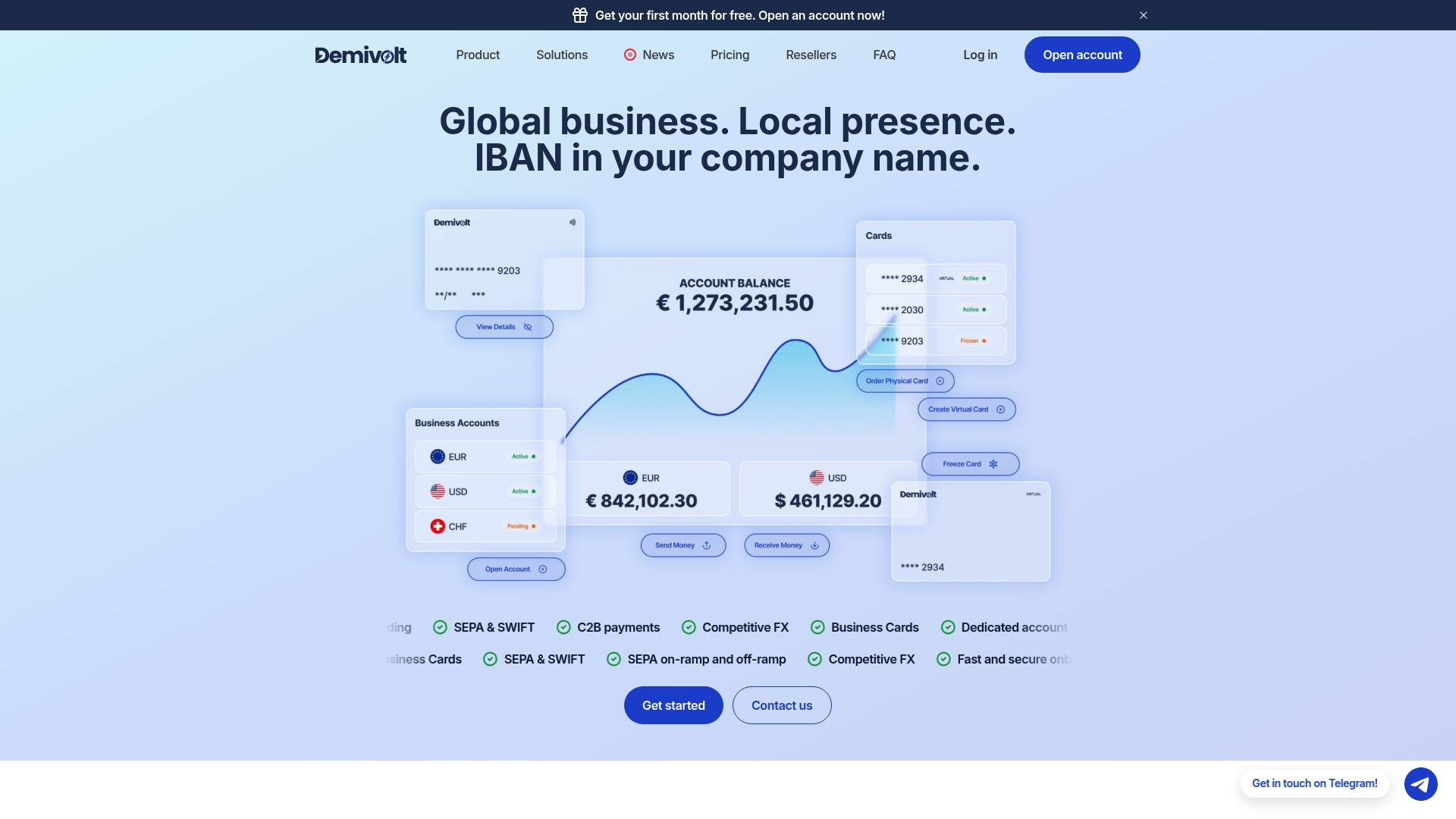
If you want a business account where safeguarding, compliance and pricing are laid out clearly, Demivolt offers business accounts with dedicated IBANs, SEPA and SWIFT payments, and virtual and physical Visa business cards. Our platform is designed around segregated client funds, risk-based onboarding and role-based access, and it supports multi-account structures for international and cross-border operations.
Published fees at a glance:
| Item | Fee |
|---|---|
| Account opening | 0 |
| Account verification | 0 |
| Dedicated Client Manager | 0 |
| Monthly maintenance | 0 per month |
| Account closure | 0 |
| Internal transfers between Demivolt accounts | 0 |
| SEPA In | 0 € |
| SEPA Out | 0.40 € per transfer |
| SWIFT In | 25.00 € |
| SWIFT Out | 30.00 € |
You can estimate outgoing euro transfers with our SEPA fee calculator, and see how we handle payments and card programmes. To get started, visit demivolt.com or contact us through the site.
Safeguarding and your wider payment risk
Safeguarding protects balances, but a sound payment set-up has other layers. Strong user permissions and audits reduce internal risk; our article on user access auditing in banks explains what regulators expect. Card controls matter as well, and card fraud prevention for Lithuanian businesses covers the practical steps. For a broader view, see our overview of payment risk management.
If you run an online business, timing also affects how much money sits where. Our guide to e-commerce payout timelines shows when funds arrive and how to plan cash flow around it.
FAQ
Are funds at an EMI in Lithuania covered by deposit insurance?
No. Electronic money balances are excluded from the EUR 100,000 deposit guarantee, as the Bank of Lithuania explains. Protection comes instead from segregation, insolvency ranking and supervision. Ask any provider how and where it holds your funds.
How quickly must an EMI safeguard incoming funds?
Funds must be safeguarded from the moment they are credited to the institution’s account, according to the Bank of Lithuania’s recommendations. A specialist summary adds that money still held at the end of the business day after receipt goes into a safeguarding account or eligible assets. Card-funded money has a five-working-day outer limit from issuance.
Can an EMI invest safeguarded client money?
Yes, in secure, liquid, low-risk assets, within limits. Resolution No 03-33 caps this at 70% of safeguarded client funds, as reported by a payments regulation monitor. Eligible assets include cash equivalents, bonds rated at least BBB and deposits of up to one year.
What happens to safeguarded funds if an EMI fails?
Safeguarded funds should be returned to clients, but through insolvency proceedings rather than a fast payout scheme. If segregation was adequate, users may not incur losses, though repayment may take long. This is why proper segregation and reconciliation are the main things to verify.
Sources
- Bank of Lithuania: client fund safeguarding requirements FAQ
- Bank of Lithuania: consultation on safeguarding customer funds
- Bank of Lithuania: recommendations on operational requirements and governance
- Bank of Lithuania: prudential requirements and ratios
- Bank of Lithuania: 2024 sector review of EMIs and PIs
- Bank of Lithuania: requirements for institutions in payment systems
- Bank of Lithuania: Financial Market Supervision Committee decisions
- IADI: E-Money and Deposit Insurance Policy Options
- Lithuania Payments Regulation Monitor
- Ecovis: new compliance requirements for e-money and payment institutions
- Ecovis: RegRally insights on EMI/PI regulation
- Protegra: EMI licence in Lithuania
- AMSEurope: safeguarding requirements for EMI companies
- Safeheld: Lithuania EMI safeguarding
- OBOLUS: client funds safeguarding in Lithuania
- Private Law Wiki: banking for EMIs