

Mass Payouts: How to Pay Many Recipients at Once

A mass payout is one funding event followed by many credits to different recipients: suppliers, contractors, sellers on a platform, affiliates or partners. Done well, it is a routine your finance team runs on a schedule. Done badly, it produces misdirected transfers, unmatched ledger lines and a month-end reconciliation nobody trusts. The payment account behind it decides most of the outcome: whether you pay from a dedicated IBAN in your company’s name, which rails you can use, how approvals are split between people, and whether someone answers when a payment fails. At Demivolt, a regulated Electronic Money Institution, business accounts, payments and a dedicated client manager sit under one framework, which is the setup this guide assumes.
DemivoltMake Payout Runs Easier to ManageDemivolt business accounts combine a dedicated company IBAN with SEPA, SWIFT and T2 payments, plus role-based user permissions.VisitTL;DR
- A mass payout debits your account once (or in a controlled run) and credits many beneficiaries. In euro, the SEPA Credit Transfer scheme supports this with no cap on the amount per payment.
- Each payout in a batch is still an individual payment: it has its own fee, its own status and its own chance of failing.
- Most errors come from bad payee data and weak approvals. Validate IBANs before the run and separate who prepares from who approves.
- Budget by rail: our example fees are €0.40 per SEPA payment sent and €30.00 per SWIFT payment sent, for lower-risk Lithuanian businesses, and set case by case otherwise.
- Reconcile per payment, not per batch: one debit does not tell you which recipient was paid.
Table of Contents
- What a mass payout is, and how it differs from a single payment
- Choosing the rail: SEPA, T2 or SWIFT
- The process, step by step
- Reducing errors and fraud in bulk runs
- Mass payouts for specific business models
- Our perspective
- Opening an account for your payout routine
- FAQ
- Sources
What a mass payout is, and how it differs from a single payment
A single payment is one instruction, one debit and one credit. A mass payout, also called a bulk or batch payment, groups many credits into one run. The EU’s SEPA statistics rules treat the two differently: electronic credit transfers are split into those initiated in a file or batch and those initiated singly, and for bulk payments each item in the batch is counted as its own transaction.
That second point matters to your finance team. The batch is a convenience for preparing and approving the run. After that, every line behaves like its own transfer. Each can be charged separately, each can be rejected for its own reason, and each needs to be matched to an invoice or a payee record.
Typical uses in the businesses we work with:
- Supplier runs: weekly or monthly payments to dozens of vendors, often in more than one currency.
- Marketplace and platform payouts: sellers, hosts, drivers or creators paid out of collected funds.
- Commissions and affiliate payments: many small amounts to many recipients, often on a fixed day.
- Payroll-like disbursements to contractors: regular amounts to freelancers and consultants abroad.
Choosing the rail: SEPA, T2 or SWIFT
The rail sets cost, speed and reach. For most European mass payouts the choice is between three.
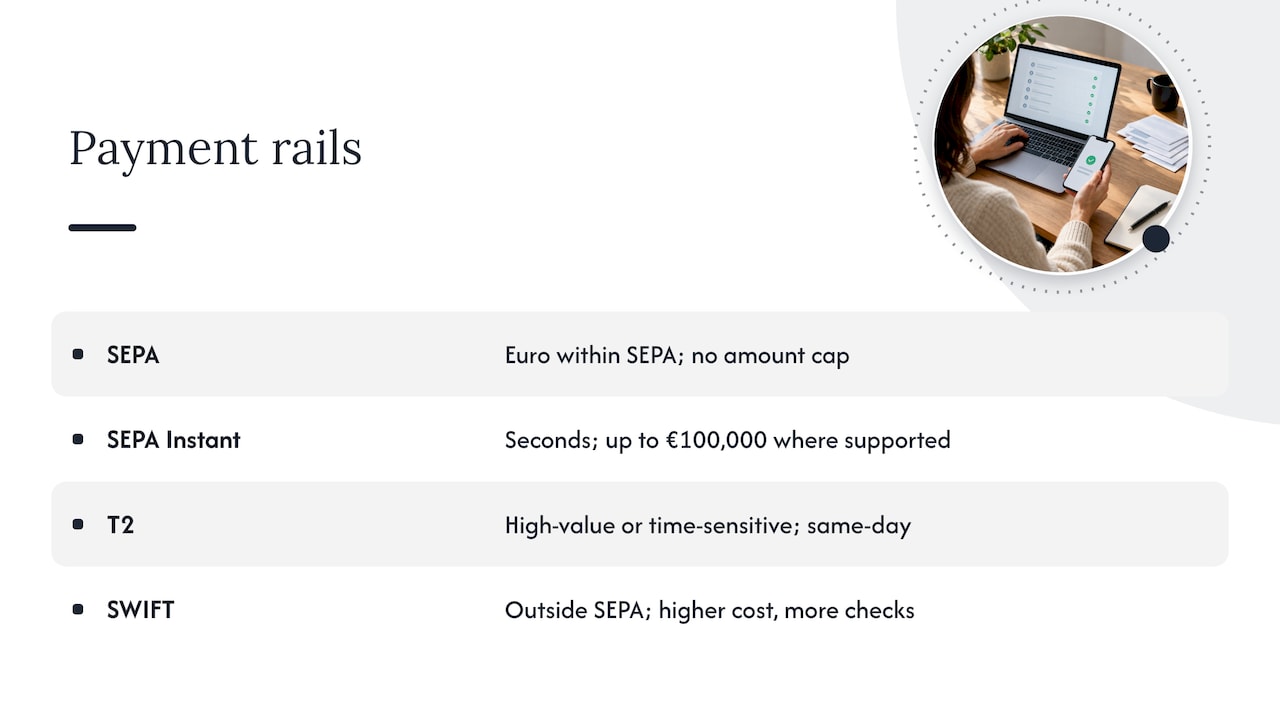
SEPA Credit Transfer. The European Payments Council describes the scheme as supporting both single and bulk payments in euro within SEPA countries, with no cap on the payment amount. Its standards are built for straight-through processing, meaning payments can pass from initiation to credit without manual handling. For a euro supplier run, this is the default.
SEPA Instant. When recipients need funds within seconds, instant credit transfers are available where the receiving provider supports them. The EPC states that the per-transaction maximum was raised from 15,000 to 100,000 euros. Our Payments service offers SEPA credit transfers, instant where available.
T2-supported euro payments. For high-value or time-sensitive euro transfers, such as a large invoice that must land the same day, T2 is the route. We support it alongside SEPA.
SWIFT. For recipients outside SEPA, SWIFT-supported international payments are the route. They cost more per payment and involve more checks, so they belong in a separate run from your euro payments.
A practical rule: split a mixed supplier list by rail before you prepare anything. One list for SEPA, one for SWIFT, and a short list of exceptions for T2 or instant. Each list then has its own fee, its own cut-off logic and its own review.
You can see our business account and payments set-up for the full range of rails. Where recipients hold accounts in other currencies, our business accounts support currency exchange across 31 currencies, so you can hold and convert funds inside the same account rather than moving them elsewhere first.
The process, step by step
Below is the routine for a bulk supplier payment run, from payee data to reconciliation, with the point at which each step usually goes wrong.
1. Collect and verify payee details
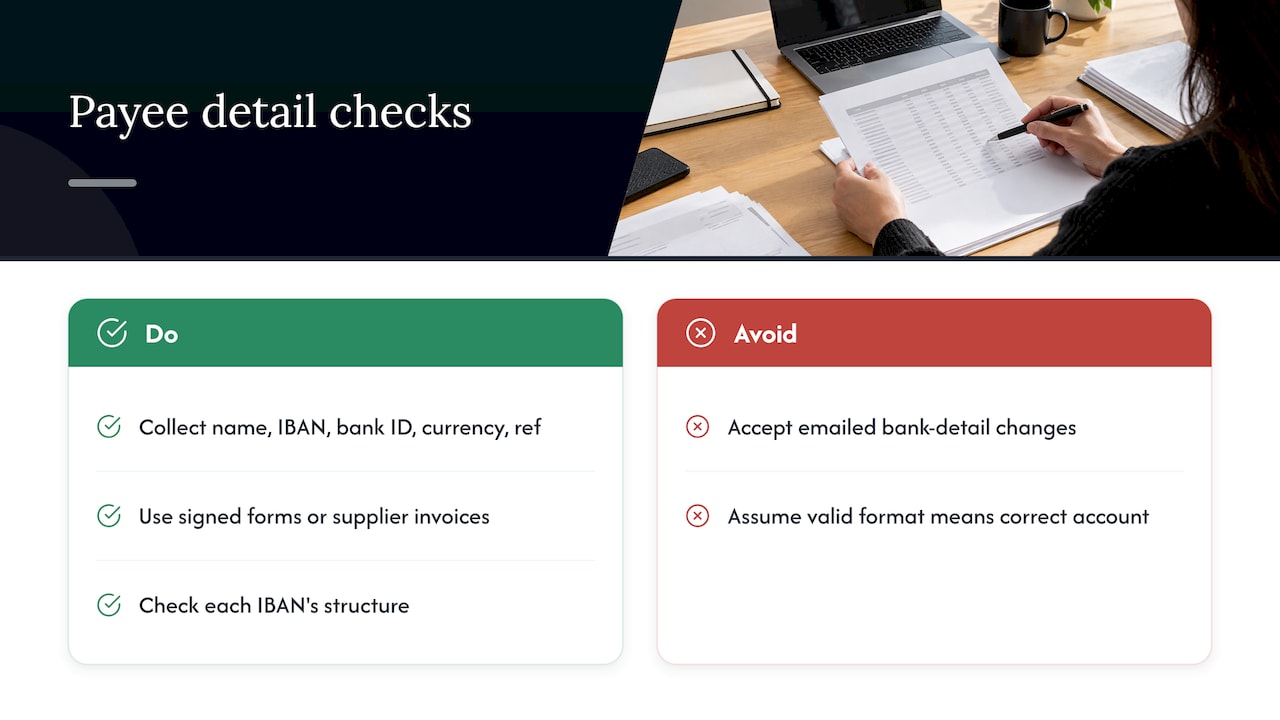
Gather the legal name, IBAN or account number, bank identifier where needed, currency and the invoice reference for every recipient. Take details from a signed onboarding form or the supplier’s invoice, never from an email that asks to “update bank details”. Changed details are the classic route for fraud, covered below.
Before the run, check every IBAN for structure. Our free IBAN Validator tests whether an IBAN is correctly formed, which catches typos and transposed digits before they become rejected payments. A wrong but well-formed IBAN is a different problem: if funds reach the wrong account, our guide on what to do if you send money to the wrong IBAN sets out the steps to take quickly.
2. Group payments by rail and currency
Separate euro SEPA payments from SWIFT payments and from any that need T2 or instant settlement. Decide whether any recipient should be paid in their own currency. Fixing the currency at this stage avoids a surprise conversion later.
3. Calculate the cost of the run
The cost is the number of payments times the fee per payment, plus any currency exchange. Our example fees, which apply to lower-risk businesses based in Lithuania, are shown in the table below. Fees for other jurisdictions, business models or higher-risk profiles are set case by case, so your own terms may differ.
| Item | Example fee |
|---|---|
| SEPA payment received | €0 |
| SEPA payment sent | €0.40 |
| SWIFT payment received | €25.00 |
| SWIFT payment sent | €30.00 |
| Transfers between Demivolt accounts | €0 |
| Monthly account maintenance | €0 |
Worked example: a run of 300 SEPA payments at the example fee of €0.40 comes to €120.00 in sending fees. Sending 40 payments by SWIFT at €30.00 comes to €1,200.00. The same 340 payments therefore cost very different amounts depending on rail, which is why step 2 comes before step 3. To model your own volumes, use the free SEPA Fee Calculator.
4. Prepare, review and approve
One person prepares the run, a different person approves it. This separation is the single most effective control against both honest mistakes and internal fraud. On our business accounts, role-based user permissions let you give preparers and approvers different rights, and sub-accounts let you keep funds for a particular programme, such as seller payouts, apart from operating cash.
The reviewer should compare three things before approving: the total against the expected total from your ledger, the number of recipients against the supplier list, and any payee whose details changed since the last run.
5. Fund and release
Make sure the account holds enough to cover every payment and every fee. A shortfall can leave part of a run unpaid, which is harder to untangle than a run that never started. For euro runs the amounts are credited under SEPA rules; for SWIFT, allow longer, as intermediary processing varies by route and destination.
6. Track outcomes and reconcile
After release, every line needs a status: completed, pending, returned or failed. Match each completed payment to its invoice and payee record, and record fees against the run. Our real-time dashboard shows account activity as it happens, so your team can reconcile on the day instead of at month end. Returned payments should be investigated the same day: confirm the cause (invalid account, closed account, name mismatch), correct the record at source and re-issue once, with approval.
A simple reconciliation table keeps this orderly:
| Run ID | Payee | Invoice | Amount | Rail | Status | Fee | Action |
|---|---|---|---|---|---|---|---|
| 2026-11-A | Supplier 1 | INV-0412 | €1,250.00 | SEPA | Completed | €0.40 | Matched |
| 2026-11-A | Supplier 2 | INV-0415 | €780.00 | SEPA | Returned | €0.40 | Verify IBAN, re-issue |
Reducing errors and fraud in bulk runs
Bulk payments concentrate risk: one successful attack or one bad file affects many recipients at once. The US Office of the Comptroller of the Currency, in its handbook on payment systems, lists the main weaknesses of batch processing: human error, training gaps, weak procedures and a lack of dual controls or separation of duties. It also names fraud through compromised credentials, email compromise, account takeover and social engineering. The handbook is written about the US ACH system, but the same failure points apply to any batch run.
Turn those into controls for your own routine:
- Dual control: preparer and approver are different people, with different log-ins.
- Callback on changes: confirm any change of bank details by phone, using a number you already hold, before it enters the payee list.
- Least privilege: give each user only the permissions their role needs. Remove access when someone changes job.
- Run-level limits: agree a ceiling per run and per payee, and require a second sign-off above it.
- Staff awareness: fake invoices and spoofed supplier emails are the usual entry point. This guide on how to spot and stop invoice phishing scams is a good briefing for the people who handle supplier details.
If your business needs formal policies behind these controls, such as AML procedures, transaction monitoring or staff training, our compliance services cover them.
Mass payouts for specific business models
The routine is the same, but the pressure points differ.
- Marketplaces and platforms: payouts follow collections, so timing and per-seller records matter most. See our page on marketplace accounts and payments.
- SaaS and software companies: payouts go to contractors, resellers and partners across currencies. See SaaS business accounts and international payments.
- Import, export and wholesale: supplier runs mix SEPA and SWIFT, and currency choice drives cost. See import, export and wholesale payments.
- Logistics and travel: many small payments to carriers, hotels and agents. See logistics payments and travel and hospitality payments.
- Licensed fintechs and payment companies: payouts sit inside a regulated flow with their own reporting duties. See fintech business accounts and payments.
If you want recipients to spend funds on cards instead of receiving transfers, our card programmes let companies launch their own branded physical or virtual Visa cards. We act as BIN sponsor and provide programme governance and oversight, with issuing and processing through approved technology partners.
Our perspective
We see mass payouts as a control problem before a technology problem. The transfer itself is routine: SEPA moves euro with no cap on the amount per payment, and SWIFT covers the rest of the world. What decides whether a run goes well is who can prepare it, who can approve it, and how quickly someone can see what happened to each line.
That is why we put the pieces under one regulated framework. Demivolt is an Electronic Money Institution authorised by the Bank of Lithuania (licence No. 77) and a direct SEPA participant through CENTROlink, so we issue IBANs on our own infrastructure. Your business account carries a dedicated IBAN in your company’s name, with sub-accounts, role-based permissions and a real-time dashboard, and your client funds are safeguarded and held separately from our own funds.
We review each eligible business individually, on its structure, activity and payment flows. Higher-risk models can be onboarded with enhanced due diligence, and low- to medium-risk applications typically take a few business days, while higher-risk ones may take longer. A dedicated client manager is free, which means a named person is available when a payment needs attention.
Demivolt Team
Opening an account for your payout routine
If your business pays suppliers, sellers or partners regularly, a Demivolt business account gives you a dedicated IBAN, SEPA, SWIFT and T2 payments, multi-currency support with currency exchange across 31 currencies, sub-accounts and role-based user permissions. In our example fee schedule for lower-risk Lithuanian businesses, account opening, verification, the dedicated client manager and monthly maintenance are all €0. Fees for other jurisdictions, business models and higher-risk profiles are set case by case.

To get started, see our business accounts or contact us through demivolt.com. If you introduce businesses to us as an adviser or reseller, our Reseller Programme lets approved partners earn up to 50% of eligible fees.
FAQ
What is the difference between mass payouts and bulk supplier payments?
The two terms describe the same mechanism: many credits to different recipients, prepared and approved as one run. “Mass payouts” is more common for platforms paying sellers or creators, while “bulk supplier payments” describes a company paying its vendors. In both cases each payment is still counted and processed as its own transaction.
Is there a limit on the amount for a bulk SEPA payment?
The SEPA Credit Transfer scheme sets no cap on the payment amount, although your provider may apply its own limits or checks. SEPA Instant has a per-transaction maximum of 100,000 euros under the EPC scheme. For very large or time-critical euro payments, T2-supported transfers are available through our Payments service.
How should I check recipient details before a run?
Validate every IBAN for structure, confirm the account name against the supplier’s own documents, and verify any change of bank details by a callback to a number you already hold. Our free IBAN Validator handles the structural check in seconds.
What should I do when a payment in a batch fails or is returned?
Find the cause first: an invalid or closed account, or details that do not match. Correct the payee record at source, get approval, then re-issue the single payment. Log the original and the replacement against the same invoice so your reconciliation shows both. Your dedicated client manager can help you trace a payment.
How long does it take to open an account for payouts?
We review each business individually. Low- to medium-risk applications typically take a few business days, while higher-risk ones may take longer. We cannot promise approval or a fixed timeline.
Sources
- Regulation (EU) No 1409/2013, EUR-Lex
- Regulation 1409/2013, consolidated text, EUR-Lex
- EPC brochure on the SEPA Credit Transfer scheme
- European Payments Council: SCT Inst limit increased to 100,000 euros
- OCC Comptroller’s Handbook: Payment Systems
- Invoice phishing scams: how to spot and stop them
Recommended
- Sent Money to the Wrong IBAN? Do This Fast
- E-Commerce Payout Timelines in Lithuania: When Money Arrives
- PayQuicker Rolls Out API v2 With Webhooks and Batch Payment Features
- Why Did They Receive Less Money Than I Sent?
This article is for general information only and does not constitute financial, legal or tax advice. Demivolt UAB is an electronic money institution authorised and regulated by the Bank of Lithuania (EMI licence No. 77).