

A Lithuanian company can handle payments in several currencies with one regulated business account that offers a dedicated IBAN, SEPA for euros and SWIFT for everything else, and fees that are published before the first transfer. The costs that matter are the per-transfer fee, the currency conversion margin and the time the money takes to arrive. At Demivolt, business accounts open with a dedicated IBAN, and the published fees are 0 € for incoming SEPA, 0.40 € for outgoing SEPA, 25.00 € for incoming SWIFT and 30.00 € for outgoing SWIFT.
This guide explains which rails to use for which payment, what the EU rules say about conversion charges, how to record foreign-currency transactions in your books, and how to decide between converting at once and holding funds.
Demivoltdemivolt.comManage Cross-Border Business PaymentsDemivolt offers dedicated IBAN accounts, SEPA and SWIFT payments, and multi-account structures for businesses operating across borders.VisitTL;DR
- Euro payments inside the EEA run on SEPA. Payments in other currencies, or to countries outside SEPA, run on SWIFT and cost more per transfer.
- Conversion margin is usually the largest hidden cost. EU rules require card-based conversion charges to be shown as a percentage mark-up over the ECB reference rate.
- For accounting, you choose a rate source and a rate date in your accounting policy and apply them consistently. Bank rates and accounting rates are different things.
- Separate accounts per currency, per entity or per purpose, with role-based access, make reconciliation much simpler.
- Demivolt publishes its transfer fees: SEPA In 0 €, SEPA Out 0.40 €, SWIFT In 25.00 €, SWIFT Out 30.00 €.
Table of Contents
- When a Lithuanian business needs multi-currency payments
- Which payment rails to use
- What it really costs: fees, margins and timing
- Accounting for foreign-currency transactions
- Convert immediately or hold the currency?
- A practical setup in six steps
- Why a regulated account makes the difference
- Perspective
- Open a business account for multi-currency payments
- FAQ
- Sources
When a Lithuanian business needs multi-currency payments
Most Lithuanian companies start with euros only. The need for other currencies appears with the first customer or supplier outside the euro area: a SaaS company invoicing a US client in dollars, an online store buying stock from a UK or Asian supplier, a consultancy paid in Swedish or Polish currency, an importer settling in USD.
Three situations are common:
- You receive money in a foreign currency. Customers prefer to pay in their own currency, and you must decide whether to convert on arrival.
- You pay suppliers abroad. Suppliers often invoice in their local currency or in dollars and expect a SWIFT transfer.
- You sell through platforms and marketplaces. Payouts arrive on a schedule, sometimes in a different currency from the sale. Our guide to e-commerce payout timelines shows when money typically lands.
In each case the same four questions apply: which rail carries the payment, what it costs in total, how long it takes, and how you record it.
Which payment rails to use
Euro payments: SEPA
The SEPA Regulation applies to euro credit transfers and direct debits when both the payer’s and the payee’s payment service providers are located in the EEA. According to the Bank of Lithuania, which is the competent authority in Lithuania, the schemes are SEPA Credit Transfer, SEPA Core Direct Debit, SEPA B2B Direct Debit and SEPA Instant Credit Transfer, all managed by the European Payments Council.
For your business this means euro payments to suppliers or from customers in other EEA countries should be cheap and predictable. EU rules also state that charges for cross-border payments in euro should be the same as for corresponding payments inside one Member State.
At Demivolt, incoming SEPA transfers cost 0 € and outgoing SEPA transfers cost 0.40 € per transfer. You can check a planned volume with the SEPA fee calculator. Timing depends on cut-off times, which we cover in SEPA cut-off times and how to avoid D+1 delays. If you pay many suppliers at once, a bulk file saves hours: see the guide to the SEPA pain.001 file.
Other currencies and non-SEPA countries: SWIFT
When the payment is in dollars, pounds, or any currency outside the euro, or the counterparty bank is outside the SEPA area, SWIFT is the usual route. The published Demivolt fees are 25.00 € for an incoming SWIFT transfer and 30.00 € for an outgoing one. Because SWIFT payments can pass through intermediary banks, planning for speed matters; our article on how long a SWIFT transfer takes explains the typical stages and where delays arise.
Cards
Cards cover recurring expenses abroad: advertising platforms, software subscriptions, travel. Virtual and physical Visa business cards can be issued from a business account, and the card programmes page describes the options. The conversion rules for card payments are covered below.
Quick comparison
| Payment type | Typical rail | Demivolt published fee | Main thing to plan for |
|---|---|---|---|
| Euro from or to the EEA | SEPA | In 0 €, Out 0.40 € | Cut-off times |
| Foreign currency in | SWIFT | 25.00 € | Intermediary bank deductions, timing |
| Foreign currency out | SWIFT | 30.00 € | Correct beneficiary and bank details, timing |
| Transfer between Demivolt accounts | Internal | 0 | Fastest way to move funds between your own accounts |
| Card spend abroad | Visa | See card programme terms | Conversion mark-up |
What it really costs: fees, margins and timing
A transfer fee is only one line. When you compare payment arrangements, look at five items.
- Per-transfer fee for each rail and direction. Incoming and outgoing are priced separately.
- Conversion margin. If a payment is converted, the provider’s rate differs from the reference rate. That difference is the real cost, and a flat transfer fee can hide it.
- Intermediary and correspondent charges on SWIFT, which can reduce the amount that arrives.
- Monthly and account fees. Demivolt’s published fees for account opening, verification, a dedicated client manager, monthly maintenance and account closure are all 0.
- Settlement time. A cheap payment that arrives two days late can cost more than a fast one if it delays a shipment or an invoice.
Conversion charges and the EU rules
Regulation (EU) 2021/1230 sets transparency rules for conversion. For card-based transactions, total currency conversion charges must be expressed as a percentage mark-up over the latest available ECB euro foreign exchange reference rates, disclosed to the payer before the transaction and made public on a broadly available electronic platform. At an ATM or point of sale, the payer must see the amount in both the payee’s and the payer’s currencies beforehand, and must be told they can refuse the conversion and pay in the payee’s currency.
The practical lesson: when a terminal or website offers to charge you in euros for a purchase made abroad, compare that offer with the ECB-based mark-up you would otherwise pay. Our article on card payment currency and how conversion works walks through the choice for Lithuanian businesses.

Accounting for foreign-currency transactions
Multi-currency payments create a second task: your books must show everything in euros.
Choosing a rate and a date
According to Ezura’s 2026 guide to multi-currency invoices, Lithuania’s Financial Accounting Law does not set one mandatory rate. Instead, the company fixes in its accounting policy where the rate comes from (the ECB reference rate, the Bank of Lithuania rate where the ECB publishes none, or another generally recognised market source) and which day’s rate applies: the operation date or the last one published before it. The same guide notes that most Lithuanian companies choose the Bank of Lithuania accounting rates and the operation-date rate.
The Bank of Lithuania publishes daily and monthly euro foreign exchange reference rates, as well as rates formed in accordance with the Law on Accounting, so the source is easy to document. If you need background on how the transaction date differs from the invoice or payment date, this overview of currency exchange in Lithuania is a useful starting point for the exchange side.
Confirm the exact policy wording with your accountant, since it depends on your company and how you report.

Exchange differences
The rate on the invoice date and the rate on the day money moves are rarely identical. The difference is a gain or loss that has to be booked. Accounting software can do this automatically: SimplBooks retrieves daily ECB reference rates, converts non-euro document amounts into euros and generates a profit or loss entry for exchange-rate changes on receivables and payments. Whatever tool you use, the bank statement should show clearly the original currency, the amount and the reference of each payment, because reconciliation starts there.
Convert immediately or hold the currency?
There is no single answer, but the decision becomes easier with a simple rule set.
- Convert at once when the money is for euro costs such as salaries, rent and taxes, and when you cannot absorb rate swings. This makes the margin the only variable.
- Hold the currency when you expect to pay suppliers in the same currency soon. Paying a dollar invoice from dollar receipts avoids converting twice.
- Match flows. Keep a rough monthly forecast of currency in and currency out. Convert only the net difference.
For a deeper treatment of exposure, thresholds and controls, see our article on payment risk management for businesses in Lithuania.
A practical setup in six steps
- List your currencies and counterparties. Note which customers pay in which currency, and which suppliers invoice in what. This tells you whether most of your flow is SEPA or SWIFT.
- Open a regulated business account with a dedicated IBAN. Demivolt’s account opening and verification are free, and onboarding is risk-based. Prepare your company documents and beneficial owner details in advance to keep it quick.
- Structure your accounts. Multi-account structures and role-based user management let you separate, for example, operating funds, tax reserves and a particular project, and give the finance lead, the bookkeeper and the buyer different permissions. Our guide to linking business bank accounts covers the practical side.
- Add cards for recurring foreign spend. Issue virtual cards per subscription or per team, and review them with card expense management routines.
- Fix your accounting policy. Choose the rate source and date, write them down and apply them consistently.
- Connect your finance stack. If you use an ERP, read about BaaS integration with ERP so statements and payments flow without re-keying.
Why a regulated account makes the difference
Multi-currency work involves more counterparties, more documents and more compliance questions than a euro-only business has. A regulated provider carries part of that load: client funds sit in segregated accounts, onboarding follows EU standards, and the fee list is public. Demivolt’s dedicated client manager is free of charge, and a client manager matters most on the day a SWIFT payment needs tracing or a compliance question arrives.
Sector matters too. Importers have different needs from SaaS companies, and the pages for import, export and wholesale payments, SaaS business accounts and e-commerce accounts describe how each sector uses the account.
Perspective
Most of the cross-border payment problems we hear about from finance teams come from three places: unclear costs, scattered accounts and slow reconciliation. A transfer fee is easy to read. The conversion margin and the timing are not, and that is where budgets quietly leak.
Our approach is to keep the structure plain. A dedicated IBAN for each business purpose, SEPA for euros, SWIFT where the currency or country requires it, cards for operating spend, and a fee list that is public before you open the account. Role-based access means the person who approves a payment is not always the person who prepares it, which is the control auditors and banks expect to see.
Compliance is not a hurdle to hurry past. It is what lets a company trade across borders without frozen payments and unanswered questions. We build onboarding, segregated funds and a dedicated client manager around that idea, so that your finance team spends its time on the business instead of on chasing transfers.
dd
Open a business account for multi-currency payments
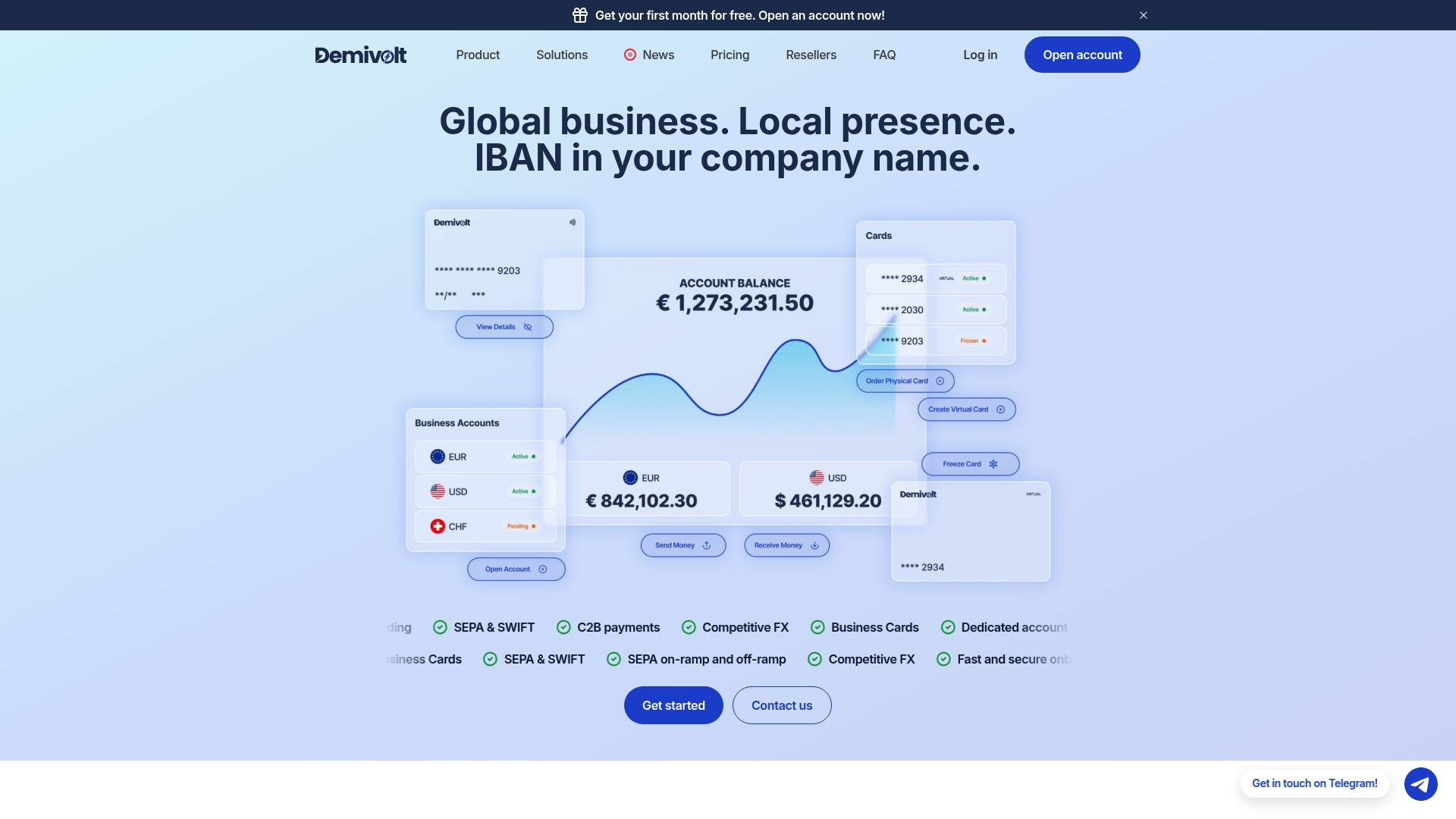
If your company pays and gets paid across borders, Demivolt offers business accounts with a dedicated IBAN, SEPA and SWIFT payments, and Visa business cards. Account opening, verification and monthly maintenance are 0, and incoming SEPA transfers are 0 €. You can see the full fee list on the Demivolt website. Get started with your company details ready, and your dedicated client manager will guide you through verification.
Advisors who bring clients with cross-border needs can look at the Reseller Programme, which pays recurring commissions.
FAQ
Can a Lithuanian company receive payments in several currencies?
Yes. Euro payments arrive over SEPA, and payments in other currencies arrive over SWIFT. At Demivolt, an incoming SEPA transfer costs 0 € and an incoming SWIFT transfer costs 25.00 €. Give customers your dedicated IBAN and, for non-euro payments, the SWIFT details your account provides.
Which exchange rate should I use in my books?
Your accounting policy decides. Lithuanian practice allows the ECB reference rate, the Bank of Lithuania rate or another recognized market source, applied on the operation date or the last published date before it. Pick one approach, document it and use it consistently. Your accountant can confirm the wording.
How do I find out the conversion cost of a card payment?
Under Regulation (EU) 2021/1230, card-based conversion charges must be disclosed as a percentage mark-up over the latest ECB reference rate before you pay. Compare that figure with the alternative of paying in the merchant’s currency. You also have the right to refuse a conversion offered at an ATM or point of sale.
How long does a SWIFT payment take?
It depends on the currency, the cut-off times and the number of intermediary banks involved. Payments can take from the same day to several business days. Our article on SWIFT transfer duration explains the stages and how to plan around them.
Sources
- SEPA | Bank of Lithuania
- Predefined tables | Bank of Lithuania
- Cross-border payments in the European Union | EUR-Lex
- Regulation (EU) 2021/1230 of the European Parliament and of the Council
- Multi-currency invoices: converting to euros (2026) | Ezura
- Multi-currency management in SimplBooks
- A Brief Guide to Currency Exchange in Lithuania