

TL;DR:
- Most US e-commerce merchants should use API-first middleware or hosted gateways for banking integrations to ensure compliance and efficiency. Clear understanding of integration types, vendor features, costs, and security requirements is essential to avoid costly mistakes. Demivolt offers regulated cross-border accounts, multi-account structures, and practical tools for scalable, compliant e-commerce banking.
For most US e-commerce merchants, the right approach to e-commerce platform banking integrations is an API-first setup using middleware when you need multi-bank connectivity, or a hosted/redirected gateway when your priority is reducing PCI scope with minimal engineering effort. Start today by opening a sandbox account and running a proof of concept that covers both payment authorization and automated reconciliation.
Before your first vendor call, confirm these at kickoff:
- PCI DSS level your integration will require and who owns scope reduction
- ACH settlement timings (standard ACH settles in 1–3 business days; same-day ACH is faster but carries additional fees)
- ISO 20022 messaging if you plan multi-bank or cross-border connectivity
- Regulated banking partner for IBAN-based or SEPA/SWIFT flows — Demivolt is a compliant option for merchants with cross-border settlement needs
Table of Contents
- What do e-commerce banking integrations actually deliver?
- What are the three gateway integration types, and when should you use each?
- Which core banking and payment features should you demand from vendors?
- How are banking integrations typically built?
- Who will you actually integrate with?
- What do banking integrations cost, and how long does onboarding take?
- What security and compliance checkpoints must you verify?
- How do you choose the right integration partner?
- What emerging options should you evaluate now?
- Key Takeaways
- The integration mistake most merchants make
- Demivolt supports merchants with cross-border and multi-account banking needs
What do e-commerce banking integrations actually deliver?
At their core, banking integrations connect your store’s order management and accounting systems to the financial rails that move money. The practical outcomes are concrete: funds settle into your merchant account after each transaction, refunds and chargebacks are processed automatically, and your books reconcile without manual exports.
Payment gateways handle the front end of this flow. They encrypt card data, run authorization requests against issuing banks, apply fraud checks, and return an approval or decline within seconds. What gateways do not do is hold your money or manage your bank account. That responsibility sits with your acquiring bank, which settles net funds into your merchant account on a defined schedule.
The distinction matters operationally. A gateway outage affects authorization; a bank settlement delay affects your cash position. Merchants who treat these as the same layer often discover the difference during a dispute or a payout delay.
Beyond authorization and settlement, a well-built integration delivers:
- Automated reconciliation: transaction-level matching between gateway reports and bank statements, reducing month-end close time
- Supplier payouts and mass-pay: batch disbursements to vendors or marketplace sellers without manual wire initiation
- Virtual card issuing: single-use or recurring virtual cards for controlled vendor spend
- Multi-currency and multi-account routing: directing revenue streams into separate sub-accounts by brand, region, or entity
- Webhook-driven order fulfillment: real-time settlement status callbacks that trigger shipping or digital delivery automatically
What are the three gateway integration types, and when should you use each?
Choosing the wrong integration type is one of the most expensive early mistakes a merchant can make. The three standard approaches each carry different trade-offs across brand control, PCI scope, and engineering cost.
| Integration type | How it works | PCI scope | Brand control | Best fit |
|---|---|---|---|---|
| On-site (API-hosted) | Card data enters your server; you call the gateway API directly | Highest (SAQ D or full audit) | Full | Enterprise merchants with dedicated security teams |
| Redirected (hosted checkout) | Customer leaves your site to complete payment on the gateway’s page | Lowest (SAQ A) | Limited | SMBs and growth merchants prioritizing speed and compliance |
| Hybrid (direct-post) | Your form collects card data but posts it directly to the gateway, bypassing your server | Medium (SAQ A-EP) | Moderate | Mid-market merchants wanting branded UX without full PCI burden |
On-site integrations give you complete control over checkout UX and conversion optimization, but they place your engineering and security teams squarely in scope for PCI DSS compliance. That means quarterly vulnerability scans, annual audits, and ongoing patching. For most SMBs, that overhead outweighs the conversion benefit.
Hosted/redirected integrations shift nearly all PCI responsibility to the gateway provider. The trade-off is a checkout experience that leaves your domain, which can reduce conversion for brands where trust and UX consistency are critical. Hybrid approaches split the difference: your form, your styling, but card data never touches your server.
Pro Tip: If you are launching or scaling quickly, start with a hosted checkout to minimize compliance overhead. Migrate to a hybrid or on-site approach only after you have the engineering capacity and security program to support it.
Which core banking and payment features should you demand from vendors?
A vendor demo is not the time to be impressed by dashboards. Require vendors to demonstrate these capabilities specifically, and get them in writing in your contract.
Payment and settlement features:
- ACH origination and ACH returns handling (R-codes, re-presentment rules)
- Real-time webhook notifications for authorization, settlement, and refund events
- Same-day and standard ACH settlement options with clear cutoff times
- Chargeback and dispute workflow with automated evidence submission
- Tokenization for recurring billing and stored payment methods
- Settlement currency options and FX conversion transparency
Banking and account management features:
- Virtual card issuing with spend controls and single-use capability
- Multi-account (sub-account) structures for brand, entity, or regional separation
- Accounting sync with QuickBooks, Xero, or your ERP via native connector or API
- Mass-pay and supplier payout batching
- Role-based access controls for finance team members
Security and trust signals to verify before signing:
- PCI DSS scope documentation and which SAQ level applies to your integration
- SOC 2 Type II report availability (request the full report, not a summary)
- FDIC partner bank disclosure and BIN sponsor identification
- Sandbox environment with full API documentation and test card sets
- SLA commitments for settlement windows and dispute response times
Pro Tip: Ask every vendor for their webhook retry and replay policy. If a webhook fails delivery and there is no replay mechanism, your reconciliation system may silently miss a settlement event. Require a minimum 72-hour retry window with a replay endpoint for historical events.
How are banking integrations typically built?
There are three delivery paths, and the right one depends on your technical resources and the complexity of your banking relationships.
Platform plugins (low-code): Pre-built connectors for Shopify, WooCommerce, Magento, and similar platforms. Stripe, PayPal, and Square all offer certified plugins that install in hours. These are appropriate for merchants with a single payment processor and no multi-bank requirements. Engineering involvement is minimal, but customization is limited.
Direct API integrations (developer-required): Your engineering team calls the gateway or bank API directly, handling authentication, error management, idempotency, and webhook processing. Stripe’s API and PayPal’s REST API are well-documented and widely used. Plaid’s API adds account-aggregation and KYC verification for bank-linked payment flows. This path offers the most flexibility but requires ongoing developer maintenance as APIs version and deprecate.

Middleware and iPaaS platforms (recommended for multi-bank setups): Tools like MuleSoft, Workato, and Dell Boomi sit between your e-commerce platform and multiple banking or payment endpoints. A banking integration fabric translates disparate file formats — ISO 20022, BAI2, SWIFT MT — into a single internal data model. When a bank updates its protocol, only the middleware connector changes, not your core application. This approach significantly reduces long-term maintenance costs for merchants with complex banking relationships.
Connectivity-as-a-Service models extend this further by externalizing the ongoing maintenance of bank connections, format updates, and compliance rule changes entirely. For merchants who do not want to staff a dedicated integration team, this is increasingly the practical default.
A typical integration stack for a mid-market merchant looks like this: checkout layer (hosted or hybrid gateway) → payment processor (Stripe, Square, or PayPal) → bank settlement feed (ACH or wire) → middleware normalization layer → accounting sync (QuickBooks or Xero). For API integration resilience, the same connectivity principles that apply in high-frequency financial systems apply here: idempotency keys, circuit breakers, and structured retry logic.
Who will you actually integrate with?
The ecosystem has four distinct partner categories, and most merchants need at least two of them.
Payment processors and gateways handle authorization, fraud screening, and tokenization. Stripe, PayPal, and Square dominate the US market for SMB and mid-market merchants. Each offers sandbox environments, extensive API documentation, and certified plugins for major e-commerce platforms. Stripe is particularly strong for developers building custom checkout flows; Square suits merchants with both online and in-person sales; PayPal adds buyer trust signals that can lift conversion for certain demographics.

Acquiring banks settle net funds into your merchant account. You may not interact with your acquirer directly — your processor often bundles acquiring — but you should know who they are and what their settlement schedule is. Ask your processor to name the acquiring bank and confirm FDIC membership.
Account-aggregation and KYC providers like Plaid connect bank accounts for ACH-based payments and identity verification. Plaid’s network covers the majority of US financial institutions and is commonly used for bank-linked checkout and payout verification. Verify sandbox and API documentation availability before committing to any aggregation provider.
Middleware, iPaaS, and BaaS providers sit above the raw banking layer. MuleSoft (Salesforce), Workato, and Dell Boomi are the enterprise-grade options for merchants with complex multi-system environments. For merchants needing embedded banking features — virtual cards, sub-accounts, or white-label financial products — modular BaaS providers offer flexible, unified APIs that embed banking services directly into the merchant workflow.
Fraud and reconciliation tools round out the stack. These may be native to your gateway or sourced separately. Confirm whether your processor’s fraud tooling covers 3D Secure 2.0, velocity checks, and device fingerprinting before assuming it does.
What do banking integrations cost, and how long does onboarding take?
Costs and timelines vary significantly by integration complexity, but these ranges give you a realistic planning baseline.
Common cost elements:
- Setup and onboarding fees: free for self-serve plugin integrations; custom API or middleware builds may incur significant costs
- Monthly platform fees vary based on gateway and feature tier
- Per-transaction fees for card payments generally include a percentage and fixed amount; fees for ACH are typically lower
- Interchange: passed through by most processors at cost; some bundle it into a flat rate
- Chargeback fees per dispute are common and vary by processor; some charge additional representment fees
- Multi-currency settlement may include a foreign exchange spread above the mid-market rate depending on the provider
Typical onboarding timeline:
- Sandbox proof of concept typically takes several weeks to cover payments and reconciliation test cases
- Technical integration and compliance checks usually require multiple weeks depending on integration type and internal reviews
- Underwriting and bank onboarding times vary and can be longer for high-risk categories or cross-border accounts
Pro Tip: Budget 10%–20% of your first-year integration cost for ongoing maintenance: API version updates, PCI re-certification, and occasional bank-side format changes. Merchants who skip this budget line routinely face unplanned engineering sprints 12–18 months post-launch.
What security and compliance checkpoints must you verify?
Every banking partner you engage in the US carries compliance obligations that flow downstream to your business. Use this table as a pre-signature checklist.
| Checkpoint | What to verify | Why it matters |
|---|---|---|
| PCI DSS scope | Which SAQ level applies; who owns scope reduction | Determines your audit burden and liability in a breach |
| SOC 2 Type II | Request the full report with auditor opinion | Confirms the vendor’s security controls are independently tested |
| FDIC partner disclosure | Named bank and FDIC certificate number | Confirms deposit insurance eligibility for funds held |
| KYC/AML onboarding | What documents are required; expected timeline | Delays here stall your go-live date |
| ACH risk controls | Return rate thresholds and dispute handling | Excessive returns can trigger processor termination |
| Fund segregation | Are merchant funds held in pooled or segregated accounts? | Segregated accounts protect you if the provider becomes insolvent |
| Webhook security | HMAC signature verification and retry policy | Prevents replay attacks and missed reconciliation events |
| Encryption at rest | AES or equivalent for stored payment data | Required for PCI compliance and SOC 2 |
| Incident response SLA | Defined response time for security events | Determines how quickly you are notified of a breach |
For cross-border operations, also verify cross-border compliance requirements including OFAC screening, withholding tax obligations, and whether your banking partner’s KYC process covers non-US beneficial owners. The role of compliance in B2B payments extends beyond onboarding — ongoing transaction monitoring is a contractual and regulatory expectation.
This article provides general information, not legal or compliance advice. Confirm your specific obligations with a qualified compliance professional or your banking partner’s compliance team.
How do you choose the right integration partner?
Run every vendor through this QA script during demos and RFP calls. Document the answers — vague responses are themselves a signal.
- Sandbox access: Can we access a full sandbox environment today, before signing a contract? Does it include settlement simulation and webhook delivery?
- API documentation: Are your API docs publicly available? Do you publish an OpenAPI spec or SDK for our tech stack?
- Settlement timing: What are your standard and expedited settlement windows? What are the cutoff times for same-day ACH?
- Chargeback workflow: Walk us through your dispute process. What evidence do you collect automatically? What do we need to submit manually?
- Multi-account support: Can we create sub-accounts or virtual accounts for separate brands or entities within one contract?
- SLA and uptime: What is your contractual uptime SLA? What is your historical uptime for the past 12 months?
- Pricing transparency: Provide a full fee schedule including interchange pass-through, FX spread, chargeback fees, and any volume tier thresholds.
- Audit reports: Can you provide your most recent SOC 2 Type II report and PCI DSS attestation of compliance?
Red flags to walk away from:
- No sandbox available before contract signing
- SLA defined only as “best effort” with no contractual commitment
- Unable or unwilling to name their FDIC-member acquiring bank
- No webhook retry mechanism or replay endpoint
- Pricing that bundles interchange without itemizing it
For small merchants, prioritize settlement reliability and PCI scope reduction over feature richness. Growth-stage merchants should weight multi-account support and accounting sync heavily. Enterprise merchants need contractual SLAs, audit report access, and a named integration success contact.
What emerging options should you evaluate now?
Three trends are actively reshaping how merchants think about integrated financial services, and each has near-term implications for your integration decisions.
Pay-by-Bank and account-to-account (A2A) rails let customers transfer funds directly from their bank account to your merchant account via real-time API connectivity. The merchant benefit is lower payment processing cost — no card interchange — and faster settlement in some implementations. Implementation requires webhook subscriptions for async status updates, and refunds can only be initiated after the original sale has settled. Account verification states (created vs. verified) must be handled correctly to avoid failed transactions. The A2A payment space is growing, particularly for high-ticket and B2B transactions where card fees are most painful.
Embedded finance and modular BaaS are shifting the competitive dynamic for platforms. Providers with flexible, embedded APIs that bundle BNPL, virtual cards, and seller payouts into a single merchant workflow are gaining volume share over traditional processor-only relationships. For merchants, this means you can add banking features — virtual cards for vendor spend, sub-accounts for marketplace sellers, integrated lending — without building a separate banking relationship. The agentic commerce push from fintechs is accelerating this trend, with platforms embedding payment and banking capabilities directly into merchant workflows.
Modular white-label platforms are the practical answer for merchants who want banking features without running compliance and underwriting operations in-house. These platforms offload risk monitoring, KYC, and underwriting, letting your team focus on checkout UX and operations. When evaluating them, confirm that the middleware or connectivity layer handles format normalization — ISO 20022, BAI2 — so your core application is insulated from bank-side protocol changes.
Key Takeaways
API-first middleware integrations with sandbox-verified partners are the most reliable path to scalable, compliant e-commerce banking infrastructure for US merchants.
| Point | Details |
|---|---|
| Start with a sandbox PoC | Test payments and reconciliation before signing any vendor contract; 1–4 weeks is a realistic timeline. |
| Match integration type to PCI capacity | Hosted/redirected for SMBs; hybrid or on-site only when your security program can support the scope. |
| Demand webhook replay and SOC 2 | Missing either creates reconciliation gaps and unverified security controls. |
| Budget for ongoing maintenance | Allocate 10%–20% of first-year integration cost annually for API updates and re-certification. |
| Demivolt for cross-border needs | Demivolt provides regulated IBANs, SEPA and SWIFT processing, and multi-account structures for merchants with cross-border settlement requirements. |
The integration mistake most merchants make
The most common error is selecting a payment processor based on the lowest advertised transaction fee and discovering six months later that settlement reliability, dispute handling, and reconciliation automation were never tested. A fee that is 0.2% lower means nothing if your finance team spends 20 hours a month manually reconciling mismatched settlement files.
The second mistake is underestimating PCI scope. Merchants who choose an on-site integration for conversion reasons, without a security program to support it, routinely face unplanned audit costs and remediation work. The hosted or hybrid approach is not a compromise — for most merchants, it is the correct decision.
The third mistake is skipping webhook replay testing in the sandbox. Production webhook failures are silent by default. If your integration does not have a replay mechanism and your reconciliation job misses a settlement event, you may not discover the gap until month-end close. Require vendors to demonstrate replay in the sandbox, not just describe it in documentation.
The practical correction for all three: run a structured sandbox PoC that covers authorization, settlement, refund, chargeback, and webhook failure scenarios before you sign a contract. Require API versioning guarantees in writing. And budget for post-launch maintenance from day one — integrations that are not maintained drift out of compliance and out of sync with bank-side changes faster than most finance teams expect.
Demivolt supports merchants with cross-border and multi-account banking needs
For US e-commerce merchants expanding into European markets or managing multi-entity financial structures, Demivolt offers regulated IBAN accounts, SEPA and SWIFT payment processing, and virtual Visa business cards within a compliant, API-accessible platform. The multi-account structure lets finance teams separate revenue streams by brand, entity, or region without opening separate banking relationships, and role-based access controls mean your team members see only what they need to.
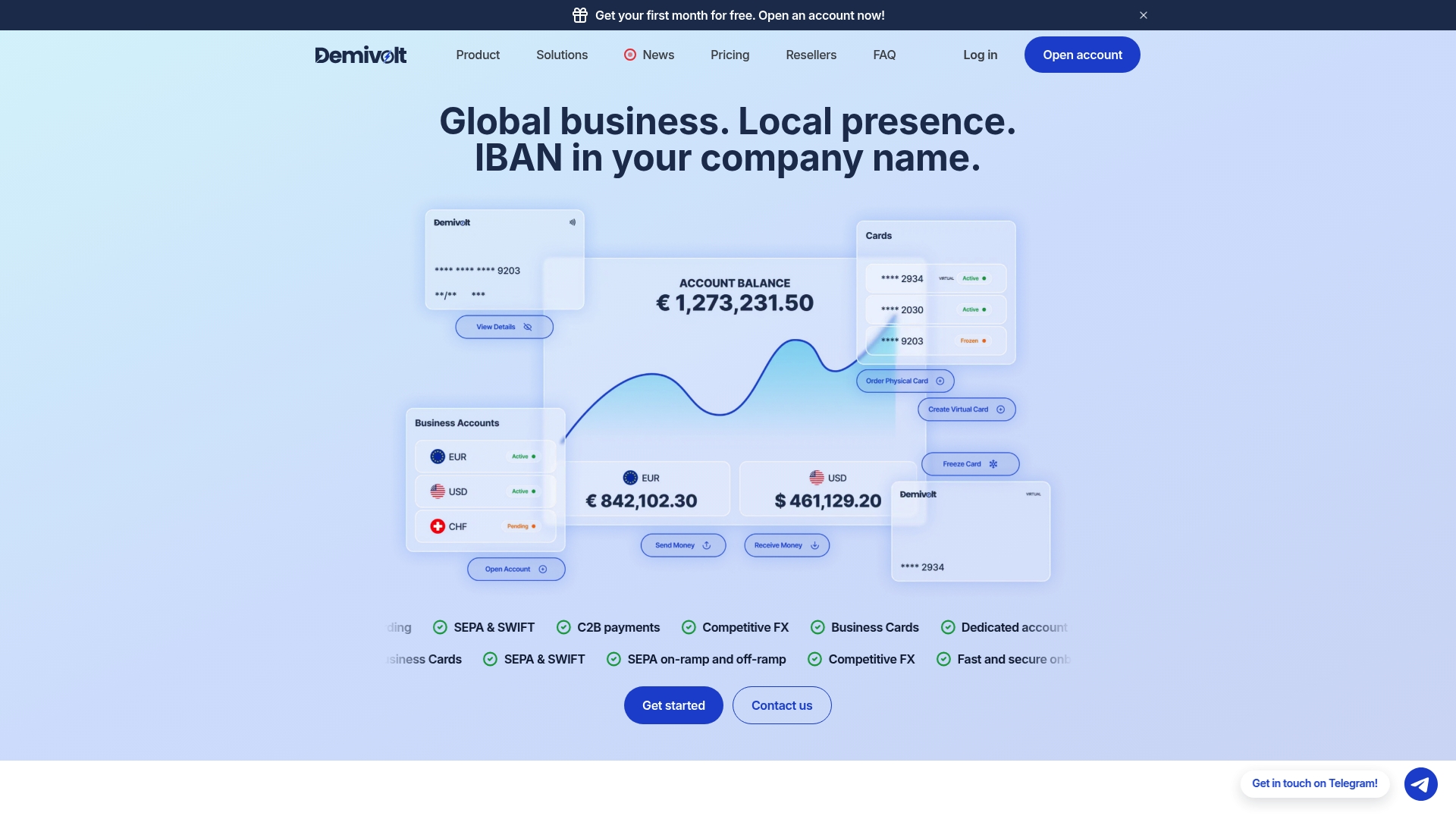
Demivolt’s sandbox and API documentation are available before onboarding, so your engineering team can validate connectivity and settlement flows against real account structures before committing. For merchants who need IBAN validation as part of cross-border payout workflows, the IBAN validator tool reduces onboarding errors and failed payment attempts. US merchants should confirm cross-border tax withholding obligations and KYC timelines with their compliance team before initiating non-US bank relationships. Contact Demivolt to discuss whether regulated IBAN accounts and SEPA/SWIFT infrastructure fit your cross-border settlement requirements.
Sources and further reading
- Pay by Bank Integration Developer Guide — CyberSource: implementation requirements for A2A payment flows including webhook subscriptions and account verification states
- Pay by Bank — Orum Developer Docs: practical implementation edge cases for Pay-by-Bank, including refund sequencing and party state management
- Payment Gateways: Main Types and How They Work — BigCommerce: reference for on-site, hosted, and hybrid integration types and PCI scope implications
- What Are Payment Gateways? — Salesforce: overview of gateway roles, tokenization, and fraud controls
- Banking Integration (Integration Fabric) — PwC: technical rationale for middleware and ISO 20022/BAI2 format normalization
- Connectivity-as-a-Service — Kyriba: operational model for externalizing bank connectivity maintenance
- Embedded Finance in E-Commerce — Tieto: analysis of how API-first embedded finance is reshaping merchant banking
- What Is API Banking? A Clear Guide for SMEs — Demivolt: foundational guide to API banking for SME finance teams
- FDIC Deposit Insurance FAQ — FDIC: primary source for FDIC coverage eligibility and fund protection rules